

Summary
- The Office of the US Trade Representative (USTR) has proposed a 10% tariff on finished aircraft imported from Brazil, ending their exemption from the 25% tariff it placed on certain Brazilian goods in July
- The proposal covers airplanes of every weight class, helicopters and gliders; Embraer, which builds the E175 regional jet flown widely in the US, says it supports zero tariffs in aerospace
- Nothing changes yet: comments are due by December 30, 2026, and a public hearing is set for January 14, 2027
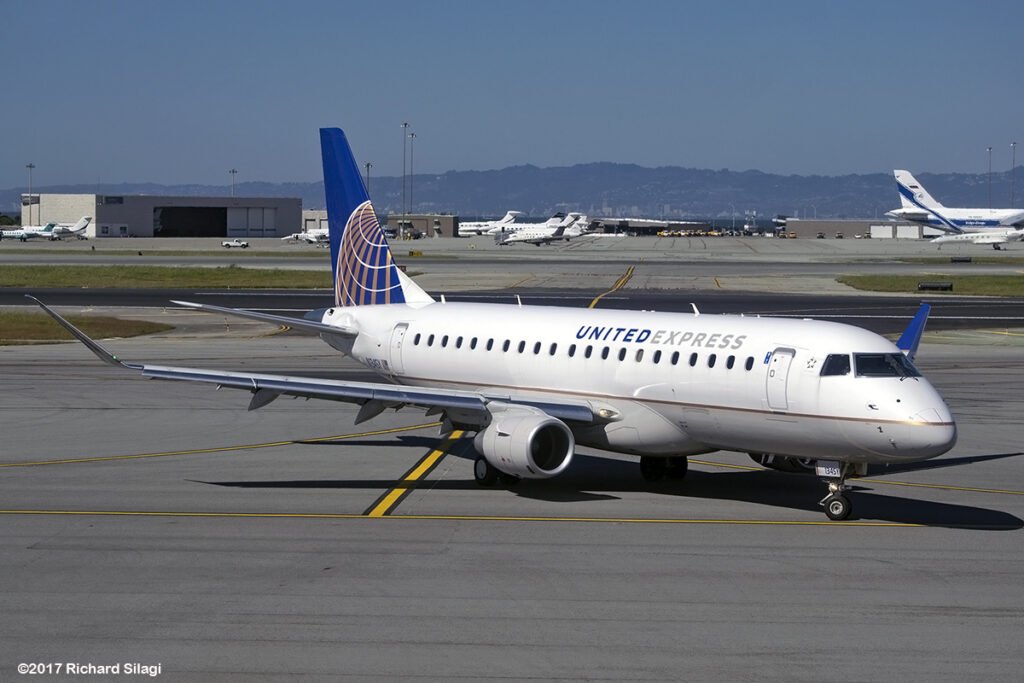
WASHINGTON, United States, 25 November 2026 – The Office of the US Trade Representative (USTR) has proposed a 10% tariff on finished aircraft imported from Brazil, which would end an exemption that has kept planes such as Embraer’s E175 regional jet out of a 25% tariff on certain Brazilian goods, according to a USTR press release dated Wednesday. The plan also targets sugar and is aimed at pushing Brazil back to trade talks.
“Today’s proposed modification would provide greater leverage to obtain the elimination of Brazil’s unreasonable acts, policies, and practices,” US Trade Representative Jamieson Greer said in the release. USTR says Washington remains open to negotiations with Brazil.
What USTR proposed
The draft Federal Register notice (docket USTR-2026-0628) would remove the exemption for finished aircraft that USTR set out on July 20, 2026, when it imposed a 25% tariff on certain Brazilian goods under Section 301 of the Trade Act of 1974. In its place, aircraft from Brazil would pay a 10% duty on their value, up from 0% today.
The annex lists airplanes of every weight class, from under 2,000 kg to over 15,000 kg, as well as helicopters, gliders and balloons, so the proposal is not limited to airliners. USTR says finished aircraft are Brazil’s fourth-largest export to the United States, and the notice describes Brazil as the leading exporter of regional aircraft to the US. A separate part of the plan would add a specific per-kilogram tariff on out-of-quota sugar.
The underlying investigation began in July 2025 and covers Brazilian policies on digital trade and electronic payments, preferential tariffs, anti-corruption enforcement, intellectual property, ethanol market access and illegal deforestation. USTR found those practices actionable on June 1, 2026.
It is not in force yet
Under the notice, the comment period opens on November 27, 2026. Anyone who wants to speak at the hearing must ask by December 7, written comments are due by December 30, and USTR’s Section 301 Committee will hold a public hearing in Washington on January 14, 2027, which may run into January 15. Rebuttal comments are due seven days after the hearing ends. The notice does not set a date for the new duty to take effect.
How Embraer responded
Embraer said it was analyzing the proposal, Aviation International News reports. “We continue to believe in, and advocate firmly for, the maintenance of the zero-tariff rule for the global aerospace industry, in place since the 1980s,” the company said in a statement quoted by AIN. Embraer also said it has about $3.5 billion in assets and 2,500 employees in the US, and it told FLYING that US suppliers provide 55% of the parts in its aircraft. Those are company figures.
Embraer shares fell about 5% after the announcement, AeroTime reports. In its latest earnings filing, AeroTime adds, Embraer said its business jet unit paid $15 million in US import tariffs in the third quarter of 2025 and none in the same quarter of 2026.
Context: why US airlines are watching
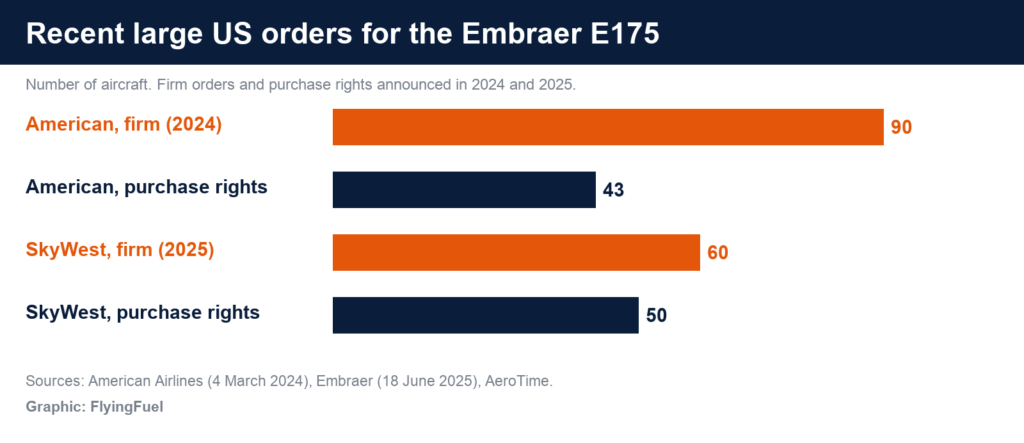
FLYING describes the E175 as a backbone of US regional airline operations, and recent US orders for it are large. American Airlines ordered 90 E175s in March 2024 alongside Airbus and Boeing jets, with purchase rights for 43 more, according to AeroTime. SkyWest placed a firm order for 60 E175s in June 2025, with purchase rights for 50 more and deliveries from 2027; Embraer valued the firm part at $3.6 billion at list price. AeroTime says the proposed duty puts Embraer at risk of higher costs in that market.
For travelers, nothing changes for now: the plan is a proposal open for comment, and the E175s already flying for US airlines have already been imported. Our Embraer E175 review explains why US regional airlines rely on the type.
Read more
- Embraer E175 review: cabin, range and who flies it
- Embraer commercial jets: every model explained
- Embraer order backlog hits a record $35.7 billion
- Airbus A220-300 vs Embraer E195-E2 compared
Sources: USTR press release and draft Federal Register notice, 25 November 2026; Aviation International News, AeroTime and FLYING, 25 November 2026; American Airlines, 4 March 2024; Embraer release via ASDNews, 18 June 2025.
Featured image: FlyingFuel graphic using a photo of an American Eagle Embraer E175 landing at Washington Reagan National by John Brighenti from Rockville, MD, United States, CC BY 2.0, via Wikimedia Commons.
 Legacy CarriersAir India vs Air India Express: Fleet, Cabins, Routes and Which to Book (2026)
 AirportsAirports in Punjab, Haryana and Himachal Pradesh: Complete Guide to Chandigarh, Amritsar, Kangra, Halwara and More (2026)
 AirbusAirbus A320neo vs A320ceo: What Changed and How to Tell Them Apart (2026)
 De Havilland CanadaDe Havilland Dash 8-400 (Q400) Review: The 90-Seat Turboprop Behind SpiceJet’s Regional Flights (2026)
 NewsCabinet Approves Rs 2,014 Crore Airport at Doloo to Replace Silchar’s Air Force Civil Enclave
 AirportsAirports in Bihar and Jharkhand: Complete Guide to Patna, Ranchi, Darbhanga, Gaya, Deoghar and More (2026)