
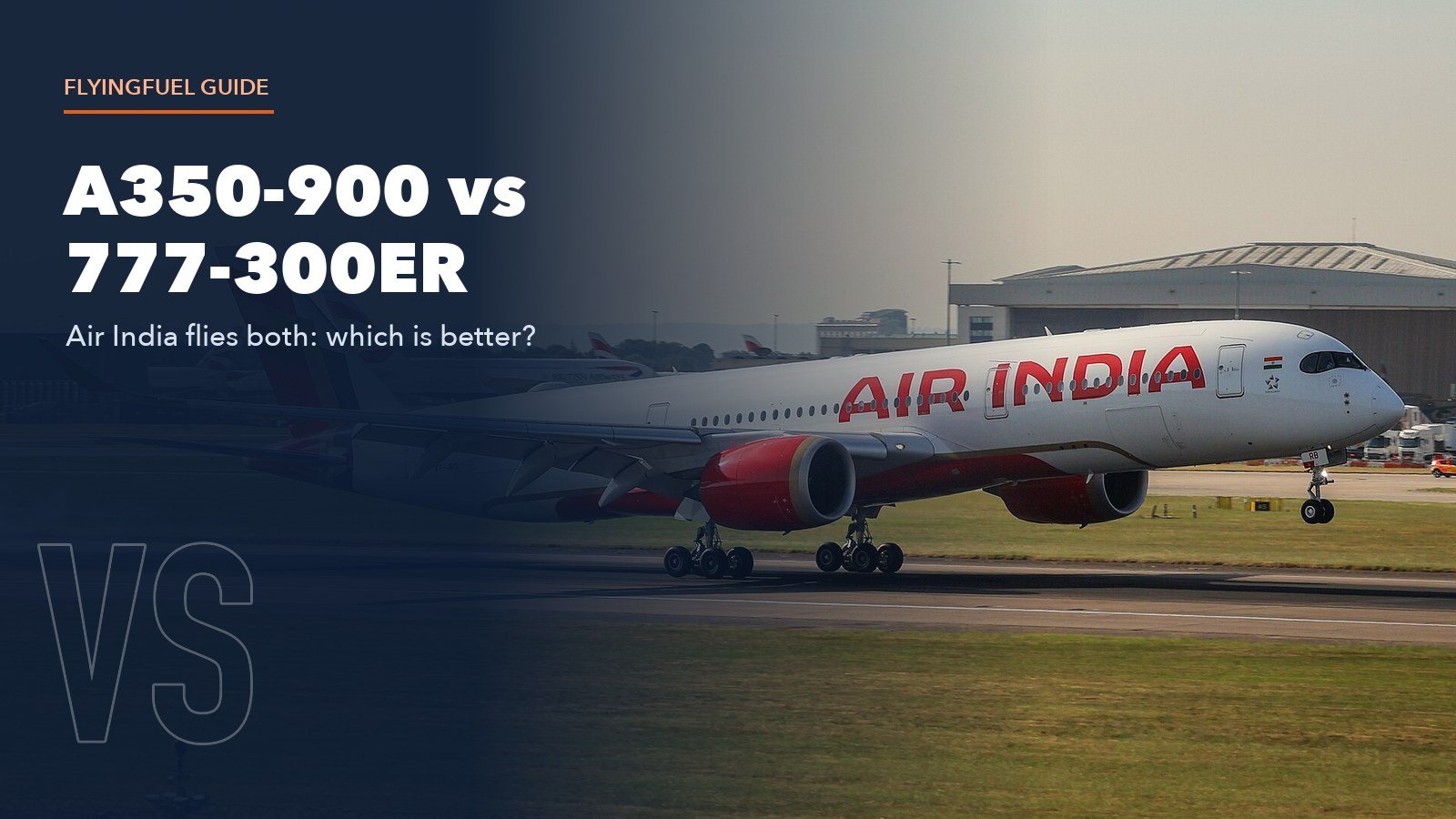
Book a long-haul flight on Air India, Emirates, Singapore Airlines or United and you will probably fly on one of two twin-engine widebodies: the Airbus A350-900 or the Boeing 777-300ER. One is a carbon-fibre jet from the 2010s; the other is the big twin that replaced the 747 on many routes. Air India flies both. Here is how they compare on size, range, cabin, engines, fuel and safety.
Quick answer: the 777-300ER is bigger: 73.9 m long, 350 to 425 seats in two classes and a 351.5-tonne maximum take-off weight. The A350-900 flies further (up to 8,500 nm against 7,500 nm), is lighter, burns less fuel and, for most passengers, is the more comfortable ride, with nine seats per row in economy and a 6,000 ft cabin altitude.
A350-900 vs 777-300ER: Specs Side by Side
| Item | Airbus A350-900 | Boeing 777-300ER |
|---|---|---|
| Seats (maker figure) | 332-352 (three classes); 440 maximum | 350-425 (two classes) |
| Range | Up to 8,500 nm (15,750 km) | Up to 7,500 nm (13,890 km) |
| Length | 66.8 m | 73.9 m |
| Wingspan | 64.75 m | 64.8 m |
| Height | 17.05 m | 18.5 m |
| Maximum take-off weight | Up to 283 tonnes | 351.5 tonnes |
| Engines | 2 x Rolls-Royce Trent XWB-84 (84,000 lbf) | 2 x GE Aerospace GE90-115B (115,000 lbf) |
| Cabin width (armrest) | 5.61 m | 5.87 m (777 family) |
| Economy seats per row | 9 (3-3-3) on most | Usually 10 (3-4-3); some 9 |
| Structure | 53% composites | Mainly aluminium |
| First flight | 14 June 2013 | 24 February 2003 |
| Entered service | January 2015, Qatar Airways | April 2004, Air France |
Sources: Airbus A350 pages and Wikipedia: Airbus A350; Boeing 777 technical specifications and Wikipedia: Boeing 777. Seat counts use different class layouts, so compare them with care.
Size and Capacity
The 777-300ER is the bigger aircraft. It is 7.1 m longer and can take off almost 70 tonnes heavier, which lets it carry more passengers and more cargo in the lower hold on the same flight. Boeing lists 350 to 425 seats in two classes; Air France flies a 777-300ER version with 472 seats. Airbus lists the A350-900 at 332 to 352 seats in three classes and up to 440 in a single-class layout limited by its exits.
Their wingspans are almost identical (64.75 m and 64.8 m), so both fit the same Code E airport gates. If an airline needs the biggest twin it can get for a busy route, it picks the 777-300ER or its successor, the 777-9; if it needs fewer seats over longer distances, the A350-900 fits better. For the bigger A350, see our 777-300ER vs A350-1000 comparison.

Range
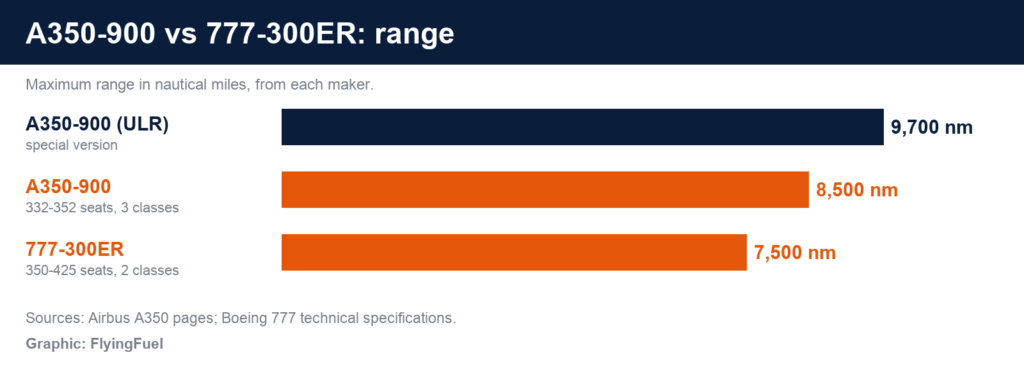
Airbus quotes up to 8,500 nm for the heaviest A350-900 (7,500 nm for the standard version), and the special A350-900ULR can fly 9,700 nm, which is why Singapore Airlines uses it on the longest flights in the world. Boeing lists the 777-300ER at up to 7,500 nm, enough to fly nonstop from Delhi or Mumbai to anywhere in Europe. For most long-haul routes both are enough; the difference shows on ultra-long flights.
Cabin and Comfort
On paper the 777 has the wider cabin: Wikipedia gives 5.87 m at armrest level against 5.61 m for the A350. In practice, airlines fill that width differently. When the 777 was new, most fitted nine economy seats per row; by 2016 more than half of new 777 deliveries had ten across (3-4-3). The A350 was designed around nine across (3-3-3), so its economy seats are usually a little wider.

The A350’s carbon-fibre fuselage also allows a lower cabin altitude. Airbus says it is pressurised to 6,000 ft or below with about 20% humidity, against around 8,000 ft on older aluminium jets. The 777’s windows, about 15 by 10 inches, were the largest of any airliner until the 787. Business and premium cabins depend entirely on the airline; Air India’s A350-900s have 28 business, 24 premium economy and 264 economy seats.
Engines and Fuel
Neither aircraft offers an engine choice. The A350-900 flies with two Rolls-Royce Trent XWB-84s, rated at 84,000 lbf, with a 3 m fan and a 9.6:1 bypass ratio. The 777-300ER uses two GE90-115Bs, rated at 115,000 lbf with a 128-inch fan; it was the largest jet engine in the world until the GE9X for the 777X. The 777 needs that extra power to lift its extra 68 tonnes, and to climb safely on one engine under ETOPS rules.
Airbus says the A350 burns 25% less fuel than previous-generation competitors, the class of aircraft the 777-300ER belongs to. Lighter weight, a carbon-fibre structure and newer engines all help. That is why airlines replacing 777-300ERs now buy the A350-1000 or the 777-9, not new 777-300ERs.
Safety Record
Both have strong records. The A350’s only hull loss came on 2 January 2024, when Japan Airlines Flight 516 collided with a Japan Coast Guard aircraft after landing at Tokyo Haneda; the A350 burned, but all 367 passengers and 12 crew escaped. Wikipedia lists 31 accidents and incidents for the 777 family as of May 2024, including eight hull losses and 542 deaths, across a fleet of 1,796 delivered aircraft and three decades of service. The 777 was also the first airliner to enter service with 180-minute ETOPS approval, in 1995.
Air India: Which Routes, Which Jet?
Air India had 19 Boeing 777-300ERs and 6 Airbus A350-900s in September 2026, and it has ordered 50 A350s in total; its first A350-900 arrived in December 2023. IndiGo has ordered 60 A350s as its first widebodies of its own. Air India uses both types on long-haul international routes; check the aircraft type in your booking if you have a preference. See our Air India fleet guide and longest flights from India.
Pros and Cons
Airbus A350-900
- Pros: longer range (8,500 nm); nine-abreast economy on most; 6,000 ft cabin altitude; 25% lower fuel burn than previous-generation jets (Airbus)
- Cons: fewer seats; one engine choice; narrower cabin than the 777 at armrest level
Boeing 777-300ER
- Pros: bigger cabin and cargo hold; 350-425 seats; proven over two decades; 833 delivered
- Cons: usually ten-abreast economy; heavier and thirstier; being replaced by the 777-9 and A350-1000
Our Verdict
If you are choosing between the two as a passenger, pick the A350-900 when you can: nine seats per row on most airlines, a lower cabin altitude and a quieter, newer cabin make a difference on a 10-hour flight. The 777-300ER is still a fine aircraft, especially with nine-abreast seating or a refreshed cabin, and airlines value its size. For airlines the choice depends on the route: maximum seats favour the 777, maximum range and fuel efficiency favour the A350. Compare the A350 with Boeing’s carbon-fibre jet in our 787-9 vs A350-900 comparison.
Frequently Asked Questions
Which is better, the A350-900 or the 777-300ER?
For passengers, usually the A350-900: it is newer, quieter, has a lower cabin altitude (6,000 ft or below, Airbus says) and most airlines fit nine economy seats per row against ten on most 777-300ERs. For airlines, the 777-300ER carries more people; the A350-900 burns less fuel, with Airbus claiming 25% lower fuel burn than previous-generation competitors.
Which is bigger, the A350-900 or the 777-300ER?
The 777-300ER. It is 73.9 m long against 66.8 m and can take off at up to 351.5 tonnes against 283 tonnes. Boeing lists 350 to 425 seats in two classes; Airbus lists 332 to 352 in three classes for the A350-900.
Which flies further, the A350-900 or the 777-300ER?
The A350-900: up to 8,500 nm (15,750 km) for the heaviest version, against 7,500 nm (13,890 km) for the 777-300ER. The special A350-900ULR flies 9,700 nm.
Is the A350 or the 777 wider inside?
The 777. Wikipedia gives a cabin width at armrest level of 5.87 m for the 777 and 5.61 m for the A350. But the 777 usually has ten economy seats per row and the A350 nine, so A350 economy seats are often wider.
Does Air India fly the A350-900 and the 777-300ER?
Yes. Air India had 6 A350-900s and 19 777-300ERs in September 2026. Its A350-900s have 316 seats: 28 business, 24 premium economy and 264 economy. It has ordered 50 A350s in total.
What engines do the A350-900 and 777-300ER use?
Each has one engine choice. The A350-900 uses two Rolls-Royce Trent XWB-84s (84,000 lbf each); the 777-300ER uses two GE Aerospace GE90-115Bs, rated at 115,000 lbf, with a 128-inch fan.
Which is safer, the A350 or the 777?
Both have strong records. The A350’s only hull loss was Japan Airlines Flight 516 at Tokyo Haneda in January 2024, when all 379 people aboard escaped. Wikipedia lists 31 accidents and incidents and eight hull losses for the 777 family since 1995, across a much larger and older fleet.
Is the 777-300ER still being built?
Airlines now order the 777-9 (777X) or the A350-1000 instead. Boeing has delivered 833 777-300ERs, the best-selling 777 model, and expects to deliver the first 777-9 in 2027.
Which has a lower cabin altitude?
The A350. Airbus says its carbon-fibre cabin is pressurised to 6,000 ft or below, against around 8,000 ft on older aluminium jets such as the 777. A lower cabin altitude can reduce tiredness on long flights.
Featured image: FlyingFuel graphic using a photo of Air India Airbus A350-900 VT-JRB at London Heathrow by S5A-0043, CC BY 4.0, via Wikimedia Commons.
 Aircraft ComparisonsBoeing 737 MAX 8 vs 737-800: What Changed and Which Is Better? (2026)
 NewsMalaysia Airlines to Buy 10 Boeing 787-10 Dreamliners to Replace Its Airbus A350s From 2032
 AirportsAirports in Odisha: Bhubaneswar, Jharsuguda, Jeypore and More Ranked (2026 Data)
 NewsNew Visakhapatnam Airport at Bhogapuram to Charge Rs 890 Per Departing Domestic Passenger From 1 December
 AirportsAirports in Karnataka: Bengaluru, Mangaluru, Hubballi, Belagavi and More Ranked (2026 Data)
 NewsTSA Says It Could Screen More Than 3 Million Passengers on the Sunday After Thanksgiving