
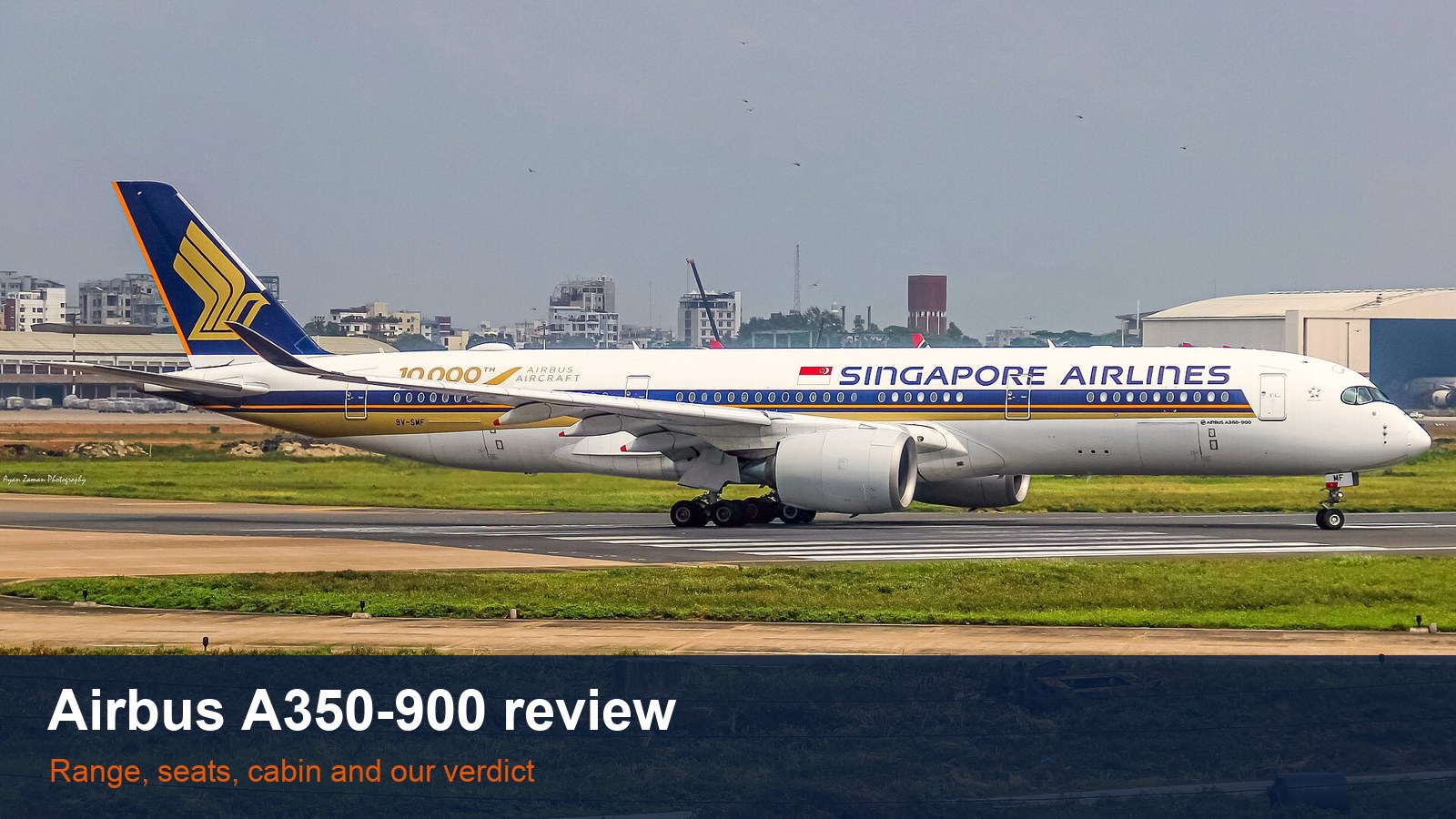
The Airbus A350-900 is Airbus’s modern long-haul flagship and the main rival to the Boeing 787. Built mostly from carbon fibre, with a wide, quiet cabin and Rolls-Royce Trent XWB engines, it flies some of the world’s longest routes. In India it is the newest widebody at Air India, and IndiGo has ordered 60 of the A350 family as its first widebodies of its own.
Our verdict in one line: the A350-900 is one of the best long-haul aircraft in the sky, with 332 to 352 seats in three classes, up to 8,500 nm of range, a cabin wider than the 787’s and, Airbus says, 25% lower fuel burn than previous-generation competitors. Its main trade-offs are a single engine choice and windows that, unlike the 787’s, still use shades on most aircraft.
In this review we explain everything step by step: why the A350 was redesigned, what its carbon-fibre body and morphing wing do, how to recognise it, what passengers get in the cabin, how the Trent XWB engine works, its range and special versions, its safety record, who flies it in India and how it compares with the Boeing 787-9 and its bigger sibling, the A350-1000.
Airbus A350-900 Quick Facts
| Item | Airbus A350-900 |
|---|---|
| Type | Twin-aisle (widebody) twin-engine airliner |
| Seats (three-class) | 332 to 352 |
| Maximum seats (exit limit) | 440 |
| Range | Up to 8,500 nm (15,750 km); 7,500 nm standard version |
| Length | 66.8 m (219 ft 2 in) |
| Wingspan | 64.75 m (212 ft 5 in) |
| Height | 17.05 m |
| Maximum take-off weight | Up to 283 tonnes |
| Fuel capacity | 140,795 litres (166,488 on the heaviest version) |
| Lower-deck cargo | 36 LD3 containers |
| Cruise speed | Mach 0.85 |
| Engines | 2 x Rolls-Royce Trent XWB-84 (84,000 lbf) |
| Structure | 53% composites |
| First flight | 14 June 2013, Toulouse |
| Entered service | 15 January 2015, Qatar Airways (Doha to Frankfurt) |
Sources: Airbus A350 facts and figures, as compiled in our A350 vs 787 comparison; Wikipedia: Airbus A350.
What Is the A350 XWB?
The first “A350”, proposed in 2004 as Airbus’s answer to the Boeing 787, was essentially an A330 with new wings and engines. Airlines were not impressed. Singapore Airlines’ chief executive said Airbus “should have gone the whole hog and designed a new fuselage”, according to the aircraft’s history. In 2006 Airbus started again with a clean-sheet design called the A350 XWB, for Extra Wide Body, and its board approved the industrial launch on 1 December 2006.
The A350-900 first flew from Toulouse on 14 June 2013. EASA certified it on 30 September 2014 and the FAA on 12 November 2014. It was the first airliner approved for “ETOPS beyond 180 minutes” before entering service. Launch customer Qatar Airways received the first aircraft on 22 December 2014 and flew the first commercial flight, Doha to Frankfurt, on 15 January 2015. By September 2026, Airbus had built 737 A350s.
Design: Carbon Fibre and a Morphing Wing
The A350 was the first Airbus aircraft built largely from carbon-fibre-reinforced polymer. Its airframe is 53% composites, used for the tail, the wing and much of the fuselage (skin, frames and keel beam). Carbon fibre is lighter than aluminium, does not corrode and does not suffer metal fatigue in the same way, which lowers maintenance and allows a more comfortable cabin, as explained below.
The wing is just as clever. It spans 64.75 m, which keeps the A350 inside ICAO airport Code E like the A330 and 777, and it has a 31.9-degree sweep. Wikipedia describes it as a limited “morphing” wing: the flaps can move together or differently in flight to change the wing’s camber (its curve) and keep the load spread in the most efficient way as fuel burns off. Airbus also uses a dropped-hinge flap similar to the A380’s.
How to recognise an A350
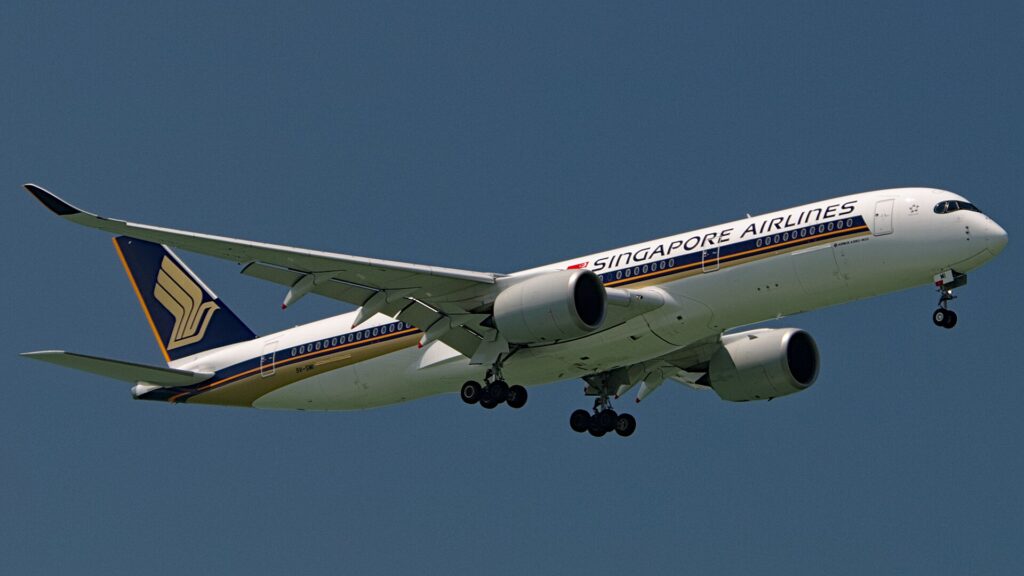
- The “raccoon mask”: most A350s have the cockpit windows framed by a dark painted band, which makes the aircraft look as if it is wearing sunglasses.
- Curved wingtips: large blended winglets that curve smoothly upward from the wing.
- Big engines: two large Trent XWB engines with a 3 m fan.
- Wide, slightly oval body: the fuselage is 5.97 m across, wider than the A330’s 5.64 m.
Inside the Cabin
The A350 cabin is one of the most comfortable in the sky. Here is what you get and why:
A wider cabin
Airbus says the A350 cabin is 5.7 m (225 in) wide, 25 cm wider than the 787’s. Wikipedia gives 5.61 m at armrest level against 5.49 m for the 787 and 5.87 m for the 777. The fuselage was designed around nine seats per row (3-3-3) in economy, one more than the A330’s eight. That usually makes A350 economy seats a little wider than nine-abreast 787 seats. Some airlines fit ten across (3-4-3), which is tighter.
Better air and a lower cabin altitude
Because carbon fibre does not corrode and is strong against pressure cycles, the cabin can be kept at higher pressure and humidity. Airbus says the A350 cabin is pressurised to an altitude at or below 6,000 ft (older aluminium jets are usually around 8,000 ft), with about 20% humidity and an airflow system that adapts to the number of passengers. Airbus says this reduces fatigue on long flights.
Quiet, with bigger bins and windows
Airbus calls the A350 the quietest twin-aisle cabin, although there is no independent test that settles this. It has more headroom, larger overhead bins and wider “panoramic” windows than earlier Airbus models. Windows originally had manual shades; since 2020 airlines can order electronically dimmable windows like the 787’s, and Starlux was the first to receive them.
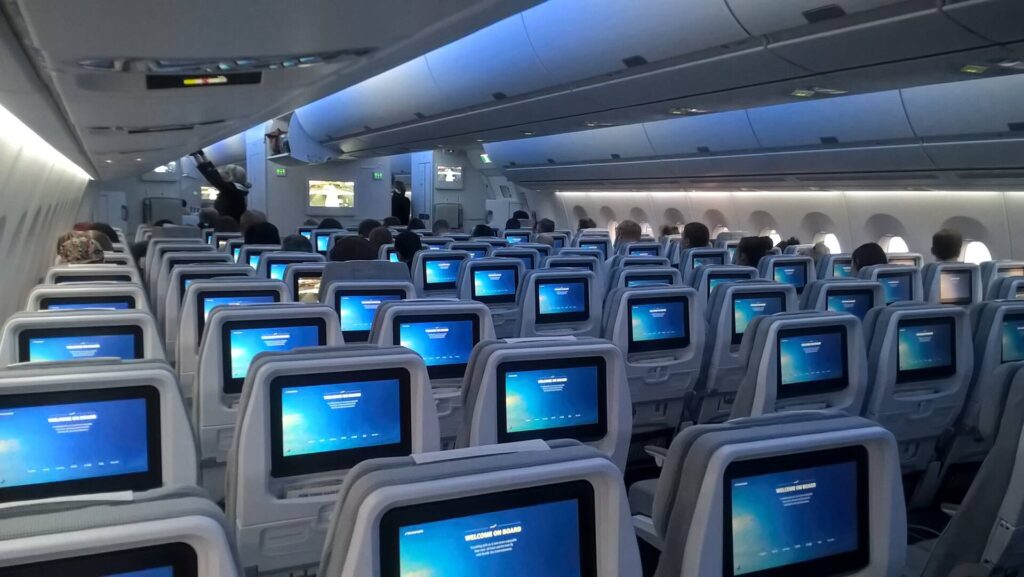
As always, the airline decides the seats. Air India’s A350-900s have 316 seats: 28 business, 24 premium economy and 264 economy.
The Cockpit
The A350 flight deck uses Airbus fly-by-wire controls with sidesticks and large displays. Airbus received approval for a Common Type Rating between the A350 and the A330, and says pilots can move from the A330 to the A350 in about eight days without full flight simulator sessions. That lets airlines that fly both types use one pool of pilots; see our A330-900neo review.
The Rolls-Royce Trent XWB Engine
Every A350 is powered by the Rolls-Royce Trent XWB, which was selected in 2006 to power the aircraft exclusively. The A350-900 uses the Trent XWB-84, rated at 84,000 lbf; the bigger A350-1000 uses the 97,000 lbf XWB-97.
| Trent XWB detail | Figure |
|---|---|
| Fan diameter | 3 m (118 in) |
| Bypass ratio | 9.6:1 |
| Overall pressure ratio | 50:1 |
| Thrust | 84,200 to 97,000 lbf across versions |
| Layout | Three-shaft Rolls-Royce Trent design |
| Title | Most powerful member of the Trent family |
Source: Wikipedia: Rolls-Royce Trent XWB.
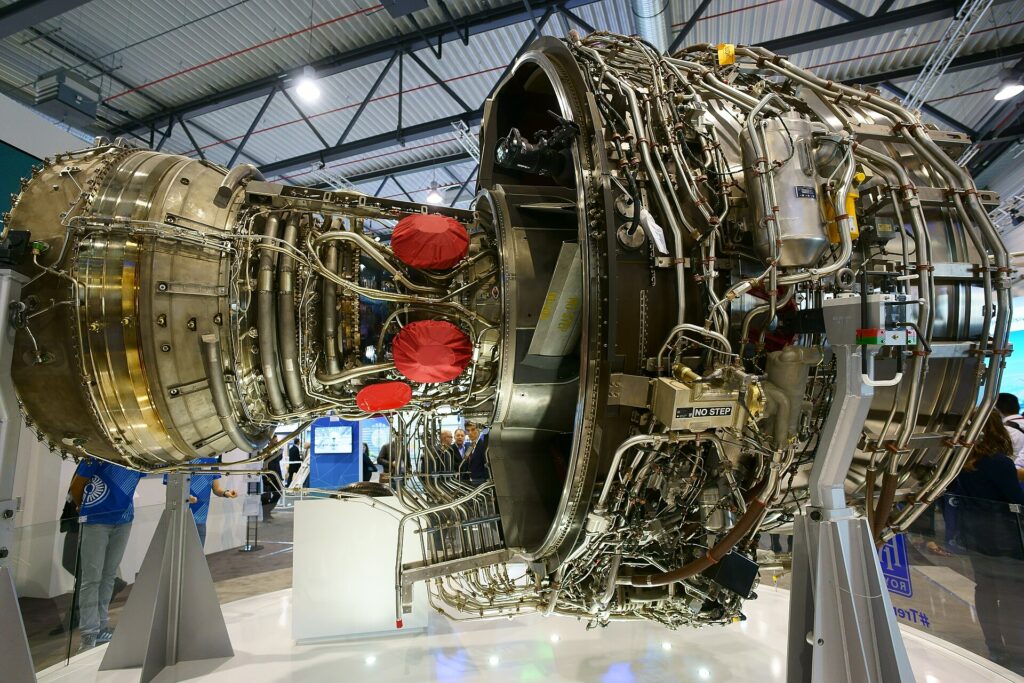
In simple words: the 3 m fan pushes a huge amount of air around the engine core, which is efficient and quiet, while the very high pressure ratio squeezes more energy out of each kilogram of fuel. Rolls-Royce’s three-shaft design lets each part of the engine spin at a speed that suits it. Wikipedia reports that fleet-leading XWB-84 engines have flown over 22,000 hours without a shop visit. For engine basics, read our turbofan vs turboprop guide.
Range, Weights and Special Versions
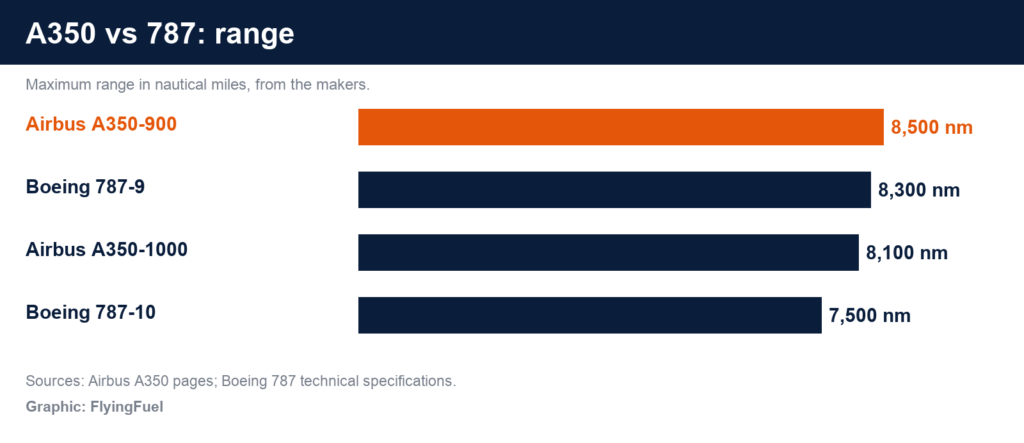
Airbus lists the A350-900 at up to 8,500 nm (15,750 km) for its heaviest version and 7,500 nm for the standard version. Airlines choose the weight version when they order, so not every A350-900 can fly the maximum range. Over time Airbus raised the maximum take-off weight from 268 tonnes to 280 tonnes and then up to 283 tonnes.
- A350-900ULR (Ultra Long Range): Airbus says it can fly 9,700 nm nonstop. It uses extra fuel space in the centre wing box rather than add-on tanks. Singapore Airlines, the launch customer, flies seven of them between Singapore and New York, among the longest flights in the world.
- A350-900 Regional: a lighter, lower-weight version for shorter, busy routes, flown by airlines such as Japan Airlines.
- A350F: a freighter version with a payload of up to 111 tonnes, in flight testing; see our largest cargo planes list.
Safety Record
The A350 has an excellent safety record. Its only hull loss happened on 2 January 2024, when Japan Airlines Flight 516, an A350-900, collided with a Japan Coast Guard Dash 8 after landing at Tokyo Haneda. The A350 caught fire and was destroyed, but all 367 passengers and 12 crew escaped using the emergency slides, with 17 injuries. Five of the six people on the Coast Guard aircraft died, according to Wikipedia.
The A350 in India
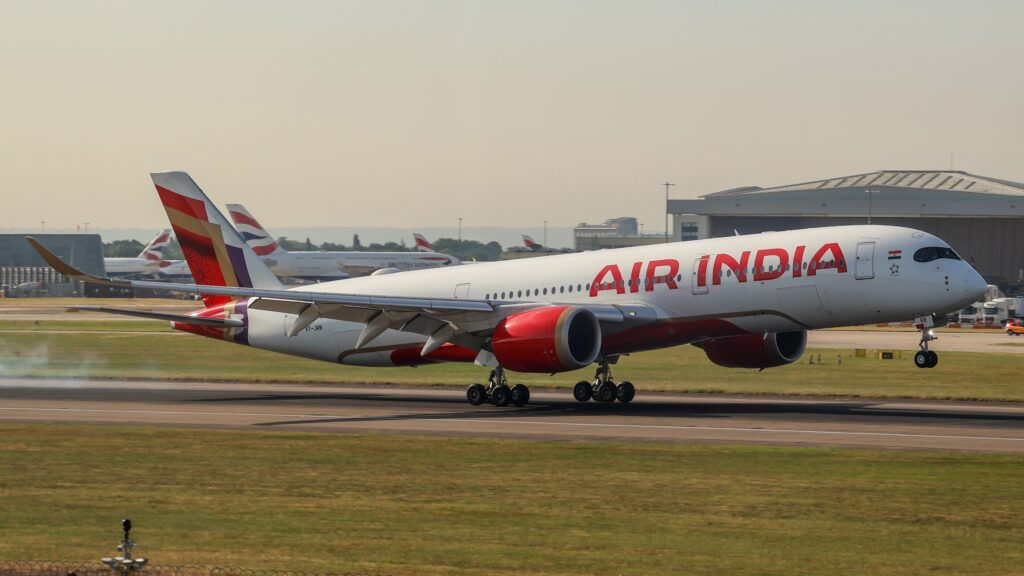
- Air India received its first A350-900 in December 2023 and had 6 in September 2026, with 50 A350s on order in total. Its A350-900s have 316 seats in three classes. See our Air India fleet guide.
- IndiGo doubled its A350 order from 30 to 60 aircraft. They will be its first widebodies of its own, with 330 or more seats, and IndiGo has said its London Heathrow flights will pause until its A350s arrive. See our IndiGo fleet guide.
A350-900 vs Its Rivals
A350-900 vs Boeing 787-9
| Airbus A350-900 | Boeing 787-9 | Better | |
|---|---|---|---|
| Length | 66.8 m | 62.8 m | A350 (more seats) |
| Wingspan | 64.75 m | 60.1 m | Both fit ICAO Code E gates |
| Maximum seats | 440 | 420 | A350 |
| Range | Up to 8,500 nm | Up to 8,300 nm | A350 (slightly) |
| Maximum take-off weight | Up to 283 t | 259 t | 787 (lighter, less fuel per trip) |
| Cabin width | 5.7 m (Airbus) | About 5.5 m | A350 |
| Windows | Shades (dimmable optional) | Largest, dimmable | 787 |
| Engine choice | 1 (Trent XWB-84) | 2 | 787 |
| Cabin altitude | 6,000 ft | 6,000 ft | Tie |
Sources: Airbus and Boeing specifications, as compiled in our A350 vs 787 comparison.
What the A350-900 does better: more seats, a wider cabin with roomier nine-abreast economy, slightly more range, and an ultra-long-range version with no 787 equivalent. What the 787-9 does better: it is lighter and usually burns less fuel per flight, has bigger dimmable windows as standard and offers two engines. Airlines often use the 787-9 on thinner routes and the A350-900 on busier ones. Read our Boeing 787-9 review.
A350-900 vs A350-1000
The A350-1000 is 7 m longer (73.78 m), seats 375 to 400 in three classes and uses the more powerful Trent XWB-97, but flies a little less far (8,100 nm). Airlines choose the -900 for range and flexibility and the -1000 for capacity. See our A350-1000 review.
Pros and Cons
Pros
- Up to 8,500 nm range; ULR version flies 9,700 nm
- Wide cabin designed for comfortable nine-abreast economy
- 6,000 ft cabin altitude, 20% humidity and a very quiet cabin
- 53% composite structure, lighter and corrosion-free
- Reliable Trent XWB engine
- Common type rating with the A330
- Only one hull loss, with every passenger safely evacuated
Cons
- Only one engine choice (Trent XWB)
- Heavier than the 787-9, so more fuel per trip
- Dimmable windows only as an option
- Ten-abreast layouts on some airlines remove the width advantage
- Engine maker Rolls-Royce is the only supplier, so airlines cannot compare engine offers
Our Verdict
The A350-900 is one of the finest long-haul aircraft ever built. Airbus listened to airlines, threw away its first design and produced a carbon-fibre jet with a wider cabin, a clever wing and an excellent engine. For passengers it delivers what matters on a long flight: space, quiet, better air and a lower cabin altitude.
It is heavier than the Boeing 787-9 and has only one engine choice, but for most airlines that is a small price for its capacity and comfort. With Air India expanding its A350 fleet and IndiGo’s first A350s on the way, Indian travellers will see much more of it in the coming years. Compare it with its bigger sibling in our A350-1000 review.
Frequently Asked Questions
How many seats does an Airbus A350-900 have?
Airbus lists 332 to 352 seats in a typical three-class layout and a maximum of 440. Air India’s A350-900s have 316 seats: 28 business, 24 premium economy and 264 economy.
What is the range of the A350-900?
Up to 8,500 nm (15,750 km) for the heaviest version and 7,500 nm for the standard version, according to Airbus. The special A350-900ULR can fly 9,700 nm.
What does XWB mean?
Extra Wide Body. Airbus used the name when it redesigned the A350 in 2006 with a new, wider fuselage, after airlines rejected the first A350 design based on the A330.
What engine does the A350-900 use?
Only the Rolls-Royce Trent XWB-84, rated at 84,000 lbf. It has a 3 m (118 in) fan, a 9.6:1 bypass ratio and a 50:1 pressure ratio.
Is the A350 made of carbon fibre?
Mostly. The A350 airframe is 53% composite materials, with carbon-fibre-reinforced plastic used for the fuselage skin and frames, the wings and the tail. It was the first Airbus aircraft built largely from carbon fibre.
Does Air India fly the A350?
Yes. Air India had 6 A350-900s in September 2026 and has ordered 50 A350s in total. Its first A350-900 arrived in December 2023.
Has IndiGo ordered the A350?
Yes. IndiGo doubled its A350 order from 30 to 60 aircraft. They will be its first widebody jets of its own, with 330 or more seats.
Is the A350 safe?
Yes. Its only hull loss came on 2 January 2024, when Japan Airlines Flight 516 collided with a Japan Coast Guard aircraft after landing at Tokyo Haneda. The A350 burned, but all 367 passengers and 12 crew escaped. Five of the six people on the Coast Guard aircraft died.
Is the A350-900 better than the Boeing 787-9?
They are close. The A350-900 is bigger, with more seats and a wider cabin. The 787-9 is lighter, usually burns less fuel per flight, has bigger dimmable windows as standard and offers two engine choices.
Featured image: FlyingFuel graphic using a photo of Singapore Airlines Airbus A350-900 9V-SMF, the 10,000th Airbus by Md Shaifuzzaman Ayon, CC BY-SA 4.0, via Wikimedia Commons.
 Embraer Executive JetsEmbraer Business Jets: Phenom 100EX, Phenom 300EV, Praetor 500E and 600E Explained (2026)
 NewseasyJet to Fit Starlink Wi-Fi Across Its Airbus Fleet From 2027
 NewsFAA Proposes Fan Blade Checks on Every CFM56-7B Engine After 737 Blade Failure
 Dassault FalconDassault Falcon Jets: Every Model From the 2000LXS to the 10X Explained (2026)
 GulfstreamGulfstream Business Jets: Every Model From the G300 to the G800 Explained (2026)
 NewsBombardier to Hire 800 in the US and Spend $270 Million on First Phase of Expansion