
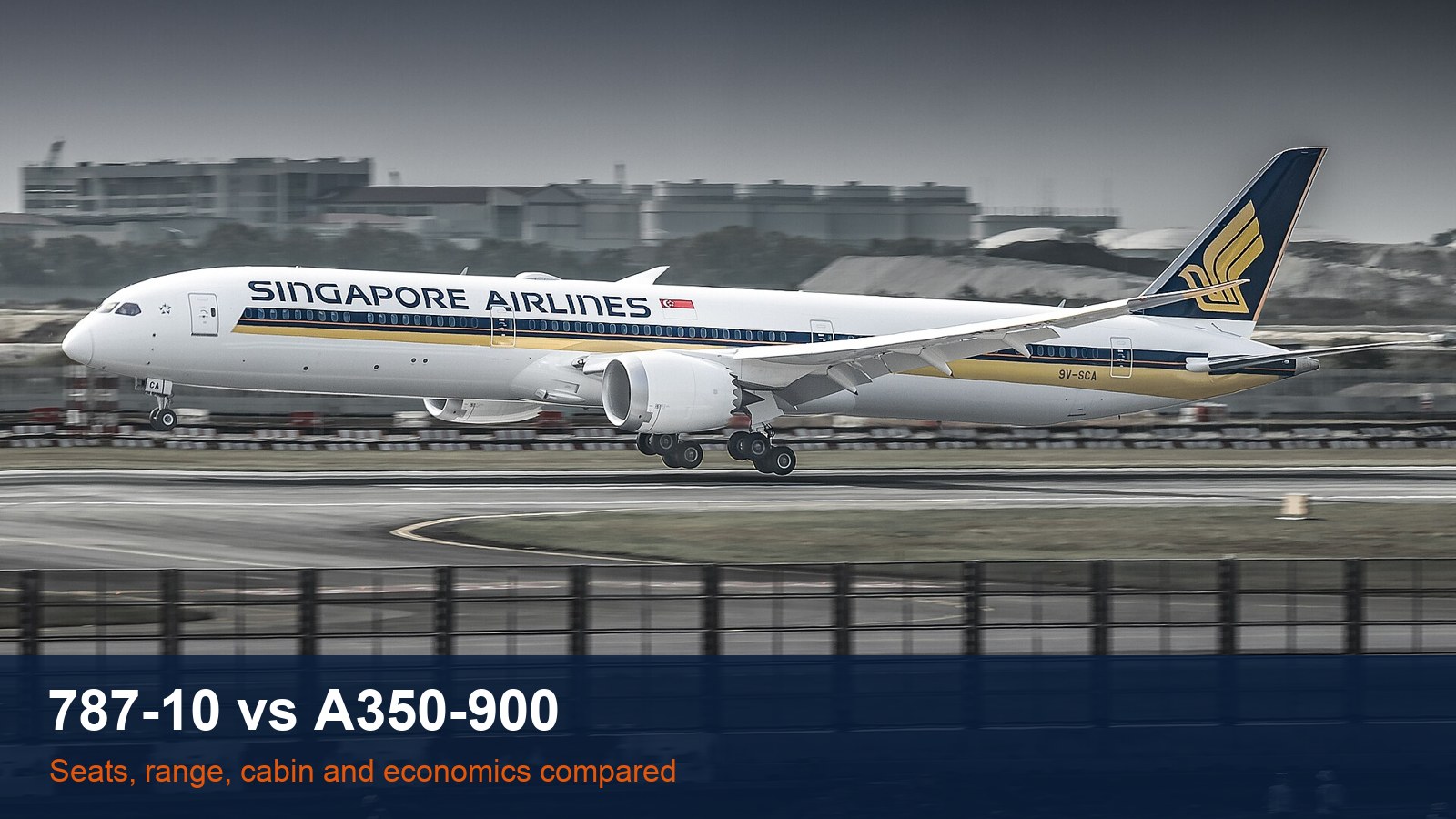
The Boeing 787-10 and the Airbus A350-900 are two of the most important long-haul jets flying today, and they are closer rivals than their names suggest. The 787-10 is the longest Dreamliner; the A350-900 is the core model of Airbus’s carbon-fibre widebody family. Both seat around 300 to 350 passengers on two engines. But they are built for slightly different jobs.
Quick verdict: the 787-10 is a high-capacity aircraft for medium and long routes, where Boeing says its economics beat the A350-900. The A350-900 flies much further, up to 8,500 nm against 7,500, with a wider cabin and a bigger wing. The 787-10 suits busy medium long-haul routes, while the A350-900 suits the longest flights; Singapore Airlines flies both.
Below we compare them step by step: size, seats, cabin, engines, weight, range, economics, operators and India. For the detailed background on each family, see our A350-900 review, our 787-9 review and 787-9 vs 787-10. If you want the A350-900 against the smaller 787-9, read A350 vs 787.
787-10 vs A350-900: Quick Comparison
| Item | Boeing 787-10 | Airbus A350-900 |
|---|---|---|
| Seats | 300 to 375 (two-class) | 332 to 352 (three-class) |
| Maximum seats | – | 440 (exit limit) |
| Range | Up to 7,500 nm | Up to 8,500 nm (heaviest); 7,500 nm standard |
| Length | 68.3 m | 66.8 m |
| Wingspan | 60.1 m | 64.75 m |
| Height | – | 17.05 m |
| Maximum take-off weight | 260,360 kg | Up to 283 tonnes |
| Engines | GEnx-1B or Rolls-Royce Trent 1000 | Rolls-Royce Trent XWB-84 only |
| Structure | About 50% composite by weight | 53% composites |
| Cabin altitude | 6,000 ft | 6,000 ft or below |
| First flight | 31 March 2017 | 14 June 2013 |
| In service | April 2018 (Singapore Airlines) | January 2015 (Qatar Airways) |
Sources: Boeing 787 specifications; Wikipedia: Boeing 787; Airbus A350 facts and figures and Wikipedia: Airbus A350, as compiled in our A350-900 review.
How Each Aircraft Came About
The 787-10 is a stretch of the 787-9. According to Wikipedia, Boeing first studied it in 2005 at the request of Emirates and Qantas. Singapore Airlines became the launch customer in May 2013, and Boeing launched the programme at the Paris Air Show on 18 June 2013 with 102 orders and commitments from Air Lease Corporation, Singapore Airlines, United Airlines, British Airways and GE Capital Aviation Services. It was meant to replace the Boeing 777-200 and Airbus A340-500 and to compete directly with the A350-900.
The 787-10 first flew on 31 March 2017, was certified by the FAA in January 2018 and was delivered to Singapore Airlines on 25 March 2018. Its first aircraft had 337 seats, 36 in business and 301 in economy, and it began commercial service on 3 April 2018.
The A350-900 came from a different starting point. Airbus’s first A350 design, based on the A330, was rejected by airlines, so in 2006 Airbus started again with the all-new A350 XWB (“Extra Wide Body”). The A350-900 first flew on 14 June 2013 and entered service with Qatar Airways on 15 January 2015, flying Doha to Frankfurt.
Size: Longer vs Wider
The two aircraft are big in different ways. The 787-10 is the longer aircraft at 68.3 m, 1.5 m longer than the A350-900. It got there by adding 10 ft (3 m) ahead of the wing and 8 ft (2.4 m) behind it to the 787-9, while keeping the same 60.1 m wing. Boeing targeted 90% commonality with the 787-9 and achieved 95%.
The A350-900 is wider and has a much bigger wing: 64.75 m of span against 60.1 m. Both still fit ICAO Code E airport gates. The bigger wing holds more fuel and lifts more weight, which is why the A350-900 can fly much further.
The 787-10’s length creates a problem: a long fuselage on the same short landing gear makes a tail strike on take-off more likely. Boeing solved it with a semi-levered main landing gear that lets the aircraft rotate over its rear wheels, similar to the 777-300ER. The 787-10’s mid-fuselage sections are also too large to transport to Everett, so it is built only in Charleston, South Carolina.
How to tell them apart
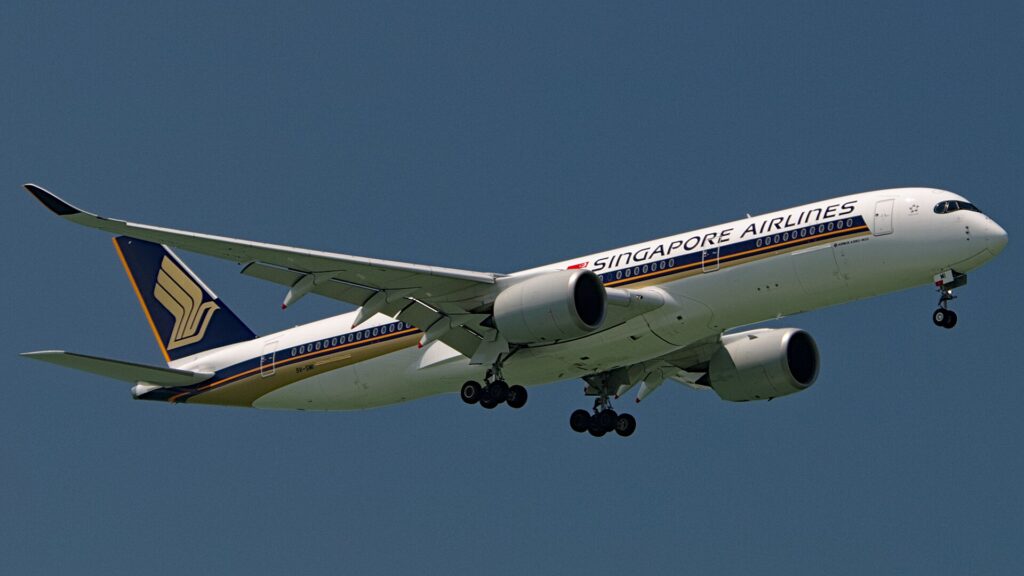
- Cockpit windows: the A350 has a dark “raccoon mask” around its cockpit windows; the 787 has four large cockpit windows and no mask.
- Wingtips: the A350 has large winglets that curve smoothly upward; the 787 has long raked wingtips with no winglet.
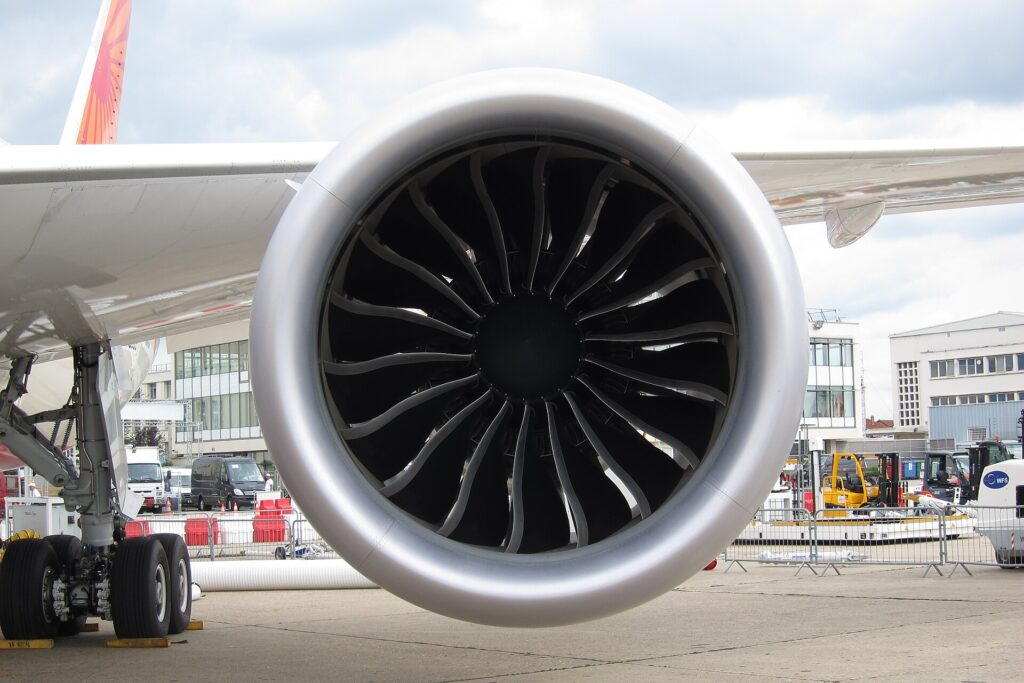
- Engines: the 787’s engine nacelles have serrated chevrons at the back; the A350’s Trent XWB has a smooth edge.
- Proportions: the 787-10 looks very long and slim for its wing.
Seats and Cabin
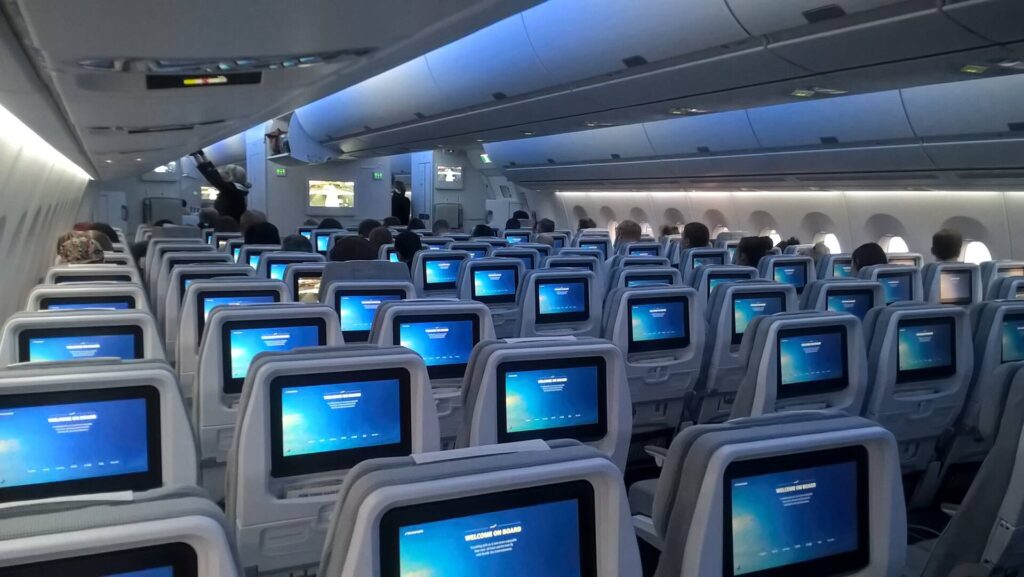
Boeing lists the 787-10 at 300 to 375 seats in two classes. Airbus lists the A350-900 at 332 to 352 in three classes, with an exit limit of 440. In real service they carry similar numbers. Wikipedia quotes a 336-seat two-class 787-10, and Singapore Airlines’ first 787-10s carry 337. Air India’s A350-900s have 316 seats in three classes.
Cabin width and seats
This is the A350’s clear advantage. Airbus says its cabin is 25 cm wider than the 787’s. Wikipedia gives 5.61 m at armrest level for the A350 against 5.49 m for the 787. Most airlines fit nine seats per row (3-3-3) in economy on both aircraft, so on the A350 each seat and the aisles get a little more space. On a nine-across 787, economy seats can be up to 17.5 inches wide.
Air, pressure and windows
- Cabin altitude: both are pressurised to about 6,000 ft instead of the 8,000 ft typical of older aluminium jets, thanks to their composite bodies. Both makers say this reduces tiredness.
- Humidity: Boeing quotes about 15% on the 787 and Airbus about 20% on the A350, against about 4% on older aircraft.
- Windows: the 787 has the largest windows of any widebody, which dim electronically at the touch of a button. Most A350s still have shades, although since 2020 airlines can order dimmable A350 windows; Starlux was first.
- Noise: Airbus calls the A350 the quietest twin-aisle cabin. The 787 uses engine chevrons and other measures to reduce noise.
The 787-10 also needed a 15% more powerful cabin air-conditioning system than the 787-9, because it carries more people.

Engines Explained
The 787-10 gives airlines a choice of two engines; the A350-900 has one. All three are large high-bypass turbofans; our turbofan vs turboprop guide explains how they work.
| Engine detail | 787-10 | A350-900 |
|---|---|---|
| Options | GE Aerospace GEnx-1B or Rolls-Royce Trent 1000 (TEN) | Rolls-Royce Trent XWB-84 only |
| Fan diameter | GEnx-1B: 111.1 in; Trent 1000: 2.85 m | 3 m (118 in) |
| Bypass ratio | GEnx-1B: about 9:1; Trent 1000: over 10:1 | 9.6:1 |
| Thrust | Around 76,000 lbf class (Wikipedia) | 84,000 lbf |
| Air system | Bleedless; electric compressors for cabin air | Conventional bleed air |
Sources: Wikipedia: General Electric GEnx; Wikipedia: Rolls-Royce Trent 1000; Wikipedia: Rolls-Royce Trent XWB; Wikipedia: Boeing 787.
Engine thrust matters most in hot weather. Wikipedia reports that Emirates, which had committed to 40 787-10s, considered cancelling them in 2019 because the engine margins were not enough for Dubai’s summer heat. At the 2019 Dubai Air Show it ordered 30 787-9s instead. Emirates also looked at the A350 as an alternative.
Range: Where Each Can Fly
This is the biggest difference. Boeing lists the 787-10 at up to 7,500 nm, the shortest range of the three 787 models. Airbus lists the A350-900 at up to 8,500 nm for its heaviest version and 7,500 nm for the standard version; airlines choose the weight version when they order.
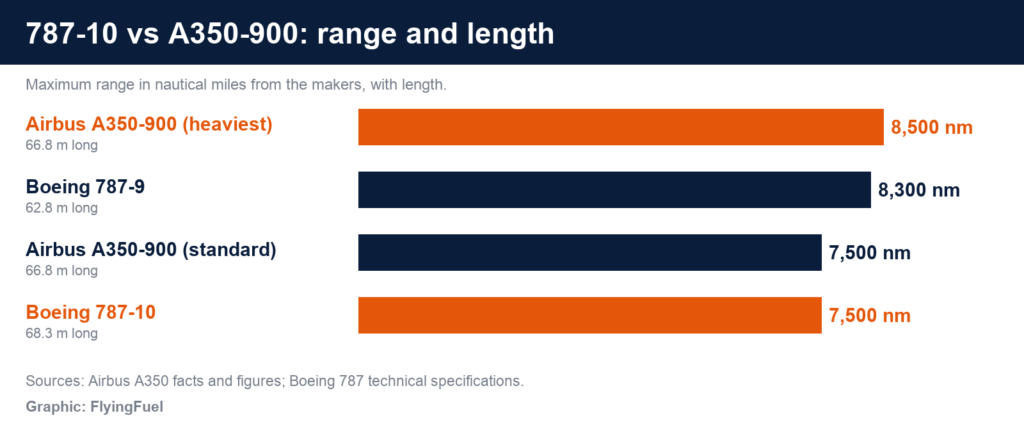
Why the gap? The 787-10 kept the 787-9’s wing and fuel tanks but carries more people, so it trades range for capacity. The A350-900 has a bigger wing, more fuel (140,795 litres, or 166,488 on the heaviest version) and a higher take-off weight. Boeing is pushing the 787-10 further: the FAA approved higher maximum take-off weights in March 2026, which Wikipedia says adds about 5 tonnes of payload or more than 400 nm of range. All 787-10s built since December 2025 can use it.
In practice, 7,500 nm is plenty for routes such as India to Europe. The A350-900’s extra range matters on the longest routes, and its special A350-900ULR version flies up to 9,700 nm; see the longest flights in the world.
Economics: Which Is Cheaper to Fly?
Boeing pitched the 787-10 as offering better economics than the A350-900 on shorter routes. Wikipedia quotes aircraft lessor Steven Udvar-Hazy: “If it’s identically configured, the -10 has a little bit of an edge on the -900”, although he said the edge was smaller than Boeing’s estimate of 10%.
The logic is simple. The 787-10 is lighter (about 260 tonnes maximum against up to 283), carries a similar number of people, and on a 7 to 10 hour flight it does not need the A350’s extra range. Carrying less fuel capacity and a smaller wing on such routes saves weight and money. On very long routes, the A350-900’s range means it can carry a full load where the 787-10 would have to leave seats or cargo empty.
Airbus, for its part, says the A350 burns 25% less fuel than previous-generation competitors. So both are big steps forward from the aircraft they replace; the choice depends on route length.
Who Flies Them?
- Singapore Airlines launched the 787-10 and also flies the A350-900, so it is a good example of one airline using both.
- United Airlines and British Airways were among the 787-10’s launch customers.
- Qatar Airways launched the A350-900 in 2015.
- Emirates once committed to 40 787-10s but switched to 30 787-9s in 2019.
As of January 2023, Wikipedia lists 189 orders for the 787-10, of which 115 had been delivered. The A350 family is much bigger overall: Airbus had built 737 A350s by September 2026.
India: A350-900 Yes, 787-10 No
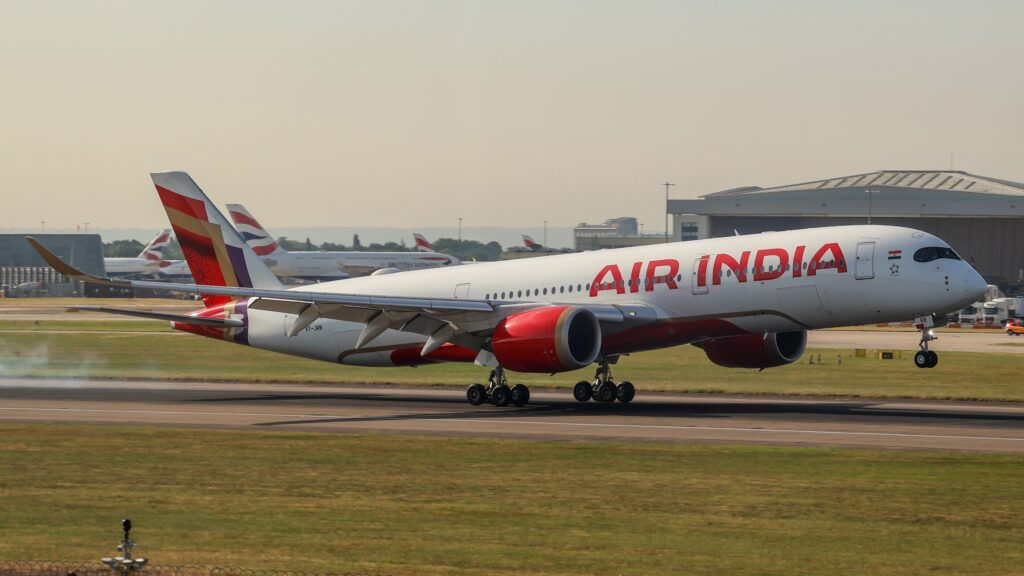
Air India had 6 A350-900s in September 2026, with 316 seats each, and has ordered 50 A350s in total. IndiGo has ordered 60 A350s as its first widebodies of its own. See our Air India fleet and IndiGo fleet guides.
No Indian airline flies the 787-10. Air India’s Dreamliners are 787-8s and 787-9s. Indian travellers are most likely to fly a 787-10 with Singapore Airlines, United or British Airways on routes to or via their hubs.
Which Is Better? Head to Head
| Area | 787-10 | A350-900 | Better |
|---|---|---|---|
| Range | 7,500 nm | Up to 8,500 nm | A350-900 |
| Length | 68.3 m | 66.8 m | 787-10 (more room for seats) |
| Cabin width | Narrower | 25 cm wider (Airbus) | A350-900 |
| Windows | Largest, dimmable | Shades on most aircraft | 787-10 |
| Engine choice | Two | One | 787-10 |
| Economics on shorter long-haul | Slight edge (Boeing, Udvar-Hazy) | Baseline | 787-10 |
| Hot-weather performance | Concerns raised by Emirates | Bigger wing, more thrust | A350-900 |
| Commonality | With 787-8 and 787-9 (95% common with -9) | With A350-1000 and A330 (common type rating) | Depends on fleet |
Sources: Boeing and Airbus specifications; Wikipedia: Boeing 787 and Airbus A350.
Pros and Cons
Boeing 787-10
- Pros: longest Dreamliner with high capacity; strong economics on medium long-haul routes; two engine choices; big dimmable windows; 95% common with the 787-9.
- Cons: shortest 787 range at 7,500 nm; narrower cabin; hot-weather performance concerns; built only in Charleston.
Airbus A350-900
- Pros: up to 8,500 nm (9,700 nm ULR); wider, quiet cabin; bigger wing; common type rating with the A330 and A350-1000; flying with Air India and ordered by IndiGo.
- Cons: one engine choice; heavier, so more fuel on shorter routes; most aircraft still have window shades.
Our Verdict
There is no single winner, because the two are tuned for different missions. On routes of up to about 7,500 nm, the 787-10 carries a big load cheaply. On the longest routes, the A350-900 wins thanks to its range, bigger wing and wider cabin.
For passengers, the A350-900 usually feels a little roomier in economy, while the 787-10 has the nicer windows. Both offer a 6,000 ft cabin altitude and more humid air than older jets, so either is a good choice for a long flight. As always, the airline’s seats matter more than the badge on the tail.
Frequently Asked Questions
Which is bigger, the 787-10 or the A350-900?
The 787-10 is longer: 68.3 m against 66.8 m for the A350-900. But the A350-900 has a wider cabin, a bigger wing (64.75 m span against 60.1 m) and a higher maximum take-off weight (up to 283 tonnes against about 260 tonnes).
Which has more range, the 787-10 or A350-900?
The A350-900. Airbus lists up to 8,500 nm for its heaviest version and 7,500 nm for the standard version. Boeing lists the 787-10 at 7,500 nm, the shortest range in the 787 family.
How many seats do the 787-10 and A350-900 have?
Boeing lists the 787-10 at 300 to 375 seats in two classes. Airbus lists the A350-900 at 332 to 352 in three classes, with an exit limit of 440. Singapore Airlines’ first 787-10s had 337 seats: 36 business and 301 economy.
Which is more comfortable, the 787-10 or A350-900?
Both have a 6,000 ft cabin altitude and more humid air than older jets. The A350 cabin is wider; Airbus says by 25 cm. The 787 has bigger, electronically dimmable windows. Both usually have nine economy seats per row, which tends to make A350 seats a little wider.
Which is more fuel efficient?
On shorter long-haul routes the 787-10 can have the edge. Boeing claimed better economics than the A350-900 on shorter routes; aircraft lessor Steven Udvar-Hazy said the -10 had “a little bit of an edge” when identically configured, but less than Boeing’s estimate of 10%. On longer routes, the A350-900’s range and bigger wing matter more.
What engines do they use?
The 787-10 can have either the GE Aerospace GEnx-1B or the Rolls-Royce Trent 1000 TEN. The A350-900 uses only the Rolls-Royce Trent XWB-84, rated at 84,000 lbf.
Which airlines fly the 787-10?
Singapore Airlines was the launch customer, receiving its first 787-10 on 25 March 2018. Other launch customers included United Airlines and British Airways. No Indian airline flies the 787-10.
Do Indian airlines fly the A350-900?
Yes. Air India had 6 A350-900s in September 2026, and IndiGo has ordered 60 A350s as its first widebodies of its own.
Why is the 787-10 only built in Charleston?
Its mid-fuselage sections are too large to transport to Boeing’s Everett factory, so it is built only in Charleston, South Carolina. It was the first Boeing airliner assembled there exclusively.
Featured image: FlyingFuel graphic using a photo of Singapore Airlines Boeing 787-10 9V-SCA, the airline’s first 787-10 by Paul Schmid, CC BY-SA 4.0, via Wikimedia Commons.
 GulfstreamGulfstream Business Jets: Every Model From the G300 to the G800 Explained (2026)
 NewsBombardier to Hire 800 in the US and Spend $270 Million on First Phase of Expansion
 NewsAll Passengers Flying to the US Must Sign an Ebola Travel Attestation From 3 November
 BombardierBombardier Business Jets: Every Global and Challenger Model Explained (2026)
 NewsSafran LEAP Engine Deliveries Rise 26% to 1,565 in First Nine Months of 2026
 NewsEmbraer Order Backlog Hits Record $35.7 Billion as E2 Jet Orders Grow