
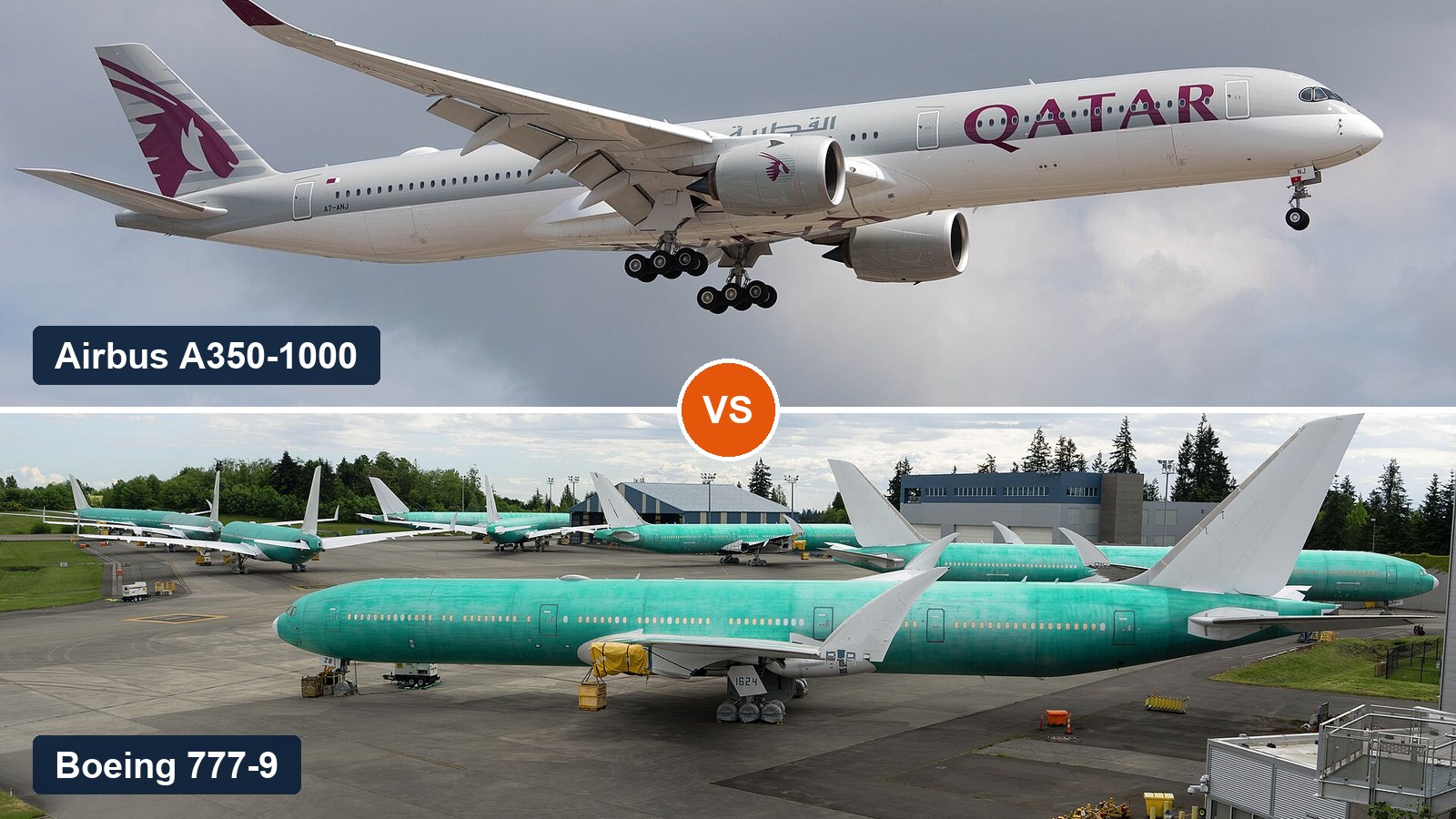
The Airbus A350-1000 and the Boeing 777-9 are two of the largest twin-engine airliners ever built, and they compete for the same job: carrying around 400 passengers on the world’s longest and busiest routes. There is one large difference between them today. The A350-1000 has been flying passengers since 2018, while the 777-9 is still being certified and has not yet been delivered to an airline.
In short: the 777-9 is the bigger aircraft, with more seats and a wider wing that folds at the tips. The A350-1000 is lighter, already in service, and offered with more range. This comparison covers size, seats, range, engines, fuel efficiency, orders and the 777-9’s delays, using figures published by Airbus, Boeing and the engine makers.
A350-1000 vs 777-9 at a Glance
| Specification | Airbus A350-1000 | Boeing 777-9 |
|---|---|---|
| Status | In service since February 2018 | In certification; first delivery expected 2027 |
| Length | 73.78 m (242 ft 1 in) | 76.7 m (251 ft 9 in) |
| Wingspan | 64.75 m (212 ft 5 in) | 71.8 m (235 ft 5 in) in flight; 64.8 m folded |
| Height | 17.08 m (56 ft 0 in) | 19.5 m (64 ft 1 in) |
| Typical seats (three-class) | 375 to 400 | 357 |
| Typical seats (two-class) | Not published | 426 |
| Maximum certified seats | 480 | Not yet certified |
| Range | 8,100 nm (15,000 km); 9,000 nm version from 2030 | Up to 8,000 nm (14,820 km) |
| Maximum take-off weight | 308 tonnes; up to 322 tonnes | 351.5 tonnes |
| Fuel capacity | 158,790 to 168,300 litres | 197,356 litres |
| Engines | Rolls-Royce Trent XWB-97 | GE Aerospace GE9X |
| Thrust per engine | 97,000 lbf | 105,000 lbf |
| Engine fan diameter | 118 in (3.00 m) | 134 in (3.40 m) |
Sources: Airbus product page and A350 Family facts and figures (figures at end of May 2026); Boeing product page and 777-9 airport planning document (September 2025, marked preliminary); engine data from Rolls-Royce and GE Aerospace. Checked in October 2026.
Seat counts are not directly comparable. Each manufacturer chooses its own example cabin, and the two-class and three-class figures above assume different mixes of business and economy seats.
Size: Which Is Bigger?
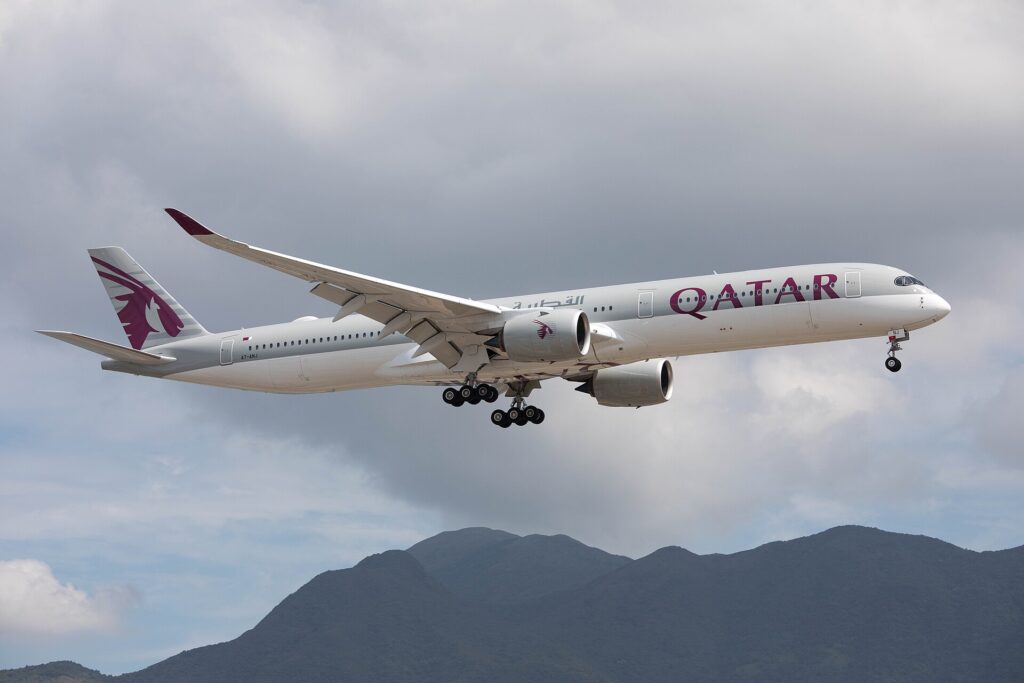
The 777-9 is bigger in every dimension. It is 76.7 m long, about 2.9 metres longer than the A350-1000. It stands 19.5 m tall against 17.08 m, and its wing is about seven metres wider in flight.
It is also much heavier. The 777-9 has a maximum take-off weight of about 351.5 tonnes. The A350-1000 is offered at 308 tonnes, or up to 322 tonnes in its highest-weight version. That weight difference of roughly 30 tonnes is the heart of the comparison: the Boeing carries more, and the Airbus needs less fuel to move itself.
The 777X Folding Wingtips
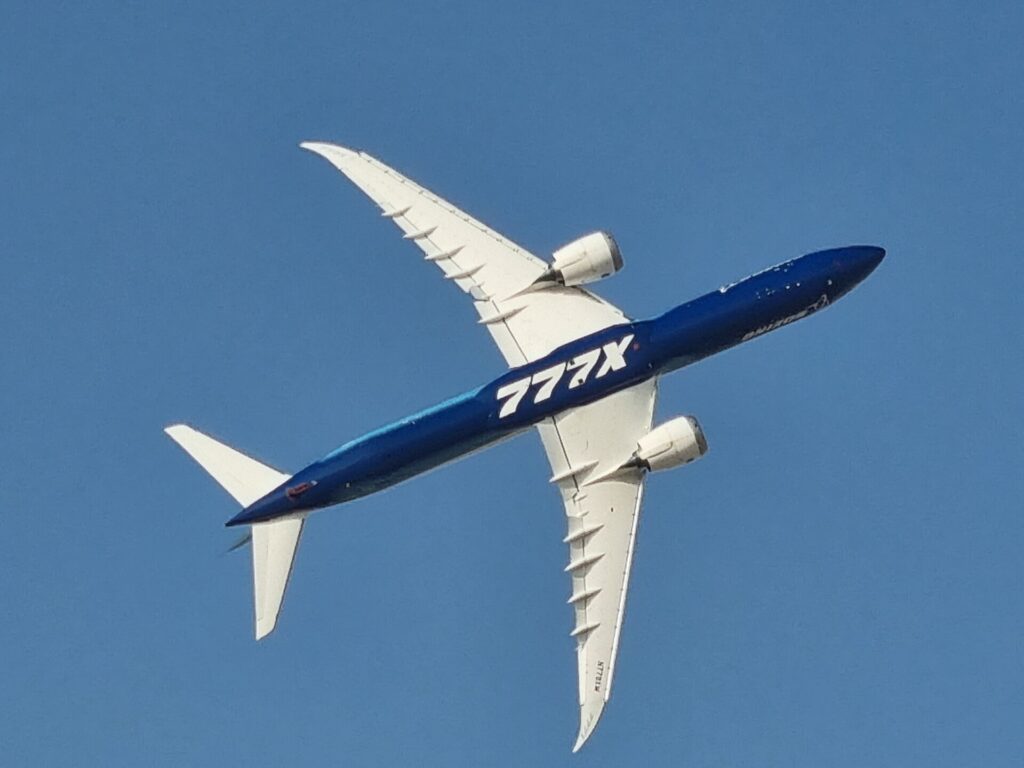
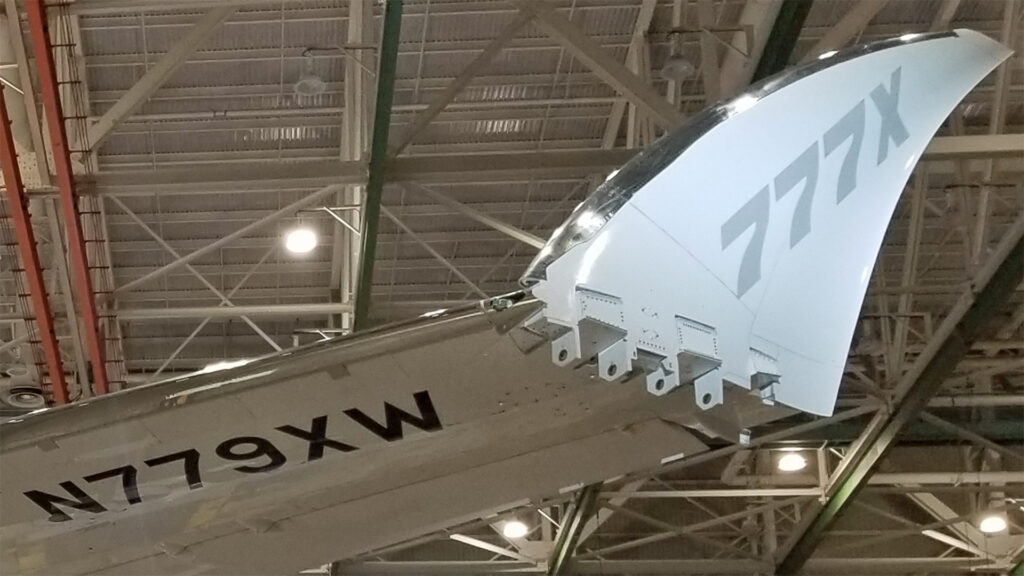
The most distinctive feature of the 777-9 is its wing. A long, slender wing is more efficient in flight, so Boeing gave the 777X a span of 71.8 m. That is too wide for the gates and taxiways used by today’s 777s, so the outer section of each wing folds upward on the ground, reducing the span to 64.8 m.
With the tips folded, the 777-9 has almost exactly the same wingspan as the A350-1000 (64.75 m) and fits the same category of airport gate. Boeing’s airport planning document describes the design as keeping “Code E” wingspan on the ground for taxiway and gate compatibility.
Folding wingtips had not been used on a commercial airliner before, so the US Federal Aviation Administration wrote special conditions for them. The tips move only on the ground, and the rules require protection against a take-off with the tips folded.
Seats and Cabin
Airbus lists the A350-1000 at 375 to 400 seats in a typical three-class layout, and it is certified for a maximum of 480. The lower figure assumes nine seats per row in economy and the higher one ten. Boeing’s planning document lists the 777-9 at 357 seats in three classes or 426 in two, and when it launched the 777X in November 2013 it described the aircraft as seating more than 400 passengers.
The A350 cabin is 5.71 m (225 in) wide, according to Airbus, and is pressurised to the equivalent of 6,000 feet rather than the 8,000 feet typical of older aircraft. Airbus credits the carbon-fibre fuselage for this and says it reduces fatigue on long flights. Boeing describes the 777X cabin as wide and spacious, with features taken from the 787, but does not publish a cabin width on its product page.
As with any airliner, what a passenger experiences depends mostly on the airline. Seat width, legroom and the number of seats per row are chosen by each carrier.
Range
On range the two are closer than their size difference suggests. Boeing lists the 777-9 at up to 8,000 nautical miles (14,820 km). Airbus lists the A350-1000 at 8,100 nautical miles (15,000 km) in its basic version.
Airbus is also developing a higher-weight A350-1000 with a range of 9,000 nautical miles (16,700 km). Its facts sheet marks that version as entering service in 2030. Airbus’s product page already quotes the higher figure, so it is worth checking which version a given number refers to.
Either aircraft can fly routes such as London to Singapore or Dubai to Los Angeles non-stop. Because both have two engines, their long over-water routes are flown under ETOPS rules.
Engines
Neither aircraft offers a choice of engine.
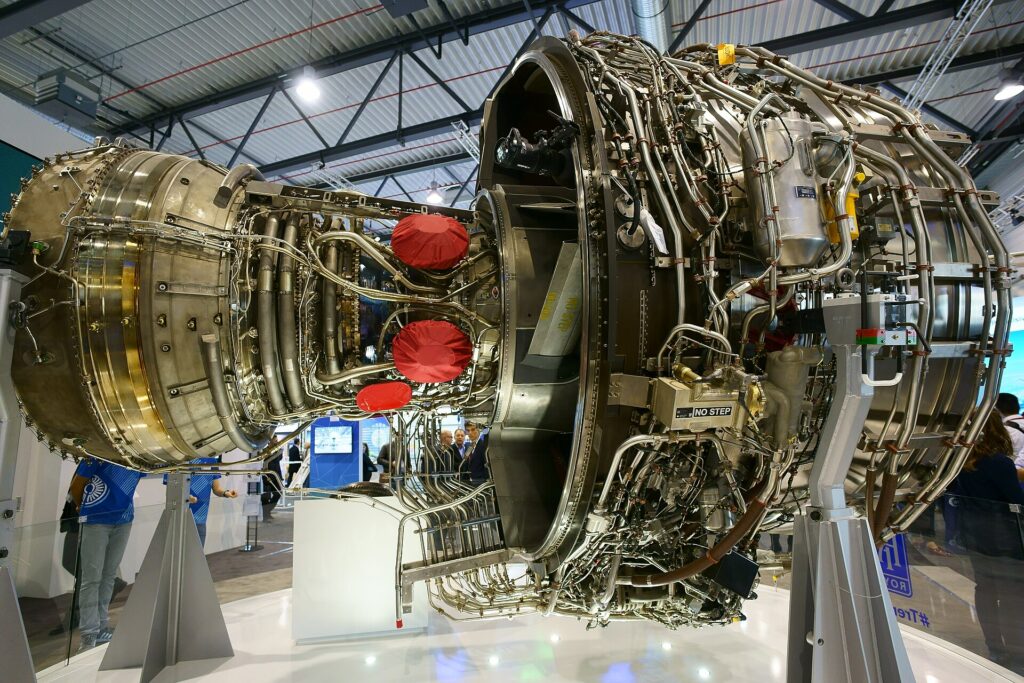
- A350-1000: two Rolls-Royce Trent XWB-97 engines, each rated at 97,000 lbf of thrust. Rolls-Royce describes it as the most powerful variant of the Trent XWB. Its fan is 118 inches (3.00 m) in diameter.
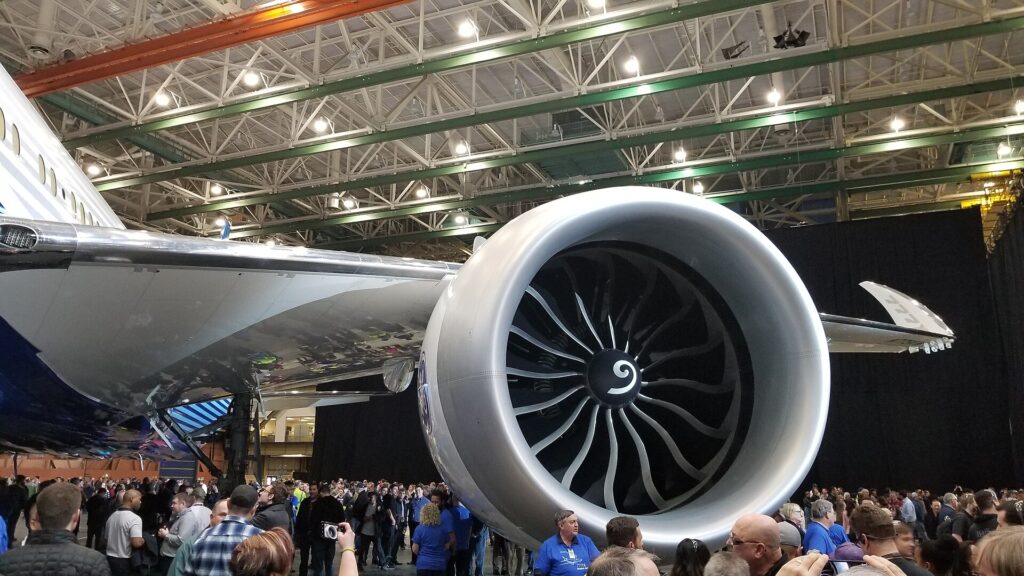
- 777-9: two GE Aerospace GE9X engines, each rated at 105,000 lbf. Its fan is 134 inches (3.40 m) in diameter, which GE Aerospace says is the largest front fan on any commercial engine.
Fuel Efficiency
Both manufacturers claim large savings, but each measures against older aircraft, not against the other.
- Airbus says the A350 brings a 25 percent advantage in fuel burn, operating costs and CO2 emissions compared with previous-generation competitor aircraft.
- Boeing says the 777-9 will achieve 20 percent lower fuel use and emissions than the aircraft it replaces, and 10 percent lower operating costs than the competition.
- GE Aerospace says the GE9X is designed for 10 percent lower fuel consumption than the GE90-115B engine that powers the 777-300ER.
There is no independent, published head-to-head measurement, and there cannot be a real-world one until the 777-9 enters airline service. The physics points in two directions. The A350-1000 is about 30 tonnes lighter, which favours it on fuel burn per trip. The 777-9 carries more passengers, which helps its fuel burn per seat when the aircraft is full.
A350-1000 vs 777-300ER, and Where the 777-9 Fits
Both aircraft are aimed at replacing the Boeing 777-300ER, one of the most widely used long-haul jets of the past two decades. The A350-1000 is Airbus’s all-new answer to it, built largely from carbon-fibre composites: Airbus says more than 70 percent of the airframe is made from advanced materials, including 53 percent composites.
The 777-9 is Boeing’s own successor. It keeps the 777’s aluminium fuselage but adds a new composite wing and new engines, and it is longer than the 777-300ER it follows.
Orders and Deliveries
The A350-1000 has a clear head start. Airbus delivered the first one to Qatar Airways in February 2018, and by the end of May 2026 it had delivered 112 A350-1000s. Across the whole A350 family, Airbus counts 1,595 orders from 68 customers and 718 deliveries.
The 777X had not been delivered to any airline when this article was written. Boeing launched the 777X in November 2013 with agreements for 259 aircraft from Lufthansa, Etihad Airways, Qatar Airways and Emirates. Emirates was the largest of those launch customers, with 150 aircraft, and Boeing booked a further 65 777-9s for the airline in the fourth quarter of 2025. For more on why Emirates favours very large aircraft, see our article on Emirates fleet strategy.
Boeing does not give a single running total for 777X orders in the quarterly and monthly reports we checked, so we have not quoted one.
Why Is the 777X Delayed?
When Boeing launched the 777X in 2013, it targeted first delivery for 2020. The aircraft made its first flight on 25 January 2020, but certification has taken far longer than planned.
In its first-quarter 2026 results, Boeing said the programme was continuing to make progress on 777-9 certification, including FAA approval to begin a further phase of certification flight testing, and that it anticipates first delivery in 2027. That is seven years later than the original target.
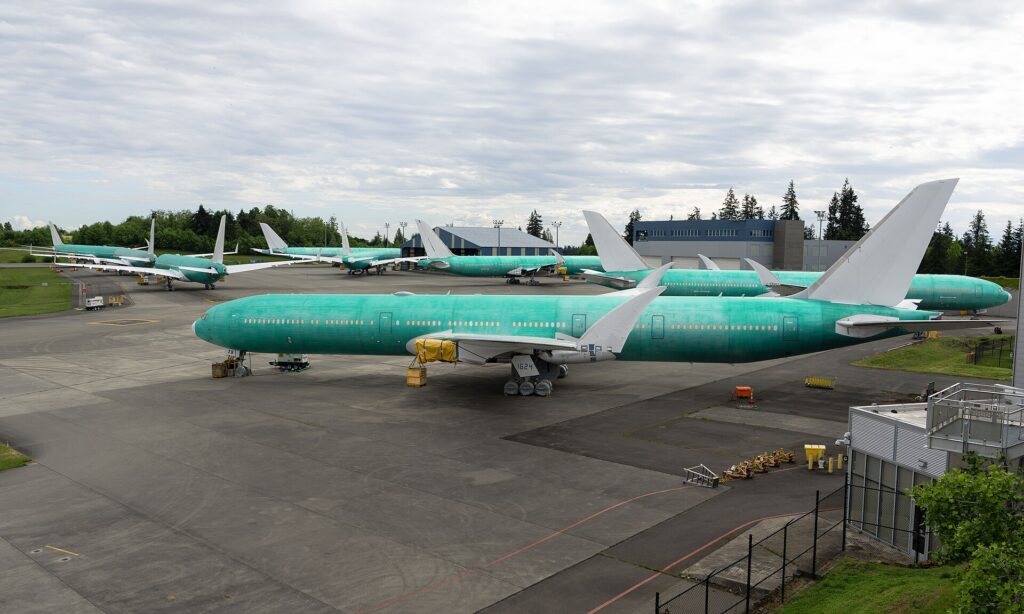
Boeing has continued to build aircraft during the delay, and completed 777-9s have been stored at its Everett site while they wait for certification.
Which Is Better?
There is no single answer, because the two aircraft suit slightly different jobs.
- Choose the A350-1000 for a lighter aircraft that is already in service, with more range on offer and about 30 tonnes less weight to carry.
- Choose the 777-9 for maximum capacity on the busiest long-haul routes, where filling more seats per flight matters more than the aircraft’s own weight.
- Many airlines choose both. Qatar Airways and Lufthansa, for example, have ordered the A350-1000 and the 777-9.
For now the practical difference is simple: an airline can take delivery of an A350-1000, while the 777-9 is still waiting for its certificate. Related comparisons: Boeing 787-9 vs Airbus A350-900 and A320neo vs 737 MAX 8. For the basics of twin-aisle jets, see our guide to widebody aircraft.
Frequently Asked Questions
Is the 777X bigger than the A350?
Yes. The Boeing 777-9 is 76.7 m long with a 71.8 m wingspan, against 73.78 m and 64.75 m for the Airbus A350-1000. It is also heavier, with a maximum take-off weight of about 351.5 tonnes against up to 322 tonnes.
Which has more range, the A350-1000 or the 777-9?
They are close. Airbus lists the A350-1000 at 8,100 nautical miles in its basic version, with a 9,000 nautical mile version due from 2030. Boeing lists the 777-9 at up to 8,000 nautical miles.
Is the Boeing 777-9 in service?
Not yet. The 777-9 first flew in January 2020 but was still in certification flight testing in 2026. Boeing said in April 2026 that it anticipates the first delivery in 2027.
Why does the 777X have folding wingtips?
The 777X wing is 71.8 m across in flight, which is too wide for the airport gates used by today’s 777s. Folding the tips on the ground reduces the span to 64.8 m so the aircraft can use the same taxiways and gates.
Which is better, the A350 or the 777X?
It depends on the airline. The A350-1000 is lighter, has been in service since 2018 and is offered with more range. The 777-9 is larger, so it can carry more passengers on the busiest routes. Several airlines, including Qatar Airways and Lufthansa, have ordered both.
What engines do the A350-1000 and 777-9 use?
Each has a single engine supplier. The A350-1000 uses the Rolls-Royce Trent XWB-97, rated at 97,000 lbf of thrust. The 777-9 uses the GE Aerospace GE9X, rated at 105,000 lbf.
How many seats do the A350-1000 and 777-9 have?
Airbus lists the A350-1000 at 375 to 400 seats in three classes, with a certified maximum of 480. Boeing’s airport planning document lists the 777-9 at 357 seats in three classes and 426 in two classes.
Featured image: FlyingFuel composite of photos by km30192002 (CC BY 2.0) and Quintin Soloviev (CC BY 4.0), via Wikimedia Commons.