
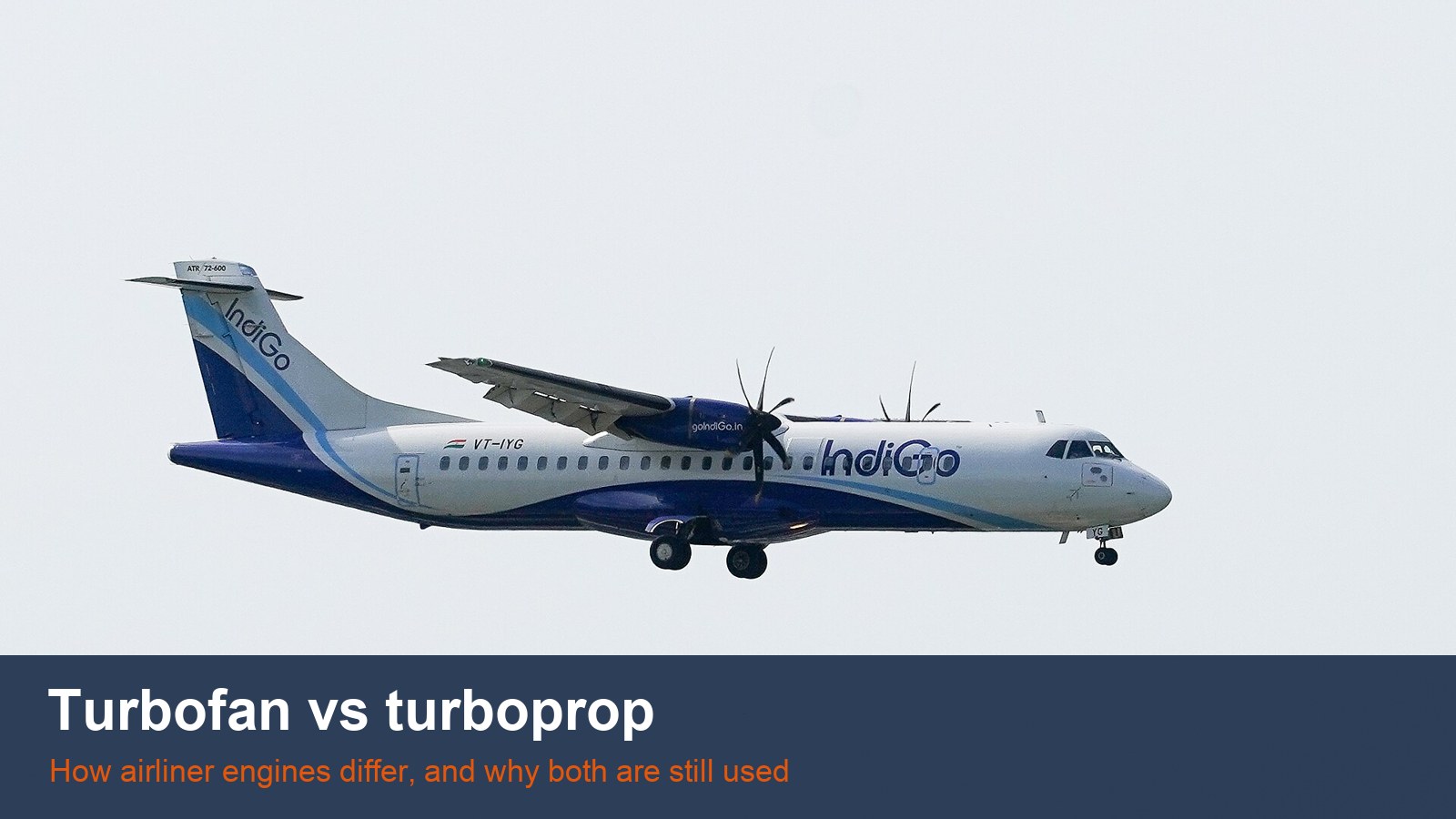
Most modern airliners use turbofan engines, found on jets such as the Airbus A320neo and Boeing 787, while many smaller regional and commuter aircraft, such as the ATR 72-600, use turboprops. Both use the same kind of gas turbine core. The difference is what that core drives: a big fan inside the engine, or a propeller outside it.
That one difference decides how fast and how far an aircraft can go, how much fuel it burns and which airports it can use. Here is how the two compare, using NASA’s engine guides and data from ATR and Embraer.
Turbofan vs Turboprop at a Glance
| Turbofan | Turboprop | |
|---|---|---|
| What the core drives | A large enclosed fan | A propeller, through a gearbox |
| Where the thrust comes from | Partly the fan (bypass air), partly the core exhaust | Mostly the propeller; exhaust adds little |
| Best at | High speeds | Low speeds and short sectors |
| Typical aircraft | Airbus A320neo, Boeing 787, Embraer E195-E2 | ATR 72-600, ATR 42-600, Dornier 228 |
| Example range | E195-E2: 3,000 nm | ATR 72-600: 740 nm |
| Example take-off distance | E195-E2: 1,775 m | ATR 72-600: 1,315 m |
Sources: NASA Glenn Research Center (turbofan, turboprop); ATR 72-600; Embraer E195-E2 specification sheet. Ranges with maximum passengers; take-off distances at maximum take-off weight.
How a Turbofan Works
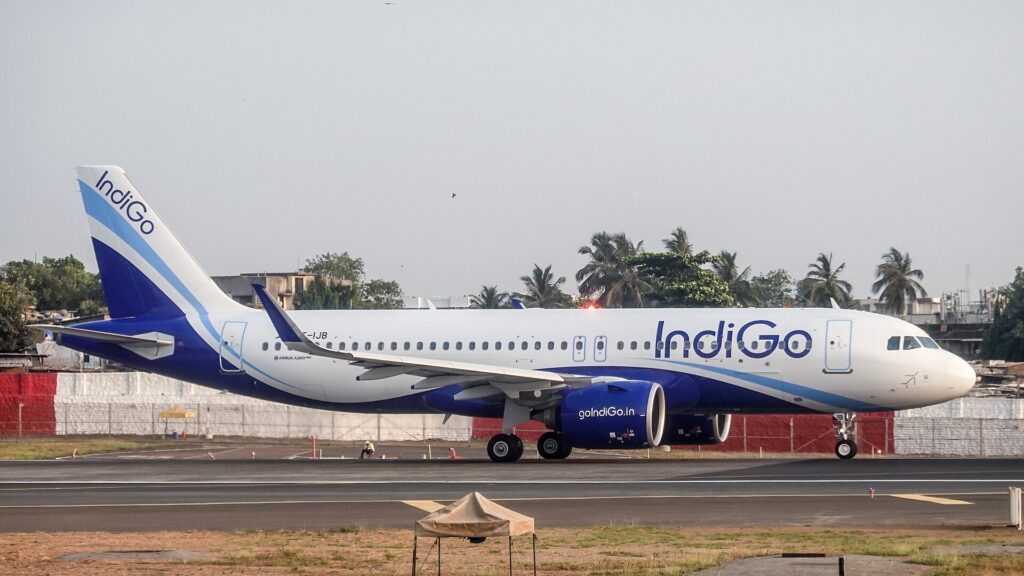
In a turbofan, the core engine (compressor, burner and turbine) is surrounded by a fan at the front and an extra turbine at the back that drives it, NASA explains. Some of the air entering the engine goes through the core, where it is mixed with fuel and burned. The rest passes through the fan and bypasses the core, much like air through a propeller.
So a turbofan gets some of its thrust from the core and some from the fan. The ratio of air going around the core to air going through it is the bypass ratio. Because adding the fan barely changes how much fuel the core burns, a turbofan makes more thrust for nearly the same fuel. NASA says high-bypass turbofans are nearly as fuel efficient as turboprops, and because the fan is enclosed and has many blades, it works efficiently at higher speeds than a simple propeller.
How a Turboprop Works
A turboprop uses the same kind of gas turbine core, but instead of pushing hot exhaust out of a nozzle for thrust, it uses most of the exhaust energy to turn a turbine. That turbine drives a shaft connected to a gearbox, and the gearbox turns the propeller, which produces most of the thrust, according to NASA. The exhaust leaves slowly and adds little thrust.
Propellers are very efficient because they move a large mass of air through a small change in speed. But they become less efficient as the aircraft flies faster, so turboprops are used on lower-speed aircraft. A close relative is the turboshaft, where the gearbox drives something other than a propeller, as in many helicopters.
Speed, Range and Runways
The engine choice shapes the whole aircraft. Compare a turboprop and a turbofan regional aircraft:
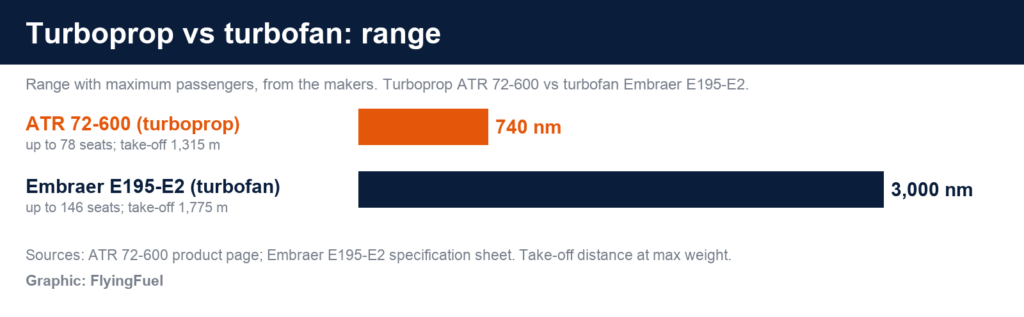
- ATR 72-600 (turboprop): up to 78 seats, a range of 740 nm (1,370 km) with maximum passengers, and a take-off distance of 1,315 m at maximum weight. ATR says it can use short, narrow and unpaved runways and steep approaches.
- Embraer E195-E2 (turbofan): up to 146 seats, a range of 3,000 nm (5,556 km) with a full passenger load, a maximum cruise speed of Mach 0.82 and a service ceiling of 41,000 ft. It needs 1,775 m of runway at maximum weight.
The jet flies about four times as far. The turboprop uses shorter runways and is built for short hops. For more on the E195-E2, see our A220-300 vs E195-E2 comparison, and for why jets cruise so high, read why planes fly at 35,000 feet.
Fuel Efficiency
On short routes, turboprops are hard to beat. ATR calls the ATR 72-600 “by far” the most fuel-efficient regional aircraft. NASA’s explanation is the reason: propellers are very efficient at low speeds. As speed and distance grow, the high-bypass turbofan wins, because it stays efficient at airliner cruise speeds where propellers do not.
Which Do Indian Airlines Use?
Both. IndiGo flies Airbus A320neo-family jets with turbofans as well as ATR turboprops; see IndiGo’s fleet. Among regional airlines in India, Alliance Air flies ATR 72-600s, ATR 42-600s and Dornier 228s, Fly91 flies only the ATR 72-600, and Star Air flies Embraer regional jets. For bigger turbofan jets, see our A320neo vs 737 MAX 8 comparison, or how twin-engine jets took over long-haul flying.
Frequently Asked Questions
What is the difference between a turbofan and a turboprop?
Both use a gas turbine core. A turbofan uses it to drive a large fan inside the engine casing, and much of the air bypasses the core. A turboprop uses it to turn a propeller through a gearbox, and the propeller produces most of the thrust.
Which is more fuel efficient, a turbofan or a turboprop?
At low speeds and on short flights, the turboprop. NASA notes that propellers are very efficient, but they lose efficiency as speed increases. High-bypass turbofans are nearly as fuel efficient as turboprops and work well at the higher speeds airliners fly.
Why do airlines still use turboprops?
For short regional routes. ATR says the ATR 72-600 is the most fuel-efficient regional aircraft and can use short, narrow and even unpaved runways, which suits small airports.
Is a turboprop a jet engine?
It is a gas turbine engine, like a jet engine, but its exhaust produces little thrust. Most of the energy turns the propeller, according to NASA.
What is bypass ratio?
The bypass ratio is the amount of air that goes around a turbofan’s core divided by the amount that goes through it. Higher bypass ratios mean more thrust for nearly the same fuel burned in the core.
Do Indian airlines fly turboprops?
Yes. IndiGo flies ATR turboprops alongside its Airbus jets, and regional airlines such as Alliance Air and Fly91 fly ATR 72-600s.
What is a turboshaft engine?
A variation of the turboprop in which the gearbox drives something other than a propeller. NASA notes that turboshafts are used in many helicopters.
Featured image: FlyingFuel graphic using a photo of IndiGo ATR 72-600 VT-IYG by Timothy A. Gonsalves, CC BY-SA 4.0, via Wikimedia Commons.
 GulfstreamGulfstream Business Jets: Every Model From the G300 to the G800 Explained (2026)
 NewsBombardier to Hire 800 in the US and Spend $270 Million on First Phase of Expansion
 NewsAll Passengers Flying to the US Must Sign an Ebola Travel Attestation From 3 November
 BombardierBombardier Business Jets: Every Global and Challenger Model Explained (2026)
 NewsSafran LEAP Engine Deliveries Rise 26% to 1,565 in First Nine Months of 2026
 NewsEmbraer Order Backlog Hits Record $35.7 Billion as E2 Jet Orders Grow