
Few building projects in Britain have been argued about for as long as a third runway at Heathrow. It was first proposed in 2009, backed by the government in 2025, and in autumn 2026 it is again in doubt, with a new Prime Minister refusing to say whether he supports it and Heathrow warning that the opening could slip to the late 2030s.
Quick answer (October 2026): the government has picked Heathrow’s own plan for a 3,500 m third runway north-west of the airport, costing about £33bn within a £49bn wider expansion. It would lift capacity from a cap of 480,000 flights to 756,000 a year and from about 85 million to 150 million passengers. A planning framework went out for consultation in 2026, but it still needs a vote in Parliament, followed by a planning application. The target opening date has moved from 2035 to “within a decade” of planning approval, which could mean 2039.
Here is the full story: the plan, the timeline, the cost, who pays, the climate debate, the politics, and what happens next. All facts come from BBC News reporting and the UK government, with dates so you can see how the picture has changed.
Heathrow Third Runway at a Glance
| Item | Details (October 2026) |
|---|---|
| Airport | London Heathrow, the UK’s busiest airport |
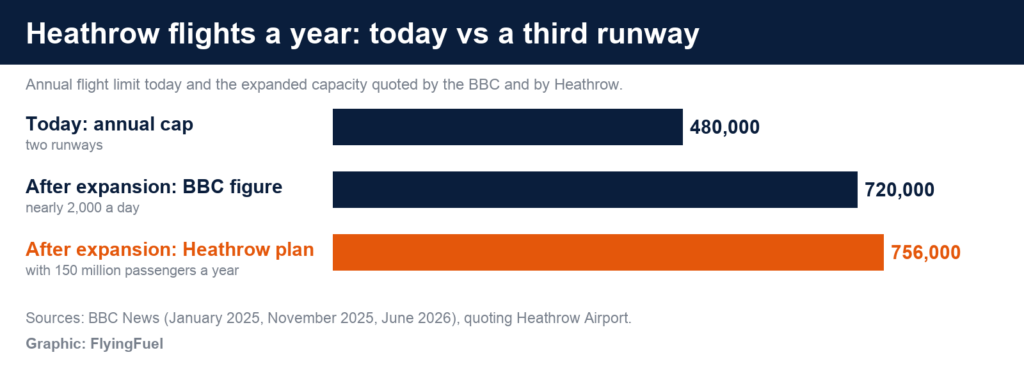
| Today | 2 runways, 4 passenger terminals, about 84 to 85 million passengers a year, cap of 480,000 flights |
| Chosen plan | Heathrow Airport Limited’s full-length north-west runway, up to 3,500 m |
| Runway cost | About £33bn, including about £1.5bn to move the M25; privately financed |
| Wider expansion | About £49bn, including a new T5X terminal, a bigger Terminal 2 and new satellite terminals |
| Capacity after | 756,000 flights and 150 million passengers a year (Heathrow figures) |
| M25 | Junctions 14 to 15 rerouted through a tunnel under the runway |
| Planned opening | Government target 2035; Heathrow now says within a decade of planning approval (around 2039) |
| Next step | Finalise the planning framework (HENPS), parliamentary vote, then a planning application |
Sources: BBC News, 25 November 2025, 18 June 2026 and 26 September 2026.
What Exactly Is Planned?
Heathrow published its expansion plans in summer 2025. According to the BBC, the whole project, expected to cost £49bn, includes:
- a new runway up to 3.5 km (2.2 miles) long to the north-west of the current airport;
- a new road tunnel taking the M25 motorway under the new runway between junctions 14 and 15;
- a new terminal, T5X, an expanded Terminal 2 and new satellite terminals;
- enough capacity for 756,000 flights and 150 million passengers a year, compared with about 84 million passengers today.
In June 2026 the BBC reported that the runway scheme itself is estimated at £33bn, including about £1.5bn to move the M25, and that it is expected to be fully privately financed. Heathrow’s owners say the cost would be met by charging airlines to use the larger airport. Building it would mean demolishing hundreds of homes and diverting rivers.
The rival plan that lost: Heathrow West
A second bid came from the Arora Group, led by hotel owner Surinder Arora. Its “Heathrow West” scheme proposed a shorter 2,800 m runway that would not require moving the M25, at a lower price of about £25bn, although the BBC noted that extra infrastructure would be needed. On 25 November 2025 the government chose Heathrow’s plan, with the Department for Transport saying it was the most deliverable option and the one most likely to get a planning decision within this Parliament. Other companies can still apply to build at the site.
Heathrow Third Runway Timeline
| Date | What happened |
|---|---|
| 2009 | Gordon Brown’s Labour government first proposes a third runway |
| June 2018 | The Airports National Policy Statement (ANPS), the planning basis for a new runway, is last updated |
| 2020 | The Supreme Court finally clears the way for the plan to go ahead |
| January 2025 | Chancellor Rachel Reeves backs a third runway, saying it is “badly needed” and aiming for planes to use it by 2035 |
| Summer 2025 | Heathrow publishes its £49bn expansion plan |
| October 2025 | Transport Secretary Heidi Alexander launches a review of the ANPS and narrows the bids to Heathrow and Arora |
| 25 November 2025 | The government chooses Heathrow’s full-length runway scheme |
| June 2026 | Draft Heathrow Expansion National Policy Statement (HENPS) published for consultation |
| 29 July 2026 | The CAA lets Heathrow recover up to £320m of early planning costs through airport charges |
| 16 September 2026 | The Climate Change Committee says expansion is not currently compatible with Net Zero without new rules |
| 26 September 2026 | Heathrow warns the runway could be delayed by up to four years |
| 27 September 2026 | Prime Minister Andy Burnham refuses to say whether he backs the runway |
| 5 October 2026 | The Conservatives pledge support for a third runway |
| 14 to 17 October 2026 | Heathrow’s boss warns against a “huge missed opportunity”; Chancellor John Healey says the case has “always been a case for growth” |
Sources: BBC News reports linked throughout this article.
When Will the Third Runway Open?
In January 2025, Rachel Reeves told the BBC she wanted “spades in the ground” in this Parliament and planes using the runway by 2035. At the time, the BBC said the formal planning process could take up to two years, followed by possible court challenges, and then six or seven years of construction.
On 26 September 2026, Heathrow said the 2035 deadline was increasingly difficult to meet without further steps to simplify planning. It now hopes to get planning permission by 2029 and then open the runway “within a decade”, which could mean a delay of up to four years, to around 2039. The Department for Transport said the timeline had “always been ambitious”. The BBC also reported that the parliamentary vote on the planning framework could be delayed until 2027.
How Much Will It Cost Passengers?
The runway is meant to be privately financed, but airlines pay Heathrow fees per passenger, and those fees end up in ticket prices. On 29 July 2026, the Civil Aviation Authority allowed Heathrow to recover up to £320m of early planning and design costs from 2025 and 2026. The CAA said this would raise the maximum airport charge by about 15p per passenger in 2028, rising to about 30p in later years. Arora Group can also recover £4.1m of its bid costs.
The CAA had already proposed capping Heathrow’s airline charges at between £27.20 and £30.50 per passenger for 2027 to 2031. How much the construction itself will add to fares will not be clear for some time.

The Climate Question
On 16 September 2026, the government’s independent advisers, the Climate Change Committee (CCC), said Heathrow expansion is “not currently compatible with the UK’s Net Zero target”. It said the runway could still go ahead, but only if the aviation industry pays for cleaner fuels and for machines that remove carbon dioxide from the air.
The CCC estimated that making the industry pay could add about £150 to a return trip to Alicante and about £400 to a return to New York by 2050, in today’s prices. Its advice cannot block the runway. Transport Secretary Heidi Alexander said the advisers had set out “one view” and that there was more than one way to meet climate obligations. Heathrow said expansion and climate goals were “not a choice” and that it would deliver both.
The Politics in 2026
- Prime Minister Andy Burnham opposed the project as Mayor of Greater Manchester and said he was “open-minded” on taking office. In September 2026 he refused to say whether he backs it, calling it “principally… a matter for London and Londoners”.
- Chancellor John Healey said in October 2026 that the case for a third runway has “always been a case for growth”, and that decisions would follow the review of consultation responses.
- The Conservatives pledged at their October 2026 conference to back the third runway and “sweep away the blockers”.
- London Mayor Sadiq Khan has long opposed expansion because of noise, air pollution and climate change.
- Unions Unite and the GMB back the runway, and the Department for Transport says it could deliver around £40bn of economic benefits and up to 60,000 local jobs.
Heathrow’s chief executive, Thomas Woldbye, told the BBC on 14 October 2026 that not building it would be a “huge missed opportunity”, warning that if the airport’s owners cannot invest in Heathrow, the private money will be invested elsewhere in the world. He suggested a decision would be made in the new year.
What Happens Next?
- Consultation review: the Department for Transport is reviewing responses to the draft HENPS consultation.
- Parliamentary vote: once finalised, the planning framework must be approved by MPs, possibly not until 2027.
- Planning application: Heathrow then applies for planning permission, with a decision hoped for by 2029.
- Legal challenges: any approval could face judicial review from opponents.
- Construction: if approved, Heathrow expects to open the runway within about ten years of permission.
Why Heathrow Matters for Travellers
Heathrow is the UK’s main long-haul hub and one of the world’s big connecting airports, with flights to North America, Asia, the Middle East and Africa. With flights capped at 480,000 a year, there is limited room for airlines to add new routes. Supporters say a third runway would bring more routes and competition; opponents say the costs, from climate to noise, are too high. For context on how Heathrow compares, see our list of the busiest airports in the world, and for other big airport projects see Noida International Airport and Navi Mumbai International Airport.
Key Takeaways
- The government chose Heathrow’s 3,500 m north-west runway plan in November 2025.
- The runway costs about £33bn within a £49bn expansion, and would move the M25 into a tunnel.
- Capacity would rise from a 480,000-flight cap to 756,000 flights and 150 million passengers a year.
- The opening target has slipped from 2035 to “within a decade” of a 2029 planning decision.
- Early costs add about 15p to 30p per passenger from 2028; climate advisers warn fares could rise more.
- In October 2026 the Prime Minister had not said whether he backs it, so the project is still uncertain.
Frequently Asked Questions
Is the Heathrow third runway going ahead?
Not yet. The government chose Heathrow’s own scheme in November 2025 and consulted on a planning framework in 2026, but Parliament still has to approve that framework, and Heathrow then has to apply for and win planning permission. In October 2026 Prime Minister Andy Burnham had not said whether he backs it.
When will the Heathrow third runway open?
The government had aimed for 2035. In September 2026 Heathrow said it hoped to get planning permission by 2029 and open the runway “within a decade”, which means it could be up to four years later, around 2039.
How much will the Heathrow third runway cost?
Heathrow’s runway scheme is estimated at £33bn, including about £1.5bn to move the M25, and is meant to be privately financed. It is part of a wider £49bn expansion that also includes new terminal capacity.
How long will the third runway be?
Heathrow’s chosen plan is a full-length runway of up to 3,500 m (about 2.2 miles). The rival Arora Group plan, which was not chosen, proposed a 2,800 m runway.
Will the M25 be moved for the third runway?
Yes, under Heathrow’s plan. The M25 between junctions 14 and 15 would be rerouted through a tunnel under the new runway.
How many more flights would a third runway allow?
Heathrow’s flights are capped at 480,000 a year today. Heathrow says expansion would allow 756,000 flights and 150 million passengers a year; the BBC has quoted up to 720,000 flights, or nearly 2,000 a day.
Will the third runway make flights more expensive?
In July 2026 the Civil Aviation Authority let Heathrow recover up to £320m of early planning costs, which it said would add about 15p per passenger in 2028, rising to about 30p later. The cost of building the runway itself will be decided later. The Climate Change Committee has also said that making airlines pay for cleaner flying could raise fares.
Why is the Heathrow third runway controversial?
Supporters say it would boost the economy and jobs. Opponents point to climate targets, noise, air pollution and the loss of homes: hundreds of homes would be demolished and rivers diverted. The Mayor of London, Sadiq Khan, opposes it.
Who owns Heathrow Airport?
A group of investors. The BBC says the largest is the French private equity firm Ardian; others include the Qatar Investment Authority, Saudi Arabia’s Public Investment Fund and the China Investment Corporation.
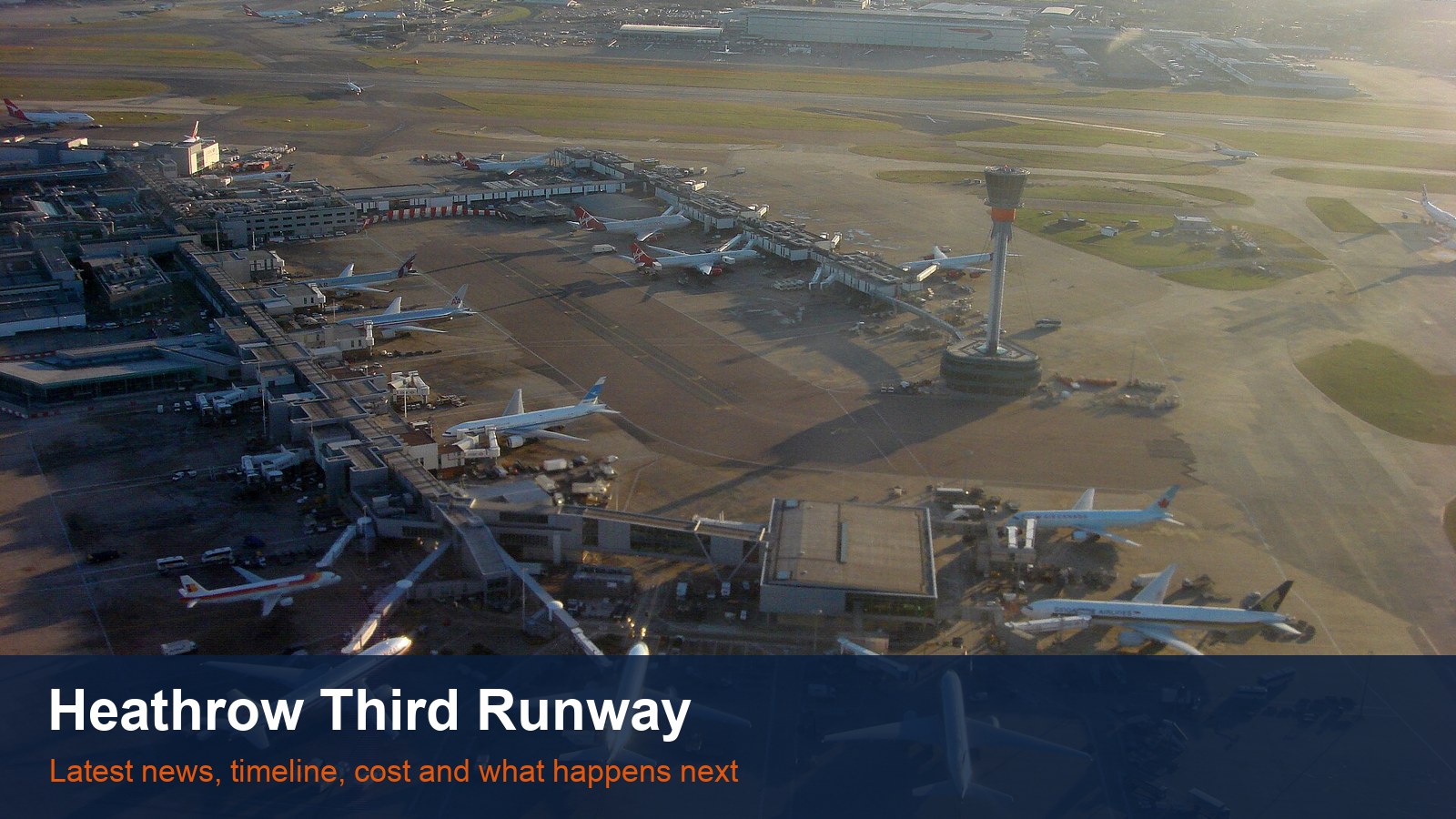
Featured image: FlyingFuel graphic using a photo of Heathrow Airport seen from the air by Panhard, CC BY 2.5, via Wikimedia Commons.
 GulfstreamGulfstream Business Jets: Every Model From the G300 to the G800 Explained (2026)
 NewsBombardier to Hire 800 in the US and Spend $270 Million on First Phase of Expansion
 NewsAll Passengers Flying to the US Must Sign an Ebola Travel Attestation From 3 November
 BombardierBombardier Business Jets: Every Global and Challenger Model Explained (2026)
 NewsSafran LEAP Engine Deliveries Rise 26% to 1,565 in First Nine Months of 2026
 NewsEmbraer Order Backlog Hits Record $35.7 Billion as E2 Jet Orders Grow