
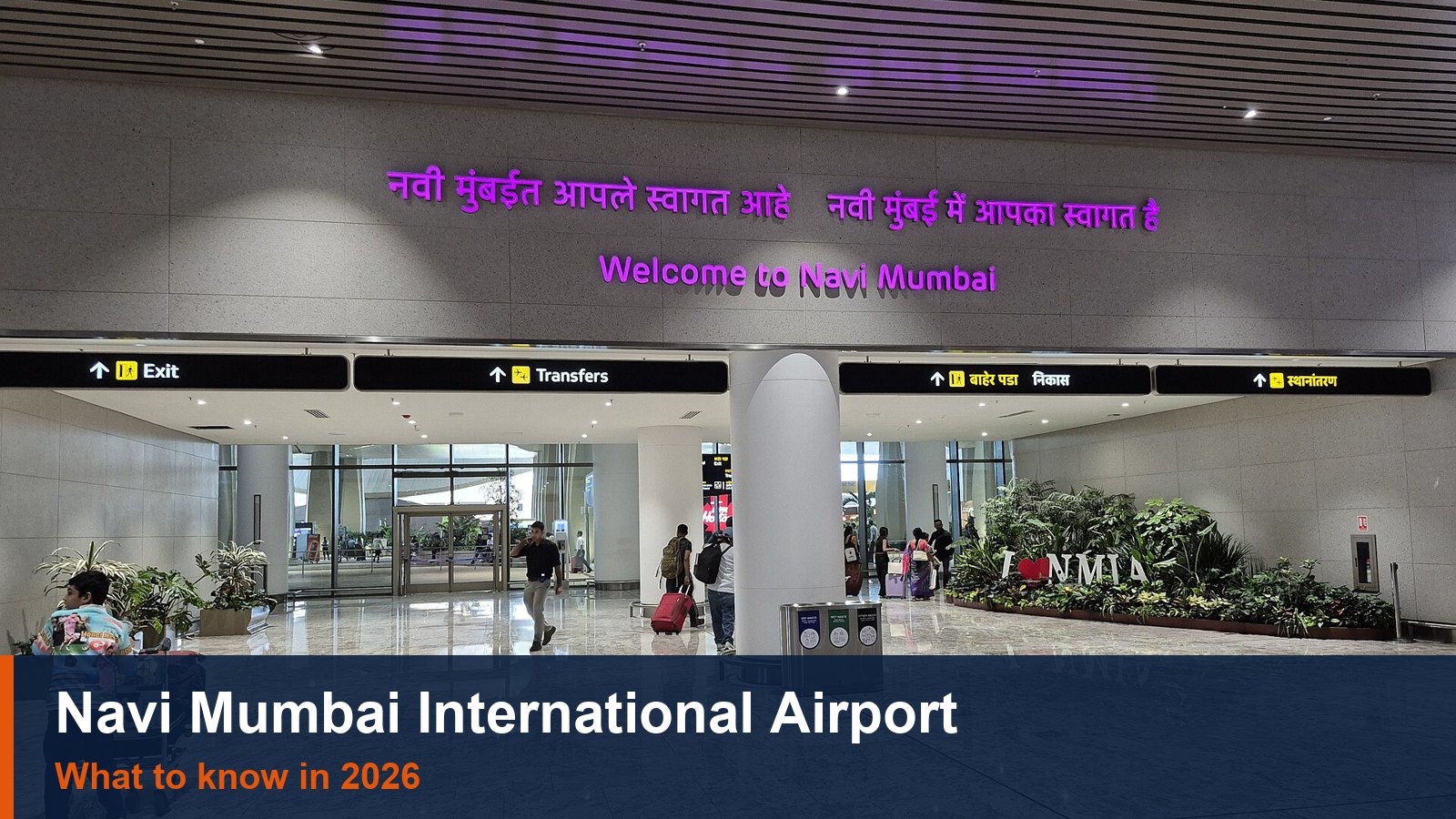
Navi Mumbai International Airport (NMIA, code NMI) is Mumbai’s second airport. It opened for commercial flights on 25 December 2025, started its first international route to Abu Dhabi on 15 July 2026, and has handled about 3 million passengers in its first eight months.
The airport sits in Ulwe in Raigad district, across the harbour from Mumbai city. It is run by Adani Airports, which also runs the older Chhatrapati Shivaji Maharaj International Airport (CSMIA). This guide covers what is open now, how big the airport will get, how to reach it, and what the plan to shift flights from the old airport means for you.
| Item | Details |
|---|---|
| Codes | IATA: NMI, ICAO: VANM |
| Location | Ulwe, Navi Mumbai, Raigad district, Maharashtra |
| Inaugurated | 8 October 2025 (phase 1) |
| First commercial flight | 25 December 2025, IndiGo 6E460 from Bengaluru |
| First international flight | 15 July 2026, Air India Express to and from Abu Dhabi |
| Terminals open | Terminal 1 only |
| Capacity now | 20 million passengers and 0.5 million tonnes of cargo a year |
| Capacity when complete | 90 million passengers and 3.2 million tonnes of cargo a year, four terminals, two parallel runways |
| Site area | 1,160 hectares |
| Phase 1 cost | About Rs 19,650 crore |
| Owner | NMIAL: MIAL (Adani Airports) 74%, CIDCO 26% |
| Architect | Zaha Hadid Architects (lotus-inspired terminal) |
Sources: Adani Group, India Today, The Indian Express.
Why Mumbai Needed a Second Airport
The old Mumbai airport is squeezed in by the city around it. Its two runways cross each other, and the BBC notes that safety and operating limits stop pilots using both at once. Arun Bansal, CEO of Adani Airport Holdings, told the BBC in September 2025 that the current airport “has hit its capacity of 55 million passengers annually” and that there was already demand for another 20 million.
Navi Mumbai was approved by the Union Cabinet back in 2007, but the project was held up for years. The Adani Group took it over in 2021, the full site was handed over in 2022 and test landings took place in 2024, according to the Adani Group. An analyst told the BBC that Mumbai is now the first large Indian city to run two airports.
Opening Day and the First Months
Prime Minister Narendra Modi inaugurated phase 1 on 8 October 2025, and paying passengers arrived on Christmas Day. According to The Indian Express, IndiGo 6E460 from Bengaluru landed at 8 am with a water cannon salute, and IndiGo 6E882 left for Hyderabad at 8:40 am. The airport had 48 flights to nine domestic cities that first day and handled more than 4,000 passengers.
It grew quickly. ACI Asia-Pacific reported that NMIA crossed 1 lakh (100,000) passengers in its first 19 days, with a busiest day of 7,345 passengers on 10 January 2026. By mid-July 2026, The Tribune reported that the airport connected 46 domestic destinations and handled around 150 flights a day.
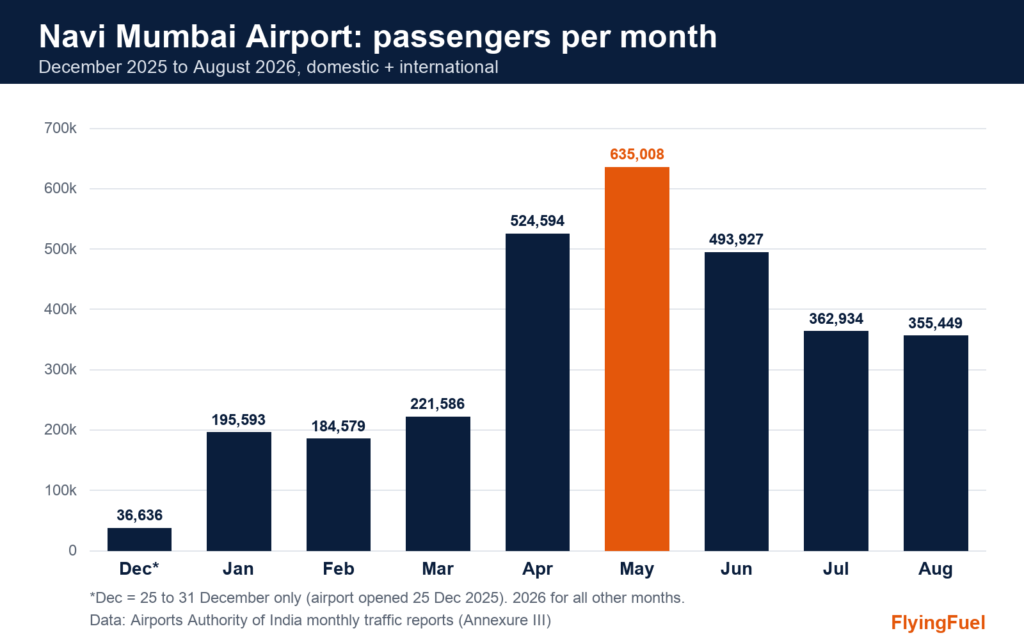
Monthly data from the Airports Authority of India shows traffic jumped from about 2 lakh passengers a month in early 2026 to a peak of 635,008 in May 2026. It then fell back to 355,449 in August. Adding up the AAI reports, the airport handled about 3.01 million passengers from opening to the end of August 2026.
For scale, the old Mumbai airport handled 4,050,443 passengers in August 2026 alone, according to AAI’s August 2026 report. Navi Mumbai is still a small airport compared with its older sibling.
Airlines and Flights
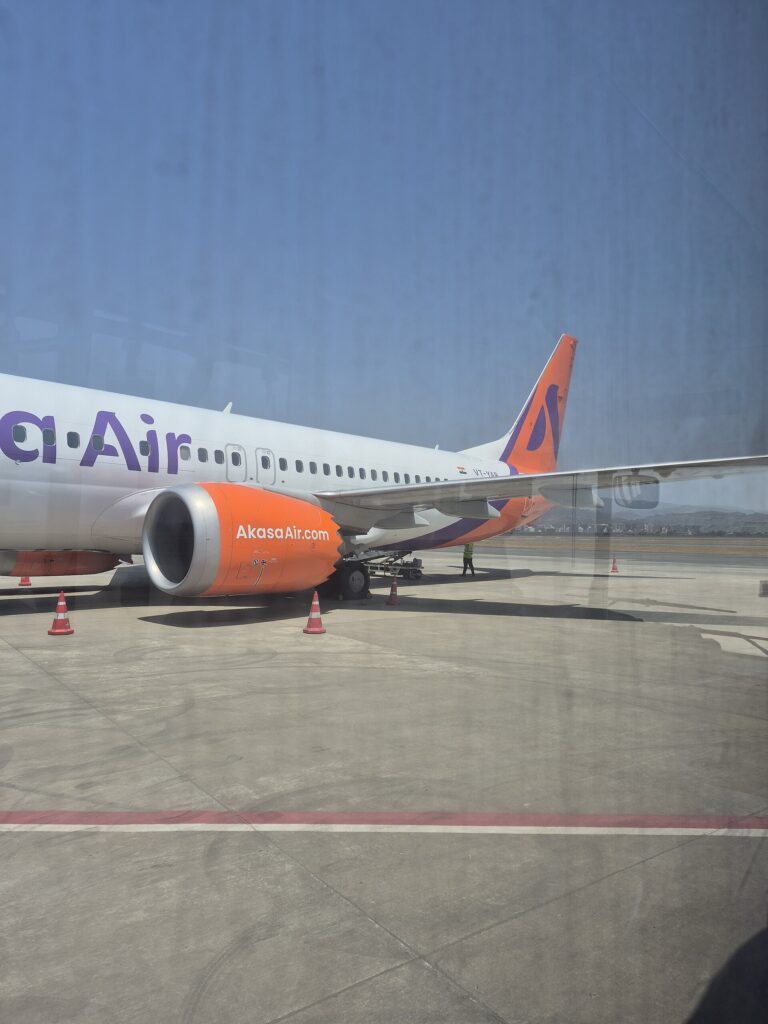
Three airlines launched the airport: IndiGo, Akasa Air and Air India Express. All three fly narrowbody jets such as the A320neo and 737 MAX, which suit the short domestic routes that make up most of the schedule.
International flights
NMIA began international flights on 15 July 2026, when Air India Express flight IX-208 arrived from Abu Dhabi. According to the Free Press Journal, the route started with two flights a week, on Wednesdays and Fridays, with a Sunday flight added from 29 July. The return flight, IX-207, leaves Navi Mumbai at 2:55 pm. The launch fare of Rs 12,671 was lower than the Rs 14,175 average fare on the same route from the old Mumbai airport.
That first flight also carried the airport’s first international export cargo, a shipment of perishable goods, The Tribune reported. In August 2026, AAI counted 2,554 international passengers at Navi Mumbai, a tiny share so far.
Flight lists change often, so check the airport’s official flight status page before you travel.
Inside the Terminal
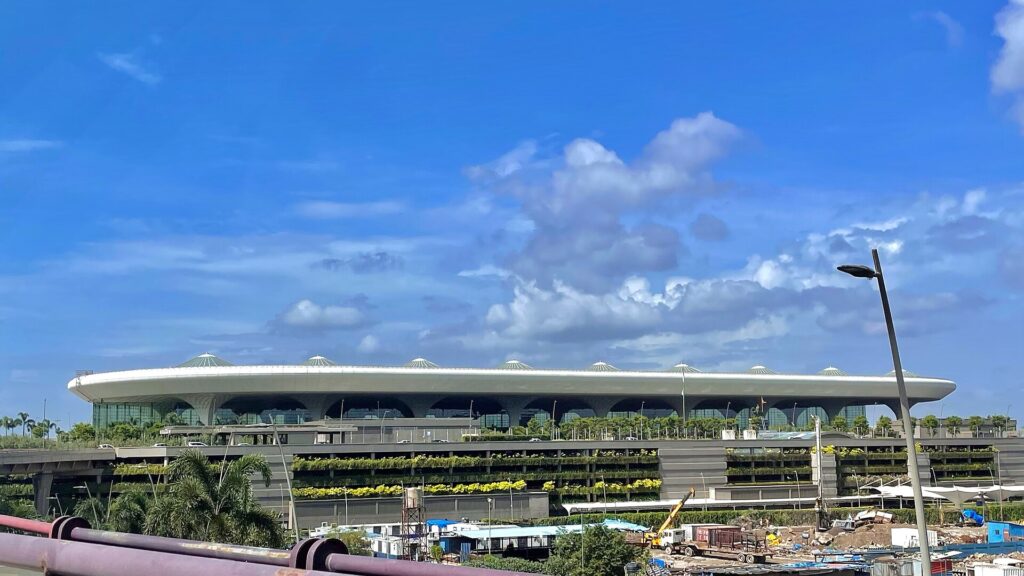
Terminal 1 was designed by London-based Zaha Hadid Architects. Its roof is inspired by the lotus, and the central atrium is meant to look like a lotus pond, with 12 feature columns and 17 mega columns holding up the roof, says the Adani Group. The terminal has about 110 shops and food outlets and 1,800 square metres of duty-free space.
The airfield is built for poor weather. According to NMIA officials told The Indian Express, NMIA uses a Category II instrument landing system that lets aircraft land when visibility is as low as 300 metres. The old Mumbai airport needs at least 550 metres, so monsoon rain and fog often force diversions there.
India Today reported plans for four terminals connected by an automated people mover, storage for sustainable aviation fuel, about 47 MW of solar power and a water taxi link to the city.
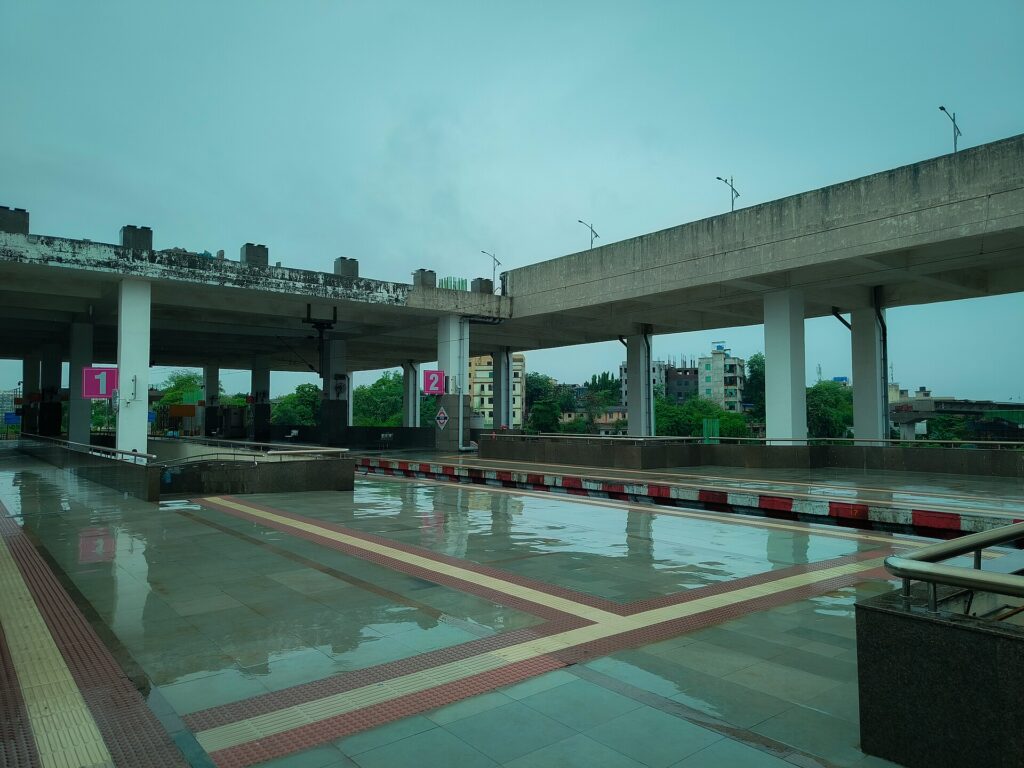
There is no metro line to the terminal yet, so road is the main way in. According to the airport’s winter transport update:
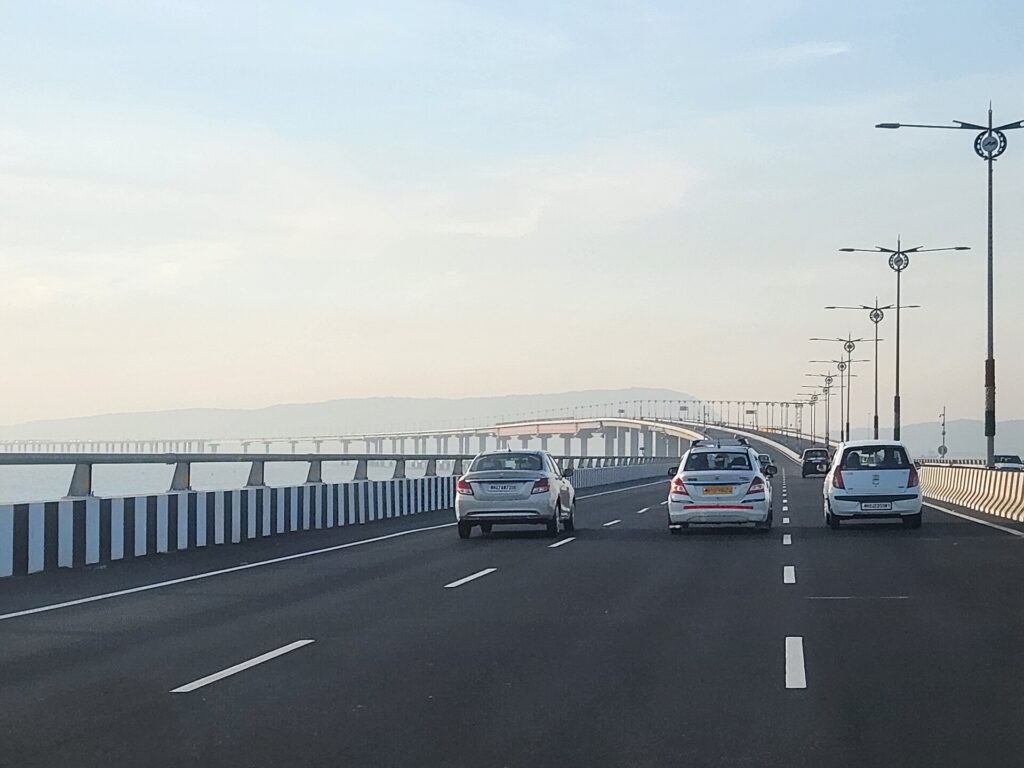
- From Mumbai city by road: the Atal Setu (Mumbai Trans Harbour Link) sea bridge is the fastest route. The BBC puts the airport about 40 km from Mumbai’s old commercial centre.
- MSRTC e-Shivai buses: electric buses from 7 October 2026 to Dadar East (Rs 170, via Sion and Atal Setu), Borivali (Rs 210, via CSMIA Terminal 1 and Bandra) and Pune (Rs 450, two a day).
- Chalo buses: 21 daily services to places such as Marol (Andheri East), Bandra, Dadar and the World Trade Centre in Colaba.
- NMMT buses: seven airport routes, A1 to A7, link Terminal 1 with Kharkopar, Targhar, Belapur, Nerul, Panvel and Khandeshwar stations.
- Taxis and cabs: prepaid taxis, Uber, autorickshaws and car rentals from the terminal.
Will Flights Move From the Old Mumbai Airport?
This is the biggest open question. The Adani Group wants to rebuild the ageing Terminal 1 at the old Mumbai airport, which means moving around five million domestic passengers a year into Terminal 2, where all international flights are handled today. To make room, it wants about a third of Mumbai’s international flights to move to Navi Mumbai.
According to Business Standard, the old airport’s operator asked airlines in early October 2026 to shift 265 of its 770 weekly international departures by 25 October. Airlines objected, and the Ministry of Civil Aviation asked the operator to hold off. On 13 October the operator told airlines it would not move any international flights before the end of the winter schedule in March 2027, and that any move would be agreed with the airlines.
For travellers, this means flights booked from the old Mumbai airport (BOM) for this winter stay there. Always check whether your ticket says BOM or NMI, because the two airports are far apart.
What Comes Next
Navi Mumbai is built in phases. Phase 1 can handle 20 million passengers a year. The full plan, with four terminals and two parallel runways, is for 90 million passengers and 3.2 million tonnes of cargo a year, the Adani Group says. That would make it bigger than the old Mumbai airport is today.
Big new airports often take years to fill up, as Tokyo Narita’s expansion shows. Watch for more international routes, any widebody long-haul flights, the metro link and the final decision on moving flights from the old airport.
Maharashtra also wants a new name. Chief Minister Devendra Fadnavis said in October 2025 that the Centre had approved naming it Loknete DB Patil Navi Mumbai International Airport, after a leader who fought for fair compensation for families affected by the project. The airport still uses the name Navi Mumbai International Airport on its website.
Frequently Asked Questions
Prime Minister Narendra Modi inaugurated phase 1 on 8 October 2025. Commercial flights started on 25 December 2025, when IndiGo flight 6E460 from Bengaluru landed at 8 am.
The IATA code is NMI and the ICAO code is VANM. The older Mumbai airport (Chhatrapati Shivaji Maharaj International Airport) keeps the code BOM.
Yes. International passenger flights began on 15 July 2026, when Air India Express started a direct service to Abu Dhabi. For now, most international flights from the Mumbai region still use Terminal 2 of the older Mumbai airport.
The launch airlines were IndiGo, Akasa Air and Air India Express. By July 2026 the airport connected 46 domestic destinations. Check the airport’s official flight status page for the current list.
It operates as Navi Mumbai International Airport (NMIA). Maharashtra wants it named Loknete DB Patil Navi Mumbai International Airport, after a local leader who fought for fair compensation for families affected by the project. In October 2025 Chief Minister Devendra Fadnavis said the Centre had approved the name.
It is about 40 km from Mumbai’s old commercial centre, according to the BBC. The fastest road route from the city is the Atal Setu sea bridge.
Navi Mumbai Municipal Transport (NMMT) runs seven airport bus routes, A1 to A7, linking Terminal 1 to Kharkopar, Targhar, Belapur, Nerul, Panvel and Khandeshwar stations. There is no direct metro link to the terminal yet.
No. Mumbai will run two airports side by side, both operated by the Adani Group. The operator wants to move about a third of Mumbai’s international flights to Navi Mumbai, but in October 2026 it told airlines that nothing would move before the end of March 2027.
Featured image: Suraj Digrase, CC0, via Wikimedia Commons.