
Summary
- From 3 November 2026, every passenger boarding a flight to the US from another country must sign a form saying they have not been in the Democratic Republic of the Congo (DRC) in the past 21 days
- The rule covers US citizens and green card holders, private jets and passengers only connecting through the US
- Airlines must check the forms before boarding and refuse travel to anyone without one; the order runs until 18 December unless the CDC changes it
WASHINGTON, United States, 22 October 2026 – The US Centers for Disease Control and Prevention (CDC) has ordered that every passenger boarding a flight to the United States from abroad must sign an attestation confirming they have not been in the Democratic Republic of the Congo during the 21 days before boarding. The order applies to flights departing at or after 11:59 p.m. Eastern Standard Time on 3 November 2026.
The order is dated 22 October and carries the name of Admiral Brian Christine, the Assistant Secretary for Health at the US Department of Health and Human Services. Reuters first reported the plan the same day, citing a CDC memo. The measure responds to an outbreak of Ebola disease caused by the Bundibugyo virus in the DRC.
Who has to sign
According to the CDC, the rule applies to all passengers on international flights into the US, including US citizens, US nationals and lawful permanent residents. It also covers general aviation and private aircraft, and passengers who are only connecting through a US airport to another country. Flights that pass over the US without landing are not covered, and nor are land border crossings or seaports.
- Paper or digital: the form can be signed on paper or electronically, and the CDC encourages airlines to build it into paperless check-in
- One form per person: a parent or other authorized adult can sign for a child under 18, and an authorized person can sign for someone unable to do so because of age or impairment
- What counts as being in the DRC: any physical presence, including changing planes at a DRC airport without leaving it; flying over the country does not count
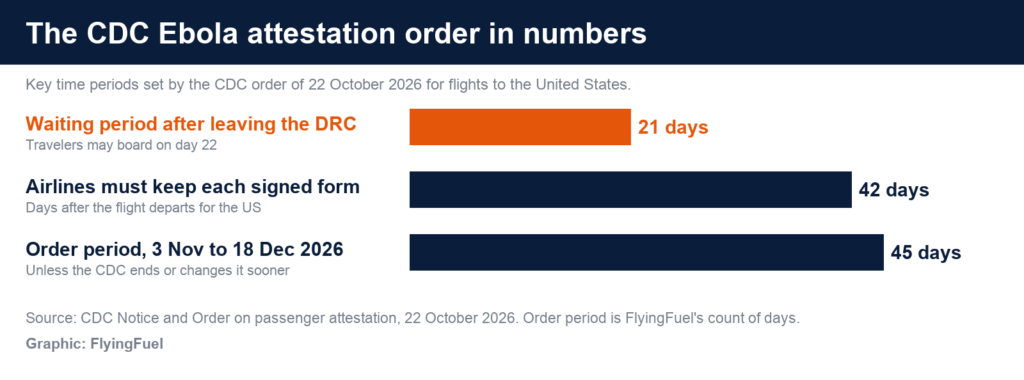
- The 21-day count: day 0 is the day a traveler leaves the DRC, and they may board a flight to the US from day 22
The form is in English only for now. The order says CDC-approved translations will be published online, and airlines that translate it themselves are responsible for the accuracy.
What airlines must do
The signed order requires airlines and other aircraft operators to review each passenger’s form before boarding, confirm to the US government at or before boarding that everyone on board has signed one, and refuse to carry anyone who has not. They must keep each form for at least 42 days and hand it over on request.
An operator that cannot give that confirmation will not receive controlled free pratique, the public health clearance that lets an arriving aircraft unload passengers at a US airport. The order lists criminal fines of up to US$200,000 for organizations and US$100,000 for individuals, and up to one year in prison, for breaking its requirements. Passengers who do not provide the form, or give false information, may face delays or be refused boarding, now or on future trips.
FlightGlobal reported on 25 October that US-bound flights will be required to make sure passengers have completed the attestation.

Why the CDC says it is needed
The order says the DRC reported 9,455 confirmed cases and 4,561 deaths in eight provinces as of 18 October 2026, with the outbreak centered on Ituri Province. It notes that the incubation period can last up to 21 days, so an infected person can travel before showing symptoms, and cites an imported case in Kenya involving a traveler who had flown from Kampala to Nairobi.
The attestation adds to earlier CDC measures. Reuters reported that the agency had already barred anyone who had been in the DRC in the previous 21 days, including US citizens, from boarding US-bound commercial flights. The new order runs until 18 December 2026 unless it is withdrawn or changed earlier, and the CDC says any extension will depend on case numbers and the spread of the outbreak at that time.
What it means for travelers
For most people flying to the US from the UK, Europe, Australia or India, the change is an extra declaration at check-in: the form asks about travel history, not health. Travelers on itineraries that connect in the US, as on many layovers between Asia or Australia and Latin America, will also need to complete it. Look out for the step in your airline’s app or at the airport, and remember the usual US entry checks still apply, from REAL ID for domestic flights to Global Entry on arrival.
Read more
- REAL ID for flying: what US travelers need to know
- TSA PreCheck vs Global Entry: which one do you need?
- Layover vs stopover: what is the difference?
- US flight cancellation and refund rules explained
Sources: CDC attestation order page; CDC Notice and Order and Attachment A (PDF), 22 October 2026; Reuters via Yahoo News, 22 October 2026; FlightGlobal, 25 October 2026.
Featured image: FlyingFuel graphic using a photo of the check-in concourse at London Heathrow Terminal 5 by chris.rycroft, CC BY 2.0, via Wikimedia Commons.
 GulfstreamGulfstream Business Jets: Every Model From the G300 to the G800 Explained (2026)
 NewsBombardier to Hire 800 in the US and Spend $270 Million on First Phase of Expansion
 BombardierBombardier Business Jets: Every Global and Challenger Model Explained (2026)
 NewsSafran LEAP Engine Deliveries Rise 26% to 1,565 in First Nine Months of 2026
 NewsEmbraer Order Backlog Hits Record $35.7 Billion as E2 Jet Orders Grow
 Airport DevelopmentGatwick Second Runway: Approved, Court Challenges Lost, What Happens Next (2026)