

You are booking a flight from India to Europe or the US, and the itinerary shows a 3-hour layover in Doha. Another option offers a two-day stopover in Abu Dhabi. Are these the same thing? Not quite. The difference matters for your ticket price, your baggage, your visa and how much of the connecting city you can see.
Quick answer: a layover is a short break between two flights, usually a few hours and less than 24 hours on an international trip, and you normally stay in the airport. A stopover is a longer, planned stay in the connecting city, usually more than 24 hours, so you can leave the airport, stay in a hotel and explore.
Below we explain the 24-hour rule, how each one affects your fare, bags and visa, and real stopover programmes from airlines that Indian travellers use, with their own rules. If you like the idea of an extra stop on the way, also read our guide to fifth freedom flights.
Layover vs Stopover at a Glance
| Layover | Stopover | |
|---|---|---|
| Typical length | A few hours; less than 24 hours on most international trips | More than 24 hours; often 1 to 7 nights |
| Where you spend it | Usually inside the airport | Outside the airport, in the city |
| Planned or not | Part of the route, not a choice | Usually chosen on purpose |
| Effect on fare | Normally included in the fare | Can change the fare, unless the airline offers free stopovers |
| Checked bags | Usually checked through to your destination | Often collected at the stopover city |
| Visa | Often not needed if you stay airside | Needed if the country requires one for your passport |
| Hotel | Not needed, unless it is an overnight layover | Needed |
What Is a Layover?
A layover is the time you wait between two flights on the same journey. You land at a connecting airport, walk to your next gate, and take the next flight. On a single ticket, both flights are booked together, so the airline plans the connection time and is responsible for getting you to your destination if the first flight is late.
Most layovers are between one and a few hours. Some are much longer, for example an overnight layover when the next flight leaves the following morning. As long as it stays under the airline’s limit, it still counts as a layover in the fare rules.

What Is a Stopover?
A stopover is a longer break in the connecting city, long enough to leave the airport and enjoy the place. Think of it as a mini-holiday on the way: two nights in Doha, Abu Dhabi or Lisbon before continuing to your destination. A stopover is usually something you choose when booking, not something the airline gives you by accident.
Because a stopover means you stay in a country for a while, it often changes how the ticket is priced and how your bags are handled, and you need to be allowed to enter that country.
The 24-Hour Rule (and the 4-Hour Rule)
There is no single law that defines these words, and travel sites sometimes use them differently. Even Wikipedia uses the terms the other way round from most airlines. What matters is how the fare rules count your break. According to Wikipedia, the maximum time for a normal connection depends on many variables, but:
- For most international itineraries (including any domestic flights on them), it is 24 hours.
- For most US and Canadian domestic itineraries, it is 4 hours.
So on a Delhi to London trip via Doha, a 10-hour wait in Doha is normally just a connection, a layover. A 30-hour or two-night stay in Doha is a stopover. That is also why many airline stopover packages start where a normal connection ends.
Related Words: Connection, Transit, Direct and Non-Stop
Airline words that sound alike can mean quite different things. Here is a simple glossary:
- Connection: changing from one flight to another on the way. The waiting time is the layover.
- Transit: passing through an airport on the way to somewhere else. “Transit passengers” are people who are connecting, not ending their trip there.
- Non-stop flight: one flight from departure to destination, with no landing in between.
- Direct flight: one flight number from start to finish, but the aircraft may land on the way. You might stay on board or wait in the terminal, then continue on the same flight. This is different from a connection, where you change flights.
- Self-transfer: connecting between two separate tickets that you booked yourself. The airlines do not protect this connection.
- Open jaw: a return trip where you fly into one city and back from a different one. It is a different idea from a stopover, though some fares allow both.
Example: the same trip, three ways
Imagine a trip from Mumbai to London on one airline through a Gulf hub:
- 2-hour layover: you land in the hub, walk to the next gate and fly on. Bags go straight to London. No visa is usually needed if you stay airside.
- 14-hour overnight layover: still a connection under 24 hours. You might rest in the airport, use a lounge, or, if your passport and the rules allow, book a hotel and see the city for an evening.
- Two-night stopover: you leave the airport, stay in a hotel and continue to London two days later. You need entry permission, and you may need to collect your bags, depending on how the trip is booked.
Why the Difference Matters
1. Your ticket price
Airline fares are built around the trip from A to B. A layover is part of that trip and is normally included. A stopover is an extra stay, so some fares do not allow it, while others charge more or price the trip as two separate journeys. The exception is airlines that use free stopovers as a way to attract passengers to their hub, which we cover below.
2. Your checked baggage
On a single ticket with a normal layover, your checked bags usually travel straight to your final destination, so you cannot open them during the connection. Qatar Airways Holidays says it plainly: you will not be able to collect your checked-in baggage for transits in Doha of less than 24 hours, so pack what you need in your carry-on bag.
3. Your visa
If you stay airside during a layover, many countries do not ask for a visa, but this depends on your passport and the country. If you want to leave the airport, even for a few hours, or take a stopover, you need permission to enter that country. Qatar Airways’ own stopover page says a valid visa may be required. Always check the official rules for your passport before booking.
4. Your risk if something goes wrong
On one ticket, the airline is responsible for the connection. If you book two separate tickets and build your own “layover”, a delay on the first flight can make you miss the second, and the second airline does not have to help. That is a self-transfer, not a protected layover.
Real Stopover Programmes You Can Use
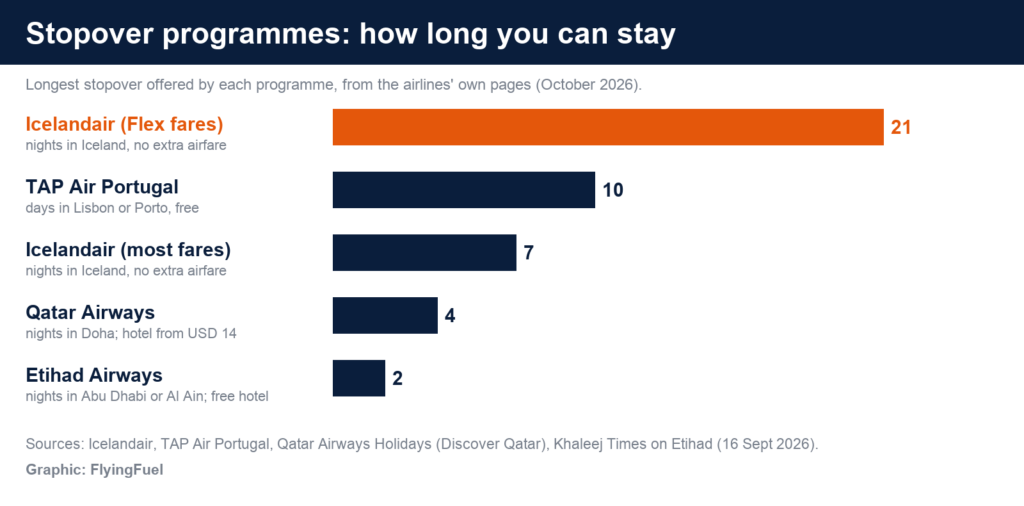
Several airlines with big connecting hubs offer special deals to make you stop in their home city. Here are four examples, with their terms as published in October 2026.
Qatar Airways: Doha
Through Discover Qatar, Qatar Airways passengers can buy stopover hotel packages in Doha for up to four nights. The Standard package with a 4-star hotel starts from USD 14 for one night and USD 76 for four nights; 5-star and luxury packages cost more. Prices are per person based on two people sharing a room. The offer needs a confirmed Qatar Airways ticket with a transit of at least 12 hours in Doha.
Etihad Airways: Abu Dhabi and Al Ain
Etihad’s Abu Dhabi Stopover programme, launched in 2024, gives eligible passengers a free one or two-night hotel stay while connecting through Abu Dhabi. Khaleej Times reported on 16 September 2026 that the offer now also covers hotels in the Al Ain region, with free shuttle transfers between Zayed International Airport and Al Ain. The boarding pass also works as a Stopover Pass with discounts on attractions and dining.
Icelandair: Iceland
On transatlantic trips, Icelandair lets you add a stopover in Iceland at no additional airfare. Most fares allow up to 7 nights, and Flex fares (Economy Flex or Saga Premium Flex) allow up to 21 nights. Icelandair notes that the total price can still change when you add a stopover, because fares vary with demand on the dates you pick.

TAP Air Portugal: Lisbon and Porto
TAP Air Portugal offers a free stopover of up to 10 days in Lisbon or Porto, on the outbound or return journey, on one-way, return or multi-city tickets. TAP adds a 25% discount code for a TAP flight within Portugal during the stopover, and offers from more than 150 partner businesses.
For Indian travellers, the Gulf programmes are the easiest to use, because Qatar Airways and Etihad fly from many Indian cities to Europe, North America and Africa through Doha and Abu Dhabi. Icelandair and TAP are useful when flying between Europe and North America.
How to Book a Stopover
- Use the airline’s own website. Most stopover offers appear in the airline’s booking engine (TAP shows an “Add a free Stopover” window on eligible flights) or on its holidays site.
- Try “multi-city” search. If there is no stopover button, book a multi-city trip: for example Delhi to Doha, then Doha to London two days later, on the same airline.
- Compare the total price. Check the price with and without the stopover; the difference can be small or zero.
- Check the visa first. Make sure you can enter the stopover country on your passport.
- Plan your bags. Ask whether your bags will be checked through or need to be collected, and pack a small overnight bag.
Tips for a Long Layover
- Check whether your airline offers a hotel or lounge for long connections, or whether your layover qualifies for a stopover package.
- Stay airside if you do not have a visa, and know where your next gate is before relaxing.
- Keep chargers, medicines and a change of clothes in your cabin bag.
- If you leave the airport, come back with plenty of time for security and immigration.
- Check the next flight’s gate and time again; they can change.
Long connections are common on the longest routes. See our lists of the longest flights from India and the longest flights in the world. If your two flights are on different partner airlines, our guides to codeshare flights and airline alliances explain how that works.
Key Takeaways
- A layover is a short connection, usually under 24 hours on international trips (4 hours on most US and Canadian domestic trips).
- A stopover is a longer, planned stay, usually more than 24 hours, so you can leave the airport and explore.
- Stopovers can change your fare, your baggage handling and your visa needs.
- Some airlines offer free or cheap stopovers: Icelandair, TAP, Etihad and Qatar Airways are examples.
- Always check visa rules and baggage handling before planning time outside the airport.
Frequently Asked Questions
What is the difference between a layover and a stopover?
A layover is a short break between two flights on the same journey, usually a few hours, and you normally stay in the airport. A stopover is a longer, planned stay in the connecting city, usually more than 24 hours on an international trip, so you can leave the airport and visit.
How long is a layover?
On most international tickets, a connection of up to 24 hours is treated as a layover (a connection). On most US and Canadian domestic tickets, the limit is usually 4 hours. Longer breaks are generally counted as stopovers.
Is a stopover more expensive than a layover?
It can be, because a stopover changes the fare rules. But some airlines offer stopovers with no extra airfare: Icelandair (up to 7 nights on most fares, 21 on Flex fares) and TAP Air Portugal (up to 10 days in Lisbon or Porto). Total prices can still differ because fares change with demand and dates.
Can I leave the airport during a layover?
Often yes, if you have enough time and are allowed to enter that country. You may need a visa, even for a few hours outside the airport. Always check the official visa rules of the transit country before you go.
Do I need a visa for a stopover?
If you leave the airport, you usually need whatever entry permission that country requires for your passport. Qatar Airways, for example, says on its stopover page that a valid visa may be required to enter Qatar.
What happens to my checked bags during a layover?
On a single ticket, bags are usually checked through to your final destination on a short layover. That is why you should pack what you need in your cabin bag. Qatar Airways warns that you cannot collect checked bags for transits in Doha of less than 24 hours.
Which airlines offer free or cheap stopovers?
Examples in October 2026: Icelandair (no extra airfare, up to 7 nights, or 21 on Flex fares), TAP Air Portugal (free, up to 10 days), Etihad (free one or two hotel nights in Abu Dhabi or Al Ain) and Qatar Airways (hotel packages from USD 14 for one night in Doha).
Is a layover the same as a connecting flight?
Almost. A connecting flight means you change planes on the way. The layover is the waiting time between those two flights.
What is a long layover?
There is no official definition, but travellers usually mean a connection of many hours, often overnight, but still under 24 hours. Some airlines, such as Qatar Airways with its 12-hour minimum, let you turn a long layover into a short stopover package.
Featured image: FlyingFuel graphic using a photo of the central hall of Hamad International Airport in Doha by DimiTalen, CC0, via Wikimedia Commons.
 Embraer Executive JetsEmbraer Business Jets: Phenom 100EX, Phenom 300EV, Praetor 500E and 600E Explained (2026)
 NewseasyJet to Fit Starlink Wi-Fi Across Its Airbus Fleet From 2027
 NewsFAA Proposes Fan Blade Checks on Every CFM56-7B Engine After 737 Blade Failure
 Dassault FalconDassault Falcon Jets: Every Model From the 2000LXS to the 10X Explained (2026)
 GulfstreamGulfstream Business Jets: Every Model From the G300 to the G800 Explained (2026)
 NewsBombardier to Hire 800 in the US and Spend $270 Million on First Phase of Expansion