
Your flight is about to land in Delhi on a foggy winter morning, and the captain announces: “Ladies and gentlemen, we are diverting to Jaipur.” Why does this happen, who decides, and what happens next? This guide explains flight diversions in simple words.
Quick answer: a flight diversion is when an aircraft lands at a different airport from its planned destination. SKYbrary lists the main reasons: bad weather, a closed or unsafe destination airport, an emergency on board (technical, medical, fuel, unruly passenger or security), and airspace or clearance problems. The captain decides, and the flight carries extra fuel so that it can always reach an alternate airport.
Diversions are closely linked to fuel planning, alternate airports and long-range rules like ETOPS. We cover all of that below, with real examples from India and abroad.
What Is a Flight Diversion?
The US FAA defines a diversion, in its air traffic control order JO 7110.65 quoted by SKYbrary, as flights that are required to land at other than their original destination for reasons beyond the control of the pilot or company. In everyday use, any landing away from the planned destination is called a diversion.
The three types of diversion
SKYbrary divides diversions into three broad groups:
| Type | What happens | Typical example |
|---|---|---|
| Air turnback | The aircraft returns to the airport it took off from | An engine or system problem soon after take-off |
| En-route diversion | The aircraft lands at another airport before reaching the destination area | A seriously ill passenger over the ocean or desert |
| Destination diversion | The aircraft reaches the destination area but goes to an alternate | Fog or a thunderstorm over the destination airport |
Why Do Flights Divert? The Main Reasons
1. Weather
Weather is one of the most common reasons. It can be fog or low cloud below the landing limits, thunderstorms over the airport or on the way, very strong crosswinds, or heavy rain that floods the runway. Sometimes the weather on the way forces such a long detour that the remaining fuel is no longer enough to reach the destination safely.
2. Problems at the destination airport
The destination may be closed for runway works, an accident with another aircraft, a security incident, or simply because the flight would arrive outside the airport’s opening hours.
3. Emergencies on board
- Technical problems: an engine, electrical, pressurisation or hydraulic failure.
- Medical emergencies: a passenger or crew member who needs a hospital quickly.
- Fuel: not enough fuel to continue safely, for example after long holding.
- Unruly passengers: someone who becomes a danger to others.
- Security: a bomb threat or hijack.
4. Airspace and clearance problems
An aircraft may not be allowed to land at its destination, or airspace on the way may be closed. If going around closed airspace makes the route too long for the fuel on board, the flight must stop somewhere to refuel. In rare cases, military interception forces a landing.
Who Decides to Divert?
Except for some security situations such as a hijack or interception, the decision is made by the pilot in command, the captain, says SKYbrary. Before deciding, the captain usually collects information from the airline’s operations centre and from air traffic control. Controllers can help with:
- current and forecast weather at the alternates and other airports;
- other suitable airports that were not in the flight plan;
- headings or direct routes to the new airport;
- runway length, available approaches and other airport information;
- coordinating with other control centres and the new airport, including entry and landing permissions.
In most cases, the aircraft goes to one of the alternate airports listed in its flight plan. If those are unsuitable or out of reach, the crew can choose another airport.
Alternate Airports and Diversion Fuel
Diversions are planned for long before take-off. When an airline plans a flight, it chooses one or more alternate airports near the destination and loads enough fuel to reach them. This is why an aircraft does not simply run out of options when the destination closes.
The SKYbrary fuel definitions explain the main parts of the fuel load:
| Fuel part | What it is for |
|---|---|
| Trip fuel | Flying from departure to destination |
| Contingency fuel | Extra for winds, route changes or delays; ICAO Annex 6 recommends at least the greater of 5% of trip fuel or 5 minutes of holding |
| Alternate fuel | From a missed approach at the destination to landing at the alternate airport |
| Final reserve fuel | About 30 minutes of holding at 1,500 ft above the alternate (some authorities require 45 minutes) |
| Additional and extra fuel | Special needs such as ETOPS or a remote island destination, plus any fuel the captain decides to add |
SKYbrary calls alternate fuel plus final reserve fuel the minimum diversion fuel. In simple words: the aircraft always aims to keep enough fuel to try the destination, give up, fly to the alternate and still have half an hour to spare.
What Makes a Good Diversion Airport?
Not every airport on the map is a good place to divert. When choosing, the crew and the airline look at several things:
- Runway length and strength: the runway must be long enough for the aircraft at its landing weight, and strong enough for its size. A small regional runway may be fine for an ATR but not for a Boeing 777.
- Weather: the alternate must have weather good enough to land, now and at the expected arrival time.
- Approach aids: instrument approaches such as ILS make landing possible in poor visibility.
- Opening hours and services: the airport must be open, with fire and rescue cover suitable for the aircraft size.
- Fuel and ground handling: fuel, steps or air bridges and staff to look after the aircraft and passengers.
- Medical facilities: for a medical diversion, a city with a good hospital nearby matters more than anything else.
- Immigration and customs: international flights are easier to handle at airports with border control, especially if passengers need to leave the aircraft.
This is why diversions often go to large airports even when a smaller one is closer, and why airlines prefer certain alternates for each route.
Diversions on long flights over oceans and deserts
On long routes over oceans, polar regions or deserts, suitable airports can be far apart. Twin-engine airliners on such routes fly under ETOPS rules, which keep them within a set flying time of a suitable diversion airport in case an engine fails. The flight plan lists these en-route alternates, and the crew keep track of them during the whole flight. This is also why some of the longest flights in the world follow routes that are not a straight line on the map.
Delhi Fog: India’s Most Familiar Diversions
For Indian travellers, the best-known diversions happen in winter, when dense fog settles over North India. When visibility at Delhi drops below what a flight’s crew and aircraft are approved to land in, incoming flights hold or divert. Jaipur is the usual choice, because it is close and usually clear.
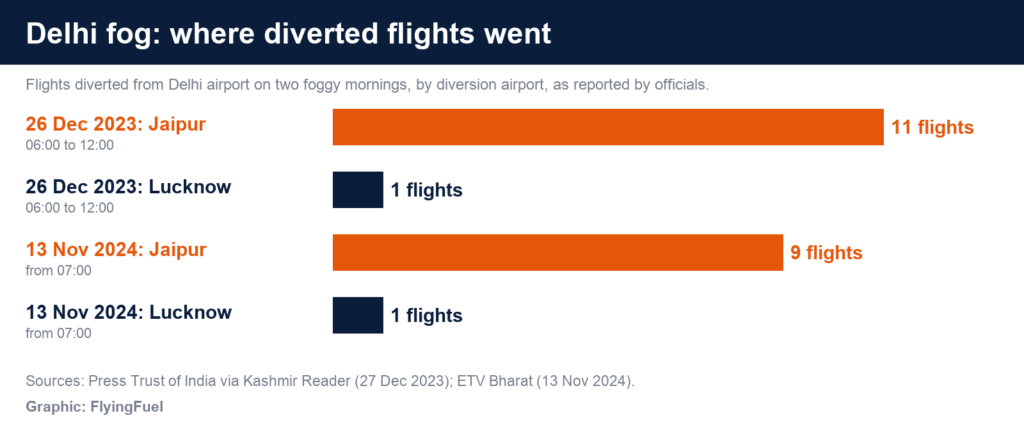
- On 26 December 2023, PTI reported that 12 flights were diverted from Delhi between 06:00 and 12:00: 11 to Jaipur and 1 to Lucknow, because of dense fog.
- On 13 November 2024, ETV Bharat reported that ten flights were diverted as low visibility hit operations: nine to Jaipur and one to Lucknow.
Delhi is India’s largest airport, so even a few hours of fog affect a large number of passengers across the country.
Diversion Examples From Around the World
The SKYbrary diversion page lists many investigated cases. A few show how different the reasons can be:
- Milan, July 2023 (en-route diversion): a Boeing 767-300 climbing out of Milan Malpensa flew into severe hail and was damaged. The crew diverted to Rome Fiumicino.
- Milan, July 2024 (air turnback): a Boeing 777-300 suffered a serious tail strike on take-off after its take-off weight was entered 100 tonnes too low. The crew declared PAN, dumped fuel and returned to Malpensa.
- Prague, September 2023 (air turnback): a Boeing 767-300 lost its right engine just after take-off when a turbine blade broke. The crew declared an emergency and returned to land.
- New Orleans, December 2023 (air turnback): a Boeing 737 MAX 8 hit a bird just after take-off; the engine fire warning came on and smoke filled the cockpit. The crew handled the emergency, and the smoke cleared.
Notice the fuel dumping in the Milan 777 case. Aircraft that take off heavy may be above their maximum landing weight, so they burn or dump fuel before landing soon after take-off. Our guide to MTOW and aircraft weights explains why.
What Happens After a Diversion?
What happens next depends on the reason for the diversion:
- Weather diversions: often the aircraft refuels at the alternate and waits for the weather at the destination to improve, then flies on. This can take from less than an hour to several hours.
- Medical diversions: the sick passenger is taken to hospital, and the flight usually continues once it is refuelled and cleared.
- Technical diversions: engineers must inspect and fix the aircraft. If it cannot fly soon, the airline may send another aircraft or rebook passengers.
- Crew duty limits: pilots and cabin crew can only work a limited number of hours. A long wait can mean the crew must rest, and a new crew or an overnight stay is needed.
Tips for passengers on a diverted flight
- Stay calm and listen to the crew; a diversion is a safety decision.
- Do not leave the aircraft or the gate area unless told to; the flight may continue quickly.
- Keep medicines, chargers and essentials in your cabin bag.
- Check the airline’s app and messages for updates on the new departure time or rebooking.
- If you have a connecting flight, tell the airline staff early so they can rebook you.
Key Takeaways
- A diversion is a landing at an airport other than the planned destination.
- The three types are air turnbacks, en-route diversions and destination diversions.
- Common reasons are weather, a closed destination, medical or technical emergencies, security and airspace problems.
- The captain decides, with help from the airline and air traffic control.
- Flights carry alternate fuel plus a 30-minute final reserve so that they can always reach an alternate airport.
- In North India, winter fog sends many Delhi flights to Jaipur.
Frequently Asked Questions
What does it mean when a flight is diverted?
It means the aircraft lands at a different airport from the one it was planned to land at. It may be an airport on the way, an alternate airport near the destination, or the airport it took off from.
Why do flights get diverted?
The most common reasons are bad weather at the destination (fog, thunderstorms, strong crosswinds, flooded runways), a medical emergency on board, a technical problem, an unruly passenger or security threat, the destination airport being closed, and airspace restrictions.
Who decides to divert a flight?
The captain (pilot in command), except in some security situations such as a hijack or a military interception. The captain usually gathers information from the airline and air traffic control before deciding.
Does a plane always have enough fuel to divert?
Flights are planned with extra fuel for this. Under ICAO-based rules, an aircraft that needs an alternate carries fuel to fly to that alternate and then hold for 30 minutes at 1,500 ft above it. Some authorities require 45 minutes.
What is an alternate airport?
An airport named in the flight plan where the aircraft can land if it cannot land at the destination. Most diversions go to one of these, but pilots can choose another suitable airport if needed.
Where do Delhi flights divert in fog?
Mostly to Jaipur, and sometimes to Lucknow. On 26 December 2023, officials said 11 flights were diverted to Jaipur and 1 to Lucknow; on 13 November 2024, 9 went to Jaipur and 1 to Lucknow.
What is an air turnback?
A diversion where the aircraft returns to the airport it took off from, for example after a technical problem soon after take-off.
What happens to passengers after a diversion?
It depends on the reason. Often the aircraft waits for the weather to improve, refuels and continues. If the crew run out of duty time or the aircraft needs repairs, the airline may arrange another aircraft, a new crew, a hotel or other transport. Stay on board or near the gate unless the crew tells you otherwise.
Is a diversion dangerous?
Usually not. A diversion is a safety decision: it means the crew chose to land somewhere safer or better equipped instead of continuing. Most diversions are for weather or a sick passenger, not an emergency with the aircraft.
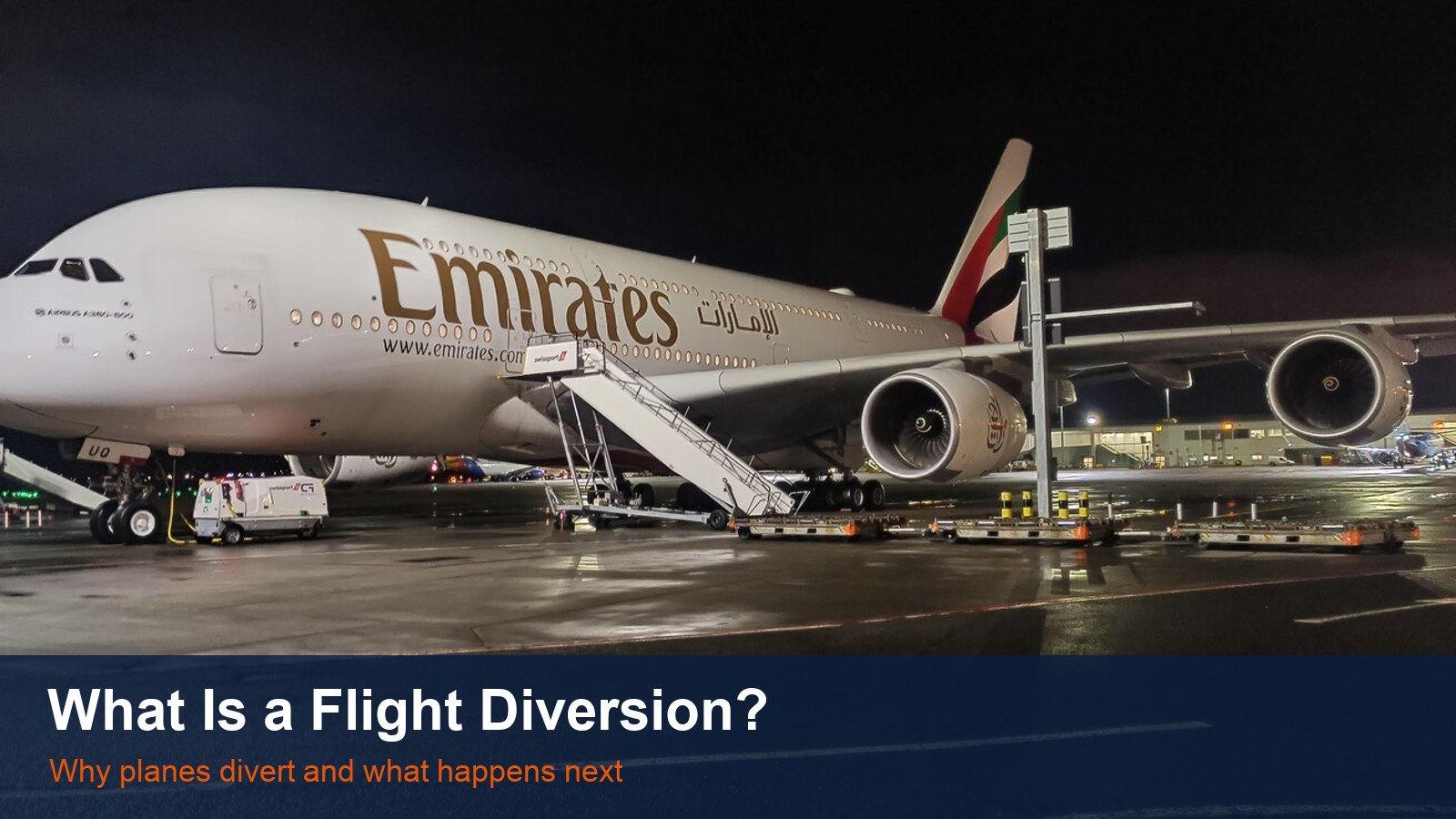
Featured image: FlyingFuel graphic using a photo of a diverted Emirates Airbus A380 at Glasgow Airport by Thomas Nugent, CC BY-SA 2.0, via Wikimedia Commons.
 GulfstreamGulfstream Business Jets: Every Model From the G300 to the G800 Explained (2026)
 NewsBombardier to Hire 800 in the US and Spend $270 Million on First Phase of Expansion
 NewsAll Passengers Flying to the US Must Sign an Ebola Travel Attestation From 3 November
 BombardierBombardier Business Jets: Every Global and Challenger Model Explained (2026)
 NewsSafran LEAP Engine Deliveries Rise 26% to 1,565 in First Nine Months of 2026
 NewsEmbraer Order Backlog Hits Record $35.7 Billion as E2 Jet Orders Grow