
Scheduled flights between Sydney and London have always made at least one stop. That is about to change. Under Project Sunrise, Qantas plans to fly non-stop from Sydney to London from October 2027 and from Sydney to New York from mid-2028, using a specially modified Airbus A350. These will be the longest scheduled passenger flights in history.
Quick answer: according to Wikipedia, Qantas has ordered 12 Airbus A350-1000ULR aircraft with an extra fuel tank that allows flights of up to 22 hours. They will have just 238 seats in four classes and a “Wellbeing Zone” for stretching. Sydney to London flights are planned to start daily in October 2027, with tickets going on sale in February 2027. Sydney to New York follows in mid-2028.
Here is everything you need to know: the routes and launch dates, the aircraft, the cabins, the science of fighting jetlag, the record-breaking test flight, the delays, and the criticism. For today’s record holders, see our list of the longest flights in the world.
Project Sunrise at a Glance
| Item | Details (October 2026) |
|---|---|
| Airline | Qantas |
| First route | Sydney to London, daily from October 2027; tickets on sale February 2027 |
| Second route | Sydney to New York from mid-2028; tickets on sale August 2027 |
| Aircraft | Airbus A350-1000ULR, 12 ordered; first delivery due April 2027 |
| Range | Almost 10,000 nautical miles (18,500 km), up to 22 hours |
| Seats | 238: 6 first, 52 business, 40 premium economy, 140 economy |
| Flight time | Sydney to London about 19 h 25 min to 21 h; London to Sydney 18 to 20 h |
| Distance | Sydney to London about 17,021 km; Sydney to New York about 16,014 km (great-circle) |
| Engines | Rolls-Royce Trent XWB-97 |
| First aircraft | Named Vega, after a star |
Source: Wikipedia: Project Sunrise (Qantas), October 2026. Distances: FlyingFuel great-circle calculation from OurAirports coordinates.
Where Will Project Sunrise Fly?
Sydney to London: from October 2027
On 17 June 2026, at an event in Toulouse, Qantas chief executive Vanessa Hudson announced that Sydney to London would be the first Project Sunrise route, with daily flights from October 2027. Wikipedia reports that flights will leave Sydney in the afternoon and arrive in London early the next morning. Most will be routed via the Middle East, but during the northern winter around 20% of flights to London will head north across the Pacific and over the North Pole to use the jet stream. Qantas may block some seats to save fuel when the weather requires it.
Sydney to New York: from mid-2028
On 23 September 2026, Qantas announced Sydney to New York flights from mid-2028, taking about 18 hours, more than three hours less than its current one-stop services. Further routes are to be announced as more aircraft arrive. Hudson said the aircraft would “absolutely operate out of Melbourne” in future, and Qantas has said some could be used on existing routes from Melbourne to Dallas and Los Angeles.
The Aircraft: Airbus A350-1000ULR
The A350-1000ULR (ultra long range) is the fourth passenger version of the Airbus A350 family. Its main change is an extra rear centre fuel tank holding 20,900 litres, which Airbus says adds 1,000 nautical miles of range, for non-stop flights of almost 10,000 nautical miles lasting up to 22 hours. It also has a reinforced structure, a higher maximum take-off weight, a new galley cooling system and Rolls-Royce Trent XWB-97 engines. Read more about the base aircraft in our Airbus A350-1000 review and our guide to MTOW.
Qantas has an exclusivity arrangement with Airbus, so other airlines cannot receive this version until the Qantas order has been delivered, although Airbus says other airlines are interested. Interestingly, Qantas had privately agreed never to buy another Rolls-Royce engine after the 2010 engine failure on Qantas Flight 32, but former chief executive Alan Joyce later wrote that Rolls-Royce’s engineering response and the Trent XWB-97’s reliability record changed its thinking.
Inside the Cabin: 238 Seats and a Wellbeing Zone
Other airlines fit more than 300 seats in an A350-1000. Qantas fits just 238, which gives passengers more space and saves weight so the aircraft can carry more fuel. The cabins were designed by Australian industrial designer David Caon with researchers from the University of Sydney’s Charles Perkins Centre.
| Cabin | Seats | Layout and pitch | Highlights |
|---|---|---|---|
| First | 6 | Three-abreast | Suite with sliding door, separate reclining armchair, 2 m bed |
| Business | 52 | Four-abreast | Suites with sliding doors, a first for Qantas |
| Premium economy | 40 | Eight-abreast, 40 inch pitch | |
| Economy | 140 | Nine-abreast, 33 inch pitch | Largest pitch of any Qantas economy cabin; 42 “Economy Plus” seats at 34 inches |
Source: Wikipedia: Project Sunrise (Qantas).
Between premium economy and economy is the Wellbeing Zone, a space to stretch and move, with sculpted wall panels, handles, guided exercise content on a screen and a self-service water and snack station (no alcohol). It won the passenger comfort category of the 2024 Crystal Cabin Awards. Qantas has also promised “fast and free” Wi-Fi.
Beating Jetlag: The Science Behind Sunrise
In 2019 Qantas flew three non-stop research flights with new Boeing 787-9s on their delivery flights, carrying only a few dozen people so the aircraft were light enough:
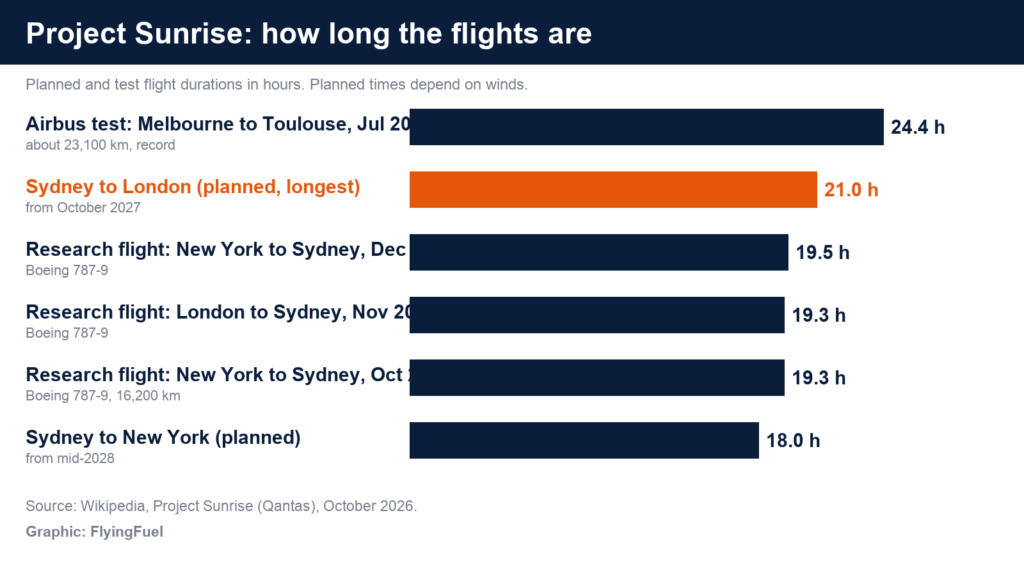
- New York to Sydney, 18 to 20 October 2019: 19 hours 16 minutes, 16,200 km.
- London to Sydney, 14 to 15 November 2019: 19 hours 19 minutes.
- New York to Sydney, December 2019: 19 hours 31 minutes, with a normal service as a control flight.
Researchers monitored passengers and pilots, including sleep diaries, cognitive tests, melatonin levels and pilots’ brain activity. Passengers who followed optimised schedules of light, meals, sleep and movement reported jetlag lasting about two days less, and were more alert after the flight. As a result, Project Sunrise cabin lighting has twelve lighting scenes, including a “Sunrise” scene that moves from the front of the cabin to the back, and meal times are planned to help passengers adjust to the destination time zone.
Crew: who flies 20 hours?
Qantas plans to train more than 360 pilots and 1,200 cabin crew for the aircraft. The pilots’ union has said its preferred model for flights of about 20 hours is three pilots qualified to land the aircraft, and Qantas has said it would start with a “more conservative” approach to crewing. Australia’s regulator, CASA, approved a new Qantas fatigue risk management system in 2020 but said Sunrise flights, with pilot duty periods of up to 23 hours, would need further approval. Cabin crew on Sunrise flights are to get 60-hour layovers. Curious where the crew sleep? See our guide: where do pilots sleep on long-haul flights.
The Record-Breaking Test Flight
The first A350-1000ULR first flew on 2 June 2026, for 3 hours 43 minutes over France. In July 2026 Airbus flew it non-stop from Toulouse to Melbourne on 23 and 24 July, about 19 hours and almost 17,000 km, with four Airbus test pilots and five flight-test engineers.
The return, on 27 and 28 July, went the long way: across the Pacific, over the US and Canada, across the Atlantic south of Greenland and over the UK to Toulouse, with two Qantas pilots joining the crew. It lasted 24 hours 24 minutes and covered around 23,100 km, reported as a new distance record for a commercial airliner. More than 3.6 million people followed it on Flightradar24. Airbus said the flight showed the aircraft could perform a 23-hour flight and tested its fuel and air-conditioning systems.
Why It Took So Long: The Timeline
| Date | Milestone |
|---|---|
| August 2017 | Alan Joyce challenges Boeing and Airbus to build an aircraft for non-stop Sydney to London |
| 2019 | Three Boeing 787-9 research flights; Qantas picks the A350-1000 in December |
| March 2020 | Board approves the project, but COVID-19 puts the order on hold |
| May 2022 | Order for 12 A350-1000s placed, aiming for late 2025 |
| February 2024 | Delivery delayed about six months; extra fuel tank had to be redesigned |
| June 2024 | Certification of the extra centre fuel tank confirmed |
| May 2026 | Airbus moves first delivery to April 2027 because of supply-chain problems |
| 2 June 2026 | First flight of the A350-1000ULR |
| 17 June 2026 | Sydney to London confirmed as first route, from October 2027 |
| July 2026 | Record test flights between Toulouse and Melbourne |
| 23 September 2026 | Sydney to New York announced from mid-2028 |
The Business Case and the Criticism
Qantas expects Project Sunrise to add about A$400 million to annual earnings once all 12 aircraft are flying. The plan relies on premium travellers: about 41% of seats are in premium cabins, compared with 29% on Qantas A380s, and Qantas expects fares about 20% higher than for one-stop journeys. It points to its non-stop Perth to London flights, which it describes as its best-performing route, as proof that people will pay for non-stop flying.
Critics question the environmental impact: ultra-long-haul aircraft carry more fuel and fewer passengers, so emissions per passenger can be higher than on a journey with a stop. Some commentators have called parts of the project “PR”, while others have praised it as a marketing masterclass. Analysts also said in 2026 that higher fuel prices had raised the project’s break-even point, while the disruption of Gulf hubs during the 2026 Iran war strengthened the case for non-stop flights.
Is Project Sunrise Worth It for Travellers?
- Pros: no connection to miss, more time saved (more than three hours to New York), more space per seat, a cabin designed to reduce jetlag.
- Cons: about 20 hours in one aircraft, higher fares, fewer seats, and no chance to stretch your legs in a stopover city. Our guide to layovers and stopovers explains the alternatives.
Key Takeaways
- Project Sunrise will bring the first non-stop flights from Australia’s east coast to London (October 2027) and New York (mid-2028).
- Qantas ordered 12 Airbus A350-1000ULRs with an extra fuel tank, able to fly up to 22 hours.
- Each aircraft has only 238 seats, about 41% in premium cabins, plus a Wellbeing Zone.
- Sydney to London is about 17,021 km and will take up to about 21 hours.
- A July 2026 test flight of 24 hours 24 minutes and about 23,100 km was reported as a record for a commercial airliner.
- Qantas expects fares about 20% above one-stop trips and A$400 million a year in extra earnings.
Frequently Asked Questions
What is Qantas Project Sunrise?
Qantas’s plan to run the first non-stop commercial flights from Australia’s east coast to London and New York, using specially modified Airbus A350-1000ULR aircraft. It was launched in 2017.
When does Project Sunrise start?
Qantas plans daily Sydney to London flights from October 2027, with tickets on sale from February 2027. Sydney to New York flights are planned from mid-2028, with tickets on sale from August 2027.
How long is the Sydney to London non-stop flight?
About 19 hours 25 minutes to 21 hours from Sydney and 18 to 20 hours in the other direction, depending on winds. The great-circle distance is about 17,021 km by our calculation.
What aircraft will fly Project Sunrise?
The Airbus A350-1000ULR, a version of the A350-1000 with an extra 20,900-litre rear centre fuel tank, a higher maximum take-off weight and Rolls-Royce Trent XWB-97 engines. Airbus says it can fly almost 10,000 nautical miles, or up to 22 hours. Qantas ordered 12.
How many seats are on the Project Sunrise A350?
238 seats: 6 first class suites, 52 business class suites, 40 premium economy seats and 140 economy seats. Other airlines’ A350-1000s usually have more than 300 seats.
What is the Wellbeing Zone?
A space between premium economy and economy where passengers can stretch and move, with guided exercise content, handles and a self-service drinks and snacks station. It won a 2024 Crystal Cabin Award.
Why was Project Sunrise delayed?
The order was put on hold during COVID-19 and placed in 2022. Delivery then slipped several times, partly because the extra fuel tank had to be redesigned, and in May 2026 Airbus moved the first delivery to April 2027 because of supply-chain problems.
Will Project Sunrise be the longest flight in the world?
Yes. At about 17,021 km, Sydney to London would be longer than today’s longest scheduled flight, Singapore to New York JFK, at about 15,340 km. Sydney to New York would be about 16,014 km.
Will Project Sunrise tickets cost more?
Qantas has said it expects fares about 20% higher than for one-stop journeys. About 41% of the seats are in premium cabins.
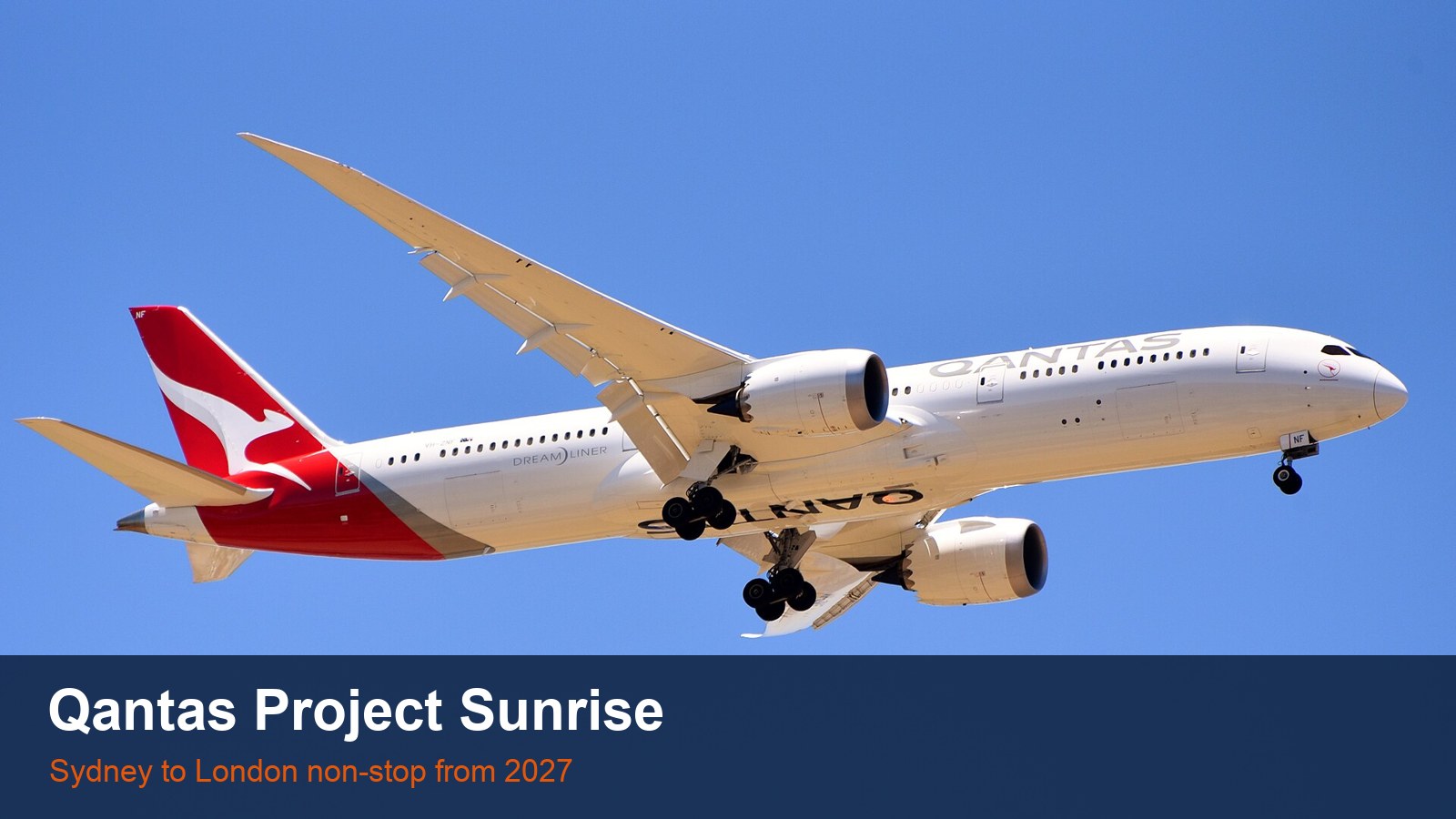
Featured image: FlyingFuel graphic using a photo of Qantas Boeing 787-9 VH-ZNF at Perth by Bahnfrend, CC BY-SA 4.0, via Wikimedia Commons.
 GulfstreamGulfstream Business Jets: Every Model From the G300 to the G800 Explained (2026)
 NewsBombardier to Hire 800 in the US and Spend $270 Million on First Phase of Expansion
 NewsAll Passengers Flying to the US Must Sign an Ebola Travel Attestation From 3 November
 BombardierBombardier Business Jets: Every Global and Challenger Model Explained (2026)
 NewsSafran LEAP Engine Deliveries Rise 26% to 1,565 in First Nine Months of 2026
 NewsEmbraer Order Backlog Hits Record $35.7 Billion as E2 Jet Orders Grow