
Summary
- The FAA has proposed a visual inspection of the fan blades on every CFM56-7B engine, the engine that powers the Boeing 737 Next Generation family
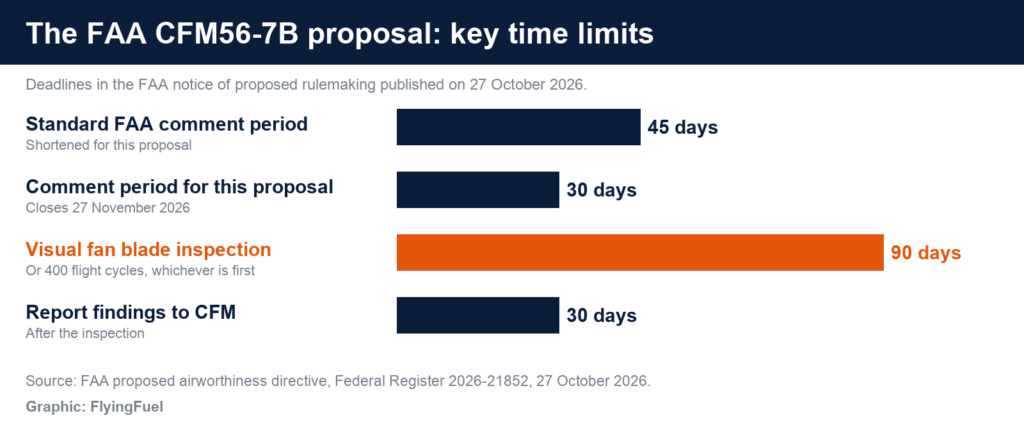
- Engines on aircraft would be checked within 400 flight cycles or 90 days of the rule taking effect, and any blade with cracks, tears or distortion replaced before further flight
- The proposal follows a fan blade failure on a Malta Air 737-800 in July, when debris broke a cabin window and the cabin lost pressure
WASHINGTON, United States, 27 October 2026 – The US Federal Aviation Administration (FAA) has proposed that every CFM56-7B engine receive a visual inspection of its fan blades, in a notice of proposed rulemaking published in the Federal Register today. The CFM56-7B powers the Boeing 737-600, -700, -800 and -900, the family known as the 737 Next Generation, or 737NG.
The FAA says the proposal was prompted by a 737-800 whose CFM56-7B26/3 engine lost a fan blade in flight. Debris went through the fuselage, the cabin lost pressure and the crew made an emergency descent. The notice does not name the airline, but its description matches the US National Transportation Safety Board (NTSB) preliminary report on Malta Air flight 1879 in July, and FlightGlobal links the proposal to that event.
What the FAA wants airlines to do
Under the proposed rule, operators would follow a CFM service bulletin dated 8 September 2026 and look for blades with cracks, tears, curled tips or local distortion on the leading edge. The main steps are:
- Deadline: engines fitted to aircraft would be inspected within 400 flight cycles or 90 days after the rule takes effect, whichever comes first; spare engines before their next flight
- Bad blade found: it must be replaced before further flight, and the blade next to it must also be inspected
- Reporting: results go to CFM within 30 days, so the manufacturer can learn more about the problem
- Credit: recent inspections done under earlier CFM bulletins can count
The FAA calls this an interim action and says it may propose more rules once the cause is understood. It estimates that 3,450 engines on US-registered aircraft would be affected, at about US$85 per inspection; replacing a blade would cost about US$51,485, including parts. Comments close on 27 November 2026, a 30-day period instead of the usual 45 days, which the FAA says lines its action up with the European Union Aviation Safety Agency (EASA).
What happened on the July flight
According to the NTSB preliminary report, Malta Air flight 1879, operating for Ryanair from Thessaloniki, Greece, to Memmingen, Germany, on 10 July 2026, was climbing through about 16,000 ft when the crew got a high vibration warning on the right engine. After a loud bang, the cabin altitude warning sounded and the crew put on oxygen masks, declared an emergency and descended, returning to Thessaloniki for what the NTSB calls an uneventful landing.
There were 155 people on board. One passenger was seriously injured when the window at row 11 was lost. Engine fragments also hit the fuselage behind the wing and the right horizontal stabilizer. The NTSB, which took over the investigation from Greek authorities, found that one fan blade had broken at its root, with about 37% of the fracture surface showing signs of fatigue. Bird remains were found in the engine and are being examined. The investigation is ongoing, and the NTSB has not given a date for its next report.

A second proposal on the same engine
This is the FAA’s second CFM56-7B fan blade proposal in three months. In July, it proposed expanding the ultrasonic blade checks that began after the 2018 Southwest Airlines fan blade failure, saying it had no information linking that work to the Malta Air event. The NTSB report notes that the failed engine had passed an ultrasonic inspection 253 flight cycles before the flight.
The new proposal is different: according to the FAA, early findings from the manufacturer suggest that deformed fan blades set off a localized vibration in the blade that failed, and the visual check is aimed at spotting that kind of damage.
What it means for passengers
The FAA’s estimate of 3,450 affected engines on US-registered aircraft alone shows how many 737NGs are still flying; Boeing’s newer 737 MAX uses the CFM LEAP-1B instead and is not covered. The proposal is an inspection requirement, not a grounding, and it is not yet final: the FAA can change it after the comment period. For background on how these engines work, see our guide to turbofan engines.
Read more
- Turbofan vs turboprop: how jet engines work
- Boeing 737 MAX 8 review: cabin, engines, range and safety
- Safran LEAP engine deliveries rise 26%
- What is a flight diversion?
Sources: FAA proposed airworthiness directive, Federal Register document 2026-21852, 27 October 2026; FAA proposed airworthiness directive, Federal Register document 2026-15532, 31 July 2026; NTSB preliminary report DCA26FA274 (PDF); FlightGlobal, 26 October 2026.
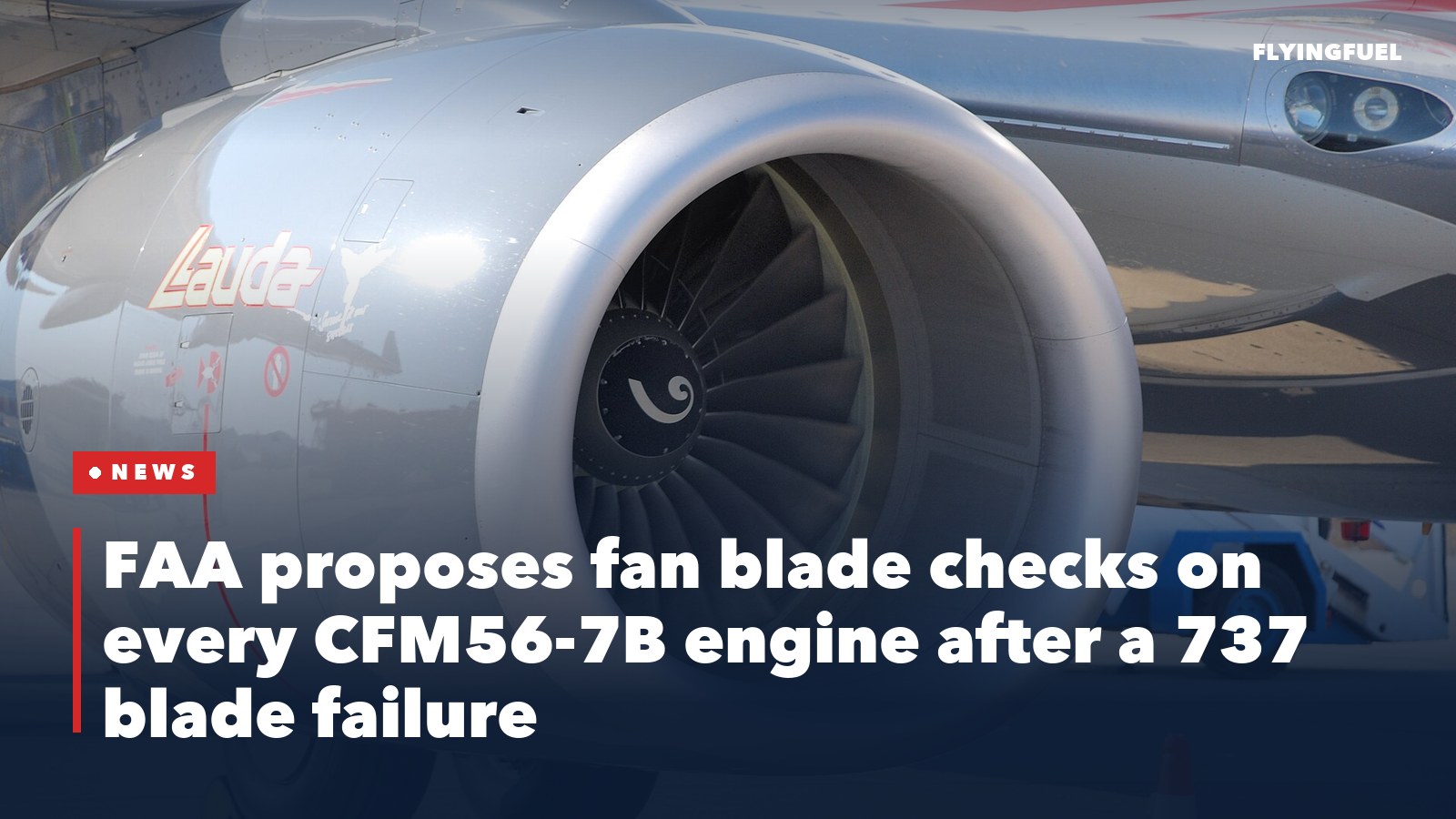
Featured image: FlyingFuel graphic using a photo of a CFM56 engine on a Lauda Air Boeing 737 by Trainler, CC BY 3.0, via Wikimedia Commons.
 Embraer Executive JetsEmbraer Business Jets: Phenom 100EX, Phenom 300EV, Praetor 500E and 600E Explained (2026)
 NewseasyJet to Fit Starlink Wi-Fi Across Its Airbus Fleet From 2027
 Dassault FalconDassault Falcon Jets: Every Model From the 2000LXS to the 10X Explained (2026)
 GulfstreamGulfstream Business Jets: Every Model From the G300 to the G800 Explained (2026)
 NewsBombardier to Hire 800 in the US and Spend $270 Million on First Phase of Expansion
 NewsAll Passengers Flying to the US Must Sign an Ebola Travel Attestation From 3 November