
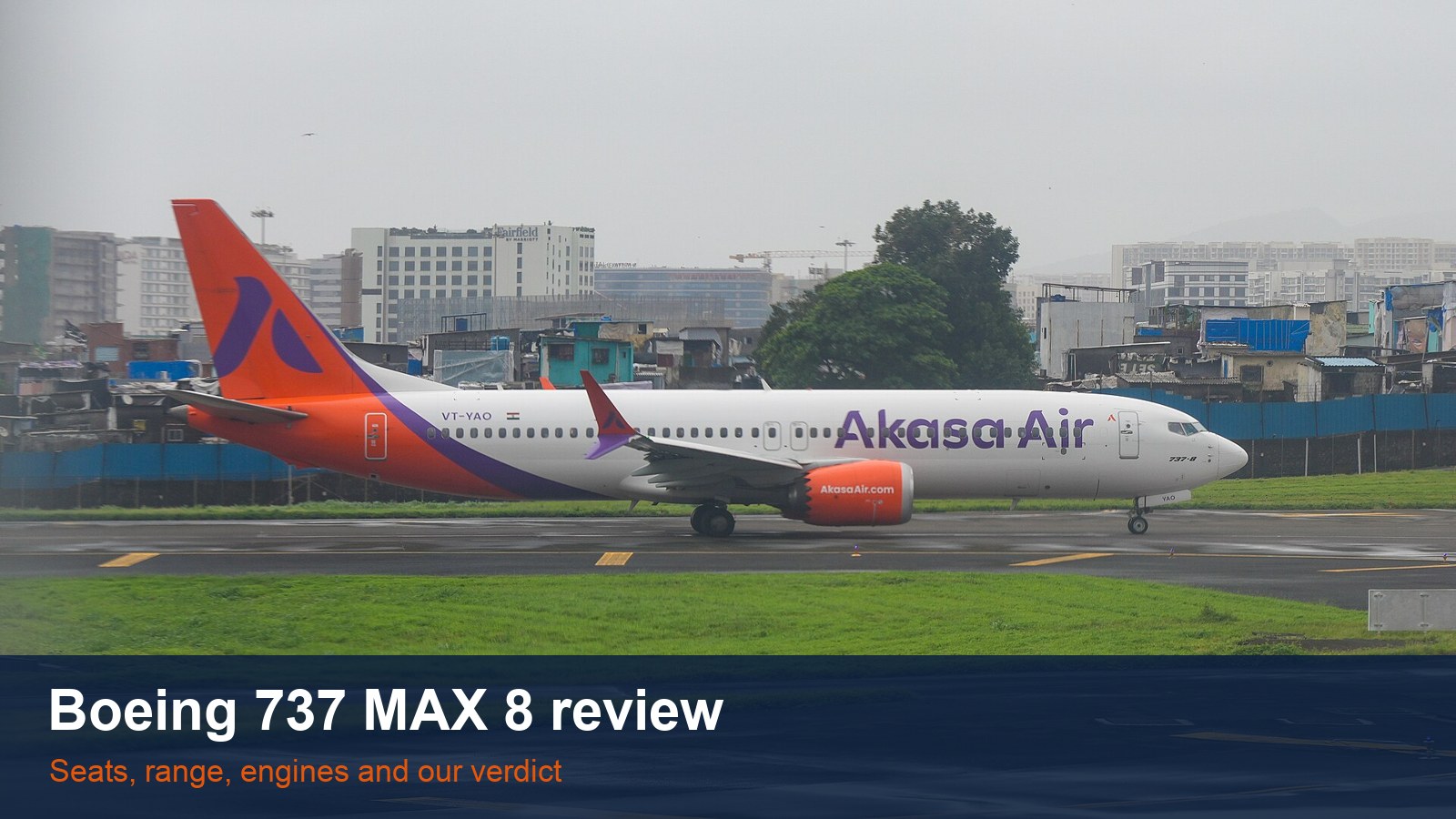
The Boeing 737 MAX 8 (officially the 737-8) is the most popular model of Boeing’s newest single-aisle family, and it is one of the two jets you are most likely to board on a short or medium flight. In India it is the aircraft behind Akasa Air and much of Air India Express.
Our verdict in one line: the 737 MAX 8 is an efficient, high-capacity short- and medium-haul jet that seats 160 to 180 people in two classes (up to 210), flies up to 3,500 nm and burns about 20% less fuel than the 737s it replaces. Its weak points are a narrower cabin than the A320neo, a single engine choice, and a safety history that made it the most closely examined airliner of its generation.
In this review we explain everything step by step: what the aircraft looks like and how to recognise it, what is inside the cabin and the cockpit, how its engine works in simple words, how far it flies, what happened with MCAS and what was fixed, who flies it in India, and how it compares with the Airbus A320neo and the older 737-800. All figures come from Boeing, CFM and the other sources linked in each section.
Boeing 737 MAX 8 Quick Facts
| Item | Boeing 737-8 (737 MAX 8) |
|---|---|
| Type | Single-aisle (narrowbody) twin-engine airliner |
| Seats (two-class) | 160 to 180 |
| Maximum seats | 210 |
| Range | Up to 3,500 nm (6,480 km) |
| Length | 39.5 m (129 ft 6 in) |
| Wingspan | 35.9 m (117 ft 10 in) |
| Height | 12.3 m (40 ft 4 in) |
| Maximum take-off weight | 82,640 kg (182,200 lb) |
| Fuel capacity | 25,816 litres |
| Engines | 2 x CFM International LEAP-1B |
| Economy layout | 6 seats per row (3-3) |
| First flight | 29 January 2016, Renton, Washington |
| First airline flight | 22 May 2017, Malindo Air, Kuala Lumpur to Singapore |
| Replaces | Boeing 737-800 |
Sources: Boeing 737 MAX technical specifications; fuel capacity from Boeing’s 737 MAX airport planning data, as used in our A320neo vs 737 MAX 8 comparison; dates from Wikipedia: Boeing 737 MAX.
What Is the 737 MAX 8?
The 737 MAX is the fourth generation of the Boeing 737, the world’s best-known single-aisle jet. Instead of designing a completely new aircraft, Boeing kept the 737 fuselage and gave it new engines, new winglets, a reshaped tail section and a new cockpit display system. This is called a re-engining, the same idea as Airbus’s A320neo (“neo” means new engine option).
Boeing’s board approved the programme on 30 August 2011. The first MAX 8, named Spirit of Renton, was rolled out at Boeing’s Renton factory on 8 December 2015 and flew for the first time on 29 January 2016. The US Federal Aviation Administration (FAA) certified it in March 2017, and Malindo Air flew the first passenger service on 22 May 2017, according to the aircraft’s history.
The MAX 8 is the second of four family members and the direct replacement for the 737-800, the most common 737 of the previous generation. Boeing describes it as offering “the greatest versatility and efficiency for core markets”, which in plain words means it is the model that suits most routes most airlines fly. For how Boeing’s names like “737-8” work, see how Airbus and Boeing name their aircraft.
How the 737 MAX 8 Looks: Exterior Design
At first glance a 737 MAX looks like any other 737: a long, slim tube with a low wing and two engines hung close under it. Look closer and you will notice several changes, each made to save fuel or reduce noise.
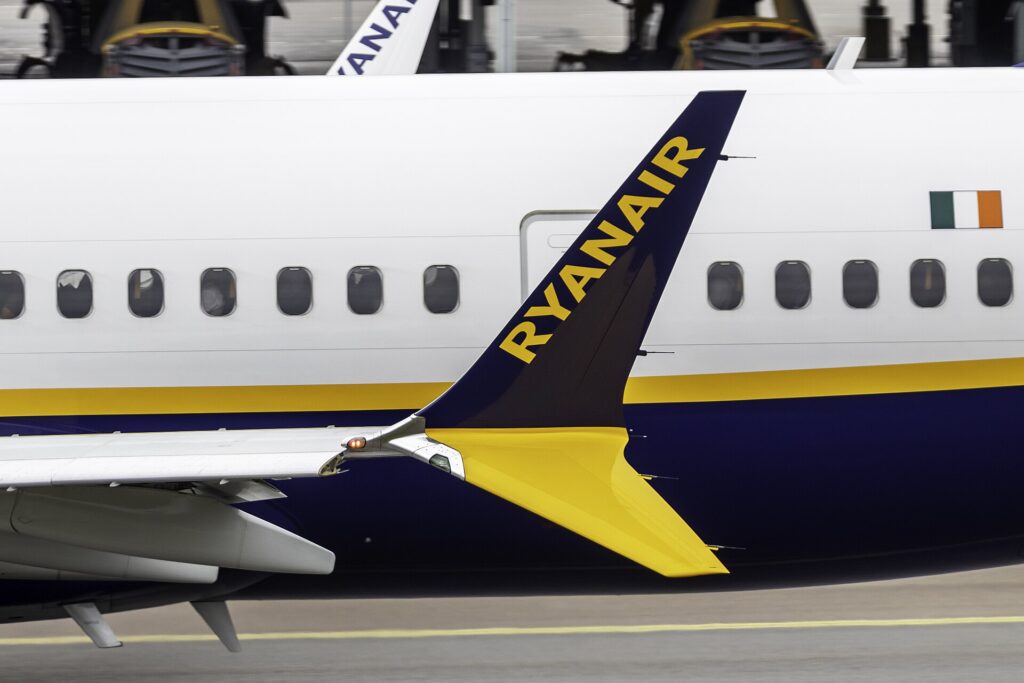
Split-tip winglets
The most obvious change is at the wingtip. The MAX uses Boeing’s Advanced Technology winglet, which has one large blade pointing up and a smaller one pointing down. A winglet reduces the swirling air (drag) at the end of the wing. Boeing says these are the most efficient winglets ever designed for a production airliner and that they cut fuel use and CO2 emissions by up to 2%.
Bigger engines with a serrated edge
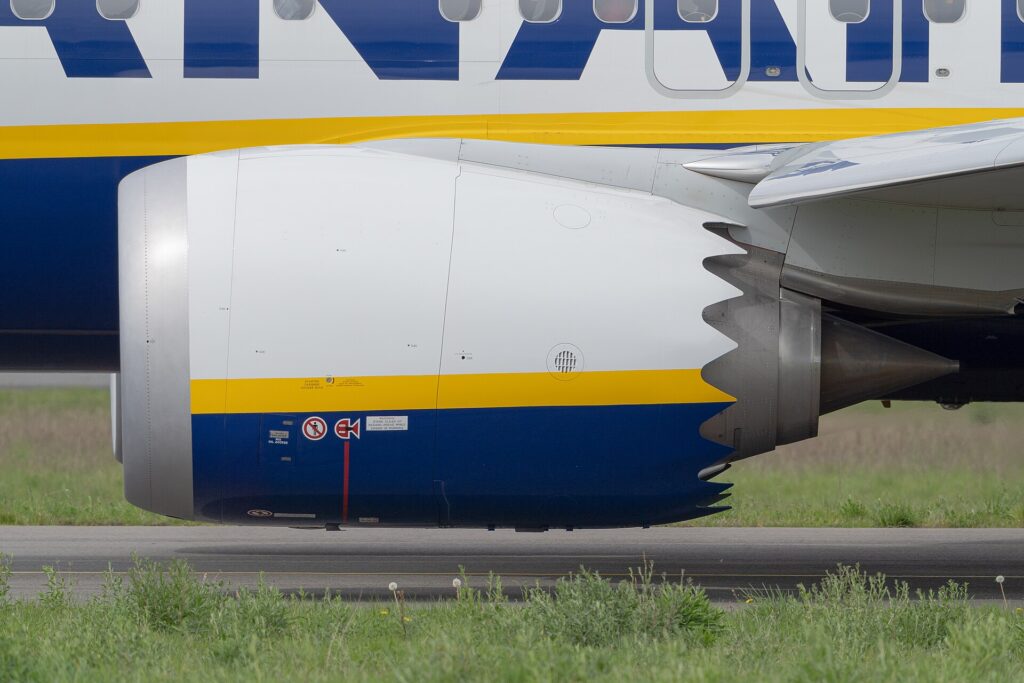
The engines are much larger than on the older 737. Look at the back edge of the engine casing (the nacelle): on the MAX it has a zig-zag, saw-tooth edge called chevrons. Boeing says this design, borrowed from the 787 Dreamliner, helps make the aircraft much quieter. The nacelle is also shaped to blend with the wing to reduce drag.
Taller nose gear and a new tail cone
The 737 sits low to the ground, which makes it easy to load bags without special equipment but leaves little room for a big engine. To fit the larger fan, Boeing made the nose landing gear 6 to 8 inches (15 to 20 cm) longer and placed the engine higher and further forward on the wing, according to the MAX’s development history. At the back, the tail section (aft body) was redesigned to be more streamlined, which Boeing says saves up to 1% of fuel.
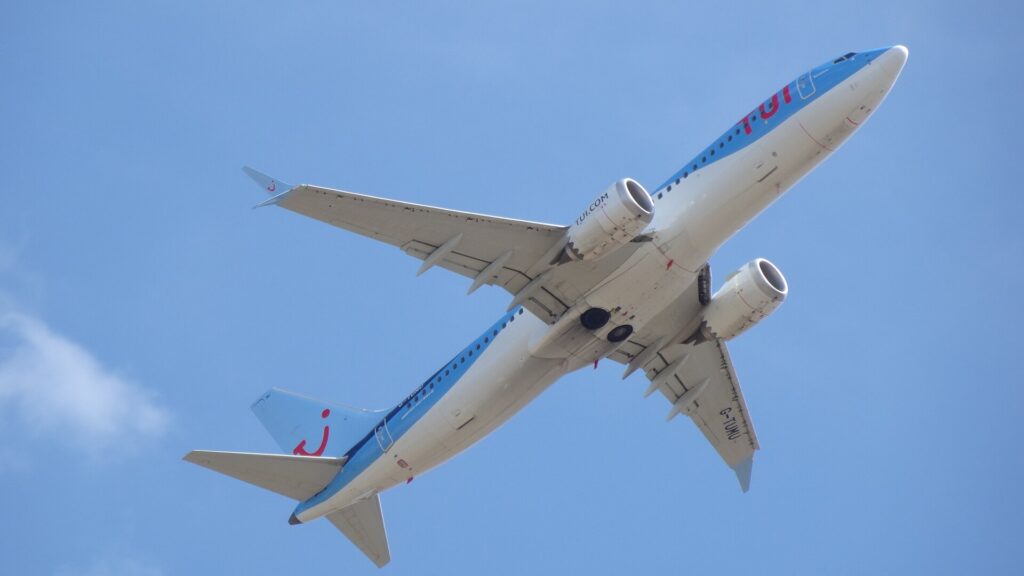
How to recognise a 737 MAX 8 at the airport
- Wingtip: split winglet (one blade up, one smaller blade down). The A320neo has a single tall, upswept “Sharklet”.
- Engine edge: serrated chevrons on the MAX; smooth on the 737-800 and the A320neo.
- Nose: the 737 has a pointed nose and cockpit side windows that angle down in a V shape; the A320 family has a rounder nose.
- Exits: the MAX 8 has two overwing exits on each side. The high-density 737-8-200 adds an extra pair of exit doors behind the wing.
The LEAP-1B Engine, Explained Simply
Every 737 MAX is powered by two CFM International LEAP-1B engines. CFM is a 50-50 company owned by America’s GE Aerospace and France’s Safran Aircraft Engines. Boeing says the LEAP-1B was designed specifically for the 737 MAX, combining the reliability of the earlier CFM56 with new fuel-saving technology.
The LEAP-1B is a high-bypass turbofan. In simple words: the big fan at the front pushes most of the air around the hot engine core, not through it. Moving a large amount of air gently is more efficient and quieter than pushing a small amount of air very fast. The bypass ratio tells you how much air goes around the core for every unit that goes through it. Our turbofan vs turboprop guide explains this idea in more detail.
| Engine detail | LEAP-1B (737 MAX) | CFM56-7B (737-800) |
|---|---|---|
| Fan diameter | 69.4 in (176 cm) | 61 in (156 cm) |
| Fan blades | 18, woven carbon fibre | 24, titanium |
| Bypass ratio | About 9:1 | 5.1:1 to 5.5:1 |
| Other technology | Ceramic matrix composite turbine shrouds; some of the first FAA-certified 3D-printed parts in a commercial jet engine | – |
Sources: Wikipedia: Boeing 737 MAX (engine development); Wikipedia: CFM International LEAP.
What these numbers mean for you: a bigger fan with fewer, lighter, stronger blades moves more air for the same fuel, so the aircraft burns less fuel per trip. Ceramic composite parts make the engine lighter. And the higher bypass ratio, together with the chevrons, makes the MAX noticeably quieter. Boeing says the 737-8 has a 50% smaller noise footprint than the 737-800, and Akasa Air says the aircraft gives it a quieter cabin with 40% less noise.
The trade-off: airlines get only one engine choice. Buyers of the A320neo can pick the CFM LEAP-1A or the Pratt & Whitney GTF, which gives them more bargaining power. The LEAP-1B also has a smaller fan than the A320neo’s LEAP-1A (78 inches), because the 737 sits lower to the ground.
Inside the Cabin: What Passengers Get
The 737 MAX 8 is a narrowbody aircraft: one aisle with three seats on each side (3-3) in economy. Boeing lists 160 to 180 seats in a typical two-class cabin and up to 210 in a maximum-density layout.
Boeing’s cabin design is called the Boeing Sky Interior. According to Boeing it brings:
- Larger pivoting overhead bins: the bin swings down to load bags and swings up to close, and the larger bins hold more cabin baggage.
- LED mood lighting: airlines can set different colour scenes, for example a calm blue for boarding or lighting that imitates day and night on longer flights.
- Larger windows: Boeing says MAX windows are 20% larger than on other single-aisle airplanes.
- A quieter ride: thanks to the new engines, as explained above.
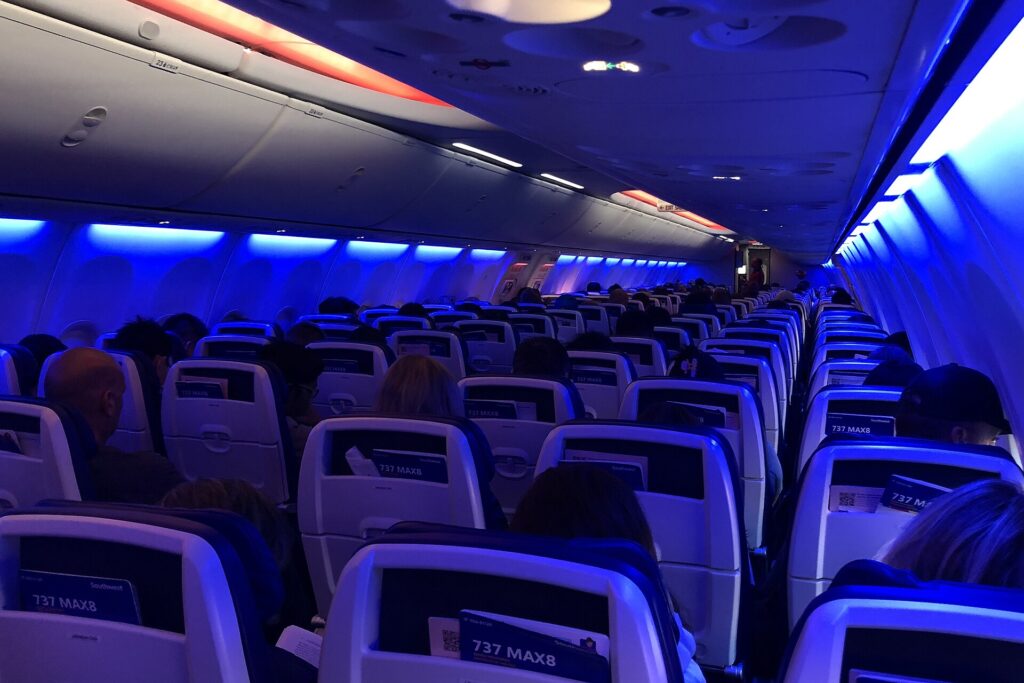
The one weakness is width. The 737 fuselage is narrower than the A320’s. Airbus says the A320 fuselage is 7 inches wider than the 737, which is roughly an extra inch per seat across a six-seat row. You may notice this as a slightly narrower seat or aisle.
Remember that the airline decides most of what you feel on board: seat pitch (legroom), seat padding, whether there are screens, power sockets, Wi-Fi or meals. Akasa Air flies an all-economy cabin, and Air India Express unveiled a new all-economy 3-3 cabin in 2025 with Collins Aerospace leather seats, lighting and charging ports.
The 737-8-200 (737 MAX 200) high-density version
Boeing also sells a high-density version of the MAX 8, launched in September 2014 and known as the 737-8-200, 737-8200 or 737 MAX 200. It needs an extra pair of exit doors because it carries more people. It was first planned for up to 200 seats and was later certified for up to 210. To make room, three of the eight service trolleys are removed. Ryanair was the launch customer, and Akasa Air flies it too, according to the aircraft’s variant history.
The Cockpit
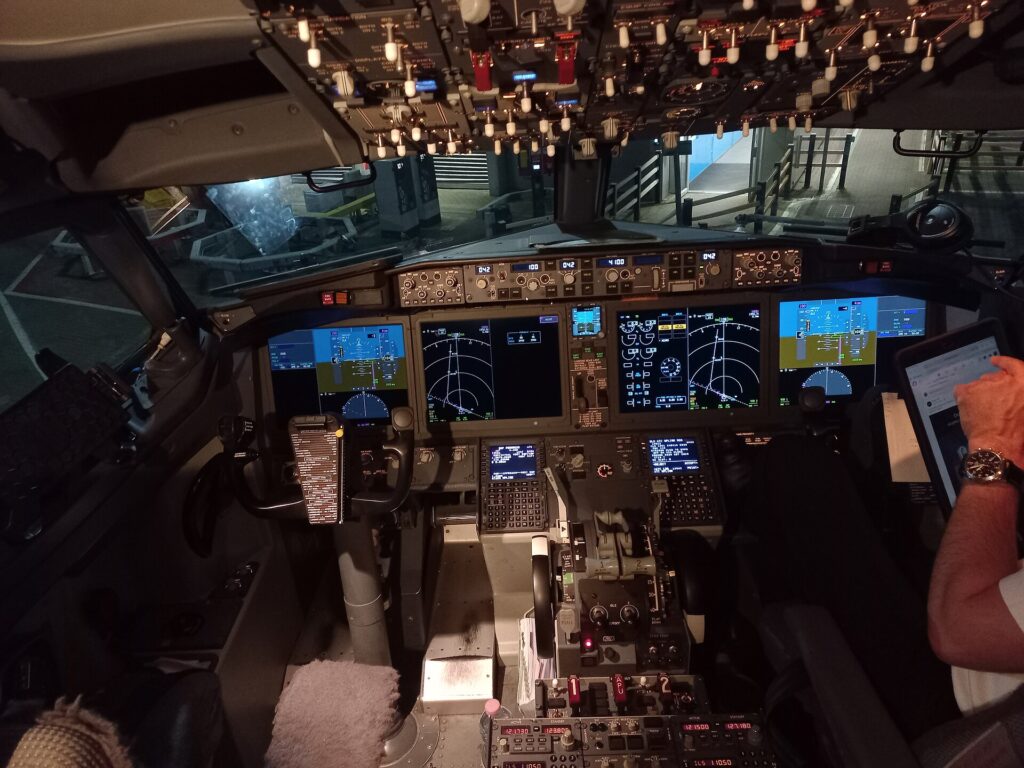
Boeing says the MAX flight deck has four large 15-inch (38 cm) displays, the same size as on the 787 Dreamliner and the 777X. It also has integrated navigation features, all-weather capability and electronic flight bag connectivity (the pilots’ tablet-based charts and manuals).
Pilots still fly the MAX with a traditional control yoke in front of each seat, like earlier 737s, while the Airbus A320 family uses a sidestick and fly-by-wire controls. Boeing deliberately kept the cockpit close to the previous 737 so that airlines could move existing 737 pilots to the MAX more easily.
Range and Performance
Boeing lists the 737 MAX 8 with a range of up to 3,500 nautical miles (6,480 km). In practice that is enough for any domestic route in India and for flights such as Delhi to Singapore. Airlines rarely use the full range: they choose the MAX 8 for many short and medium flights a day, where its low fuel burn matters most.
For a real-world idea of fuel use, during a test flight for Aviation Week a MAX 8 cruising at 449 knots true airspeed and a weight of 140,500 lb (about 63.7 tonnes) burned 4,460 lb (about 2,023 kg) of fuel per hour, and that was at a lower-than-ideal altitude of 35,000 ft, as reported in the aircraft’s history. Read why airliners prefer high altitudes in why planes fly at 35,000 feet.
The MAX 8 has a maximum take-off weight of 82,640 kg. It has a lower empty weight and a higher maximum take-off weight than the A320neo, so it can carry a little more payload or fuel.
The 737 MAX Family: Where the MAX 8 Fits
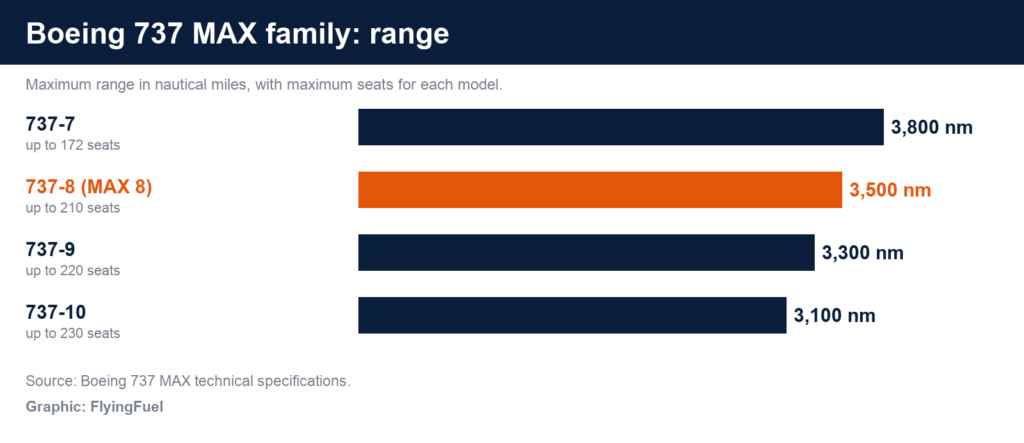
| Model | Seats (two-class) | Max seats | Range | Length |
|---|---|---|---|---|
| 737-7 | 135-160 | 172 | 3,800 nm | 35.6 m |
| 737-8 (MAX 8) | 160-180 | 210 | 3,500 nm | 39.5 m |
| 737-9 | 175-195 | 220 | 3,300 nm | 42.1 m |
| 737-10 | 185-210 | 230 | 3,100 nm | 43.8 m |
Source: Boeing 737 MAX technical specifications. All four share the same 35.9 m wingspan, 12.3 m height and LEAP-1B engines.
The MAX 8 is the middle choice: more seats than the 737-7, more range than the 737-9 and 737-10. It is the most-ordered model of the family. Boeing says more than 100 customers have placed firm orders for about 7,000 737 MAX aircraft and that more than 1 million passengers fly on a 737 MAX every day. Because all four models share pilots, cabin crew, mechanics, ramp staff, spares and maintenance programmes, an airline can mix them with little extra cost.
Safety: MCAS, the Grounding and What Changed
No honest review of the 737 MAX can skip its safety history. Here is what happened, in simple words, using the investigation summaries collected in Wikipedia: Boeing 737 MAX groundings and Wikipedia: MCAS.
What was MCAS?
Because the MAX’s larger engines sit further forward and higher than on older 737s, the aircraft had a tendency to raise its nose in one specific situation: flaps up, a high angle of attack and manual flight. Boeing added software called the Maneuvering Characteristics Augmentation System (MCAS) to push the nose down automatically in that situation, so the MAX would handle like the previous 737.
What went wrong?
MCAS originally relied on just one of the aircraft’s two angle-of-attack sensors. When that sensor gave wrong data, MCAS repeatedly pushed the nose down. This happened on Lion Air Flight 610 on 29 October 2018 and Ethiopian Airlines Flight 302 on 10 March 2019. The two crashes killed 346 people. Investigations also found that Boeing had not properly explained MCAS to airlines and pilots, and identified weaknesses in the FAA’s certification process.
What was fixed?
The MAX was grounded worldwide from March 2019. The FAA cleared it to return on 18 November 2020, after an airworthiness directive required changes on every aircraft:
- MCAS now needs input from both angle-of-attack sensors and will not activate if they disagree.
- MCAS can no longer activate again and again.
- Pilots can override it if necessary.
- The flight-control computer architecture was redesigned for more redundancy.
- All MAX pilots need MCAS-related simulator training.
India’s Directorate General of Civil Aviation (DGCA) lifted its ban on 26 August 2021, on the condition that aircraft meet FAA and EASA requirements. In January 2024 a door plug blew out on Alaska Airlines Flight 1282, a 737 MAX 9, which led to a temporary grounding of affected MAX 9s and new scrutiny of Boeing’s production quality. That incident involved the MAX 9’s optional mid-cabin exit, not the MAX 8. For context on how flying risks compare, see our guide to how dangerous turbulence is.
Who Flies the 737 MAX 8 in India?
- Akasa Air flies only Boeing 737 MAX aircraft. It began commercial flights on 7 August 2022 and says it has a firm order for 226 737 MAX aircraft and currently operates 43. Its fleet includes the 737 MAX 8 and the high-density 737-8-200, and in January 2024 it ordered 99 737-10s.
- Air India Express, the Air India group’s low-cost airline, flies the 737-8. By January 2026 it had received 51 of them from Air India’s 2023 Boeing order, and in December 2025 it received the first MAX built specifically for it, registered VT-RNT in honour of Ratan Tata (Wikipedia: Air India Express). See our Air India fleet guide.
India’s largest airline, IndiGo, flies the rival Airbus A320neo family instead; see IndiGo’s fleet.
737 MAX 8 vs Its Rivals
737 MAX 8 vs Airbus A320neo
The A320neo is the MAX 8’s direct rival, and the two are very close.
| Boeing 737 MAX 8 | Airbus A320neo | Better | |
|---|---|---|---|
| Length | 39.5 m | 37.57 m | MAX 8 (more room for seats) |
| Maximum seats | 210 | 194 | MAX 8 |
| Range | 3,500 nm | 3,400 nm | MAX 8 (slightly) |
| Maximum take-off weight | 82.6 t | 79.0 t | MAX 8 |
| Fuel capacity | 25,816 L | 26,730 L | A320neo |
| Cabin width | Narrower | 3.70 m (7 in wider fuselage) | A320neo |
| Engine choice | 1 (LEAP-1B) | 2 (LEAP-1A or PW GTF) | A320neo |
| Flight controls | Yoke, conventional | Sidestick, fly-by-wire | Depends on the airline’s pilots |
| Fuel saving vs predecessor | 20% (Boeing) | At least 20% per seat (Airbus) | Tie |
Sources: Boeing and Airbus specifications, as compiled in our A320neo vs 737 MAX 8 comparison.
What the MAX 8 does better: more seats, a little more range and weight capacity, and easy pilot transition for airlines that already fly 737s. What the A320neo does better: a wider cabin, two engine choices and a family that includes the long-range A321XLR (see our A321XLR review).
737 MAX 8 vs 737-800 (the aircraft it replaces)
| 737 MAX 8 | 737-800 | |
|---|---|---|
| Engine | CFM LEAP-1B | CFM56-7B |
| Fan / bypass ratio | 69.4 in / about 9:1 | 61 in / about 5.1:1 |
| Fuel use and CO2 | 20% lower (family, Boeing) | Baseline |
| Noise footprint | 50% smaller (Boeing) | Baseline |
| Fan blades | 18, woven carbon fibre | 24, titanium |
For airlines, the upgrade is mostly about fuel and noise: same size class, same crews and similar airports, but noticeably cheaper to run.
Pros and Cons
Pros
- Up to 210 seats, more than the A320neo’s 194
- 3,500 nm range covers almost every domestic and regional route
- 20% lower fuel use and CO2 than the previous 737 generation (Boeing)
- 50% smaller noise footprint than the 737-800 (Boeing)
- Larger windows, pivoting bins and LED mood lighting
- Same pilots, crews and spares across the whole MAX family
- Easy upgrade for airlines that already fly 737s
Cons
- Narrower cabin than the A320neo (about 7 inches)
- Only one engine option (LEAP-1B)
- Smaller fan than the A320neo’s LEAP-1A because the 737 sits low
- Older-style cockpit design compared with Airbus fly-by-wire
- Safety and production-quality history that damaged trust, even after the fixes
- For longer single-aisle routes, Airbus offers the A321LR and A321XLR
Our Verdict
The 737 MAX 8 does exactly what most airlines need from a single-aisle jet: lots of seats, enough range for nearly every short- and medium-haul route, and a big step in fuel efficiency and noise over the 737-800. For passengers, the MAX brings larger windows, a quieter cabin and more overhead bin space, though the cabin is a little narrower than an A320neo’s.
Its history is the big asterisk. MCAS was a serious design and certification failure that cost 346 lives. The aircraft flying today has the redesigned system, two-sensor checks and new pilot training required by regulators, including India’s DGCA. If you are booked on an Akasa Air or Air India Express flight, you will most likely be on a 737 MAX 8, and it is one of the most closely examined aircraft flying today.
Rating summary: efficiency and range are excellent for its class, capacity is class-leading, passenger comfort is good but not the widest, and pilot and fleet commonality are its strongest selling points for airlines.
Frequently Asked Questions
How many seats does a Boeing 737 MAX 8 have?
Boeing lists the 737-8 (737 MAX 8) with 160 to 180 seats in a typical two-class layout and a maximum of 210 seats. The exact number depends on the airline. Low-cost airlines such as Akasa Air and Air India Express fit an all-economy cabin.
What is the range of the 737 MAX 8?
Up to 3,500 nautical miles (6,480 km), according to Boeing. That is enough for routes such as Delhi to Singapore. Real range depends on passengers, cargo, weather and fuel reserves.
Is the Boeing 737 MAX 8 safe to fly now?
The MAX was grounded worldwide from March 2019 after two crashes linked to the MCAS flight-control software. Before it was allowed to fly again in late 2020, an FAA airworthiness directive required design changes: MCAS now needs input from both angle-of-attack sensors, cannot activate repeatedly, and pilots can override it. Pilots also need MCAS-related simulator training. India’s DGCA lifted its ban in August 2021 on the condition that aircraft meet FAA and EASA requirements.
Is the 737 MAX 8 the same as the 737-8?
Yes. Boeing’s specification table calls the aircraft the 737-8. “737 MAX 8” is the common name for the same model. The 737-8-200 (or 737 MAX 200) is a high-density version with an extra pair of exit doors.
What engine does the 737 MAX 8 use?
The CFM International LEAP-1B. It is the only engine offered on the 737 MAX family. CFM is a 50-50 joint venture between GE Aerospace and Safran Aircraft Engines. The LEAP-1B has a 69.4-inch (176 cm) fan with 18 woven carbon-fibre blades.
How much more efficient is the 737 MAX 8 than the 737-800?
Boeing says the 737 MAX family uses 20% less fuel and emits 20% less CO2 than the previous generation, and that the 737-8 has a 50% smaller noise footprint than the 737-800.
Which Indian airlines fly the 737 MAX 8?
Akasa Air flies an all-737 MAX fleet. Its website says it operates 43 737 MAX aircraft and has a firm order for 226. Air India Express also flies the 737-8; by January 2026 it had 51 from Air India’s 2023 Boeing order.
Which is better, the 737 MAX 8 or the A320neo?
Neither is clearly better. The 737 MAX 8 is longer, seats more at maximum (210 vs 194) and flies slightly further (3,500 vs 3,400 nm). The A320neo has a wider cabin (Airbus says 7 inches wider than the 737), a choice of two engines and fly-by-wire controls. For passengers, the airline’s seats and service matter more than the aircraft type.
How can I tell if I am on a 737 MAX?
Look at the wingtip and the engine. The 737 MAX has a split-tip winglet, with one blade pointing up and a smaller one pointing down, and the rear edge of its engine casing is serrated (chevrons). The rival A320neo has a single curved Sharklet wingtip and a smooth engine edge.
Featured image: FlyingFuel graphic using a photo of Akasa Air Boeing 737 MAX 8 VT-YAO by Timothy A. Gonsalves, CC BY-SA 4.0, via Wikimedia Commons.
 Embraer Executive JetsEmbraer Business Jets: Phenom 100EX, Phenom 300EV, Praetor 500E and 600E Explained (2026)
 NewseasyJet to Fit Starlink Wi-Fi Across Its Airbus Fleet From 2027
 NewsFAA Proposes Fan Blade Checks on Every CFM56-7B Engine After 737 Blade Failure
 Dassault FalconDassault Falcon Jets: Every Model From the 2000LXS to the 10X Explained (2026)
 GulfstreamGulfstream Business Jets: Every Model From the G300 to the G800 Explained (2026)
 NewsBombardier to Hire 800 in the US and Spend $270 Million on First Phase of Expansion