
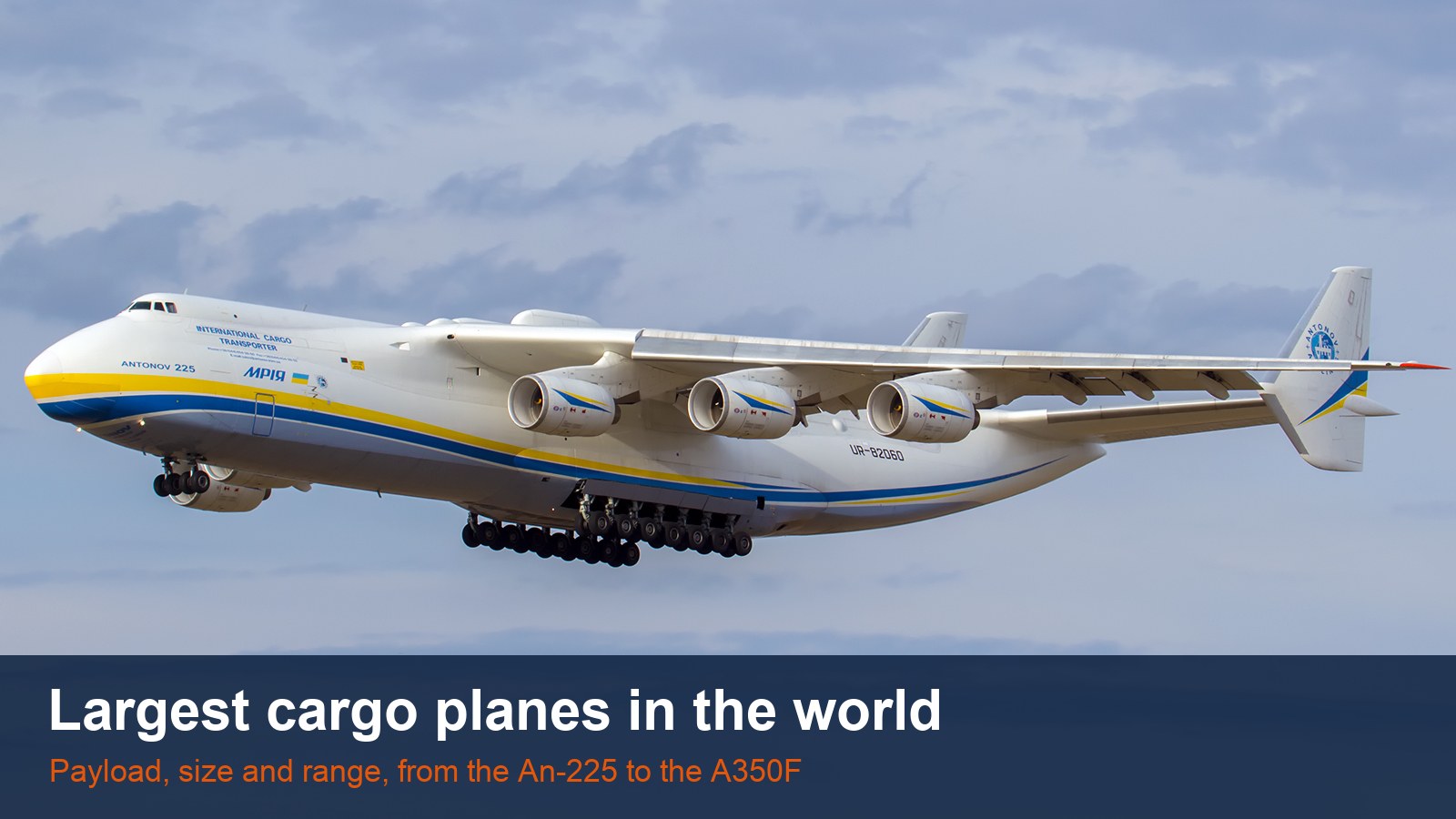
The largest cargo plane ever built is the Antonov An-225 Mriya: 84 m long, with an 88.4 m wingspan, and able to lift a record 247 tonnes of cargo. But the only completed An-225 was destroyed in February 2022. Today the biggest cargo plane built in numbers is the Antonov An-124 Ruslan (up to 150 tonnes), and the largest freighters airlines buy new are the Boeing 777F, the coming Airbus A350F and the Boeing 777-8 Freighter.
Below, we rank the biggest cargo aircraft by payload and explain each one, using figures from Antonov, Boeing and Airbus.
Largest Cargo Planes at a Glance
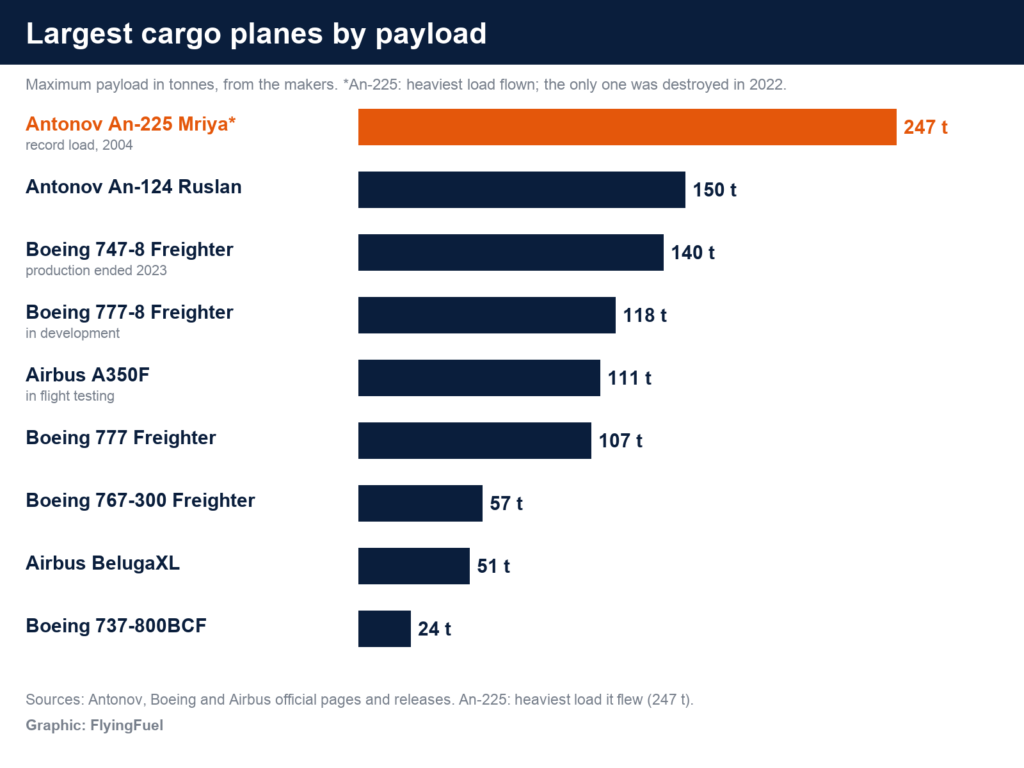
| Aircraft | Max payload | Range | Length | Wingspan | Status |
|---|---|---|---|---|---|
| Antonov An-225 Mriya | 247 t (record load) | – | 84 m | 88.4 m | Destroyed in 2022 |
| Antonov An-124 Ruslan | Up to 150 t | – | 69.1 m | 73.3 m | Built 1984 to 2004 |
| Boeing 747-8 Freighter | 140 t | 4,475 nm | – | – | Production ended 2023 |
| Boeing 777-8 Freighter | 118 t | 5,000 nm with 110 t | 70.9 m | 71.8 m | In development |
| Airbus A350F | Up to 111 t | 4,700 nm | – | – | In flight testing |
| Boeing 777 Freighter | 107 t | 5,000 nm | 63.7 m | 64.8 m | In production |
| Boeing 767-300 Freighter | 57 t | 3,300 nm | 54.9 m | 47.6 m | In production |
| Airbus BelugaXL | 51 t | – | 63.1 m | – | Six aircraft, Airbus use only |
| Boeing 737-800BCF | 24 t | 2,000 nm | 39.5 m | 35.8 m | Converted freighter |
Sources: Antonov An-225 and An-124 pages; Boeing freighters and 747-8F release; Airbus A350F release; A350F page and Beluga page; AirData News (An-225 loss). Boeing payloads are gross structural payloads. “-” means the maker does not give the figure on the pages we used.
1. Antonov An-225 Mriya: The Largest Ever
The An-225 was designed in the Soviet Union to carry the Buran space shuttle orbiter and parts of the Energiya rocket on its back. Antonov says two were started but only one was completed. It rolled out in November 1988 and first flew in December 1988.
It set records through its life, according to Antonov:
- March 1989: took off with 156.3 tonnes of cargo and set 110 world records in one flight.
- June 2004: flew 247 tonnes of cargo, four pipe-laying machines, from Prague to Tashkent, setting six world records.
- June 2010: carried the longest cargo items ever sent by air, two 42.1 m wind turbine blades from China to Denmark.
- 2016: carried a single item weighing 182 tonnes, a 155-tonne electric turbine in a 27-tonne frame, from Sao Paulo to Santiago.
The An-225 was hit during the Russian attack on Hostomel airport near Kyiv in February 2022. Ukraine’s state company Ukroboronprom said it was destroyed, and AirData News reported that it could not be flown out because one of its engines had been removed for maintenance.

2. Antonov An-124 Ruslan
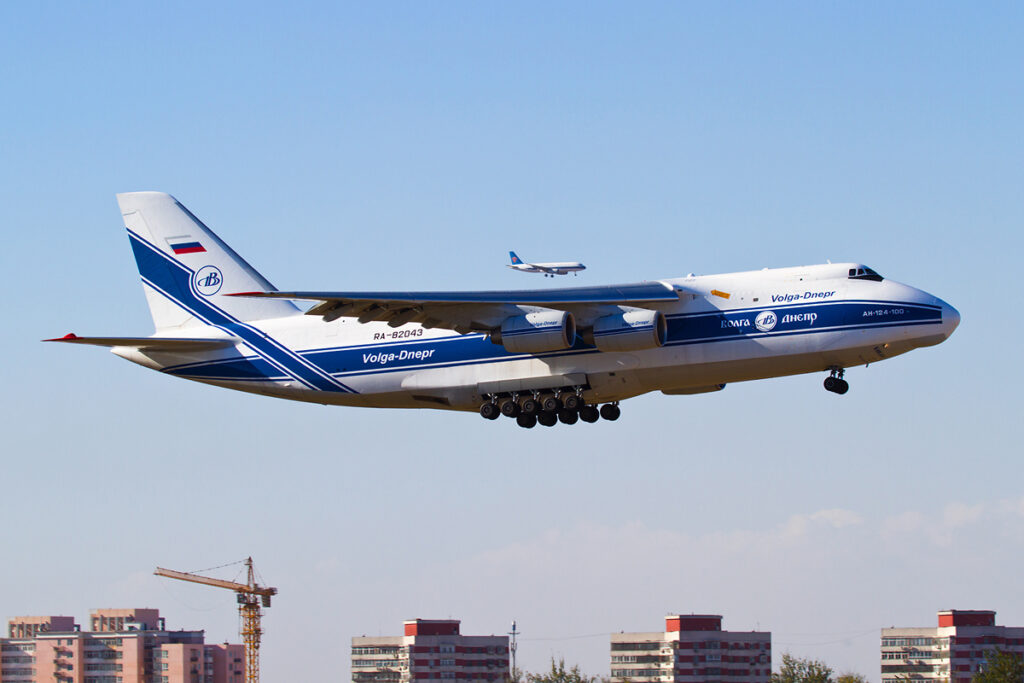
The An-124 first flew on 24 December 1982 as a heavy military transport able to carry up to 150 tonnes. It is 69.1 m long with a 73.3 m wingspan. Antonov says 18 were built in Kyiv between 1984 and 2003 and 36 in Ulyanovsk between 1985 and 2004.
It is famous for oversized loads. In 1991 an An-124 flew 129 tonnes of cargo, three 43-tonne transformers, from Barcelona to Noumea. In September 1993 an An-124-100 carried a 135.2-tonne Siemens electric generator from Dusseldorf to Delhi, a flight recorded in the Guinness Book of Records.
3. Boeing 747-8 Freighter
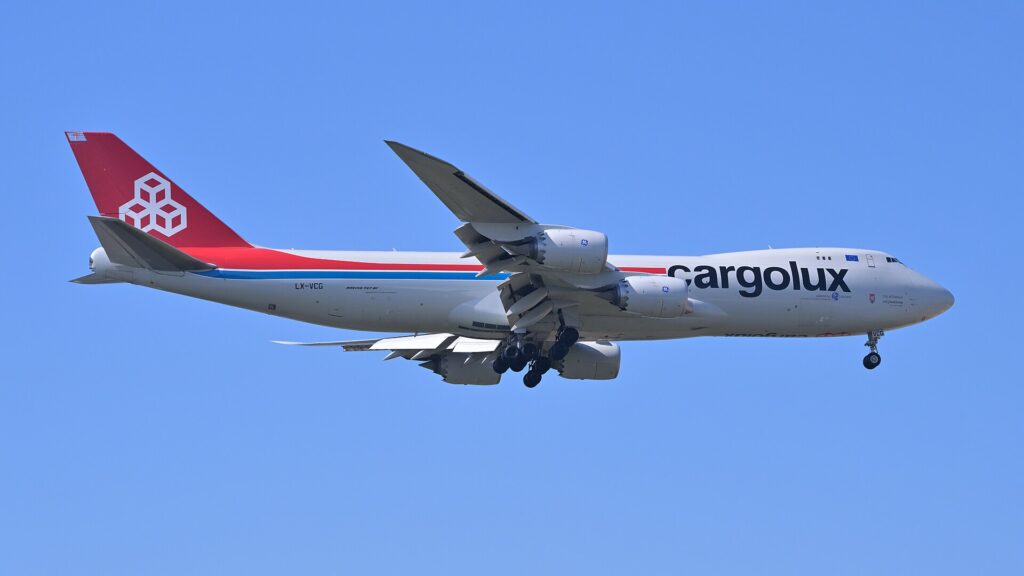
When Boeing fixed the design of the 747-8 Freighter in 2006, it gave the aircraft a maximum structural payload of 140 tonnes and a range of 4,475 nm (8,288 km). It is 5.6 m longer than the 747-400F and has 16% more cargo volume, enough for seven more standard pallets, according to Boeing. Like earlier 747 freighters, its nose swings up for loading.
The last 747 ever built was a 747-8 Freighter, delivered to Atlas Air on 31 January 2023. Boeing said that 1,574 747s were built over the life of the programme.
4. Boeing 777-8 Freighter
The 777-8F is the freighter version of the 777X family. Boeing lists a gross structural payload of 118 tonnes and a range of 5,000 nm with 110 tonnes on board. It carries 31 pallets on the main deck and has 17% more volume than the 777F. Its GE9X engines and folding wingtips come from the 777X; the span is 71.8 m in flight and 64.8 m on the ground. Boeing says it will burn 30% less fuel than the aircraft it replaces. For the passenger 777-9, see our A350-1000 vs 777-9 comparison.
5. Airbus A350F
The A350F is Airbus’s new large freighter, based on the A350 passenger jet. It made its first flight on 29 September 2026 from Toulouse, starting a flight test campaign of more than nine months, according to Airbus.
- Payload and range: up to 111 tonnes over 4,700 nm (8,700 km).
- Cargo door: 4.3 m wide, which Airbus calls the largest main-deck cargo door in the industry, big enough for large jet engines.
- Engines: Rolls-Royce Trent XWB-97. Airbus claims up to 40%% lower fuel burn than competitor aircraft with similar payload and range.
- Orders: 115 from 14 disclosed customers by the end of August 2026.
6. Boeing 777 Freighter
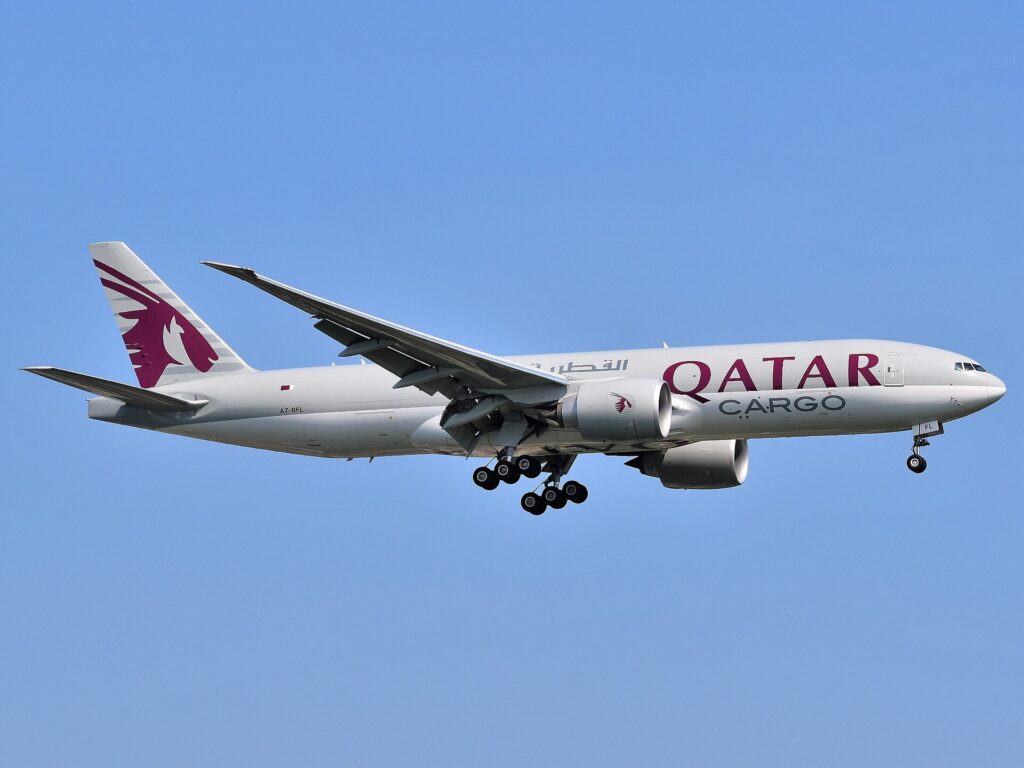
The 777F is the freighter airlines can buy and fly today. Boeing calls it its best-selling widebody freighter and lists a gross structural payload of 107 tonnes, a range of 5,000 nm, 27 main-deck pallets, a length of 63.7 m and a 64.8 m wingspan. It is a twin-engine widebody jet powered by GE90 engines, part of the story of how twin-engine jets took over long-haul flying.
7. Boeing 767-300 Freighter
The 767-300F is Boeing’s medium widebody freighter: 57 tonnes of gross structural payload, 3,300 nm of range and a length of 54.9 m. Boeing also converts used 767-300 passenger jets into freighters (the 767-300BCF) with the same payload.
8. Airbus BelugaXL
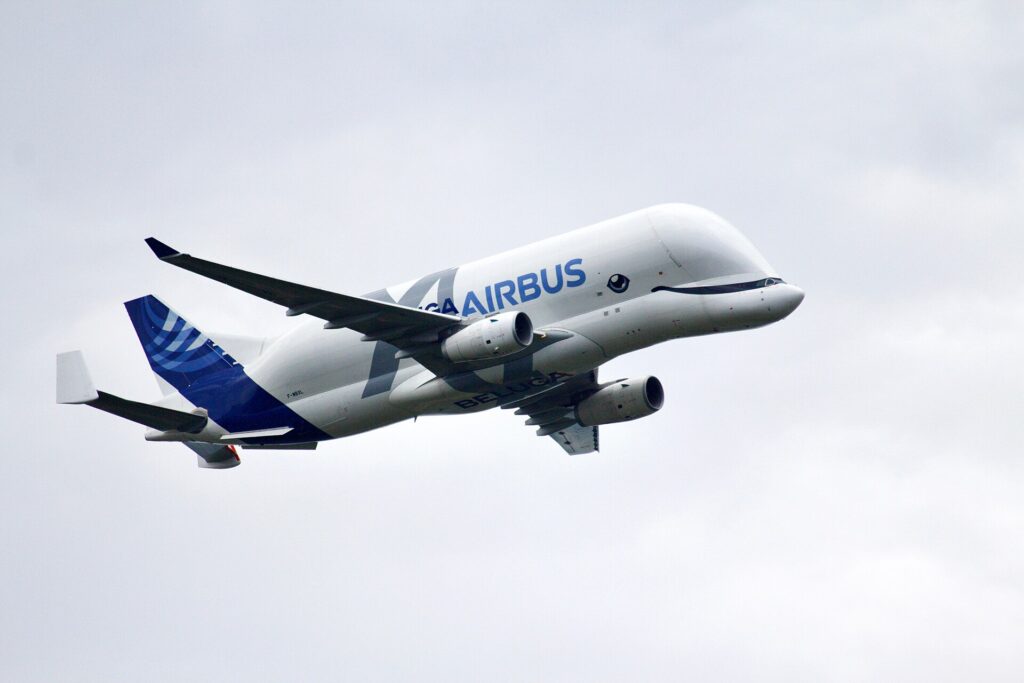
The BelugaXL is not sold to airlines. It is based on the A330-200 and has a huge, whale-shaped upper fuselage, so it can carry very large but light loads. Airbus uses its fleet of six to move aircraft parts between 11 sites in Europe. Airbus says it carries 51 tonnes, is 63.1 m long, can take two 30 m wings at once and has 30% more capacity than the older BelugaST.
9. Boeing 737-800BCF
The smallest jet in this list is the 737-800 Boeing Converted Freighter, a used 737-800 passenger jet turned into a freighter. Boeing lists 24 tonnes of payload and 2,000 nm of range. That range suits shorter routes.
Largest by Payload vs Largest by Size
“Largest” can mean different things. The An-225 was the largest by every measure. After that, the order depends on what you count:
- Payload: the An-124 (150 t) and 747-8F (140 t) lead, ahead of the 777-8F (118 t), A350F (111 t) and 777F (107 t).
- Length: the 777-8F (70.9 m) is longer than the An-124 (69.1 m).
- Volume: the BelugaXL carries only 51 tonnes but is built for bulky aircraft sections.
Big freighters fly between the world’s major cargo hubs. See our guide to the busiest airports in the world for the airports that handle the most cargo, or read how Airbus and Boeing name their aircraft to understand names such as 777F and A350F.
Frequently Asked Questions
What is the largest cargo plane in the world?
The largest cargo plane ever built is the Antonov An-225 Mriya. It is 84 m long with a wingspan of 88.4 m, and in 2004 it flew 247 tonnes of cargo from Prague to Tashkent. The only completed An-225 was destroyed at Hostomel airport near Kyiv in February 2022.
Is the An-225 still flying?
No. The only completed An-225 was hit during the Russian attack on Hostomel airport in February 2022. Ukraine’s state company Ukroboronprom said the aircraft was destroyed. It could not be flown out because one of its engines had been removed for maintenance.
What is the biggest cargo plane after the An-225?
The Antonov An-124 Ruslan. Antonov says it can carry up to 150 tonnes of cargo, and it is 69.1 m long with a 73.3 m wingspan. Antonov built 18 in Kyiv and 36 in Ulyanovsk.
What is the biggest Boeing cargo plane?
The Boeing 747-8 Freighter. Boeing gave it a maximum structural payload of 140 tonnes and a range of 4,475 nm. Production ended in January 2023. Among Boeing freighters on sale, the 777-8 Freighter (118 tonnes) will be the biggest, followed by the 777F (107 tonnes).
What is the biggest Airbus cargo plane?
The A350F, which made its first flight on 29 September 2026. Airbus says it can carry up to 111 tonnes over 4,700 nm. The BelugaXL is larger in volume but carries 51 tonnes and is used only to move Airbus aircraft parts.
How much can a Boeing 777F carry?
Boeing lists the 777F with a gross structural payload of 107 tonnes and a range of 5,000 nm with that payload. It carries 27 pallets on the main deck.
Has an An-124 carried cargo to India?
Yes. Antonov records that in September 1993 an An-124-100 flew a 135.2-tonne Siemens electric generator from Dusseldorf in Germany to Delhi, a flight listed in the Guinness Book of Records.
Featured image: FlyingFuel graphic using a photo by Myroslav Kaplun, CC BY-SA 4.0, via Wikimedia Commons.
 GulfstreamGulfstream Business Jets: Every Model From the G300 to the G800 Explained (2026)
 NewsBombardier to Hire 800 in the US and Spend $270 Million on First Phase of Expansion
 NewsAll Passengers Flying to the US Must Sign an Ebola Travel Attestation From 3 November
 BombardierBombardier Business Jets: Every Global and Challenger Model Explained (2026)
 NewsSafran LEAP Engine Deliveries Rise 26% to 1,565 in First Nine Months of 2026
 NewsEmbraer Order Backlog Hits Record $35.7 Billion as E2 Jet Orders Grow