
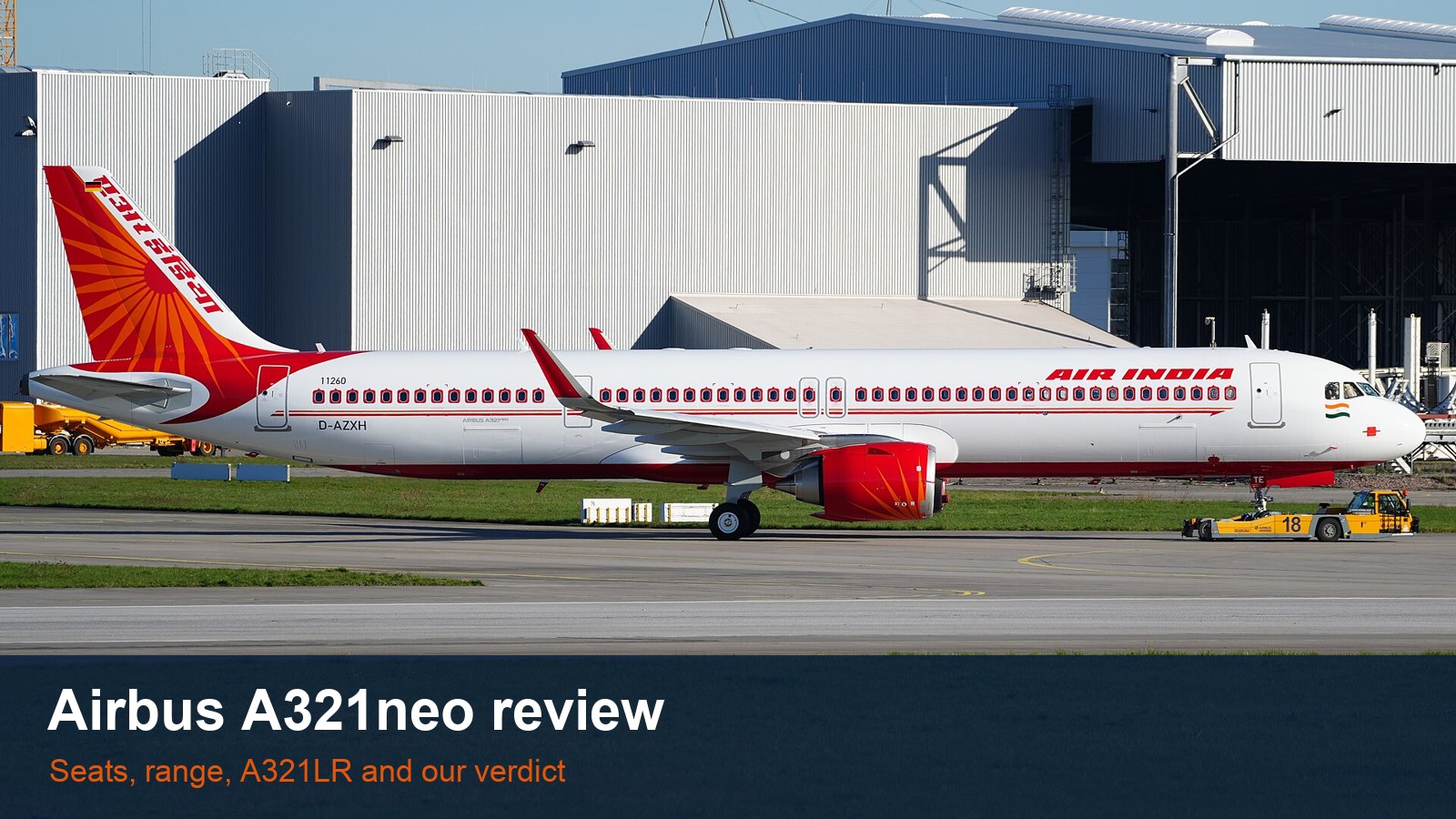
The Airbus A321neo is the longest member of the A320neo family and the most successful large single-aisle jet flying today. It is now the biggest aircraft type in IndiGo‘s fleet, it flies with Air India, and its long-range versions, the A321LR and A321XLR, let airlines fly single-aisle jets on routes that used to need a widebody.
Our verdict in one line: the A321neo is the most capable single-aisle jet on sale, seating 180 to 220 passengers in two classes (up to 244) and flying up to 4,000 nm, with about 20% lower fuel burn per seat than the aircraft it replaces. Airbus says it holds over 80% of its market segment. Its weak points are the same Pratt & Whitney engine problems that hit the A320neo, and a cabin that can feel crowded at maximum density.
In this review we explain everything step by step: how the A321neo differs from the A320neo, its clever Cabin Flex door layout, the cabin and cockpit, its two engines, the LR and XLR long-range versions, who flies it in India, and how it compares with the A320neo, the Boeing 737 MAX and the Boeing 757 it replaced. For a quick side-by-side, read A320neo vs A321neo.
Airbus A321neo Quick Facts
| Item | Airbus A321neo |
|---|---|
| Type | Single-aisle (narrowbody) twin-engine airliner |
| Seats (two-class) | 180 to 220 |
| Maximum seats | 244 (EASA, with Cabin Flex) |
| Range | Up to 4,000 nm (7,400 km) |
| Length | 44.51 m |
| Wingspan | 35.80 m, with Sharklets |
| Height | 11.76 m |
| Maximum take-off weight | 97 tonnes |
| Cargo hold | 51 m3 without extra tanks |
| Engines | CFM LEAP-1A or Pratt & Whitney PW1100G-JM, 24,500 to 35,000 lbf |
| Economy layout | 6 seats per row (3-3), about 18 in wide |
| First flight | 9 February 2016, Hamburg |
| Entered service | 31 May 2017, Virgin America |
| Orders | 7,064 ordered, 1,752 delivered (June 2025) |
Sources: Airbus A321neo page; Wikipedia: Airbus A321neo; Wikipedia: Airbus A320neo family.
What Is the A321neo?
The original A321 (now called the A321ceo) was the stretched version of the A320 and entered service in 1994. Airbus announced the A321neo in December 2010, 16 years later, as part of the A320neo programme, giving it the same new engines and Sharklet wingtips as the A320neo. “neo” means New Engine Option; see our A320neo review for the full story of the family.
The A321neo first flew from Hamburg on 9 February 2016. The prototype, D-AVXB, had CFM LEAP-1A engines. EASA and the FAA certified the LEAP version together on 1 March 2017, and Virgin America flew the first passenger service on 31 May 2017, with 185 seats, according to its history.
Airbus says the A321neo gives about 20% better fuel efficiency per passenger than the A321ceo, along with either 500 nm more range or 2 tonnes more payload. Demand has been huge: by July 2019 the A321neo made up about 40% of A320neo family sales, and Airbus converted its former A380 final assembly line in Toulouse to build A321s. By June 2025, 7,064 A321neos had been ordered by 88 disclosed customers.
How the A321neo Looks
From outside, the A321neo looks like a longer A320neo. It is 44.51 m long, almost 7 m longer than the A320neo (37.57 m), with the same 35.80 m wingspan and Sharklet wingtips. That long, thin shape is the easiest way to recognise it at the airport. The new engines have bigger fans than the older A321ceo’s, and the base A321neo has structural strengthening in the landing gear and wing to handle the higher weights.
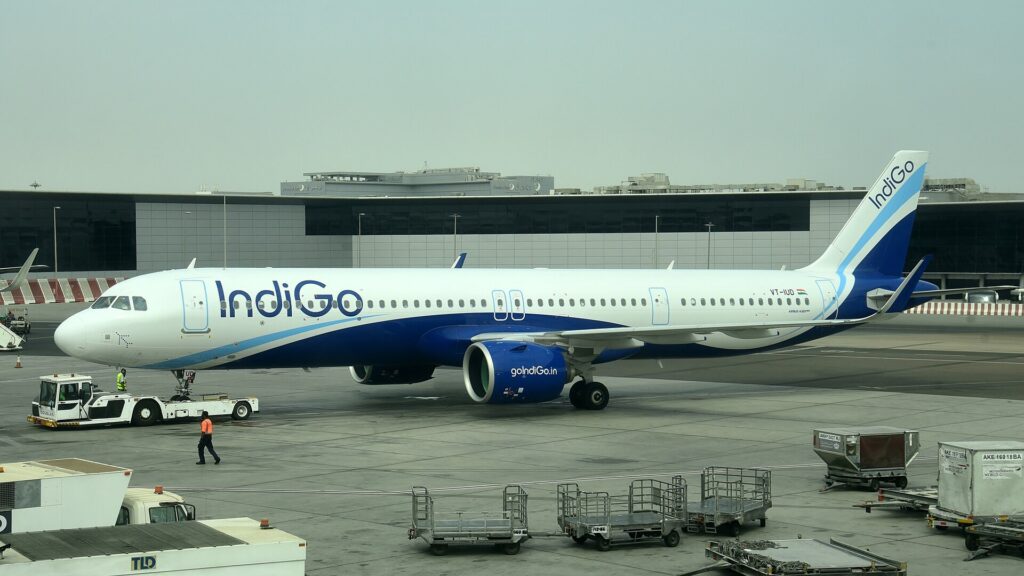
Look at the doors and you may spot the biggest change: most A321neos built since 2020 have the Cabin Flex layout, with two small overwing exits on each side instead of a full-size door ahead of the wing.
Cabin Flex: The Clever Door Layout
Exits decide how many people an aircraft is allowed to carry, because everyone must be able to get out quickly in an emergency. Early A321neos kept the A321ceo’s four pairs of doors: two ahead of the wing and two behind. In 2015 Airbus introduced Airbus Cabin Flex (ACF), which Wikipedia describes in detail:
- The second pair of doors ahead of the wing is replaced by two pairs of Type III+ overwing exits with dual-lane slides.
- The third pair of doors, behind the wing, is moved further back.
- Airlines can switch exits on or off: for a lower-density cabin, some exits can be replaced with lighter plugs that need no door mechanism or maintenance.
- At maximum density, EASA allows up to 244 passengers, using larger Type C* doors with dual-lane slides and moving cabin-crew seats. The FAA does not recognise these exit types and limits US aircraft to 200 passengers.
With 240 seats, Airbus says fuel burn per seat improves by about 6%, and with the new engines and Sharklets the total saving exceeds 20%. The changes add only about 100 kg. The first ACF aircraft flew on 31 January 2018, Turkish Airlines received the first one in July 2018, and ACF has been the standard A321neo layout since 2020.
Inside the Cabin
Like the A320neo, the A321neo has a 3.70 m-wide cabin, wider than the Boeing 737’s, with six seats per row in economy, each about 18 inches wide. The extra length simply gives more rows. In two classes Airbus lists 180 to 220 seats; airlines such as IndiGo use the space for high-capacity, all-economy cabins.
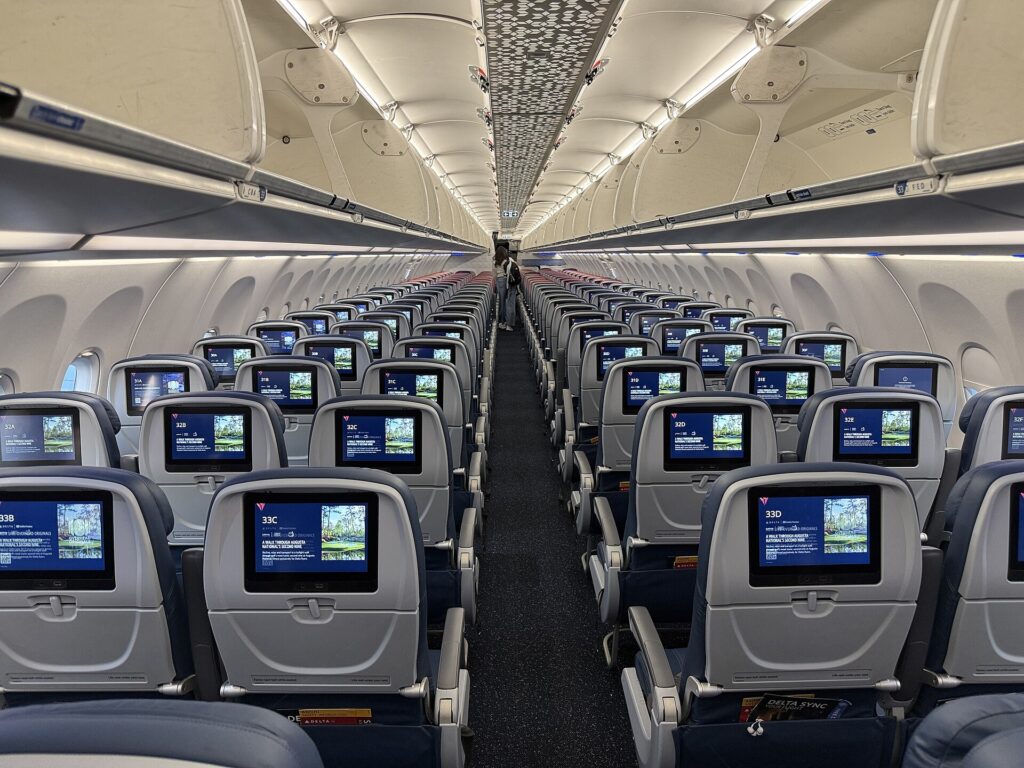
Your experience depends on the airline. IndiGo flies most of its A321neos with 222 or 232 seats, and some with its IndiGoStretch cabin, a roomier front section, for 220 seats in total. Full-service airlines fit business-class seats at the front. With up to 244 seats, a full A321neo has many passengers sharing one aisle, so boarding and getting off can take longer than on a smaller jet.
The Cockpit
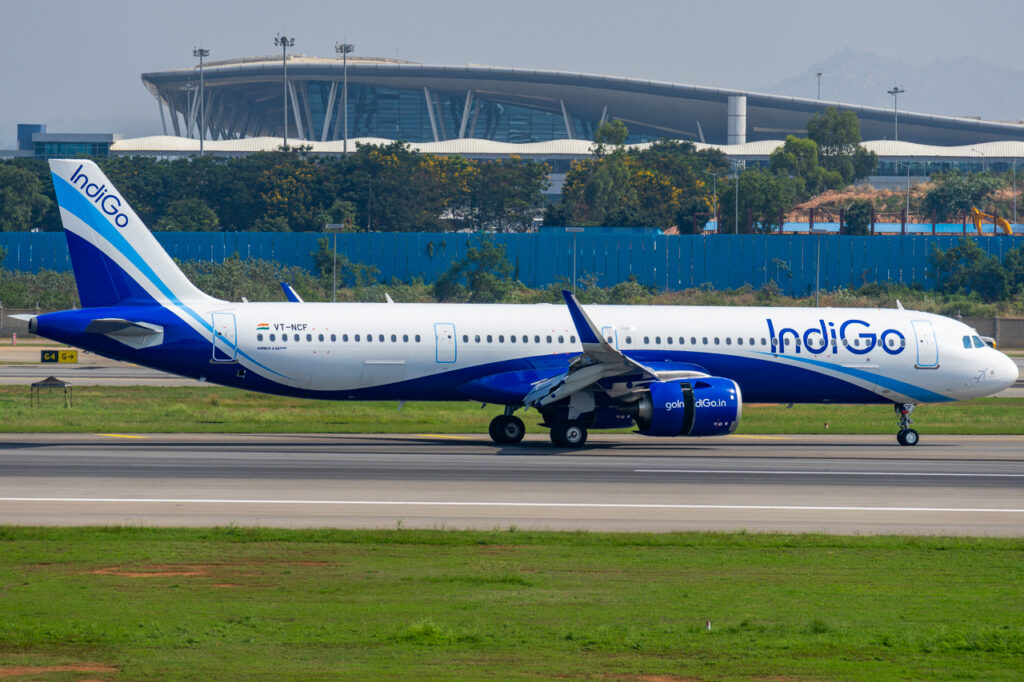
The A321neo flight deck is the same as on every A320 family aircraft: fly-by-wire controls, a sidestick beside each pilot and the same displays. Airbus says all A320 Family aircraft share the same flight controls, so pilots can move between the A319, A320 and A321 with little extra training. For IndiGo, which flies A320neos, A321neos and A321XLRs, that keeps pilot training simple across its narrowbody fleet.
Engines
Airlines choose between the CFM International LEAP-1A and the Pratt & Whitney PW1100G-JM geared turbofan (GTF), with 24,500 to 35,000 lbf of thrust. Both are high-bypass turbofans; the GTF uses a 3:1 gearbox so its 81-inch fan can turn slower than the turbine that drives it. Our A320neo review explains both engines in detail, and our turbofan vs turboprop guide covers the basics.
The GTF’s early reliability problems also delayed A321neo deliveries. Airlines such as Cebu Pacific and Air New Zealand had to wait longer for their aircraft while Pratt & Whitney retrofitted fixes, and later powdered-metal defects forced many GTF-powered aircraft to be parked for inspections and repairs.
Range and the Long-Range Versions
Airbus lists the standard A321neo at up to 4,000 nm (7,400 km). That covers domestic India, the Gulf and Southeast Asia easily. Two versions stretch it further by adding fuel:
| Version | Extra fuel | Max take-off weight | Range |
|---|---|---|---|
| A321neo | Optional | 97 t | Up to 4,000 nm |
| A321LR (Long Range) | Up to 3 removable additional centre tanks (ACTs) in the cargo hold | 97 t | Up to 4,000 nm with 206 passengers |
| A321XLR (Xtra Long Range) | Permanent 12,900-litre rear centre tank (RCT), plus an optional ACT | 101.5 t | Up to 4,700 nm (8,700 km) |
Sources: Airbus A321neo and A321XLR pages, as compiled in our A321XLR guide; Wikipedia: Airbus A321neo.
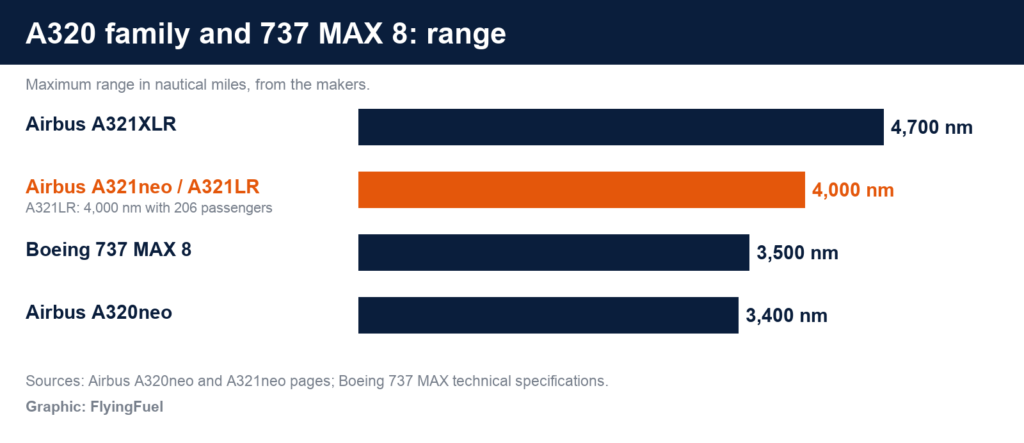
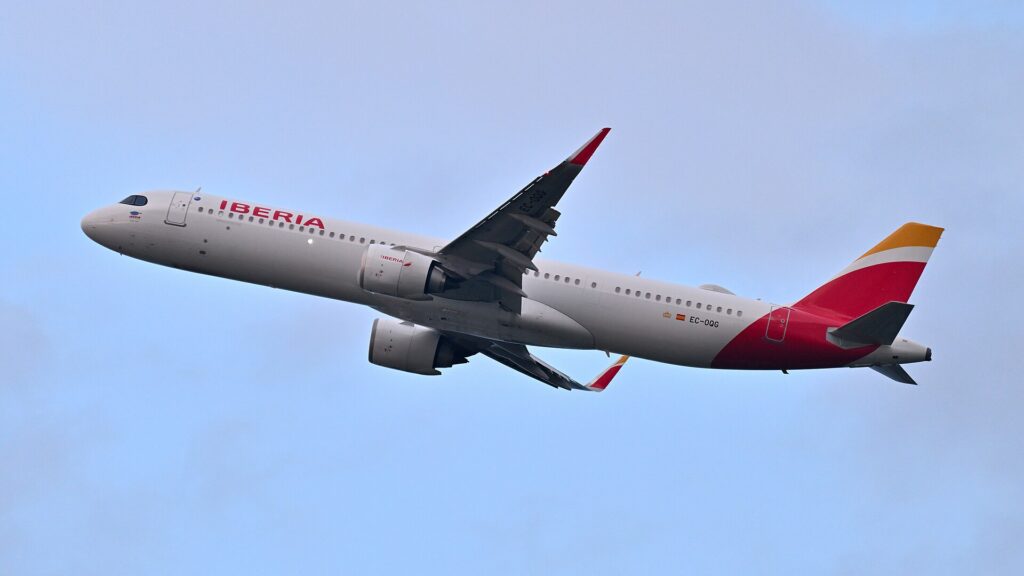
The A321LR was the first A320 family aircraft with true transatlantic range. Airbus pitched it as flying further than a Boeing 757-200 with 169 seats, at 27% lower trip costs and 24% lower costs per seat. The A321XLR flies 15% further than the LR, for up to about 11 hours. Iberia received the first XLR on 30 October 2024, and IndiGo became the first Indian airline to fly it, starting Mumbai and Delhi to Athens flights in January 2026. The trade-off: extra fuel tanks take up cargo space.
The A321neo in India
- IndiGo had 176 A321neos on 30 June 2026, making it the airline’s largest aircraft type. They fly busy domestic and international routes with 222 or 232 seats, or 220 with IndiGoStretch. IndiGo also flies 3 A321XLRs and expects more. See our IndiGo fleet guide.
- Air India had 10 A321neos in September 2026, used on busier domestic and regional routes. See our Air India fleet guide.
Globally, Wizz Air is the largest A321neo operator, followed by airlines such as IndiGo, United and Delta.
A321neo vs Its Rivals
| Airbus A321neo | Airbus A320neo | Boeing 737 MAX 8 | Boeing 737-10 | |
|---|---|---|---|---|
| Length | 44.51 m | 37.57 m | 39.5 m | 43.8 m |
| Maximum seats | 244 | 194 | 210 | 230 |
| Range | Up to 4,000 nm | Up to 3,400 nm | Up to 3,500 nm | Up to 3,100 nm |
| Engine choices | 2 | 2 | 1 | 1 |
| Long-range versions | A321LR, A321XLR | – | – | – |
| Status | In service | In service | In service | Still being certified |
Sources: Airbus and Boeing specifications.
Boeing’s closest rival in size is the 737-10, but it carries fewer passengers at maximum (230), flies less far (3,100 nm) and was only certified by the FAA on 20 October 2026. That is why Airbus dominates this segment. Against its own sibling, the A320neo, the A321neo carries up to 50 more passengers on the same cockpit and crew training; airlines pick the A320neo only where they cannot fill the extra seats. Read our A320neo review and 737 MAX 8 review for the details.
Pros and Cons
Pros
- Up to 244 seats, the most of any single-aisle jet in service
- Up to 4,000 nm; the LR and XLR versions fly further
- About 20% lower fuel per seat than the previous generation (Airbus)
- Cabin Flex lets airlines tailor exits and seats
- Wider single-aisle cabin than the Boeing 737
- Same cockpit and pilots as the A320neo
- Two engine choices
Cons
- Pratt & Whitney GTF problems grounded and delayed aircraft
- Long single-aisle cabin means slow boarding when full
- High-density layouts feel crowded
- Extra fuel tanks on the LR and XLR reduce cargo space
- FAA rules limit US aircraft to 200 passengers
Our Verdict
The A321neo has become the default choice for airlines that want the most seats and range from a single-aisle jet. It burns far less fuel per seat than the jets it replaced, and with the LR and XLR versions it can now fly routes such as India to southern Europe. Boeing has no direct answer in service.
For passengers, the experience depends on the airline: a 232-seat all-economy cabin is efficient but busy, while a two-class layout is very comfortable for a single-aisle jet. If you fly IndiGo, the A321neo is now the aircraft you are most likely to board. Compare it with the smaller A320neo in our A320neo review.
Frequently Asked Questions
How many seats does an Airbus A321neo have?
Airbus lists 180 to 220 seats in a typical two-class layout and up to 244 in a high-density layout. IndiGo flies its A321neos with 222 or 232 seats, or 220 with the IndiGoStretch cabin.
What is the range of the A321neo?
Up to 4,000 nautical miles (7,400 km), according to Airbus, for both the A321neo and the A321LR. The A321XLR flies up to 4,700 nm.
What is the difference between the A321neo, A321LR and A321XLR?
They share the same fuselage, wings and engines. The A321LR adds up to three removable extra fuel tanks in the cargo hold. The A321XLR has a permanent 12,900-litre rear centre tank and a 101.5-tonne maximum take-off weight, and flies up to 4,700 nm.
What is A321neo Cabin Flex (ACF)?
A door layout introduced in 2015 and standard since 2020. It replaces the second pair of doors with two pairs of overwing exits and moves the rear-middle doors further back, which lets airlines fit more seats. Airlines can also plug exits they do not need.
What engines does the A321neo use?
Either the CFM International LEAP-1A or the Pratt & Whitney PW1100G-JM geared turbofan, with 24,500 to 35,000 lbf of thrust.
How many A321neo does IndiGo have?
IndiGo had 176 A321neos on 30 June 2026, its largest aircraft type. Air India had 10 in September 2026.
Is the A321neo better than the A320neo?
It is bigger rather than better. The A321neo is about 7 m longer, carries up to 244 passengers against 194 and flies further, while the A320neo is cheaper to fly on routes that do not need so many seats. Both share the same cockpit and pilots.
Can the A321neo fly from India to Europe?
The long-range A321XLR can. IndiGo flies A321XLRs from Mumbai and Delhi to Athens. The standard A321neo, with 4,000 nm of range, is mainly used on domestic, Gulf and Southeast Asian routes.
Did the A321neo replace the Boeing 757?
In many fleets, yes. Airbus pitched the A321LR as having more range than a Boeing 757-200 with lower trip and seat costs, and Wikipedia describes it as replacing the 757 in the middle of the market.
Featured image: FlyingFuel graphic using a photo of Air India Airbus A321neo VT-RTE by MarcelX42, CC BY-SA 4.0, via Wikimedia Commons.
 Embraer Executive JetsEmbraer Business Jets: Phenom 100EX, Phenom 300EV, Praetor 500E and 600E Explained (2026)
 NewseasyJet to Fit Starlink Wi-Fi Across Its Airbus Fleet From 2027
 NewsFAA Proposes Fan Blade Checks on Every CFM56-7B Engine After 737 Blade Failure
 Dassault FalconDassault Falcon Jets: Every Model From the 2000LXS to the 10X Explained (2026)
 GulfstreamGulfstream Business Jets: Every Model From the G300 to the G800 Explained (2026)
 NewsBombardier to Hire 800 in the US and Spend $270 Million on First Phase of Expansion