
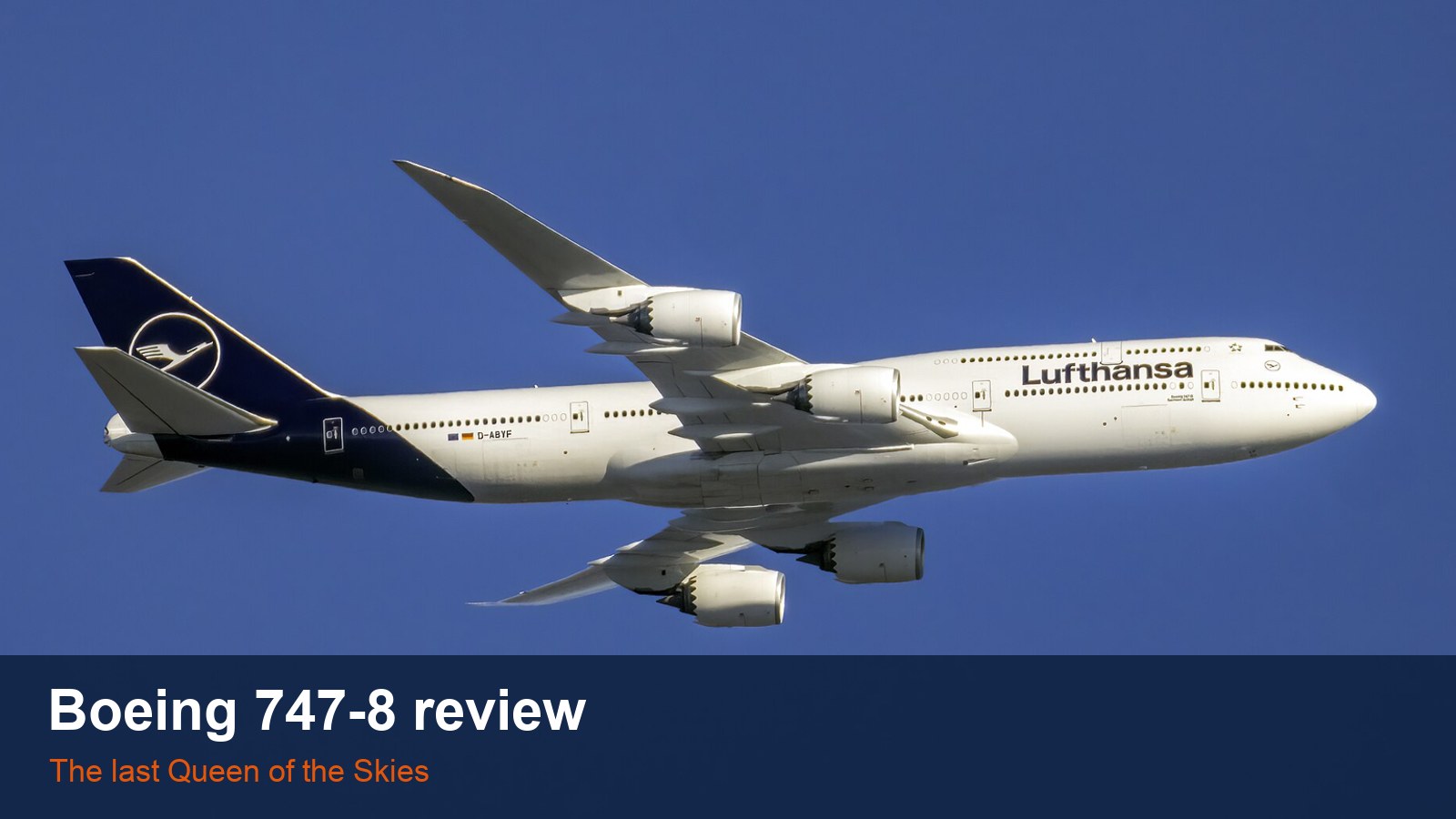
The Boeing 747-8 is the final and biggest version of the Boeing 747, the original “jumbo jet” and “Queen of the Skies”. It came in two versions: the 747-8 Intercontinental passenger jet and the 747-8 Freighter. Boeing delivered the very last one, a freighter, to Atlas Air on 31 January 2023, ending more than five decades of 747 production.
Our verdict in one line: the 747-8 is a magnificent end to a legendary line. As a freighter it is still unmatched among Western aircraft, with 140 tonnes of payload and a nose that swings open. As a passenger jet it was elegant, quiet and spacious, but four engines could not compete with the economics of big twins, so only 48 passenger versions were built.
In this review we explain everything step by step: the 747 story, what changed on the 747-8, how to recognise it, the upper deck and cabin, the GEnx-2B engines, the freighter and its nose door, who flies it, why production ended and how it compares with the Airbus A380 and Boeing 777-9.
Boeing 747-8 Quick Facts
| Item | Boeing 747-8 |
|---|---|
| Versions | 747-8 Intercontinental (passenger) and 747-8 Freighter |
| Passengers (Intercontinental) | 467 in a typical three-class layout |
| Freighter payload | 140 tonnes maximum structural payload |
| Range | About 7,790 nm (passenger); 4,475 nm (freighter, Boeing) |
| Length | 76.3 m (250 ft 2 in) |
| Wingspan | 68.4 m (224 ft 5 in) |
| Height | 19.5 m (64 ft) |
| Fuselage width | 6.5 m (21 ft 4 in) |
| Maximum take-off weight | 442 tonnes (975,000 lb), the heaviest Boeing airliner |
| Fuel capacity | 238,610 litres |
| Engines | 4 x General Electric GEnx-2B |
| First flight | 8 February 2010 (Freighter); 20 March 2011 (Intercontinental) |
| Entered service | 12 October 2011 with Cargolux; 1 June 2012 with Lufthansa |
| Built | 155 (107 freighters, 48 passenger), 2008 to 2023 |
Sources: Wikipedia: Boeing 747-8; Boeing 747-8 Freighter configuration release; Boeing final 747 delivery release.
A Short History of the 747
The 747 story began in 1967 at Boeing’s Everett factory. It was the first twin-aisle airliner and the first “jumbo jet”, and Boeing says it “shrank the world” by letting airlines fly nonstop across oceans with hundreds of passengers. Its hump, with seats on an upper deck behind the cockpit, became one of the most recognisable shapes in aviation. Boeing improved the design with the 747-400 in 1988, and over the life of the programme it built 1,574 747s.
In the early 2000s Boeing studied bigger 747s to compete with the Airbus A3XX, which became the A380. The stretched aircraft, first called the 747 Advanced, was launched as the 747-8 on 14 November 2005. The “8” was chosen to reflect its technology links with the 787 Dreamliner, according to its history. Cargolux and Nippon Cargo Airlines launched the freighter; Lufthansa became the launch customer for the passenger version.
Development was difficult. Boeing delayed the programme because of limited engineering resources, design changes and a strike, and in October 2009 took a US$1 billion charge for the delays. The Freighter first flew on 8 February 2010 and entered service with Cargolux on 12 October 2011; the Intercontinental first flew on 20 March 2011 and entered service with Lufthansa on 1 June 2012, flying Frankfurt to Washington, D.C.
What Changed on the 747-8
From a distance a 747-8 looks like a 747-400, but almost everything important was updated:
- Longer fuselage: stretched by about 5.6 m (18 ft 3.5 in), with the extra length added just in front of and behind the wing, for a total length of 76.3 m.
- New wing: deeper and thicker, holding more fuel, with a 68.4 m span and larger raked (swept-back) wingtips for better aerodynamics.
- 787 technology: new GEnx engines from the 787 family and fly-by-wire control of the ailerons and spoilers.
- More weight: a maximum take-off weight of 975,000 lb (442 tonnes), making it the heaviest airliner Boeing has built. During testing on 21 October 2010, a 747-8F took off from Victorville, California, weighing 1,005,000 lb.
747-8 vs 747-400 at a glance
| 747-400 | 747-8 | |
|---|---|---|
| Length | About 70.7 m | 76.3 m (5.6 m longer) |
| Passengers (three-class) | About 416 | 467 (51 more) |
| Cargo volume (passenger version) | Baseline | 26% more |
| Freighter cargo volume | Baseline (747-400F) | 16% more, seven extra pallets |
| Engines | Older generation | GEnx-2B, from the 787 family |
| Flight controls | Conventional | Fly-by-wire ailerons and spoilers |
| Maximum take-off weight | Lower | 442 t, heaviest Boeing airliner |
Sources: Wikipedia: Boeing 747-8; Boeing 747-8F release. 747-400 length and seats are derived from Boeing’s stated differences.
How to recognise a 747-8
- The hump: all 747s have it, but the 747-8 Intercontinental’s upper deck is longer than the 747-400’s, so the hump stretches further back.
- Wingtips: long raked wingtips that sweep back smoothly, with no upturned winglet.
- Engines: four engines with serrated chevrons on the back of the nacelles, like the 787.
- Length: noticeably longer than other 747s, with more windows between the doors.
The GEnx-2B Engines
Every 747-8 has four General Electric GEnx-2B engines. They are a smaller version of the GEnx built for the 787, so the 747-8 shares engine technology with Boeing’s most modern widebody. Wikipedia lists the GEnx-2B with a 104.7-inch fan (the 787 version has 111.1 inches), about 66,500 lbf of take-off thrust and a bypass ratio of 8:1. The GEnx family uses swept composite fan blades and a composite fan case, technology that came from the GE90.
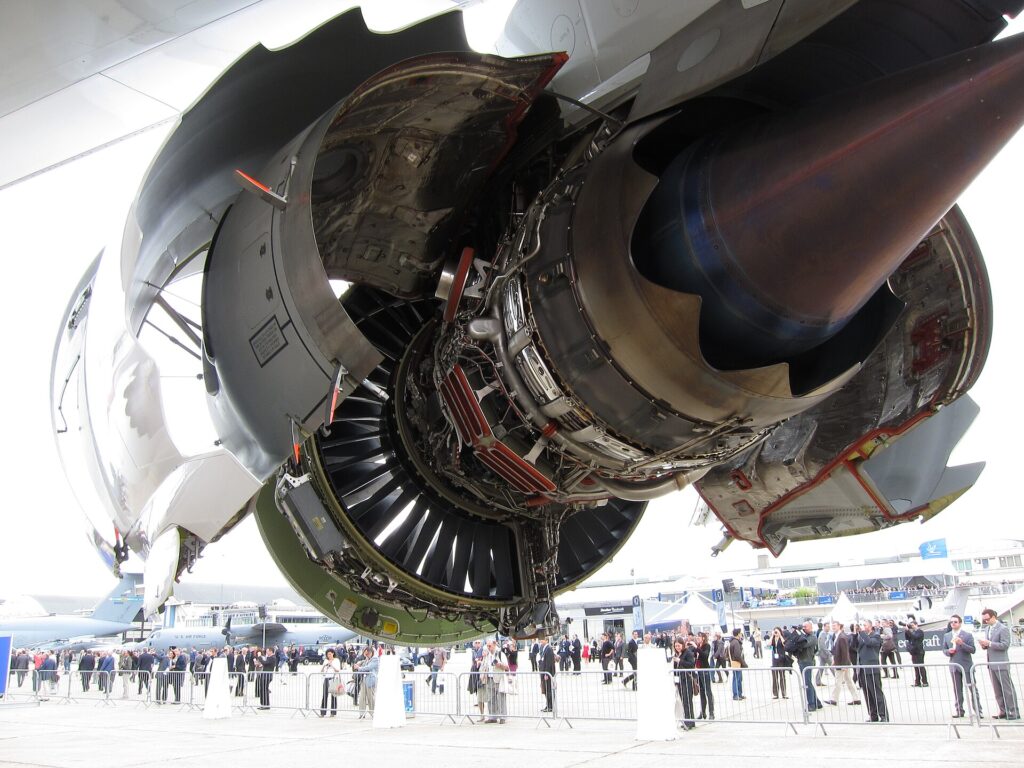
In simple words: a bigger fan pushes more air around the hot core, which is quieter and burns less fuel. The chevrons, the saw-tooth edge at the back of the engine, reduce noise further. Boeing kept improving the aircraft after service entry: a later package made the 747-8 about 9,000 lb lighter than the first production aircraft and cut fuel burn by 3.5%, partly through thinner chevrons and revised fairings. Still, four engines need more fuel and maintenance than two, which is the core of the 747-8’s problem as a passenger jet; see why twin-engine jets took over long-haul flying.
The 747-8 Intercontinental: Inside the Cabin
The passenger version, the 747-8I, carries 467 passengers in a typical three-class layout, 51 more than the 747-400, plus 26% more cargo volume, according to Wikipedia. It flies at Mach 0.855.
- Upper deck: the hump is longer than on the 747-400, giving more room upstairs for a small cabin above the main deck; each airline decides which class to put there.
- Curved stairway: a curved staircase leads from the main deck to the upper deck, and the main passenger entrance is more spacious.
- 787-style interior: the main cabin uses an interior similar to the 787’s, with curved overhead bins and a centre row designed to feel open.
- Wide main deck: the fuselage is 6.5 m (21 ft 4 in) wide.
Boeing also proposed “SkySuites” and “SkyBunks” in the unused space above the main cabin, sold at a premium, but they never went into service.
The 747-8 Freighter
The freighter is where the 747-8 really shines. Boeing, when it fixed the design in 2006, gave the 747-8F a maximum structural payload of 140 tonnes and a range of 4,475 nm (8,288 km). It is 5.6 m longer than the 747-400F and has 16% more cargo volume, enough for seven more standard pallets: four on the main deck and three in the lower hold. Like the 747-400F, its upper deck is shorter than on the passenger version.
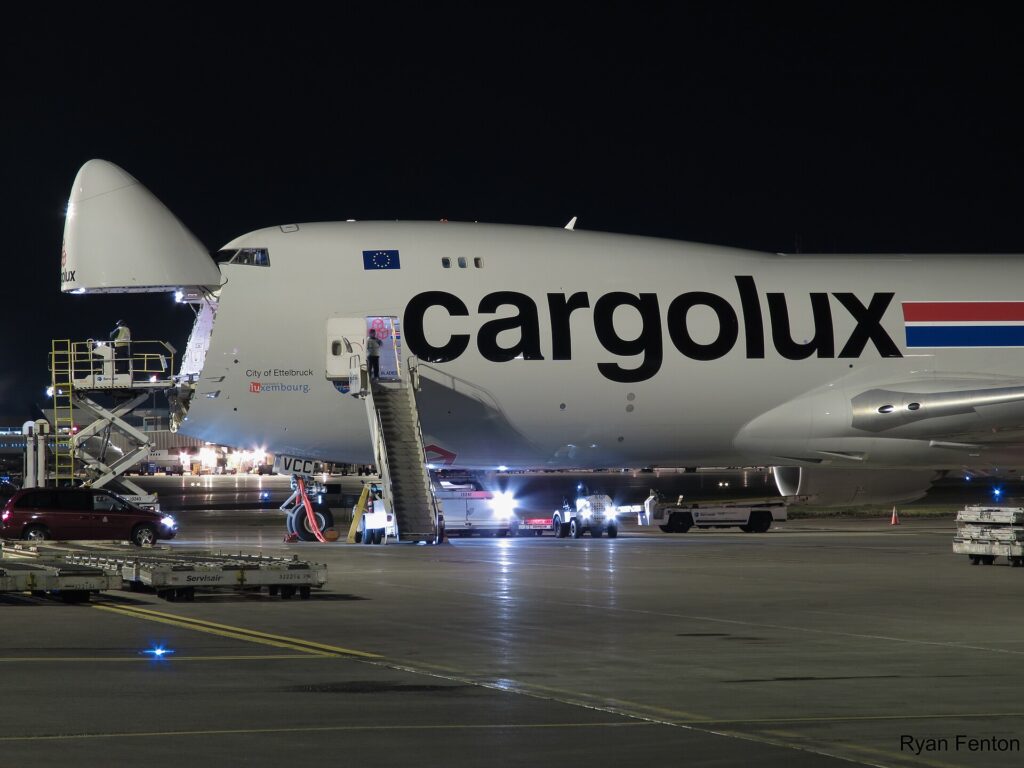
Its most famous feature is the nose door: the whole nose swings up so long or bulky items can be loaded straight into the main deck. Only the giant Antonov An-225 and An-124 can lift more; see our list of the largest cargo planes in the world.
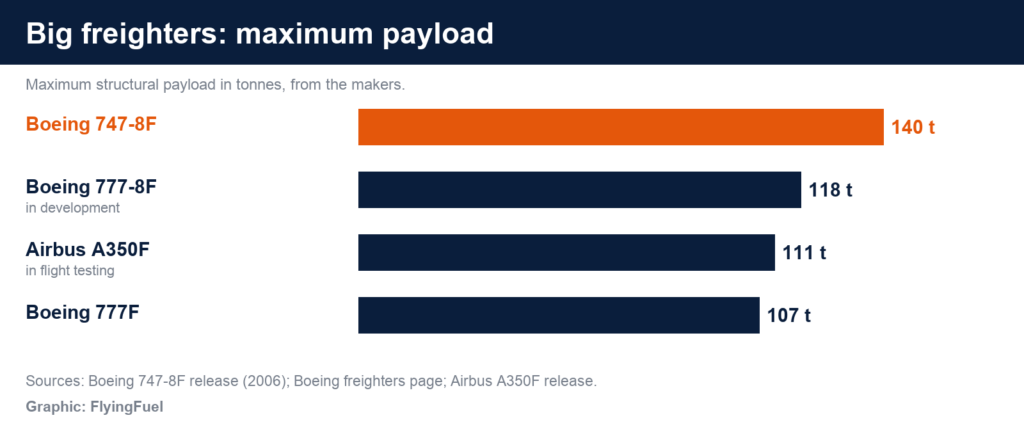
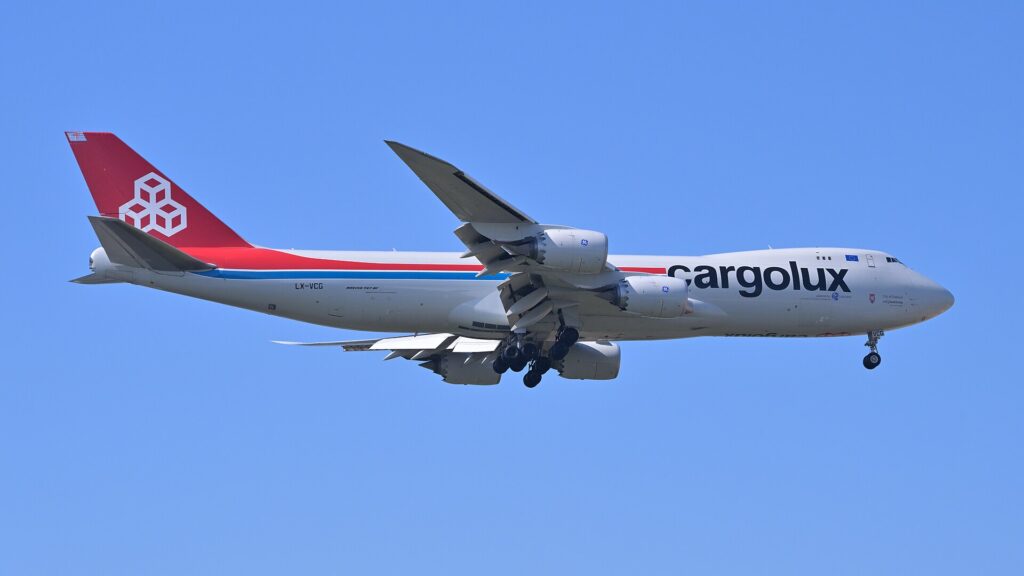
The 747-8F out-lifts every newer twin-engine freighter: the 777-8F (118 tonnes, in development), the Airbus A350F (111 tonnes, in flight testing) and the 777F (107 tonnes). That is why cargo airlines such as UPS, Cargolux and Cathay Pacific Cargo still value it highly. For the two biggest US cargo airlines, see our FedEx vs UPS comparison.
Who Flies the 747-8?
Of the 155 747-8s built, 107 were freighters and 48 passenger aircraft. The largest customers listed by Wikipedia include:
- Passenger (747-8I): Lufthansa (19), Korean Air (10) and Air China (7). Lufthansa is the biggest operator of the passenger version.
- Freighters (747-8F): UPS Airlines (now the largest 747-8 operator overall), Cargolux (14), Cathay Pacific Cargo (14), AirBridgeCargo, Polar Air Cargo, Silk Way West, Atlas Air and Nippon Cargo Airlines.
- Government: the VC-25B, the next US presidential aircraft (“Air Force One”), is based on the 747-8.
No Indian airline ordered the 747-8. The three airlines that ordered the passenger version are based in Frankfurt (Lufthansa), Seoul (Korean Air) and Beijing (Air China).
Why Production Ended
Boeing originally forecast a market of 300 747-8s. It sold about half that. The reasons, according to the aircraft’s history:
- Big twins got better. Boeing’s own 777 took away the 747’s range advantage at lower operating cost. Airlines preferred two engines to four.
- Few passenger orders. By February 2009 only Lufthansa had ordered the passenger 747-8, and Boeing considered whether to continue the programme.
- The 777-9 replaced it. The 777-9 “mini-jumbo” is projected to have a lower fuel cost per seat mile and more cargo capacity, and it has already attracted more orders than the 747-8I.
Freighter demand kept the line open for another decade, until the last 747-8F rolled out to Atlas Air in January 2023.
747-8 vs Its Rivals
747-8I vs Airbus A380
The 747-8I and A380 were the last two four-engine passenger jets in production. The A380 has two full-length passenger decks and carries more people; the 747-8 has a partial upper deck. Boeing claimed the 747-8 was more than 10% lighter per seat than the A380, used 11% less fuel per passenger, had a 21% lower trip cost and a seat-mile cost more than 6% lower. These are Boeing’s own figures, and in the end both aircraft stopped production as airlines moved to twins. For the A380 story, see our Emirates A380 fleet strategy piece.
747-8I vs Boeing 777-9
| Boeing 747-8I | Boeing 777-9 | |
|---|---|---|
| Engines | 4 x GEnx-2B | 2 x GE9X |
| Length | 76.3 m | 76.7 m |
| Passengers | 467 (three-class) | 375-450 (two-class) |
| Range | About 7,790 nm | Up to 8,000 nm |
| Maximum take-off weight | 442 t | 351.5 t |
| Status | Production ended 2023 | First delivery expected 2027 |
The 777-9 carries a little fewer passengers on two engines and about 90 tonnes less take-off weight. That is why it is the 747’s successor on busy long-haul routes. Read our Boeing 777-9 review.
Pros and Cons
Pros
- 140-tonne freighter payload, the most of any Western airliner
- Nose door for loading long and outsized cargo
- 467 passengers with a spacious, quiet upper deck
- 787-style interior and GEnx engines with chevrons
- Heaviest Boeing airliner, with about 7,790 nm range
- Iconic 747 shape, loved by passengers
Cons
- Four engines burn more fuel and cost more to maintain than big twins
- Only 48 passenger versions were built
- Production ended in January 2023
- Few operators of the passenger version
- Not flown by any Indian airline
Our Verdict
The 747-8 is the best 747 ever built and a fitting farewell to the Queen of the Skies. As a freighter it remains outstanding: nothing else in Western production can carry 140 tonnes and load through the nose. As a passenger aircraft it is spacious and graceful, and the upper deck is still one of the nicest places to sit on any airliner.
But it arrived in a world that had already chosen twin-engine jets. Its sales were a fraction of earlier 747s, and the 777-9 is now taking over its role. If you ever get the chance to fly upstairs on a Lufthansa or Korean Air 747-8, take it: there will never be another new 747. Compare it with its successor in our 777-9 review and with the 777-300ER in our 777-300ER review.
Frequently Asked Questions
Is the Boeing 747-8 still in production?
No. Boeing delivered the last 747, a 747-8 Freighter, to Atlas Air on 31 January 2023, ending production after 1,574 747s. In total 155 747-8s were built: 107 freighters and 48 passenger aircraft.
How many passengers does a 747-8 carry?
The 747-8 Intercontinental carries 467 passengers in a typical three-class layout, 51 more than the 747-400.
How long is the Boeing 747-8?
76.3 m (250 ft 2 in). It is 5.6 m longer than the 747-400 and was the longest airliner in service when it entered service.
How much can a 747-8 Freighter carry?
Boeing gave the 747-8F a maximum structural payload of 140 tonnes and a range of 4,475 nm. It has 16% more cargo volume than the 747-400F, enough for seven more standard pallets.
What engines does the 747-8 have?
Four General Electric GEnx-2B engines, a smaller version of the GEnx built for the 787 Dreamliner, with a 104.7-inch fan and chevrons on the nacelle to reduce noise.
Which airlines fly the 747-8 passenger version?
Lufthansa, Korean Air and Air China ordered the 747-8 Intercontinental. Lufthansa was the launch customer and flew the first passenger service, from Frankfurt to Washington, on 1 June 2012.
Is the 747-8 better than the A380?
The A380 carries more passengers on two full decks. Boeing claimed the 747-8 was more than 10% lighter per seat and burned 11% less fuel per passenger than the A380. Both lost out to big twins such as the 777-300ER and A350-1000.
Why did the 747-8 sell so few passenger aircraft?
Airlines preferred large twin-engine jets such as the 777, which cost less to run and later offered similar range. By February 2009 only Lufthansa had ordered the passenger 747-8, and the 777-9 has since attracted more orders than the 747-8I.
Is the new Air Force One a 747-8?
Yes. The VC-25B, the new US presidential aircraft, is based on the Boeing 747-8.
Featured image: FlyingFuel graphic using a photo of Lufthansa Boeing 747-8 D-ABYF by Acroterion, CC BY-SA 4.0, via Wikimedia Commons.
 GulfstreamGulfstream Business Jets: Every Model From the G300 to the G800 Explained (2026)
 NewsBombardier to Hire 800 in the US and Spend $270 Million on First Phase of Expansion
 NewsAll Passengers Flying to the US Must Sign an Ebola Travel Attestation From 3 November
 BombardierBombardier Business Jets: Every Global and Challenger Model Explained (2026)
 NewsSafran LEAP Engine Deliveries Rise 26% to 1,565 in First Nine Months of 2026
 NewsEmbraer Order Backlog Hits Record $35.7 Billion as E2 Jet Orders Grow