
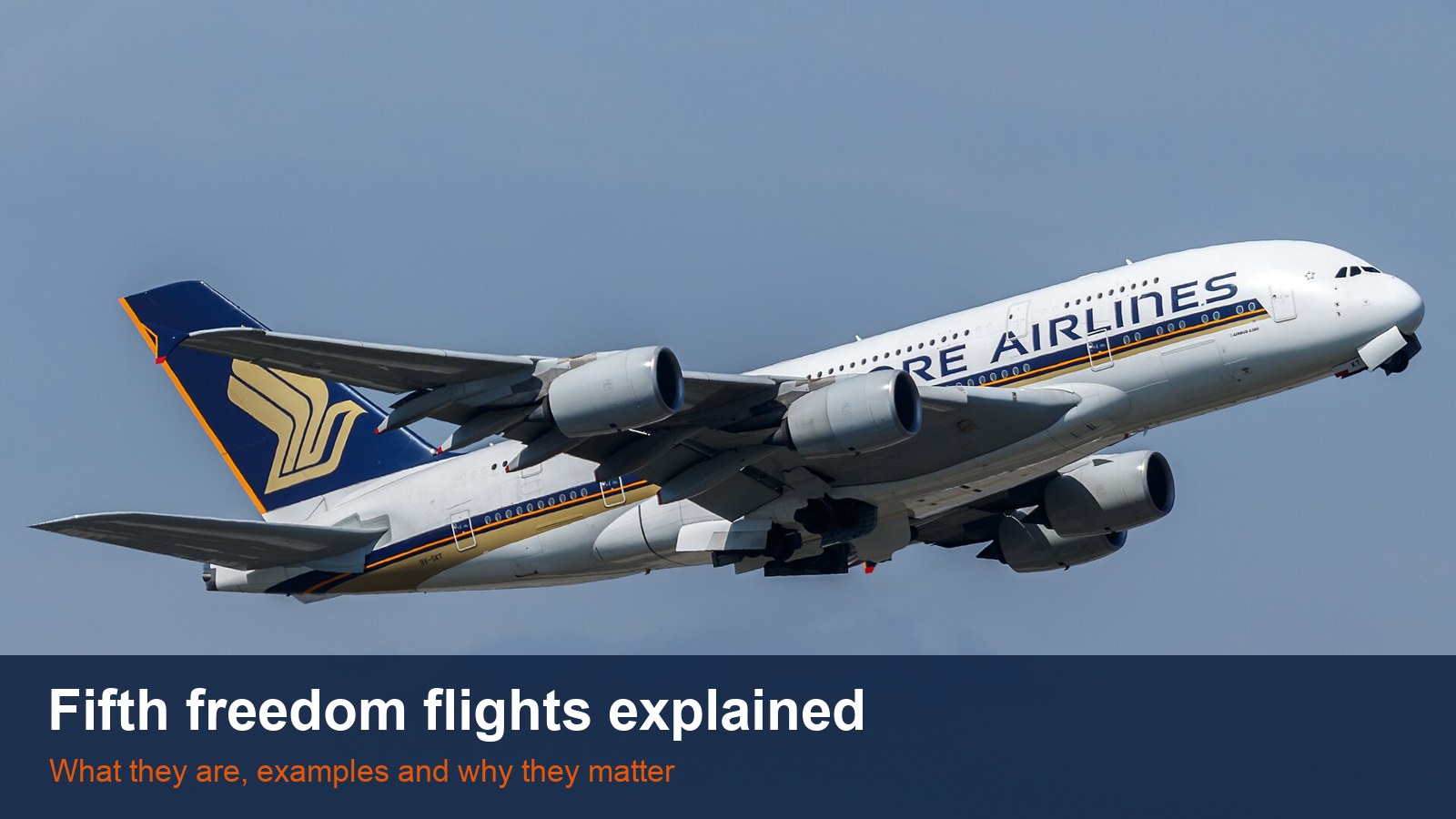
Have you ever seen an airline from Singapore flying passengers from Frankfurt to New York, or an Australian airline selling tickets from Singapore to London? These are fifth freedom flights, one of the most interesting and least understood parts of international aviation. They let an airline carry passengers between two countries that are not its own, as part of a longer route that starts or ends at home.
In one line: a fifth freedom flight is a leg flown by a foreign airline between two other countries, with its own aircraft, crew and flight number, on a route connected to its home country. Passengers can buy a ticket for just that leg.
In this guide we explain it step by step: the nine freedoms of the air in plain words, how fifth freedom flights work, real examples, India’s history with them, why countries limit them, how to spot and book one, and how they differ from codeshare flights and sixth freedom hubs.
What Are the Freedoms of the Air?
An airline cannot simply fly wherever it wants. To fly over, land in or carry passengers to another country, it needs permission. The freedoms of the air are a standard list of those permissions. According to Wikipedia, they came out of disagreements at the Chicago Convention of 1944, the treaty that created the rules of international civil aviation. The United States wanted wide-open skies, while most other countries feared that big US airlines would dominate unless there were strict rules.
The compromise was a numbered list of rights. Countries then grant these rights to each other in bilateral air services agreements, which also set limits such as how many flights a week each side may operate, which airlines may fly and which airports they may use. The first two freedoms are about passing through a country; the rest are about carrying paying traffic.
The Nine Freedoms in Plain Words
| Freedom | What it allows | Example (from Wikipedia) |
|---|---|---|
| 1st | Fly over a foreign country without landing | A Mexican airline flying Canada to Mexico over the United States |
| 2nd | Land in a foreign country only to refuel or for maintenance, without passengers getting on or off | A British airline flying UK to US with a fuel stop at Shannon, Ireland |
| 3rd | Fly passengers from your own country to another | A New Zealand airline flying New Zealand to Japan |
| 4th | Fly passengers from another country back to your own | A Brazilian airline flying Chile to Brazil |
| 5th | Fly passengers between two foreign countries, on a journey starting or ending in your own country | A Malaysian airline flying Melbourne to Kuala Lumpur via Denpasar, selling Melbourne to Denpasar tickets |
| 6th | Fly passengers between two foreign countries via a stop in your own country | A Chilean airline flying New Zealand to Colombia via Santiago |
| 7th | Fly between two foreign countries without touching your own | An Irish airline flying Spain to Sweden |
| 8th | Fly within a foreign country, as part of a route to or from your own country | A South African airline flying San Francisco to Cape Town via New York, selling San Francisco to New York |
| 9th | Fly within a foreign country with no link to your own | A German airline flying Paris to Lyon |
Source: Wikipedia: Freedoms of the air.
The first five freedoms are officially listed in international treaties, especially the Chicago Convention. The sixth to ninth are unofficial: no broad treaty recognises them, but some countries agree to them in their own deals. As a rule, the lower-numbered freedoms are almost universal, while the higher-numbered ones are rarer and more controversial.
How a Fifth Freedom Flight Works
Take the classic example. Singapore Airlines flight SQ 26 flies from Singapore to New York (JFK) with a stop in Frankfurt. The flight has three possible journeys:
- Singapore to Frankfurt: a normal third freedom journey from Singapore’s home country.
- Singapore to New York: passengers stay on board through Frankfurt.
- Frankfurt to New York: the fifth freedom leg. Germany and the United States are both foreign to Singapore Airlines, yet it can sell tickets for this leg alone.
Wikipedia uses SQ 26 as its example of a fifth freedom traffic right, where tickets may be sold on all legs. The same flight number is used throughout. Wikipedia also notes that each leg can even be flown by a different aircraft, as long as the same flight number is used.
For this to happen, three governments must agree: Singapore, Germany and the United States. Germany has to let Singapore Airlines pick up passengers in Frankfurt for the US, and the US has to let it bring them in from Germany. That is why fifth freedom rights take a long time to negotiate.
Three kinds of fifth freedom
- Intermediate point: the foreign stop is between the home country and the final destination, like Frankfurt on SQ 26.
- Beyond point: the airline flies to a foreign country and then continues beyond it to a third country.
- Behind point: the airline serves points behind its home country, outside the two countries of the main agreement.
Real Fifth Freedom Flights Today
According to Wikipedia, as of 2024 Qantas operated two fifth freedom services:
- Auckland to New York (JFK): part of flights QF3 and QF4 between Sydney and New York. Wikipedia lists it as the fifth-longest scheduled flight in the world.
- Singapore to London Heathrow: part of flights QF1 and QF2 between Sydney and London.
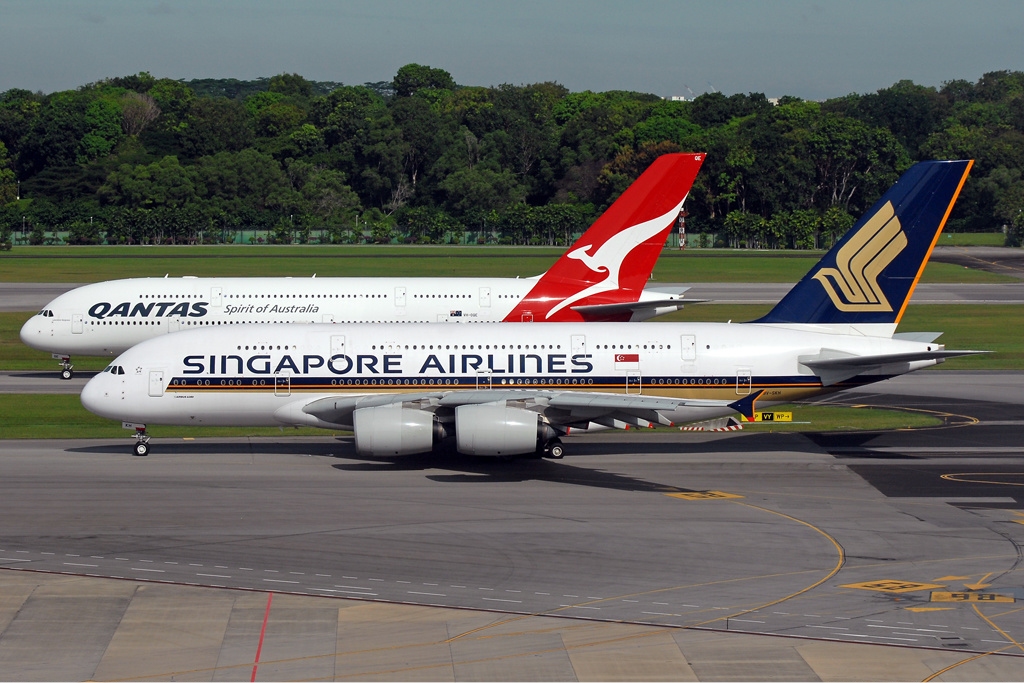
There are many more around the world, especially in Asia. Wikipedia notes that fifth freedom flights remained very common in East Asia during the 2000s, particularly on routes serving Tokyo, Hong Kong and Bangkok. In 2004, at least four airlines based outside both Hong Kong and Bangkok flew between those two cities. The Singapore to Bangkok route was also a big fifth freedom market: in the late 1990s, half of the seats between the two cities were offered by airlines with fifth freedom rights.
Because airline schedules change often, always check the current timetable. A route that was a fifth freedom flight last year may now be nonstop, or may have been dropped.
Why Fifth Freedom Flights Exist
The main reason is economics. A very long route can be hard to fill with passengers going all the way. By stopping in a big city halfway and selling seats on each leg, an airline fills empty seats and makes the whole route pay.
Before the 1980s, this was how long-haul flying worked. Aircraft could not fly very far nonstop, so flights hopped from country to country, picking up and dropping off passengers along the way. Wikipedia gives an example: in the mid-1980s an Alitalia service flew from Rome to Tokyo via Athens, Delhi, Bangkok and Hong Kong. Fifth freedom flights were common between Europe and Africa, South America and the Far East.
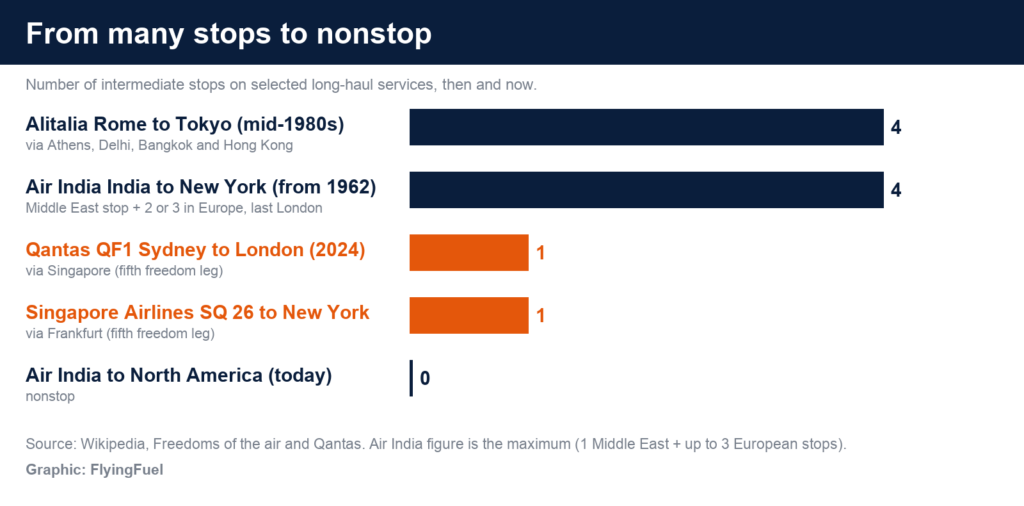
Then aircraft got better. Longer-range twin-engine jets, and growing passenger numbers, made more nonstop flights possible from the early 1980s. Today, long-range jets fly most long routes nonstop; see our longest flights in the world and why twin-engine jets took over long-haul. But fifth freedom stops still make sense where a stopover city is a big market in its own right, or where an aircraft must stop anyway.
Airlines also seek fifth freedom rights to start routes that nobody else serves, or when their flights already make a technical stop somewhere, so they might as well sell seats from there. Some governments, such as Thailand, have encouraged fifth freedom flights to bring in more tourists by adding seats.
India and Fifth Freedom Flights
India has a long history with fifth freedom flying. According to Wikipedia, until the 1980s all Air India flights to New York were operated under fifth freedom rights. From the start of Boeing 707 service in 1962, flights stopped at one Middle East airport (Kuwait, Cairo or Beirut), then two or three European airports, the last always London Heathrow, before crossing the Atlantic. This continued well into the Boeing 747 era.
Today, Air India’s North American flights are nonstop Boeing 777 services. Wikipedia mentions a later revival of a fifth freedom route, Newark to London Heathrow to Ahmedabad with a Boeing 787, which Air India does not currently operate. See our Air India fleet guide for the aircraft that make those nonstop flights possible.
For Indian travellers today, the bigger story is the sixth freedom, explained below: Gulf and Southeast Asian airlines carrying Indian passengers to Europe, the Americas and Australia through their home hubs.
Why Countries Limit Fifth Freedom Rights
Fifth freedom rights are, in Wikipedia’s words, the most controversial of the “beyond rights”. Here is why:
- Unfair competition worries: local airlines and governments often see a foreign airline selling seats between two other countries as unfair, especially if it is subsidised or has lower costs.
- Three countries must agree: negotiations are slow because at least three governments are involved.
- Protecting the flag carrier: even when tourism would benefit from more seats, governments may resist in order to protect their own national airline.
- Unequal deals: a famous example is the 1952 Japan-United States agreement, which gave US airlines unlimited fifth freedom rights beyond Japan to Asia-Pacific destinations. In the early 1990s Japan refused a New York to Osaka to Sydney route, arguing that only about 10% of the traffic on the Japan to Australia leg was actually travelling to or from the US.
Even when fifth freedom rights exist, limits on capacity and frequency may mean an airline can only use them for stopover passengers, or cannot carry local traffic at all. A small example: South African flights to St Helena have to refuel at Walvis Bay in Namibia but are not allowed to board new passengers there.
These three are often confused. Here is the difference:
| Fifth freedom | Sixth freedom | Codeshare | |
|---|---|---|---|
| What it is | An airline flies passengers between two foreign countries | An airline connects passengers between two foreign countries through its home hub | An airline sells seats on another airline’s flight under its own flight number |
| Who operates the flight | The foreign airline itself | The airline itself, on two flights via its hub | The partner airline |
| Example | Singapore Airlines Frankfurt to New York | A Gulf airline flying India to Europe via its home airport | A seat sold by one alliance airline on its partner’s flight |
| Officially recognised? | Yes (Chicago Convention) | No, but widely practised | A commercial agreement, not a freedom |
Wikipedia notes that sixth freedom traffic has long been widespread in Asia. Thai Airways and Singapore Airlines carried passengers between Europe and Australia on the Kangaroo Route via their hubs, and more recently Persian Gulf airlines have built huge intercontinental sixth freedom hubs. Qantas has complained that Emirates, Singapore Airlines and other sixth freedom airlines have an unfair advantage between Europe and Australia. For more on how partner airlines share flights, read what is a codeshare flight and airline alliances explained.
How to Spot and Book a Fifth Freedom Flight
- Look at the airline, not the route: if an airline from a third country flies between two cities you are travelling between, it may be a fifth freedom flight.
- Check the flight number: the same flight number continues from the airline’s home country, through the stop, to the final destination.
- Search the leg directly: book the two cities you need on the airline’s website. If it has traffic rights on that leg, it can sell you that leg alone.
- Expect a long-haul aircraft: because the flight is part of a long route, you will often get the aircraft and cabin used on the full long-haul journey.
- Check the schedule often: these routes change when airlines buy longer-range aircraft or governments change agreements.
For frequent travellers and aviation fans, fifth freedom flights can be a fun way to try a foreign airline’s product on a route where it normally would not fly.
The Other Freedoms in Brief
First and second freedoms: transit rights
These let an airline pass through a country without carrying local traffic. The International Air Services Transit Agreement, the “Two Freedoms Agreement”, had been accepted by 133 countries by the end of 2017; India is a member. Countries can charge fees for overflight; the US charges by distance flown in its airspace. In 2022, after Russia blocked Western airlines from its airspace, flights from the EU to Japan began flying over Central Asia and China instead.
The second freedom, technical stops, is rarely used by passenger airlines now that aircraft fly further, but it is still common for cargo airlines. Shannon in Ireland was the stop for most transatlantic flights until the 1960s, and Anchorage in Alaska was used by flights between Europe and East Asia while Soviet airspace was closed.
Seventh to ninth freedoms: cabotage
These let an airline fly between or within foreign countries with no link to home. Carrying domestic passengers inside a foreign country, called cabotage, is extremely rare outside the European Union, where airlines from any member state can fly routes within other member states. Australia and New Zealand also created a single aviation market in 1996.
Key Takeaways
- A fifth freedom flight is a leg flown by a foreign airline between two other countries, on a route linked to its home country.
- The freedoms of the air date back to the 1944 Chicago Convention; the first five are officially recognised.
- Classic examples include Singapore Airlines via Frankfurt to New York and Qantas via Singapore to London.
- Until the 1980s, Air India reached New York only through fifth freedom stops in the Middle East and Europe.
- Long-range aircraft made many fifth freedom stops unnecessary, and governments still limit them to protect local airlines.
Frequently Asked Questions
What is a fifth freedom flight in simple words?
A flight where an airline carries paying passengers between two foreign countries, as part of a route that starts or ends in its own country. For example, Singapore Airlines flies Singapore to New York via Frankfurt and can sell tickets for just Frankfurt to New York, even though neither city is in Singapore.
What are the freedoms of the air?
A set of international aviation rights that let airlines fly over, stop in and carry passengers between countries. They grew out of the 1944 Chicago Convention. The first five are officially listed in international treaties; the sixth to ninth are unofficial but appear in some agreements.
No. On a codeshare, one airline sells seats on another airline’s flight under its own flight number. On a fifth freedom flight, the airline actually operates the flight between two foreign countries with its own aircraft and crew.
Can I book only the middle leg of a fifth freedom flight?
Yes, if the airline has fifth freedom traffic rights on that leg, it can sell tickets for that leg alone. That is the whole point of the right. Search for the two cities directly on the airline’s website.
What is the difference between fifth and sixth freedom?
On a fifth freedom flight the airline carries passengers between two foreign countries with a stop outside its home country. Sixth freedom means carrying passengers between two foreign countries by connecting them through the airline’s home hub, like a Gulf airline flying passengers from India to Europe via its home airport.
Why do countries limit fifth freedom rights?
Local airlines and governments often see them as unfair competition, because a foreign airline gets to sell seats on a route between two countries that are not its own. Negotiations are slow because at least three countries must agree.
Did Air India fly fifth freedom flights?
Yes. Until the 1980s, all Air India flights to New York were fifth freedom services, stopping in the Middle East and in Europe, with the last leg from London Heathrow to New York. Today its North American flights are nonstop.
What is the second freedom of the air?
The right to stop in a foreign country only to refuel or for maintenance, without picking up or dropping off passengers. Shannon in Ireland and Anchorage in Alaska were famous technical-stop airports.
What is cabotage in aviation?
Carrying passengers between two points inside a foreign country, called the eighth or ninth freedom. It is very rare outside the European Union, where airlines from member states can fly domestic routes in other member states.
Featured image: FlyingFuel graphic using a photo of Singapore Airlines Airbus A380 9V-SKT climbing out of Frankfurt by tjdarmstadt, CC BY 2.0, via Wikimedia Commons.
 Embraer Executive JetsEmbraer Business Jets: Phenom 100EX, Phenom 300EV, Praetor 500E and 600E Explained (2026)
 NewseasyJet to Fit Starlink Wi-Fi Across Its Airbus Fleet From 2027
 NewsFAA Proposes Fan Blade Checks on Every CFM56-7B Engine After 737 Blade Failure
 Dassault FalconDassault Falcon Jets: Every Model From the 2000LXS to the 10X Explained (2026)
 GulfstreamGulfstream Business Jets: Every Model From the G300 to the G800 Explained (2026)
 NewsBombardier to Hire 800 in the US and Spend $270 Million on First Phase of Expansion