
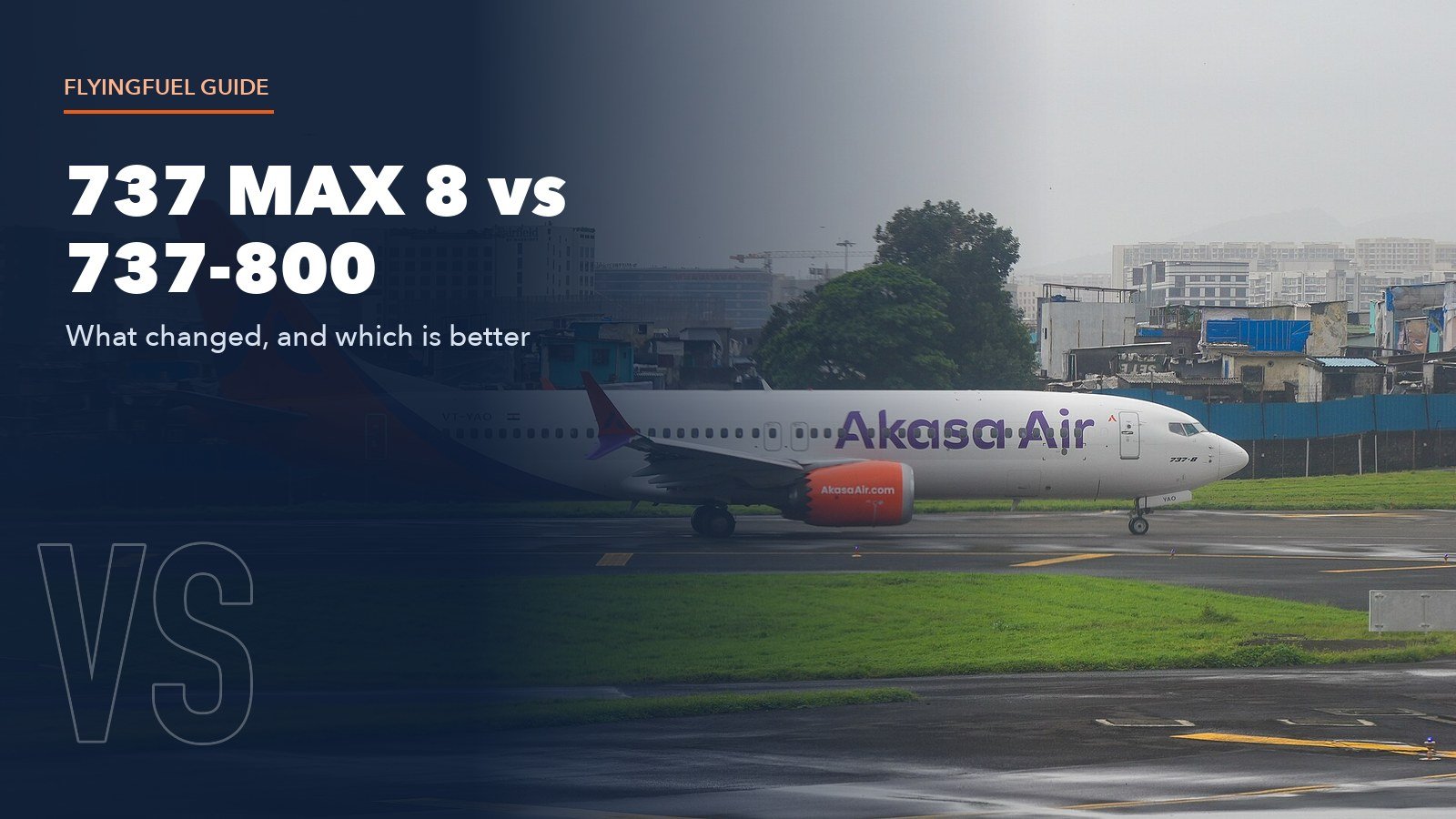
In India, if you fly Air India Express you could board either a Boeing 737-800 or its replacement, the 737 MAX 8; on Akasa Air it is always the MAX. In the US and Europe, the same two jets carry millions of passengers a year. They look almost identical, but under the skin a lot changed. Here is how they compare on range, seats, engines, fuel, noise, cabin and safety.
Quick answer: the 737 MAX 8 is the newer, more efficient version: same length, but bigger LEAP-1B engines, new winglets, up to 210 seats and about 3,500 nm of range, with Boeing claiming 20% less fuel than the previous generation. The 737-800 carries up to 189 people about 2,927 nm and went out of production in 2020.
737 MAX 8 vs 737-800: Specs Side by Side
| Item | Boeing 737 MAX 8 (737-8) | Boeing 737-800 |
|---|---|---|
| Seats (two-class) | 160-180 | About 160 |
| Maximum seats | 210 | 189 |
| Range | Up to 3,500 nm (6,480 km) | About 2,927 nm (5,420 km) |
| Length | 39.5 m | 39.47 m |
| Wingspan | 35.9 m | 35.79 m with winglets |
| Maximum take-off weight | 82,640 kg | 79,016 kg |
| Fuel capacity | 25,816 litres | 26,022 litres |
| Engines | 2 x CFM LEAP-1B | 2 x CFM56-7B |
| Fan diameter / blades | 69.4 in / 18 carbon-fibre | 61 in / 24 titanium |
| Bypass ratio | About 9:1 | 5.1-5.5:1 |
| First flight | 29 January 2016 | 31 July 1997 |
| Entered service | May 2017, Malindo Air | April 1998, Hapag-Lloyd Flug |
| In production | Yes | No (last delivered January 2020) |
Sources: Boeing 737 MAX technical specifications; Wikipedia: Boeing 737 MAX; Wikipedia: Boeing 737 Next Generation (737-800 with CFM56-7B26); engine data from Wikipedia’s CFM LEAP and 737 MAX articles.
Why Boeing Built the MAX
The 737-800 was Boeing’s best-seller: 5,238 ordered, the most of any 737 Next Generation model. Its successor, the 737 MAX, keeps the 737 airframe but adds new, more efficient engines and aerodynamic changes. It first flew on 29 January 2016 and entered service in May 2017. The MAX 8 is the direct replacement for the 737-800, almost exactly the same length.
Range and Weight
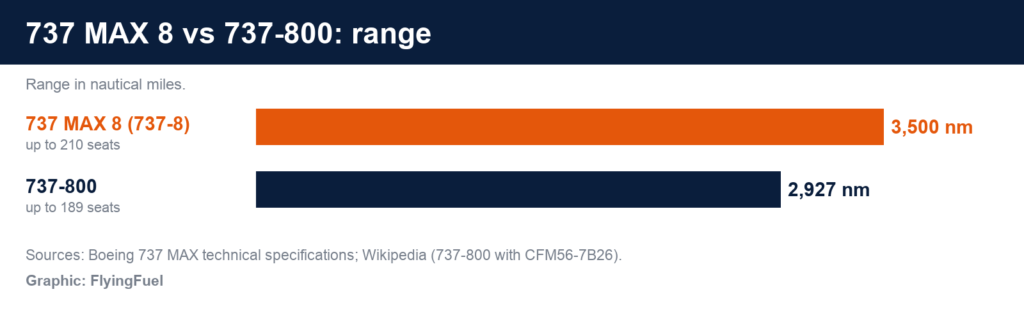
The MAX 8 can take off at 82,640 kg, about 3.6 tonnes more than the 737-800, and its engines burn less fuel, so it flies about 570 nm further: 3,500 nm against 2,927 nm. Boeing says that is enough for routes such as Delhi to Singapore. Oddly, the MAX 8 carries slightly less fuel (25,816 litres against 26,022); the gain comes from the engines and aerodynamics. See what MTOW means.
Engines: LEAP-1B vs CFM56-7B
This is the biggest change. The 737-800 uses the CFM56-7B, a 61-inch fan with 24 titanium blades and a bypass ratio of about 5:1. The MAX uses the CFM LEAP-1B, with a 69.4-inch fan of 18 woven carbon-fibre blades and a bypass ratio of about 9:1, plus ceramic composite parts and some of the first FAA-certified 3D-printed parts in a commercial jet engine. A higher bypass ratio means the fan pushes more air around the engine core, which saves fuel and cuts noise.
Fitting a bigger engine under a low-slung 737 was not easy. Boeing lengthened the nose gear by 6 to 8 inches and mounted the engines higher and further forward. That change in handling is what the MCAS software was designed to manage (see the safety section). Boeing says the MAX family uses 20% less fuel and emits 20% less CO2 than the previous generation. Our turbofan guide explains how bypass works.
How to Tell Them Apart
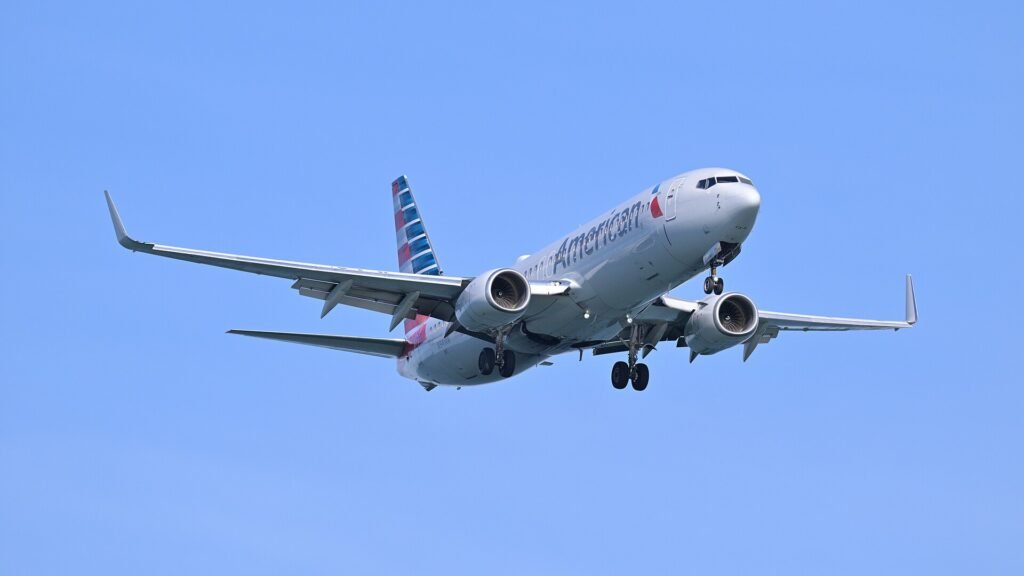
- Wingtips: the MAX has split winglets, one blade up and a smaller one down. Most 737-800s have a single tall blended winglet; some have Split Scimitar retrofit winglets that look similar.
- Engines: MAX engines are bigger and have serrated chevrons at the rear of the nacelle; CFM56-7B exhausts are smooth.
- Tail: the MAX has a redesigned, more streamlined tail section, which Boeing says saves up to 1% of fuel.
- Nose gear: 6 to 8 inches longer on the MAX, to give the bigger engines ground clearance.
Cabin and Noise
The fuselage cross-section is the same, so economy is six-abreast (3-3) on both, and seat width and pitch depend on the airline. The MAX comes with the Boeing Sky Interior: larger pivoting overhead bins, LED mood lighting and, Boeing says, windows 20% larger than on other single-aisle airplanes. Some later 737-800s also have the Sky Interior, so cabins vary from aircraft to aircraft.
The MAX is noticeably quieter. Boeing says the 737-8 has a 50% smaller noise footprint than the 737-800 around airports, and Akasa Air says its cabins are 40% quieter. Maximum seating is 210 on the MAX 8 against 189 on the 737-800; Air India Express fits 189 seats in its 737-800s.
Safety
Boeing’s analysis of accidents from 1959 to 2017 gave the 737 Next Generation a hull-loss rate of 0.17 per million departures. Its deadliest accident was Jeju Air Flight 2216 in South Korea in December 2024, which killed 179 of 181 on board; in India, Air India Express lost 737-800s at Mangaluru in 2010 and Kozhikode in 2020.
The MAX had a worse start. Faulty MCAS behaviour contributed to Lion Air Flight 610 (October 2018) and Ethiopian Airlines Flight 302 (March 2019), which killed 346 people, and the MAX was grounded worldwide from March 2019. Before it returned in late 2020, an FAA airworthiness directive required MCAS to use both angle-of-attack sensors, to activate only once and to be overridable by pilots, plus new pilot training. In January 2024 a door plug blew out on a 737 MAX 9 (Alaska Airlines Flight 1282), which brought new scrutiny of Boeing’s production. Our 737 MAX 8 review covers the fixes in detail.
In India: Air India Express and Akasa
Air India Express had 26 Boeing 737-800s and 53 737 MAX 8s in October 2026, according to the Wikipedia fleet table, and is replacing older jets with the MAX. Akasa Air flies an all-737 MAX fleet. For the Airbus rival used by IndiGo, see A320neo vs 737 MAX 8, and for Boeing’s bigger MAX, 737 MAX 8 vs A321neo.
Pros and Cons
Boeing 737 MAX 8
- Pros: about 570 nm more range; 20% less fuel (Boeing); 50% smaller noise footprint; up to 210 seats; in production
- Cons: troubled start (MCAS, 2019-2020 grounding); one engine choice; same narrow 737 cabin
Boeing 737-800
- Pros: proven over 25+ years; 5,238 ordered; freighter conversions available (737-800BCF)
- Cons: thirstier and noisier; 2,927 nm range; out of production since 2020
Our Verdict
For airlines, the 737 MAX 8 is the clear successor: more range, more seats and lower fuel burn in the same-size airframe. For passengers the differences are smaller: the cabin is the same width, but the MAX is quieter and usually newer inside. If you want the quieter, newer cabin, check whether your flight is on a 737-8 or 737 MAX 8 when you book.
Frequently Asked Questions
What is the difference between the 737-800 and the 737 MAX 8?
The MAX 8 (officially the 737-8) is the 737-800’s replacement. It is the same length (about 39.5 m) but has bigger CFM LEAP-1B engines, split-tip winglets, a higher maximum take-off weight (82,640 kg against 79,016 kg) and more range (3,500 nm against 2,927 nm). Boeing says the MAX family uses 20% less fuel than the previous generation.
How can I tell a 737 MAX 8 from a 737-800?
Look at the wingtips and engines. The MAX has split winglets (one blade up, a smaller one down) and engines with serrated chevrons at the back. Most 737-800s have a single tall blended winglet and smooth engine exhausts, though some carry Split Scimitar retrofit winglets that look similar.
Which has more seats, the 737 MAX 8 or the 737-800?
The MAX 8 can take up to 210 seats against 189 for the 737-800, both limited by their emergency exits. In two classes both seat about 160 to 180.
Is the 737 MAX 8 safe now?
After two crashes in 2018 and 2019 that killed 346 people, the MAX was grounded worldwide from March 2019. An FAA airworthiness directive required changes before it returned in late 2020: MCAS now needs input from both angle-of-attack sensors, cannot activate repeatedly, and pilots received new training.
Is the 737-800 still being built?
No. Boeing stopped assembling passenger 737 Next Generation aircraft in 2019, and the final deliveries went to China Eastern on 5 January 2020. 5,238 737-800s were ordered.
Which is quieter, the 737 MAX 8 or the 737-800?
The MAX 8. Boeing says the 737-8 has a 50% smaller noise footprint than the 737-800, and Akasa Air says it gives a quieter cabin with 40% less noise.
Does Air India Express fly the 737-800 or the 737 MAX 8?
Both. Air India Express had 26 737-800s (189 seats each) and 53 737 MAX 8s in October 2026, according to the Wikipedia fleet table. Akasa Air flies only the 737 MAX.
Which engines do the 737 MAX 8 and 737-800 use?
The MAX uses the CFM LEAP-1B, with a 69.4-inch fan of 18 woven carbon-fibre blades and a bypass ratio of about 9:1. The 737-800 uses the CFM56-7B, with a 61-inch fan of 24 titanium blades and a bypass ratio of 5.1 to 5.5:1.
Does the 737 MAX 8 have bigger windows than the 737-800?
Boeing says MAX windows are 20% larger than on other single-aisle airplanes. The MAX also has the Boeing Sky Interior with pivoting overhead bins and LED mood lighting, which was also fitted to later 737-800s.
Featured image: FlyingFuel graphic using a photo of Akasa Air Boeing 737 MAX 8 VT-YAO at Mumbai by Timothy A. Gonsalves, CC BY-SA 4.0, via Wikimedia Commons.
 NewsMalaysia Airlines to Buy 10 Boeing 787-10 Dreamliners to Replace Its Airbus A350s From 2032
 AirportsAirports in Odisha: Bhubaneswar, Jharsuguda, Jeypore and More Ranked (2026 Data)
 NewsNew Visakhapatnam Airport at Bhogapuram to Charge Rs 890 Per Departing Domestic Passenger From 1 December
 AirportsAirports in Karnataka: Bengaluru, Mangaluru, Hubballi, Belagavi and More Ranked (2026 Data)
 Aircraft ComparisonsAirbus A350-900 vs Boeing 777-300ER: Which Long-Haul Jet Is Better? (2026)
 NewsTSA Says It Could Screen More Than 3 Million Passengers on the Sunday After Thanksgiving