

The Boeing 787-8 is where the Dreamliner story began: the first 787 to fly, the first to carry passengers, and still the most common widebody in the Air India fleet. It is the shortest member of the family, built to fly a few hundred people a very long way, and it introduced ideas passengers now take for granted, from a lower cabin altitude to electronically dimmed windows.
Our verdict in one line: the 787-8 is a long-range jet with a mid-size cabin, 200-275 seats and up to 8,000 nm, which makes it ideal for opening long routes that could never fill a bigger aircraft. Its weaknesses are age-related: early aircraft carry the 787’s production and engine troubles, older cabins can feel dated, and it is the model fewest airlines now order.
This review explains what makes the 787-8 different from its bigger siblings, what it is like inside, its engines and cockpit, its safety record, its role at Air India, and how it compares with the 787-9 and the Airbus A330-900. For a side-by-side look at the two, see our 787-8 vs 787-9 comparison.
Boeing 787-8 Quick Facts
| Item | Boeing 787-8 |
|---|---|
| Type | Twin-aisle (widebody) twin-engine airliner |
| Seats (two-class) | 200 to 275 (typical 248) |
| Range | Up to 8,000 nm (14,820 km) |
| Length | 56.7 m (186 ft 1 in) |
| Wingspan | 60.1 m (197 ft 3 in) |
| Height | 16.9 m (55 ft 6 in) |
| Maximum take-off weight | 227,930 kg (502,500 lb) |
| Engines | GE Aerospace GEnx-1B or Rolls-Royce Trent 1000 |
| First flight | 15 December 2009 |
| Certified | 26 August 2011 (FAA and EASA) |
| Entered service | October 2011, All Nippon Airways |
| ICAO type code | B788 |
Sources: Boeing 787 technical specifications; Wikipedia: Boeing 787 Dreamliner.
The First Dreamliner
Boeing announced the 7E7 on 29 January 2003 and launched it on 26 April 2004 with an order for 50 aircraft from All Nippon Airways (ANA). ANA originally wanted a mix of short-range 787-3s and long-haul 787-8s; by January 2010 all Japanese orders had been switched to the 787-8 and Boeing cancelled the 787-3, Wikipedia records. The 787-8 was the base model, aimed at replacing the Boeing 767-200ER and at opening new nonstop routes where larger aircraft would not pay.
The programme ran about three years late. Early airframes were overweight, and Boeing wrote off two 2009 flight-test aircraft in 2016. The first 787-8 finally flew on 15 December 2009 from Paine Field in Everett, landing three hours later at Seattle’s Boeing Field. The FAA and EASA certified it on 26 August 2011, and ANA flew the first passenger service in October 2011.
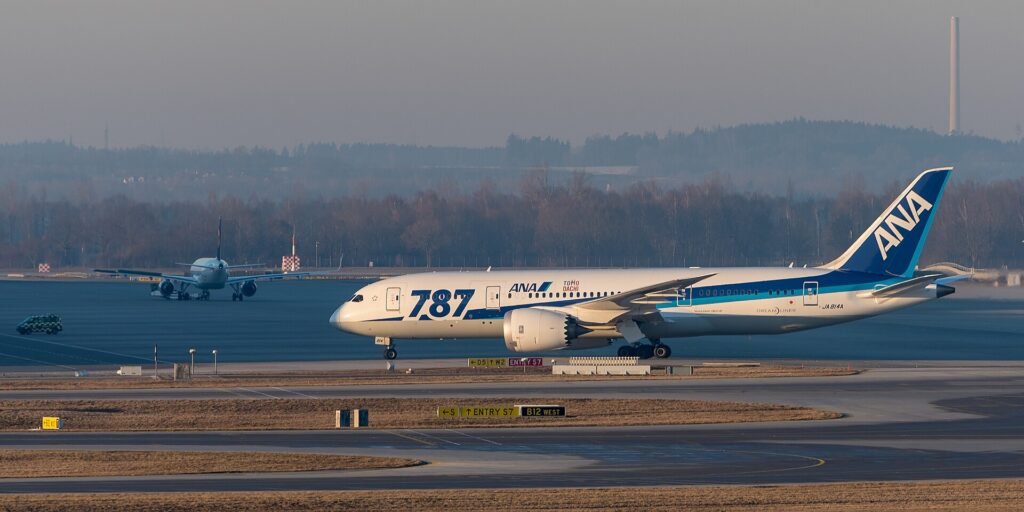
Reliability improved quickly once airlines got used to it: Wikipedia says the 787-8 started with about 96% dispatch reliability, reached about 98.5% in April 2015 and 99.3% in 2017, while daily use rose from five hours in 2013 to twelve in 2014.
Why the 787 Is Different
The 787 was the first production airliner with a fuselage made of one-piece carbon-fibre composite barrels instead of riveted aluminium panels; Boeing says about half of the airframe by weight is composite. It is also “bleedless”: it uses electric compressors rather than hot engine air to pressurise the cabin. Boeing said at launch the 787 would burn about 20% less fuel than the 767. For the full explanation of the composite body and the cabin features, see our 787-9 Dreamliner review; the 787-8 shares all of them.
How to tell a 787-8 from a 787-9
- Length: the 787-8 is 56.7 m, the 787-9 62.8 m. On the 787-8 the body looks short and stubby compared with the long wings.
- Wingspan: both are 60.1 m, so the 787-8 has the largest wingspan relative to its length of the three 787s.
- Type code: B788 on flight-tracking apps, against B789 and B78X.
Inside the Cabin
The 787-8 cabin has the same cross-section and passenger features as every 787: a cabin altitude of 6,000 ft instead of the 8,000 ft of older jets, more humid air, the largest windows of any widebody, dimmed electronically instead of with shades, and full-colour LED mood lighting. It is simply shorter.
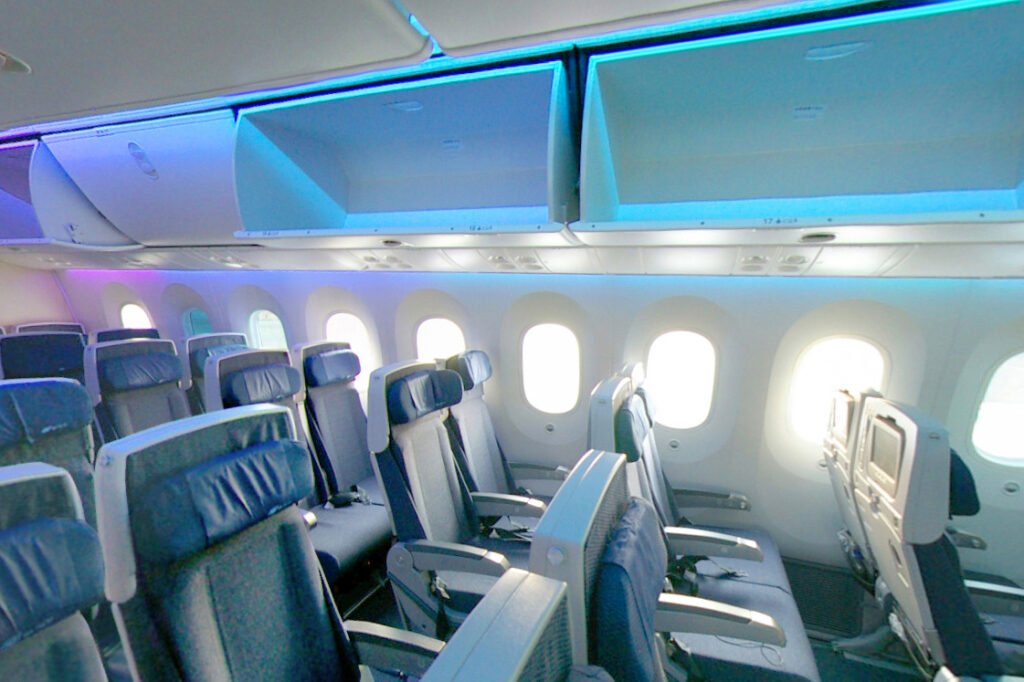
Wikipedia says the 787-8 typically seats 234 in three classes or 240 in a two-class domestic layout, and up to 296 in high-density economy. Premium cabins range from four to seven seats per row (1-2-1, 2-2-2 or 2-3-2); economy is eight (2-4-2) or, more often, nine (3-3-3) abreast, where seats get tight. Because the 787-8 is often one of an airline’s older widebodies, cabin quality varies widely: check the seat map and the age of the cabin.
Air India’s retrofit
Air India has started refitting its 787-8s. In April 2026 it unveiled the first, VT-ANT (the aircraft in our featured image), after a nose-to-tail cabin refresh that changed it from a two-class to a three-class layout; Air India says the work took about 12,825 man-hours over 45 days. See our Air India fleet guide for the full fleet.
Cockpit
The flight deck is the same across the 787 family: fly-by-wire controls with traditional control yokes, large LCD displays and dual head-up displays, according to Boeing. Boeing says the layout and handling are close enough to the 777 that pilots can move between the two with little extra training, which suits airlines like Air India that fly both.

Engines
Airlines choose between two engines: the GE Aerospace GEnx-1B and the Rolls-Royce Trent 1000. Both are high-bypass turbofans with very large fans that push most of the air around the engine core. The Trent 1000 had a difficult period from 2016, when turbine blade cracking grounded up to 44 787s across the family, and Rolls-Royce later introduced the improved Trent 1000 TEN. For a full side-by-side of the two engines, see the engines section of our 787-9 review and our guide to how turbofans work.
Range: Small Plane, Long Legs

Boeing lists the 787-8 at up to 8,000 nm, only 300 nm less than the 787-9, with a maximum take-off weight of 227,930 kg, about 31 tonnes less than the 787-9. Wikipedia notes that the 787-8’s long wing makes it more efficient on longer flights. That combination of long range and fewer seats is the 787-8’s whole point: an airline can fly a thin long-haul route without having to fill 300 seats.
| Model | Seats (two-class) | Range | Length | Max take-off weight |
|---|---|---|---|---|
| 787-8 | 200-275 | 8,000 nm | 56.7 m | 227,930 kg |
| 787-9 | 250-325 | 8,300 nm | 62.8 m | 259,220 kg |
| 787-10 | 300-375 | 7,500 nm | 68.3 m | 260,360 kg |
Source: Boeing 787 technical specifications. All three share the 60.1 m wingspan and the same engine choices.
Wikipedia says the 787-8 and 787-9 share only about 50% of their parts: the 787-9’s wing, fuselage and systems needed a major redesign, and in 2018 Boeing said it would change the 787-8’s production to raise commonality with the 787-9. Compare the bigger two in 787-9 vs 787-10.
Safety Record
The 787 family had a long safe record until 2025. In January 2013 the FAA grounded all 787s for about three months over lithium-ion battery fires, and from January 2021 to August 2022 production quality problems almost stopped deliveries. Then, on 12 June 2025, Air India Flight 171, a 787-8 registered VT-ANB, crashed shortly after take-off from Ahmedabad on its way to London Gatwick. All but one of the 242 people on board died, along with 19 people on the ground. It was the first fatal accident and first hull loss of any 787. The preliminary report by India’s Aircraft Accident Investigation Bureau said both engines shut down after their fuel control switches moved from RUN to CUTOFF; the cause of that movement is still under investigation, and the report did not recommend any action for Boeing or 787 operators. We will update this review when the final report is published. For how investigators work, see our report on an AAIB investigation.
787-8 vs Its Rivals
787-8 vs Airbus A330-900
| Boeing 787-8 | Airbus A330-900 | |
|---|---|---|
| Seats | 200-275 (two-class) | Up to 287 (Airbus); 310 optimised |
| Range | Up to 8,000 nm | Up to 7,350 nm |
| Length | 56.7 m | 63.69 m |
| Maximum take-off weight | 227.9 t | 251 t |
| Engines | GEnx-1B or Trent 1000 | Trent 7000 only |
| Body | Carbon-fibre composite | Mostly aluminium, new wing |
Sources: Boeing; Airbus figures as compiled in our A330-900neo review.
The 787-8 flies about 650 nm further with fewer seats and a lighter, composite airframe; the A330-900 is longer and carries more passengers. The choice usually comes down to route length and how many seats an airline can fill.
787-8 vs 787-9
For most airlines ordering today, the 787-9 is the default choice: about 50 more seats and slightly more range for a modest weight penalty. The 787-8 makes sense where demand is thinner, which is why only about 26% of 787 orders are for it.
Pros and Cons
Pros
- Up to 8,000 nm range with only 200-275 seats: ideal for thin long-haul routes
- All the 787 passenger features: 6,000 ft cabin altitude, humid air, big dimmable windows
- About 20% less fuel than the 767 it replaces (Boeing’s target at launch)
- Choice of GE or Rolls-Royce engines
- Common cockpit with the 787-9, 787-10 and similar to the 777
Cons
- Smallest and least ordered 787; airlines now prefer the 787-9
- Only about 50% common with the 787-9
- Many airframes are older, with dated cabins until retrofitted
- Nine-abreast economy is tight
- Trent 1000 engine problems and the 2025 Air India accident under investigation
Our Verdict
The 787-8 changed long-haul flying by proving that a mid-size twin could fly 8,000 nm efficiently and profitably on routes too thin for a 777 or 747. It remains a comfortable aircraft to fly in, especially in a refreshed cabin. But it has been overtaken by its own stretched sibling, and in India its reputation now depends on Air India’s retrofit programme and the final AI171 report. For the bigger picture, read our 787-9 vs A350-900 comparison and our list of the longest flights from India.
Frequently Asked Questions
How many seats does a Boeing 787-8 have?
Boeing lists 200 to 275 seats in a typical two-class layout. Wikipedia gives 248 as a typical figure, 234 in three classes and up to 296 in a high-density economy layout.
What is the range of the 787-8?
Boeing lists up to 8,000 nautical miles (14,820 km). That is only 300 nm less than the larger 787-9 and 500 nm more than the 787-10.
What is the difference between the 787-8 and the 787-9?
The 787-9 is 6.1 m longer (62.8 m against 56.7 m), carries about 50 more passengers and flies 300 nm further, with a 31-tonne higher maximum take-off weight. Both have the same 60.1 m wingspan and engine choices; Wikipedia says the two share only about 50% of their parts.
How many 787-8s does Air India have?
Air India had 26 Boeing 787-8s in September 2026, its most numerous widebody, according to its fleet media kit. It is retrofitting them; the first refreshed aircraft, VT-ANT, was unveiled in April 2026 with a new three-class cabin.
Which aircraft was Air India Flight 171?
A Boeing 787-8, VT-ANB, which crashed shortly after take-off from Ahmedabad on 12 June 2025. It is the only fatal accident of the 787 family. The preliminary report by India’s Aircraft Accident Investigation Bureau said both engines shut down after their fuel control switches moved to CUTOFF; the cause is still under investigation.
When did the 787-8 first fly?
On 15 December 2009 from Paine Field in Everett, Washington. It was certified by the FAA and EASA on 26 August 2011 and entered service with All Nippon Airways in October 2011.
What engines does the 787-8 use?
Airlines choose either the GE Aerospace GEnx-1B or the Rolls-Royce Trent 1000. Both are high-bypass turbofans; the Trent 1000 had turbine blade problems from 2016 that grounded up to 44 aircraft across the 787 family.
Is the 787-8 still being built?
It is still on Boeing’s product list, but it is the least ordered model: Wikipedia says about 26% of 787 orders are for the 787-8, with 386 delivered.
What did the 787-8 replace?
Boeing aimed it at replacing the Boeing 767-200ER and at opening new nonstop routes where bigger jets would not be economic, and said the 787 would burn about 20% less fuel than the 767.
Featured image: FlyingFuel graphic using a photo of Air India Boeing 787-8 VT-ANT at London Heathrow by John Taggart from Sunbury on Thames, Middlesex, CC BY-SA 2.0, via Wikimedia Commons.
 Aircraft ComparisonsBoeing 737 MAX 8 vs 737-800: What Changed and Which Is Better? (2026)
 NewsMalaysia Airlines to Buy 10 Boeing 787-10 Dreamliners to Replace Its Airbus A350s From 2032
 AirportsAirports in Odisha: Bhubaneswar, Jharsuguda, Jeypore and More Ranked (2026 Data)
 NewsNew Visakhapatnam Airport at Bhogapuram to Charge Rs 890 Per Departing Domestic Passenger From 1 December
 AirportsAirports in Karnataka: Bengaluru, Mangaluru, Hubballi, Belagavi and More Ranked (2026 Data)
 Aircraft ComparisonsAirbus A350-900 vs Boeing 777-300ER: Which Long-Haul Jet Is Better? (2026)