

Summary
- India’s AAIB has published its final report on a serious incident at Goa’s Dabolim airport on 3 April 2026, when an Air India Express Boeing 737-8 entered the runway while an Indian Navy fighter was taking off
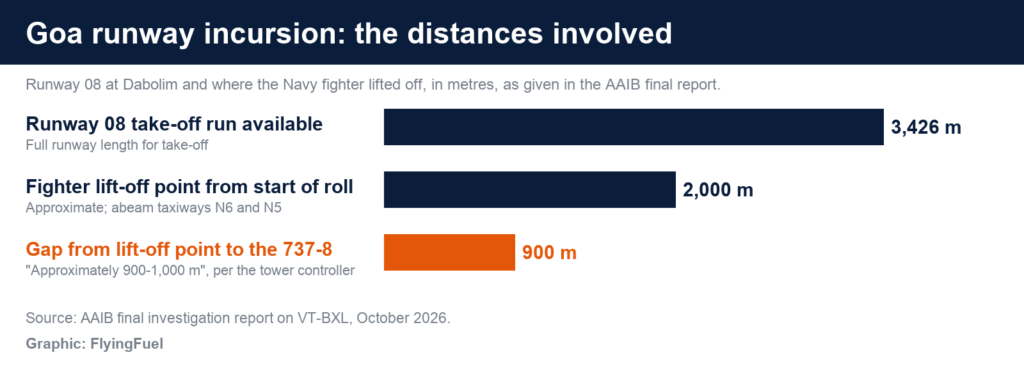
- The fighter lifted off roughly 900-1,000 metres from the airliner; none of the 171 people on board the 737-8 was hurt and neither aircraft was damaged
- The probable causes were a misread “expect backtrack” radio call and taxi instructions that were not fully followed; the AAIB has made recommendations to the airline, AAI, the Navy and the DGCA
NEW DELHI, India, 3 November 2026 – India’s Aircraft Accident Investigation Bureau (AAIB) has released its final report into a runway incursion at Dabolim airport in Goa on 3 April 2026. An Air India Express Boeing 737-8, registration VT-BXL, entered the active runway without clearance while an Indian Navy fighter was on its take-off roll. The report was first covered by PTI and Business Today on 31 October.
The AAIB notes that, under Annex 13 of the Chicago Convention and India’s investigation rules, the sole aim of its work is to prevent future accidents and incidents, not to apportion blame or liability.
What happened on 3 April
Flight AXB-1109 was a scheduled service from Goa to Delhi with 171 people on board: six crew and 165 passengers. The captain was a line training captain, and the first officer was a trainee on supervised line flying, according to the report.
Shortly before the jet taxied, the runway in use changed from 26 to 08. The ground (surface movement) controller, from the Airports Authority of India, told the crew to expect a backtrack and then to taxi via taxiway N2 and hold at the runway 08 holding point. The read-back left out “hold at holding point”, and the controller did not pick this up. When the crew were told to contact Navy air traffic control on 119.7 MHz, they added “entering runway” to their reply; that call was not acknowledged, and the aircraft entered the runway before making contact on the new frequency.
At the same time, the Navy tower had cleared a single-seat fighter to take off from runway 08. The tower warned the fighter pilot that an unidentified aircraft had entered the runway. The report says the fighter expedited its take-off and lifted off about 2,000 metres down the runway, roughly 900-1,000 metres from the 737-8, and reached about 450 ft as it passed over the runway near taxiway N3. The Air India Express jet later vacated the runway, waited for a second Navy fighter to depart, and took off for Delhi.
What the AAIB found
The report lists two probable causes:
- The pilot flying took the ground controller’s “expect backtrack” call to be a clearance to enter the runway and backtrack, and did not ask for clarification.
- The crew did not fully follow the instructions to hold at the holding point and contact Navy approach on 119.7 MHz. Had they stopped and made positive contact with Navy ATC first, the report says, the incident could have been avoided.
As contributory factors, the AAIB says the trainee first officer, acting as pilot monitoring, was overly reliant on the instructor and was busy with heads-down take-off calculations after the runway change. It also cites a hear-back error: the ground controller did not insist on a complete read-back of the “hold at holding point” instruction. Other findings note that the ground controller, who had just taken over the shift, was not clear about the runway change, and that runway slope meant the two crews could not see each other from where they were.

Recommendations and changes already made
Dabolim is a civil enclave run by the Airports Authority of India (AAI) inside the Navy air base INS Hansa, which provides the tower and approach control. The report makes recommendations to all the parties involved:
- Air India Express: counselling for the crew, training for the captain on the lapses, and a circular to all crew.
- AAI: a circular to controllers on standard phraseology, a review of phrases such as “expect backtrack”, and treating taxiway N2 as a hotspot because of its closeness to the civil apron.
- Indian Navy (INS Hansa): publish its stop bars and their use in the Aeronautical Information Publication, and set a standard procedure for civil aircraft changing from the ground to the tower frequency.
- DGCA: set up, as a priority, a formal framework for sharing information between civil investigators and the defence services.
Some changes are already in place. The report says the Navy and AAI amended their coordination procedure on 20 April 2026, and that ground controllers now confirm the runway in use and frequency change-over with Navy ATC on a hotline when they take over a shift. FlyingFuel had not seen a public statement from Air India Express on the report at the time of publishing.
Why runway incursions matter
A runway incursion is any case of an aircraft, vehicle or person being on a runway where they should not be. The AAIB warns that the Goa event could have had catastrophic consequences, particularly if the fighter had suffered an emergency during its take-off roll, because the Navy pilot knew he no longer had the full runway available to stop. For passengers, events like this are rare, and they are investigated in detail so that procedures change; our guide to go-arounds explains another way pilots and controllers keep runways safe.
Read more
- Air India fleet explained, including Air India Express
- Boeing 737 MAX 8 review: cabin, cockpit, engines and safety
- The largest airports in India by passengers, with AAI data
- What is a go-around? Why pilots abort a landing
Sources: AAIB final investigation report on VT-BXL, October 2026; PTI via ETV Bharat, 31 October 2026; Business Today, 31 October 2026; The Hindu BusinessLine, 31 October 2026.
Featured image: FlyingFuel graphic using a photo of Air India Express Boeing 737-8 VT-BXY by Krish Aarush, CC BY-SA 4.0, via Wikimedia Commons.
 Aircraft ComparisonsBoeing vs Airbus: How to Tell the Difference (Nose, Windows, Wings, Engines)
 Aircraft ComparisonsPilatus PC-24 vs Embraer Phenom 300E: Which Light Jet Is Better? (2026)
 PilatusPilatus PC-24 Review: The Jet That Lands on Grass and Gravel (2026)
 Aircraft ComparisonsBombardier Global 6500 vs Gulfstream G600: Same Range, Different Jets (2026)
 BombardierBombardier Global 6500 Review: Range, Cabin, Speed and Price (2026)
 Aircraft ComparisonsEmbraer Praetor 600E vs Bombardier Challenger 3500: Which Super-Midsize Jet Wins? (2026)