
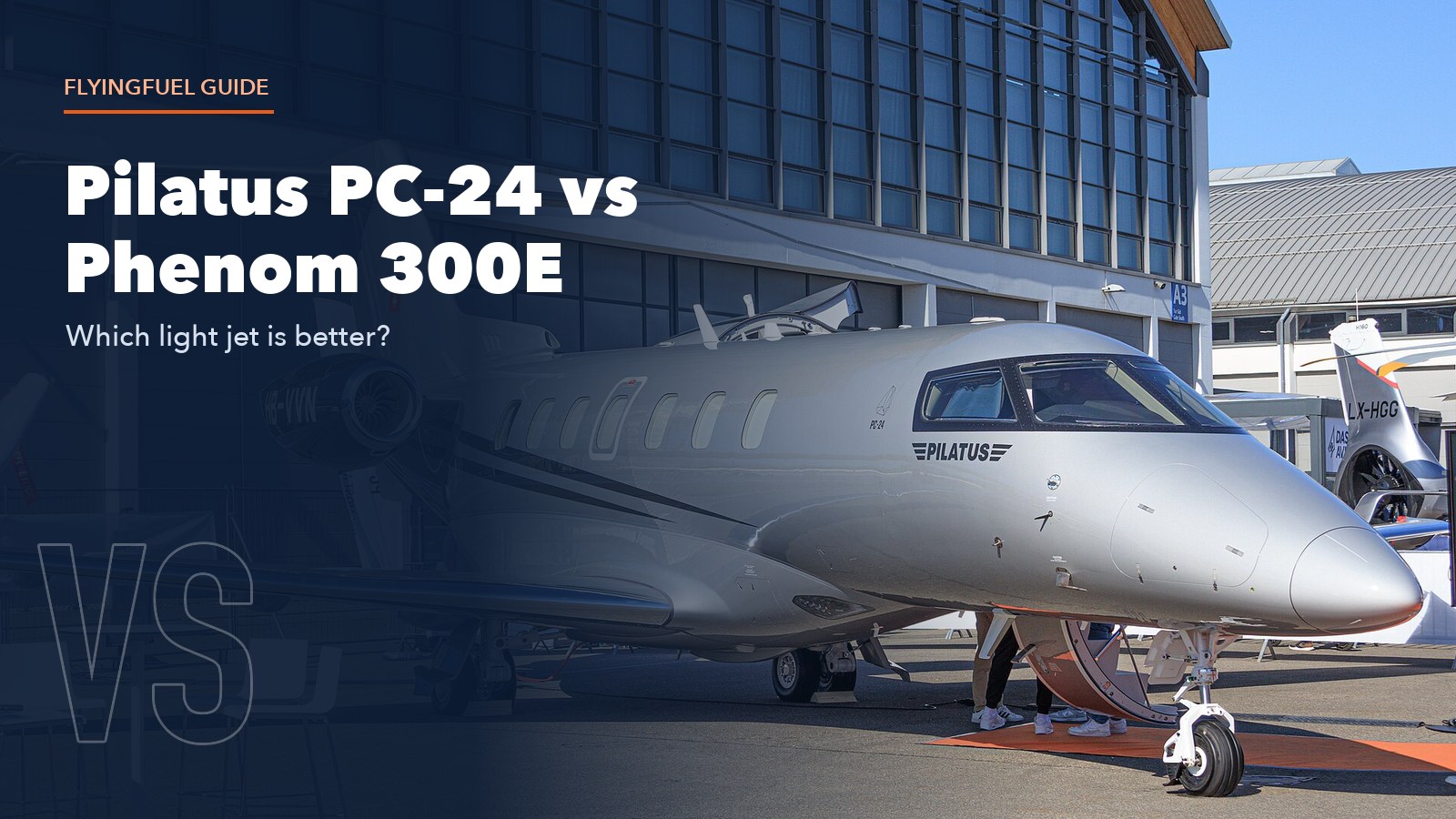
The Embraer Phenom 300E is the best-selling light jet of recent years. The Pilatus PC-24 is the most unusual one: a jet that can land on grass and gravel and carries a cargo door. They fly about the same distance and cost about the same, so the choice comes down to how and where you fly.
Quick answer: the Phenom 300E is faster (464 kt) and a little cheaper (about US$11 million in early 2023), and lands in a shorter distance on paved runways. The PC-24 has a cabin nearly 6 ft longer, a standard cargo door, a shorter take-off and is certified for unpaved runways. Choose the Phenom for speed and value, the PC-24 for space and versatility.
Figures come from Pilatus PC-24 technical data and the Embraer Phenom 300E brochure, with prices from Wikipedia. Full reviews: Pilatus PC-24 review and Embraer Phenom 300E review.
PC-24 vs Phenom 300E at a Glance
| Pilatus PC-24 | Embraer Phenom 300E | |
|---|---|---|
| Range | 2,040 nm (4 passengers) | 2,010 nm (5 occupants) |
| Speed | 440 KTAS maximum cruise | 464 kt high-speed cruise; Mach 0.80 max |
| Occupants | 6 to 8 executive, up to 10 commuter | 6 to 8 typical, up to 10 with one pilot |
| Cabin (L x W x H) | 23 ft 0 in x 5 ft 7 in x 5 ft 1 in | 17 ft 2 in x 5 ft 1 in x 4 ft 11 in |
| Cabin volume / baggage | 498 cu ft / 90 cu ft | Not compared / 84 cu ft |
| Cargo door | Standard, 4 ft 1 in x 4 ft 3 in | No |
| Unpaved runways | Certified | No |
| Take-off distance | 3,090 ft (over 50 ft obstacle) | 3,209 ft |
| Landing distance | 2,410 ft (over 50 ft obstacle) | 2,212 ft |
| Engines | 2 x Williams FJ44-4A QPM, 3,420 lbf | 2 x P&WC PW535E1, 3,478 lbf |
| Maximum altitude | 45,000 ft | 45,000 ft |
| Single-pilot | Yes | Yes |
| Price | About US$12.2m (2023) | About US$11.0m (early 2023) |
Sources: Pilatus: PC-24, Embraer Phenom 300E brochure; cabin size and prices from Wikipedia: PC-24 and Wikipedia: Phenom 300. Each maker measures range and runway distances its own way.
Cabin: The PC-24 Is Much Bigger

The PC-24 cabin is 23 ft long, nearly 6 ft longer than the Phenom 300E’s 17 ft 2 in, and 6 in wider. Neither is a stand-up cabin for most adults (5 ft 1 in against 4 ft 11 in). Pilatus offers seven layouts including an air ambulance, and a divan that becomes a full-size bed; Embraer seats 6 to 8 in a typical layout.

Speed and Range
The Phenom 300E is the faster jet: 464 kt high-speed cruise against 440 KTAS for the PC-24. Range is almost the same, about 2,000 nm, enough for trips such as London to Moscow or Sydney to Perth. On a 1,000 nm trip the speed gap saves only a few minutes.
Runways: The PC-24’s Superpower
This is where the two jets really differ. Wikipedia says the PC-24 is certified for dry sand and gravel (since late 2018) and grass, wet earth and snow (since February 2020). It has rugged trailing-link landing gear, low-pressure twin main wheels and flaps that shield its high-mounted engines from debris. The Phenom 300E needs paved runways. On paved strips both are short-field performers: the PC-24 takes off in less distance, the Phenom lands in less.
Cargo Door and Practicality
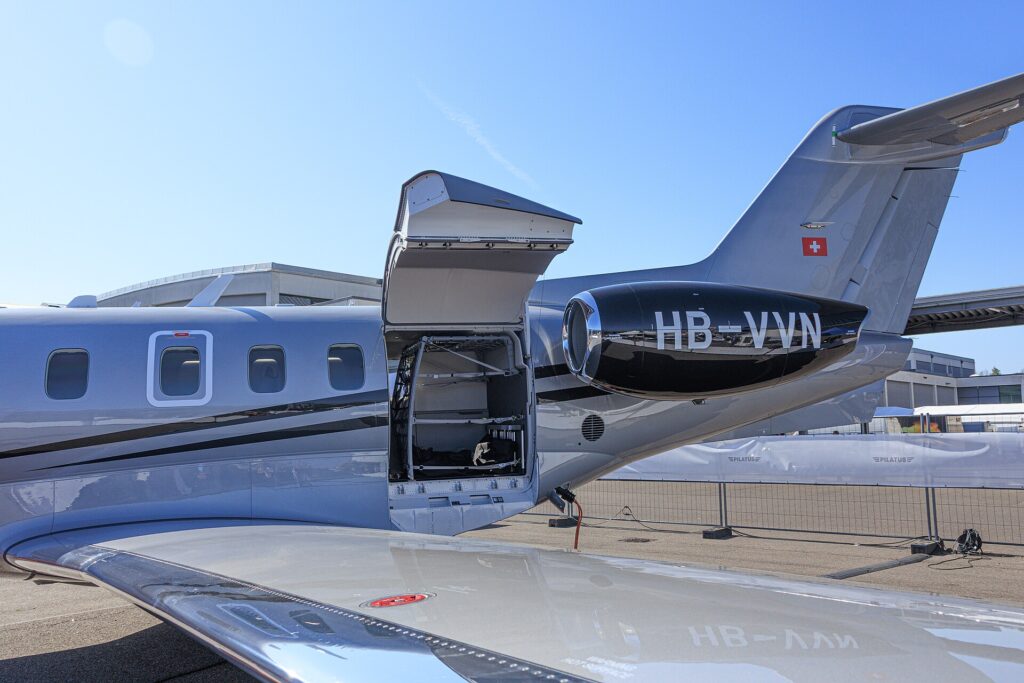
The PC-24’s pallet-sized cargo door (4 ft 1 in x 4 ft 3 in) is standard and unique in its class, which is why air ambulance operators such as Australia’s Royal Flying Doctor Service use it. The Phenom 300E has 84 cu ft of baggage space through a conventional door.
Cockpit
Both are certified for single-pilot operation. The PC-24 uses the Honeywell-based ACE cockpit with four 12-inch screens, synthetic vision and an autothrottle. The Phenom 300E uses Embraer’s Garmin-based Prodigy Touch flight deck; see our Phenom review for its features.

Price
Wikipedia lists about US$12.2 million equipped for the PC-24 (2023) and about US$10.995 million for the Phenom 300E (early 2023). The Phenom is about US$1.2 million cheaper to buy.
Which Should You Choose?
- Choose the Phenom 300E if you fly between paved airports, want the fastest light jet and the lowest price, and value Embraer’s huge fleet and support network.
- Choose the PC-24 if you need a bigger cabin, carry cargo or stretchers, or fly into short, remote or unpaved strips.
- Also consider the Cessna Citation CJ4 Gen3; see our Cessna Citation guide.
Our Verdict
For most private owners flying between city airports, the Phenom 300E is the smarter buy: faster, cheaper and proven. But the PC-24 does things no other light jet can, and its cabin is in a different league. If your missions ever leave the paved world, or you need the space, the PC-24 is worth every extra dollar. For the full size ladder, see private jet sizes explained.
Key Takeaways
- Range is almost identical: about 2,000 nm for both.
- The Phenom 300E is faster (464 kt against 440 KTAS) and about US$1.2 million cheaper.
- The PC-24 cabin is nearly 6 ft longer and has a standard cargo door.
- Only the PC-24 is certified for grass, gravel, sand and snow runways.
Frequently Asked Questions
Which is better, the PC-24 or the Phenom 300E?
The Phenom 300E is faster (464 kt against 440 KTAS) and cheaper (about US$11 million against US$12.2 million in 2023). The PC-24 has a much longer cabin (23 ft against 17 ft 2 in), a standard cargo door, a shorter take-off and certification for grass and gravel runways.
Which flies further?
They are very close: Pilatus lists 2,040 nm for the PC-24 with 4 passengers, and Embraer 2,010 nm for the Phenom 300E with 5 occupants. Each maker measures range its own way.
Which is faster?
The Phenom 300E, with a 464 kt high-speed cruise and a Mach 0.80 maximum. The PC-24’s maximum cruise is 440 KTAS.
Can the Phenom 300E land on grass?
No. The PC-24 is certified for grass, gravel, sand, wet earth and snow, according to Wikipedia; the Phenom 300E is not certified for unpaved runways.
Which has the bigger cabin?
The PC-24: 23 ft long, 5 ft 7 in wide and 5 ft 1 in high, with 498 cu ft. The Phenom 300E cabin is 17 ft 2 in long, 5 ft 1 in wide and 4 ft 11 in high.
Can one pilot fly both?
Yes. Both the PC-24 and the Phenom 300E are certified for single-pilot operation.
How much do they cost?
Wikipedia lists about US$12.2 million equipped for the PC-24 (2023) and about US$10.995 million for the Phenom 300E (early 2023).
Which needs less runway?
The PC-24 takes off in 3,090 ft (over a 50 ft obstacle) against 3,209 ft for the Phenom 300E. For landing, the Phenom quotes 2,212 ft and the PC-24 2,410 ft over a 50 ft obstacle.
What engines do they use?
The PC-24 has two Williams FJ44-4A QPM engines of 3,420 lbf each. The Phenom 300E has two Pratt & Whitney Canada PW535E1 engines of 3,478 lbf each.
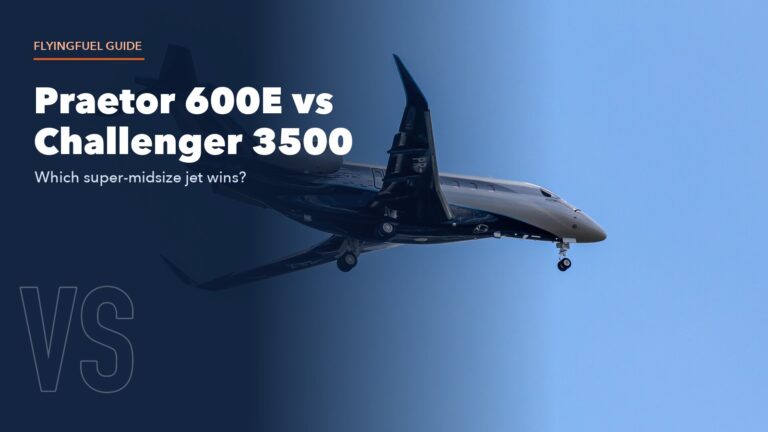
Featured image: FlyingFuel graphic using a photo of a Pilatus PC-24 at AERO Friedrichshafen 2025 by New York-air, CC BY-SA 4.0, via Wikimedia Commons.
 Aircraft ComparisonsBoeing vs Airbus: How to Tell the Difference (Nose, Windows, Wings, Engines)
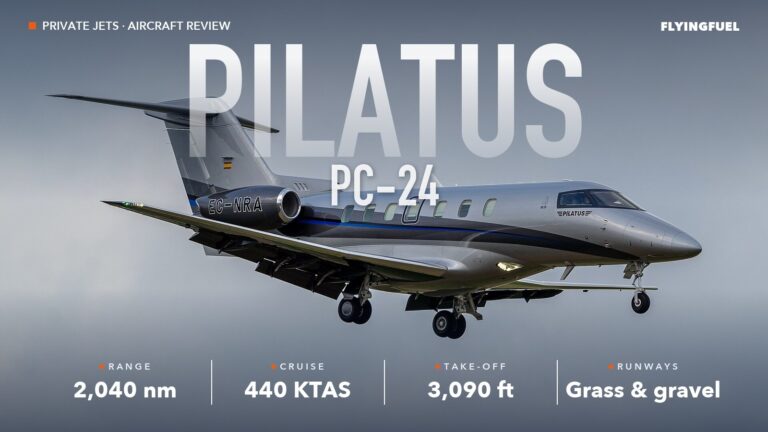 PilatusPilatus PC-24 Review: The Jet That Lands on Grass and Gravel (2026)
 Aircraft ComparisonsBombardier Global 6500 vs Gulfstream G600: Same Range, Different Jets (2026)
 BombardierBombardier Global 6500 Review: Range, Cabin, Speed and Price (2026)
 Aircraft ComparisonsEmbraer Praetor 600E vs Bombardier Challenger 3500: Which Super-Midsize Jet Wins? (2026)
 Embraer Executive JetsEmbraer Praetor 600E Review: The Longest-Range Super-Midsize Jet (2026)