
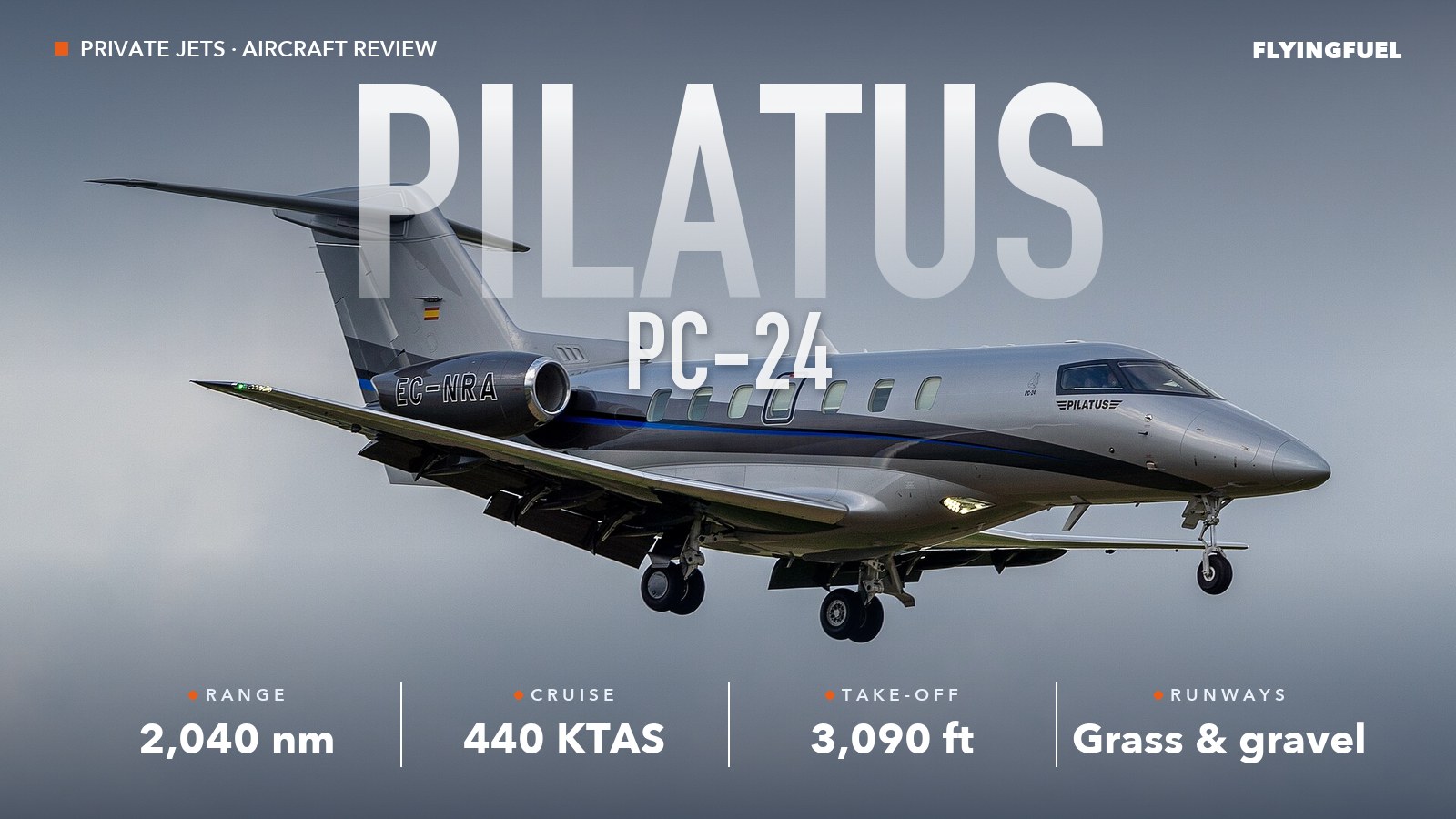
Most business jets need a long, paved runway. The Pilatus PC-24 does not. This Swiss light jet is certified to land on grass, gravel, sand and snow, takes off in just 3,090 ft, and has a large cargo door as standard. Pilatus calls it the world’s first “Super Versatile Jet”. In this review we look at it the way we review airliners: the looks, the cabin, the engines, the cockpit, the range, the price, safety and how it compares with its rivals.
Quick answer: the PC-24 is a twin-engine light jet that flies 2,040 nm at up to 440 KTAS, seats 6 to 10 and can be flown by one pilot. It entered service in 2018 and cost about US$12.2 million equipped in 2023. Rivals such as the Embraer Phenom 300E are faster and cheaper, but none can use unpaved runways or carry a pallet through a cargo door.
Pilatus PC-24 Quick Facts
| PC-24 | Figure |
|---|---|
| Maker | Pilatus Aircraft (Stans, Switzerland) |
| Class | Light business jet, single-pilot certified |
| Maximum range | 2,040 nm with 4 passengers; 2,000 nm with 6 |
| Maximum cruise speed | 440 KTAS |
| Maximum altitude | 45,000 ft (27.1 minutes to climb there) |
| Seating | 6 to 8 executive; up to 10 commuter |
| Cabin (L x W x H) | 23 ft 0 in x 5 ft 7 in x 5 ft 1 in |
| Cabin volume / baggage | 498 cu ft / 90 cu ft |
| Cargo door (W x H) | 4 ft 1 in x 4 ft 3 in |
| Engines | 2 x Williams FJ44-4A QPM, 3,420 lbf each (3,600 lbf with automatic reserve) |
| Take-off / landing distance | 3,090 ft / 2,410 ft (over a 50 ft obstacle) |
| Stall speed | 83 KIAS |
| Runways | Paved, grass, gravel, sand, wet earth, snow |
| Length / wingspan / height | 55 ft 2 in / 55 ft 9 in / 17 ft 4 in |
| Maximum take-off weight | 18,740 lb |
| Certification | EASA and FAA, 7 December 2017 |
| Price | About US$12.2 million equipped (2023) |
Sources: Pilatus: PC-24 technical data; dates, runway approvals and price from Wikipedia: Pilatus PC-24.
What Is the PC-24?
The PC-24 is Pilatus’s only jet (see our guide to Pilatus aircraft). Wikipedia says it grew out of the success of the PC-12 single-engine turboprop: PC-12 owners asked for more speed and range while keeping its ruggedness and short-runway ability. Pilatus began work in 2007, paid for it from its own funds, and showed the PC-24 to the public at EBACE in Geneva on 21 May 2013. At the time, chairman Oscar Schwenk said it combined the versatility of a turboprop with the cabin of a medium light jet and the performance of a light jet.
The first prototype rolled out on 1 August 2014, Switzerland’s national day, and first flew from Buochs on 11 May 2015. Three prototypes flew 2,205 hours, including icing, very hot weather and bird-strike tests, before EASA and the FAA certified the jet on 7 December 2017. The Royal Flying Doctor Service in Australia received the first of five on 26 November 2018, and Wikipedia counts 212 built by early 2024.

How the PC-24 Looks: Built for Rough Strips
The PC-24 is 55 ft 2 in long with a 55 ft 9 in wingspan, about the size of other large light jets. It has a T-tail and two engines mounted high on the rear fuselage. Several design details exist purely so it can use rough runways:
- Long-stroke trailing-link landing gear that smooths out bumpy surfaces.
- Dual main wheels inflated to just 70 psi, so the aircraft does not sink into soft ground.
- Flaps with a replaceable, abradable surface that also shield the high-mounted engines from stones and debris.
- A large double-slotted flap system that gives a stall speed of only about 81 to 83 knots, so it can land slowly on short strips.
Source: Wikipedia: Pilatus PC-24.
The cargo door
On the left side at the back is a cargo door 4 ft 1 in wide and 4 ft 3 in high, standard on every PC-24. Pilatus says no other business jet in its class has one as standard, and Wikipedia notes Pilatus’s claim that the PC-24 was the first business jet with a pallet-sized cargo door. It makes loading stretchers, bikes, skis or freight easy, which is why air ambulance operators love it.

How to recognise a PC-24 at the airport
- A small jet with engines mounted high on the rear fuselage and a T-tail
- A large square cargo door behind the wing on the left side
- Twin wheels on each main landing gear leg
- A cabin door at the front left, plus overwing emergency exits
The Williams FJ44-4A Engine, Explained Simply
Two Williams FJ44-4A QPM turbofans each give 3,420 lbf of thrust, or 3,600 lbf with automatic reserve if one engine fails on take-off. Wikipedia says Williams received EASA and FAA certification for this version in August 2017. The same FJ44-4A family powers the Cessna Citation CJ4.
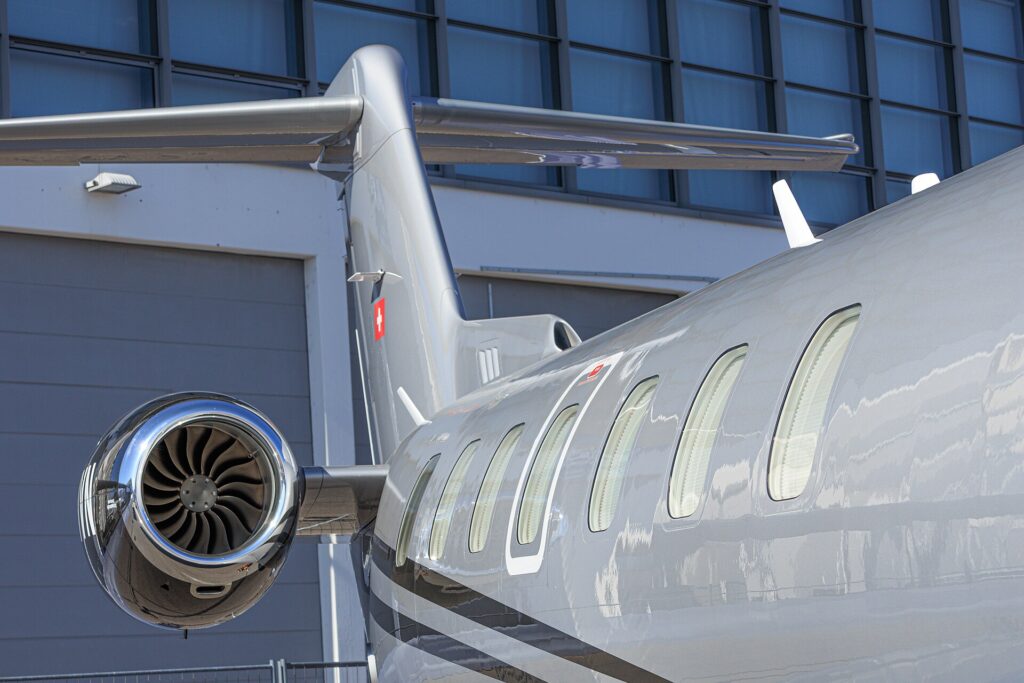
Wikipedia gives a fuel flow of about 850 lb per hour at 45,000 ft at long-range cruise (Mach 0.65, about 372 kt), rising to 970 lb per hour at its Mach 0.74 high-speed cruise. That is low for a jet and helps explain its range. For how turbofans differ from the PC-12’s turboprop, see our turbofan vs turboprop explainer.
Inside the Cabin
The cabin is 23 ft long, 5 ft 7 in wide and 5 ft 1 in high, with 498 cu ft of space and a flat floor. Pilatus says its volume beats business jets costing up to twice as much. It is not a stand-up cabin for most adults, but it is noticeably longer than other light jets: the Phenom 300E cabin is 17 ft 2 in long.
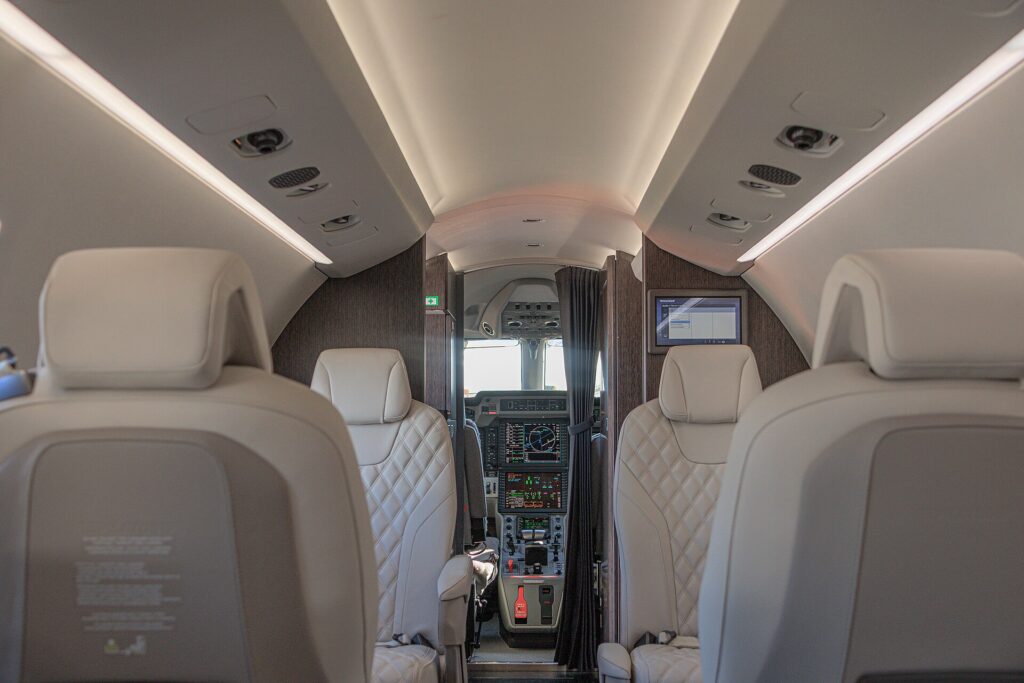
- Seven layouts: from a six-seat executive cabin to a 10-seat commuter and an air ambulance version.
- A full-size bed: the divan can be converted into a bed.
- BMW Designworks styling: Wikipedia says the interior colour schemes were designed by BMW Designworks.
- 2021 updates: lighter, more comfortable quick-release seats and an optional galley in place of the forward coat closet.
- Baggage: 90 cu ft, reachable through the cargo door.
The Cockpit: Pilatus ACE

Pilatus and Honeywell designed the Advanced Cockpit Environment (ACE), based on Honeywell’s Primus Epic system. It has four 12-inch screens, synthetic vision, an autothrottle and dual flight management systems, and the PC-24 is certified for single-pilot operations. Wikipedia says the 2021 update added touchscreen controls, tactile feedback in pitch and roll with limit protection, pilot-defined visual approaches and automated audible callouts, plus lighter lithium-ion batteries.
Range and Performance
Pilatus quotes 2,040 nm with 4 passengers and 2,000 nm with 6, at a maximum cruise speed of 440 KTAS. That covers trips such as London to Moscow or Sydney to Perth nonstop. It climbs to 45,000 ft in about 27 minutes.

The real story is the runway. With 3,090 ft for take-off and 2,410 ft for landing, both over a 50 ft obstacle, and certification for unpaved strips, the PC-24 reaches places no other business jet in its class can. Pilatus’s own examples include beaches and outback strips. For how the 2,000 nm range compares with bigger jets, see private jet sizes explained.

Safety and Reliability
Wikipedia lists no accidents for the PC-24. By January 2021 the first 100 aircraft had flown 33,500 hours. During testing, the three prototypes were flown beyond the normal flight envelope and through icing, extreme heat, bird-strike, structural stress and noise tests. Its slow stall speed, automatic reserve thrust and the Honeywell-based ACE cockpit all add margin, which matters most on short, remote strips.
Price and Who Flies It
Wikipedia gives a price of US$8.9 million at certification in 2017 and about US$12.2 million equipped in 2023. Its operators show how versatile it is:
- Air ambulance: Australia’s Royal Flying Doctor Service (5) and NSW Ambulance (2), Svenskt Ambulansflyg in Sweden (6), and Ornge in Ontario (2 on order).
- Charter and fractional: Platoon Aviation in Germany (11) and FlyingGroup in Belgium (9); PlaneSense in the US received the first delivery.
- Governments and air forces: the Qatar Emiri Air Force (2), the French Navy (deliveries from March 2026), Spain’s air force and navy (7 selected in April 2026) and the Indonesian Air Force (12 on order).
PC-24 vs Its Rivals
| Pilatus PC-24 | Embraer Phenom 300E | Cessna Citation CJ4 Gen3 | |
|---|---|---|---|
| Range | 2,040 nm (4 passengers) | 2,010 nm (5 occupants) | 2,165 nm |
| Speed | 440 KTAS max cruise | 464 kt high-speed cruise | 451 ktas |
| Occupants | 6 to 10 passengers + pilots | Up to 10 with one pilot | Up to 10 |
| Cabin length | 23 ft 0 in | 17 ft 2 in | 17 ft 4 in |
| Take-off distance | 3,090 ft | 3,209 ft | See Textron |
| Unpaved runways | Yes (certified) | No | No |
| Cargo door | Standard, 4 ft 1 in wide | No | No |
| Engines | 2 x Williams FJ44-4A | 2 x P&WC PW535E1 | 2 x Williams FJ44-4A |
| Price | About US$12.2m (2023) | About US$11.0m (early 2023) | Not compared |
Sources: Pilatus, Embraer Phenom 300E brochure, Textron Aviation: CJ4 Gen3; prices from Wikipedia. Each maker measures range its own way.
PC-24 vs Embraer Phenom 300E
The Phenom 300E is the best-selling light jet: faster and a little cheaper. The PC-24 answers with a longer cabin, a cargo door and unpaved-runway access. Read our Phenom 300E review.
PC-24 vs Cessna Citation CJ4 Gen3
The CJ4 Gen3 uses the same engine family and flies slightly further, with Garmin Emergency Autoland, but has a shorter cabin and no cargo door. See our Cessna Citation guide.
Pros and Cons
Pros
- Certified for grass, gravel, sand, wet earth and snow runways
- Short take-off (3,090 ft) and landing (2,410 ft)
- Standard pallet-sized cargo door
- Long 23 ft cabin with seven layouts, including air ambulance
- Single-pilot certified, with a modern Honeywell-based cockpit
- Rugged gear and engines shielded from debris
Cons
- Slower than the Phenom 300E and CJ4
- Cabin is only 5 ft 1 in tall, so most adults cannot stand
- About US$12.2 million (2023), more than the Phenom 300E
- 2,040 nm range limits nonstop transatlantic flights
Our Verdict
The PC-24 is not the fastest light jet, nor the cheapest, but it is the most versatile by a wide margin. If your missions include short, remote or unpaved strips, medical flights, or cargo as well as passengers, nothing else in the class comes close. For owners who only fly between big paved airports, a Phenom 300E or CJ4 gives more speed for the money. Pilatus built a jet with the soul of a bush plane, and its success with air ambulance services and air forces shows that the idea works.
Key Takeaways
- The PC-24 is certified for unpaved runways and takes off in 3,090 ft.
- It flies 2,040 nm at up to 440 KTAS and can be flown by one pilot.
- A pallet-sized cargo door is standard; the 23 ft cabin seats 6 to 10.
- It cost about US$12.2 million in 2023; rivals are the Phenom 300E and CJ4 Gen3.
Frequently Asked Questions
Can the Pilatus PC-24 land on grass and gravel?
Yes. Wikipedia says it was certified for dry sand and gravel runways in late 2018 and for grass, wet earth and snow in February 2020. Pilatus calls it the world’s first and only “Super Versatile Jet”.
How far can a PC-24 fly?
Pilatus lists 2,040 nm with 4 passengers and 2,000 nm with 6, at a maximum cruise speed of 440 KTAS.
How much runway does a PC-24 need?
Pilatus lists 3,090 ft to take off and 2,410 ft to land, both over a 50 ft obstacle. Its stall speed is 83 KIAS.
How many passengers does a PC-24 carry?
6 to 8 in executive layouts and up to 10 in a commuter layout, according to Pilatus, plus one or two pilots.
Can one pilot fly the PC-24?
Yes. Pilatus says the PC-24 and its ACE cockpit are certified for single-pilot operations.
How much does a PC-24 cost?
Wikipedia says it was priced at US$8.9 million at certification in 2017, and lists about US$12.2 million equipped in 2023.
What engines does the PC-24 have?
Two Williams FJ44-4A QPM turbofans of 3,420 lbf each, or 3,600 lbf with automatic reserve, according to Pilatus.
How big is the PC-24 cargo door?
4 ft 1 in wide and 4 ft 3 in high, and it is standard. Wikipedia says Pilatus claims the PC-24 was the first business jet with a standard pallet-sized cargo door.
Pilatus PC-24 vs Phenom 300E: which is better?
The Phenom 300E is faster (464 kt against 440 KTAS) and cheaper (about US$11 million against US$12.2 million in 2023). The PC-24 has a bigger cabin, a cargo door, a shorter take-off run and is certified for unpaved runways.
Featured image: FlyingFuel graphic using a photo of a Pilatus PC-24 landing at Toulouse-Francazal by Hugo LUC, CC BY-SA 4.0, via Wikimedia Commons.
 Aircraft ComparisonsBoeing vs Airbus: How to Tell the Difference (Nose, Windows, Wings, Engines)
 Aircraft ComparisonsPilatus PC-24 vs Embraer Phenom 300E: Which Light Jet Is Better? (2026)
 Aircraft ComparisonsBombardier Global 6500 vs Gulfstream G600: Same Range, Different Jets (2026)
 BombardierBombardier Global 6500 Review: Range, Cabin, Speed and Price (2026)
 Aircraft ComparisonsEmbraer Praetor 600E vs Bombardier Challenger 3500: Which Super-Midsize Jet Wins? (2026)
 Embraer Executive JetsEmbraer Praetor 600E Review: The Longest-Range Super-Midsize Jet (2026)