
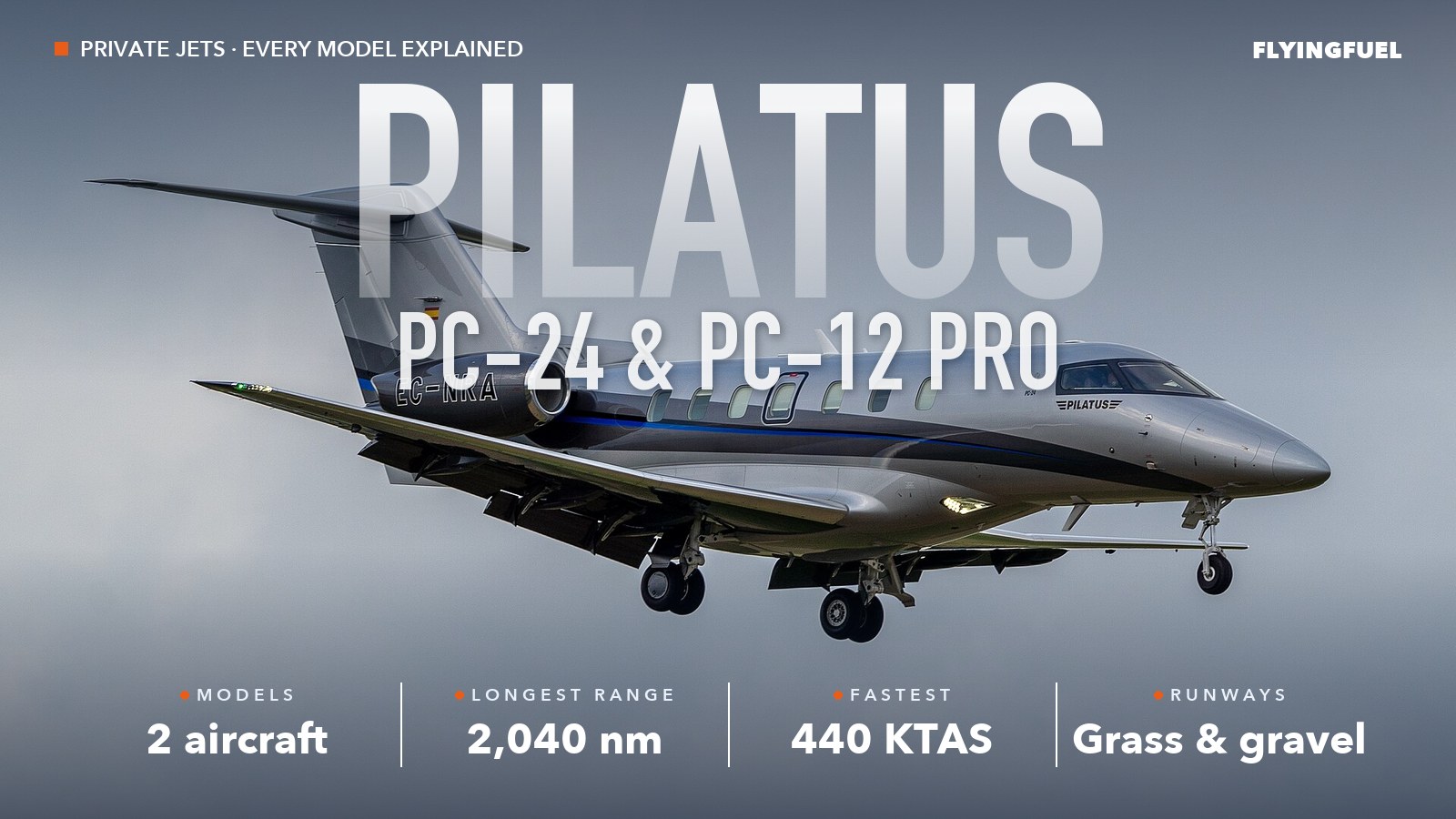
Pilatus builds two very different business aircraft from a small airport in the Swiss Alps: the PC-24, a twin-engine jet that can land on grass and gravel, and the PC-12 PRO, the latest version of Pilatus’s best-selling single-engine turboprop. Both are famous for reaching short and rough runways that most business jets cannot use. In this guide we explain both, with the same facts for each: range, speed, cabin, engines, cockpit and what they are best for.
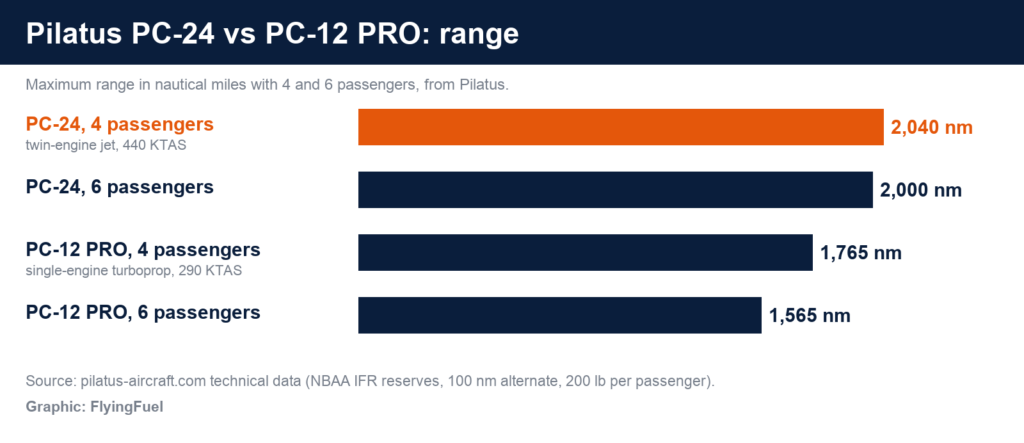
Quick answer: the PC-24 is a 440-knot jet with a 2,040 nm range, a big cargo door and certification for unpaved runways. The PC-12 PRO is a 290-knot single-engine turboprop with a 1,765 nm range, Garmin Autoland and a 4 ft 5 in cargo door. More than 2,000 PC-12s have been built.
Pilatus Aircraft at a Glance
| PC-24 | PC-12 PRO | |
|---|---|---|
| Type | Twin-engine jet | Single-engine turboprop |
| Max range (4 / 6 passengers) | 2,040 / 2,000 nm | 1,765 / 1,565 nm |
| Maximum cruise speed | 440 KTAS | 290 KTAS |
| Maximum altitude | 45,000 ft | 30,000 ft |
| Take-off distance (over 50 ft) | 3,090 ft | 2,485 ft |
| Cabin (L x W x H) | 23 ft x 5 ft 7 in x 5 ft 1 in | 16 ft 11 in x 5 ft x 4 ft 9 in |
| Cargo door (W x H) | 4 ft 1 in x 4 ft 3 in | 4 ft 5 in x 4 ft 4 in |
| Engines | 2 x Williams FJ44-4A QPM, 3,420 lbf | 1 x Pratt & Whitney Canada PT6E-67XP, 1,200 shp take-off |
| Unpaved runways | Yes (grass, gravel, earth, snow) | Yes (grass, gravel, snow) |
Sources: Pilatus technical data for the PC-24 and PC-12 PRO, and the PC-12 PRO page.
Pilatus: The Company in Brief
According to Wikipedia, Pilatus was founded on 16 December 1939 as Pilatus Flugzeugwerke AG, by Emil Bührle and Antoine Gazda. It is based in Stans, Switzerland, with its headquarters and factory at Buochs Airport, has about 3,000 employees and has been owned by Swiss investors since December 2000. Besides the PC-12 and PC-24, it builds military trainers such as the PC-21 and the older PC-6, PC-7 and PC-9, and has a US facility in Broomfield, Colorado.
| Company fact | Detail |
|---|---|
| Headquarters | Stans, Switzerland (Buochs Airport) |
| Founded | 16 December 1939 |
| Owner | Swiss investors (since 2000) |
| Employees | About 3,000 (2025) |
| Business aircraft | PC-24 jet, PC-12 PRO turboprop |
| Best seller | PC-12, 2,000 delivered by May 2023 |
Sources: Wikipedia: Pilatus Aircraft; Wikipedia: Pilatus PC-12.
1. Pilatus PC-24: The Jet for Short and Rough Runways
The PC-24‘s big selling point is access. It needs just 3,090 ft of runway to take off over a 50 ft obstacle and is certified for unpaved strips. Wikipedia says it was certified for dry sand and gravel in late 2018 and for grass, wet earth and snow in February 2020. It also has a large cargo door, 4 ft 1 in wide, so it can carry stretchers, bikes or freight. Wikipedia says it was introduced at EBACE on 21 May 2013, first flew on 11 May 2015, was certified by EASA and the FAA on 7 December 2017 and first delivered to PlaneSense on 7 February 2018.
PC-24 specifications
| PC-24 | Figure |
|---|---|
| Maximum range | 2,040 nm with 4 passengers; 2,000 nm with 6 |
| Maximum cruise speed | 440 KTAS |
| Maximum altitude | 45,000 ft (27.1 min to climb there) |
| Seating | 6 to 8 executive seats; up to 10 in commuter layout |
| Cabin (L x W x H) | 23 ft 0 in x 5 ft 7 in x 5 ft 1 in |
| Cabin volume / baggage | 498 cu ft / 90 cu ft |
| Cargo door (W x H) | 4 ft 1 in x 4 ft 3 in |
| Engines | 2 x Williams FJ44-4A QPM, 3,420 lbf each (3,600 lbf with automatic reserve) |
| Take-off / landing distance | 3,090 ft / 2,410 ft (over 50 ft obstacle) |
| Stall speed | 83 KIAS |
| Maximum take-off weight | 18,740 lb |
| Length / wingspan / height | 55 ft 2 in / 55 ft 9 in / 17 ft 4 in |
| Price | About US$12.2 million equipped (2023) |
Sources: Pilatus: PC-24 technical data; dates and price from Wikipedia: Pilatus PC-24.
Cabin and cockpit
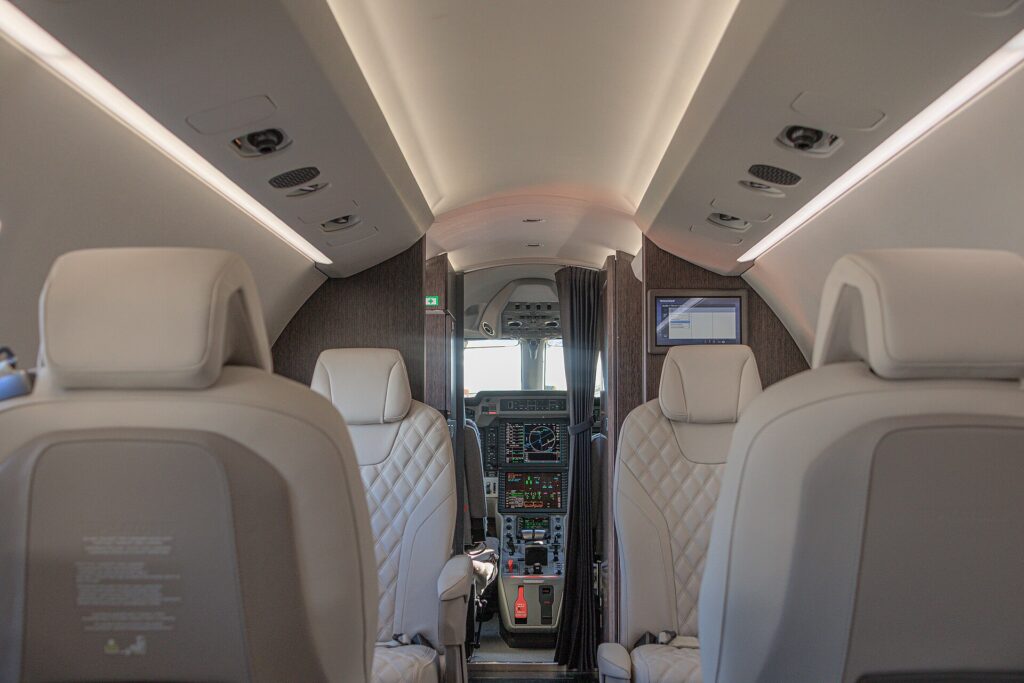
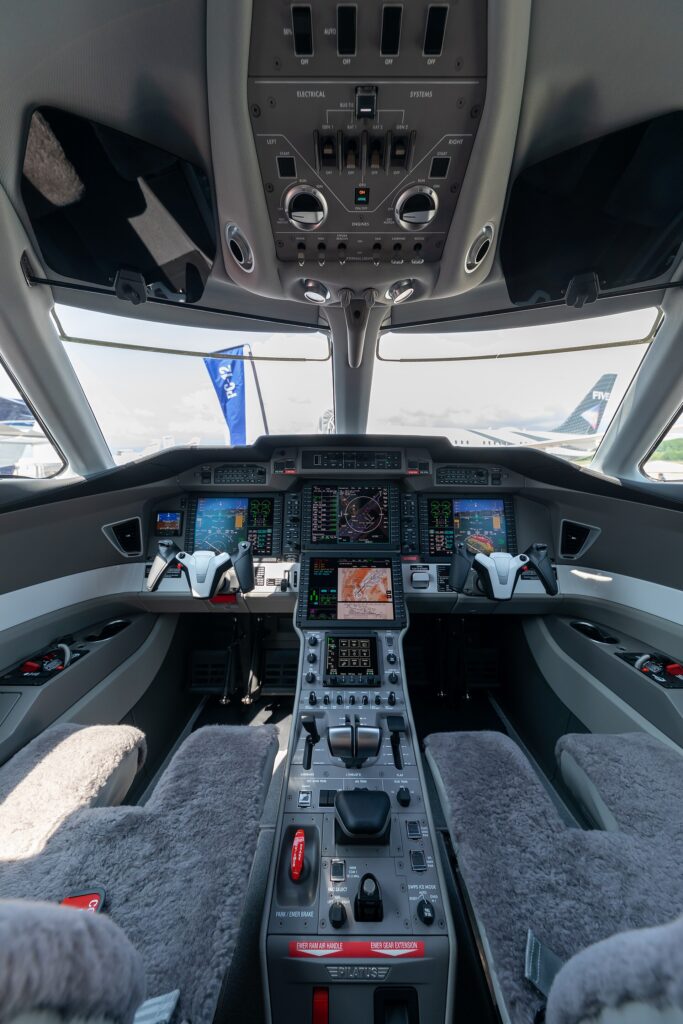
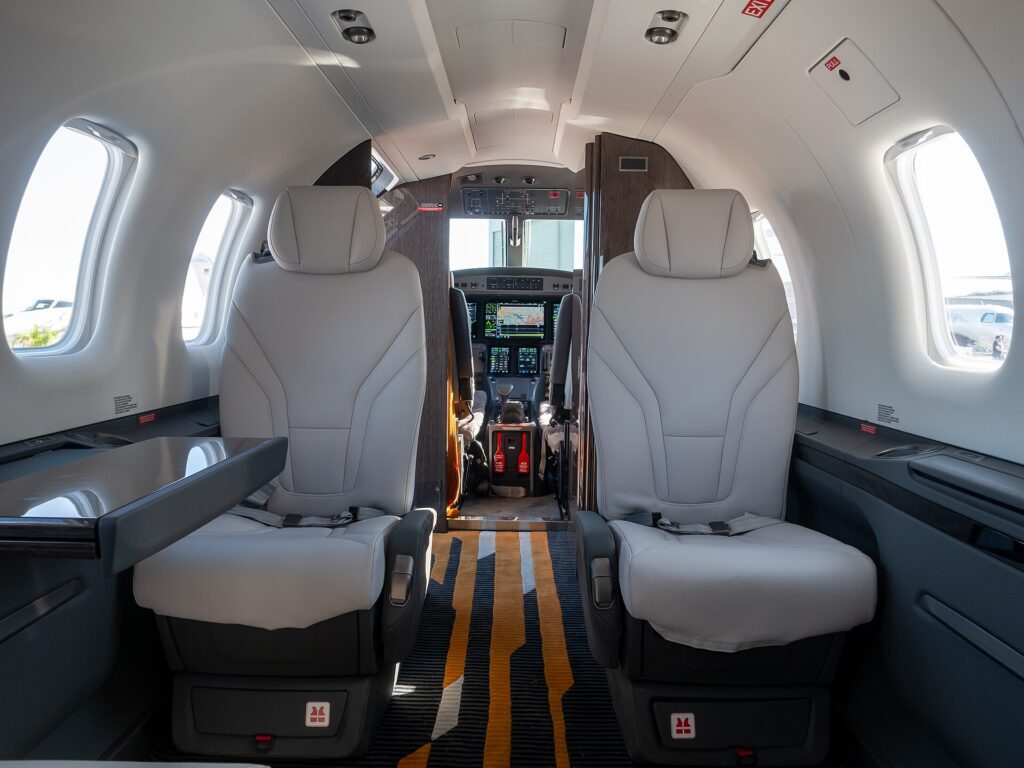
Pilatus offers seven cabin layouts, from a six-seat executive cabin to a 10-seat commuter and an air ambulance. A divan can turn into a full-size bed. The cockpit is Pilatus’s Advanced Cockpit Environment (ACE), powered by Honeywell, with four 12-inch screens, synthetic vision, an autothrottle and dual flight management systems, and the PC-24 is certified for single-pilot operation.
Best for: owners and operators who need jet speed but fly into short, remote or unpaved strips, such as air ambulance services. Wikipedia notes the Royal Flying Doctor Service received the first of five PC-24s on 26 November 2018.
2. Pilatus PC-12 PRO: The Single-Engine Workhorse
The PC-12 is Pilatus’s best seller. Wikipedia says it first flew on 31 May 1991, entered service in 1994 and passed 2,000 deliveries in May 2023. The latest version, the PC-12 PRO, has a new Garmin G3000 PRIME cockpit with Garmin Autoland, an autothrottle and Electronic Stability and Protection, plus new interiors designed with BMW Designworks. It cruises at up to 290 KTAS and flies up to 1,765 nm on one Pratt & Whitney Canada PT6E-67XP engine.
PC-12 PRO specifications
| PC-12 PRO | Figure |
|---|---|
| Maximum range | 1,765 nm with 4 passengers; 1,565 nm with 6 |
| Maximum cruise speed | 290 KTAS |
| Maximum altitude | 30,000 ft |
| Seating | 6 to 8 executive seats; commuter and air ambulance layouts |
| Cabin (L x W x H) | 16 ft 11 in x 5 ft 0 in x 4 ft 9 in |
| Cabin volume / baggage | 326 cu ft / 34.3 cu ft |
| Cargo door (W x H) | 4 ft 5 in x 4 ft 4 in |
| Engine | 1 x Pratt & Whitney Canada PT6E-67XP, 1,845 shp (1,200 shp take-off) |
| Take-off / landing distance | 2,485 ft / 2,170 ft (over 50 ft obstacle) |
| Stall speed | 67 KIAS |
| Maximum take-off weight | 10,450 lb |
| Length / wingspan / height | 47 ft 3 in / 53 ft 5 in / 14 ft 0 in |
| Fuel | Approved for blends of up to 50% sustainable aviation fuel |
Sources: Pilatus: PC-12 technical data and PC-12 PRO page; history from Wikipedia: Pilatus PC-12.
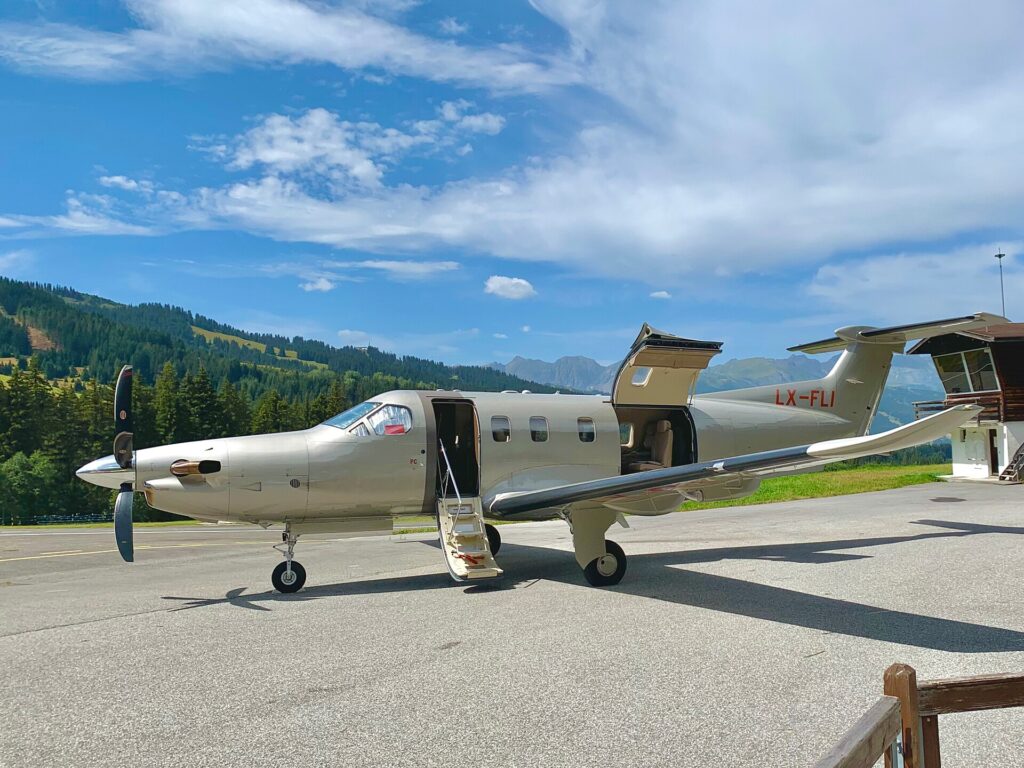
Like the PC-24, the PC-12 PRO can use short runways and unmade grass, gravel or snow strips, and its 4 ft 5 in cargo door makes it a favourite for cargo, medical and charter work. Wikipedia says the Royal Flying Doctor Service was its launch customer in 1994 and flies 32 PC-12s, and the US Air Force flies a special operations version, the U-28A Draco.
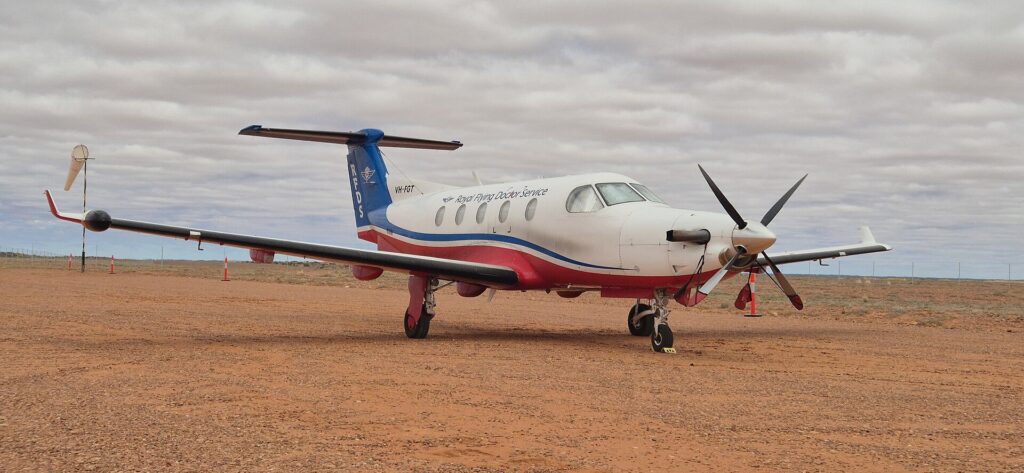
Best for: owner-pilots and operators who want low running costs, a big cargo door and access to remote or mountain airstrips, on trips of up to about 5 to 6 hours.
PC-24 or PC-12 PRO: Which Is Right for You?
| If you need to… | Choose | Why |
|---|---|---|
| Fly faster and higher | PC-24 | 440 KTAS and 45,000 ft vs 290 KTAS and 30,000 ft |
| Fly further | PC-24 | 2,040 nm vs 1,765 nm with 4 passengers |
| Use the shortest runways | PC-12 PRO | 2,485 ft take-off vs 3,090 ft |
| Keep costs and price down | PC-12 PRO | One engine; the PC-12 NGX cost about half the PC-24’s equipped price (2023) |
| Carry bulky cargo | Either | Both have a cargo door over 4 ft wide |
Pilatus vs Its Rivals
The PC-24 is about the size of light jets such as the Cessna Citation CJ4 and Embraer Phenom 300, but adds unpaved-runway certification and a large cargo door. The PC-12 PRO competes with other single-engine turboprops. See our guides to Cessna Citation jets and Embraer business jets, and our explainer on turbofan vs turboprop engines.
Pros and Cons of Pilatus Aircraft
Pros
- Certified for grass, gravel, earth and snow runways
- Large cargo doors on both aircraft
- Garmin Autoland on the PC-12 PRO
- The PC-12 is a proven design, with 2,000 delivered by 2023
Cons
- Shorter range than midsize jets: 2,040 nm for the PC-24
- Small cabins: 5 ft 1 in tall on the PC-24 and 4 ft 9 in on the PC-12
- The PC-12 PRO is slower than jets, at 290 KTAS
Key Takeaways
- Pilatus builds two business aircraft: the PC-24 jet and the PC-12 PRO turboprop.
- The PC-24 flies 2,040 nm at 440 KTAS and is certified for unpaved runways.
- The PC-12 PRO adds a Garmin G3000 PRIME cockpit with Autoland; over 2,000 PC-12s have been built.
- Both have large cargo doors and serve operators such as Australia’s Royal Flying Doctor Service.
Frequently Asked Questions
Can the Pilatus PC-24 land on grass?
Yes. Wikipedia says it was certified for dry sand and gravel runways in late 2018 and for grass, wet earth and snow in February 2020, so it can use unpaved strips.
How far can a PC-24 fly?
Pilatus lists 2,040 nm with 4 passengers and 2,000 nm with 6, at up to 440 KTAS.
Is the Pilatus PC-12 a jet?
No. The PC-12 PRO is a single-engine turboprop, with a Pratt & Whitney Canada PT6E-67XP engine and a propeller. It cruises at up to 290 KTAS and flies up to 1,765 nm.
What is the difference between the PC-12 NGX and PC-12 PRO?
The PC-12 PRO is the latest version. Pilatus says it has a new Garmin G3000 PRIME cockpit with Garmin Autoland and new interiors designed with BMW Designworks; the NGX before it introduced the PT6E-67XP engine with digital engine control in 2019.
How many PC-12s have been built?
Wikipedia says the 2,000th PC-12 was delivered in May 2023, making it Pilatus’s best-selling aircraft.
Who flies the PC-12 and PC-24?
The Royal Flying Doctor Service in Australia was the PC-12’s launch customer in 1994 and flies 32 of them, plus PC-24s. The US Air Force flies a military version, the U-28A Draco. PlaneSense received the first PC-24 in 2018.
How much does a PC-24 cost?
Wikipedia lists US$8.9 million at certification in 2017 and an equipped price of about US$12.2 million in 2023. It gives about US$6.0 million (2023) for the PC-12 NGX.
Can one pilot fly the PC-24?
Yes. Pilatus says the PC-24 is certified for single-pilot operations, and the PC-12 PRO is also flown by one pilot.
Where is Pilatus based?
In Stans, Switzerland, at Buochs Airport. Pilatus was founded on 16 December 1939 and also builds military trainers such as the PC-21.
Featured image: FlyingFuel graphic using a photo of a Pilatus PC-24 landing at Toulouse-Francazal by Hugo LUC, CC BY-SA 4.0, via Wikimedia Commons.
 Aircraft ComparisonsBoeing 747 vs Airbus A380: Which Is Bigger and Better? (2026)
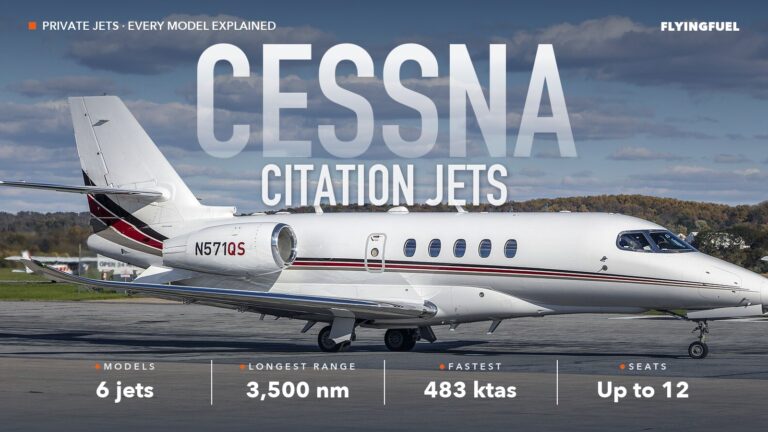 Cessna CitationCessna Citation Jets: Every Model From the M2 to the Longitude Explained (2026)
 NewsAeromexico to Fly Mexico City to Orange County, Fort Lauderdale and Portland From January 2027
 NewsBoeing Narrows Q3 Loss to $116 Million, Still Targets First 777X Delivery in 2027
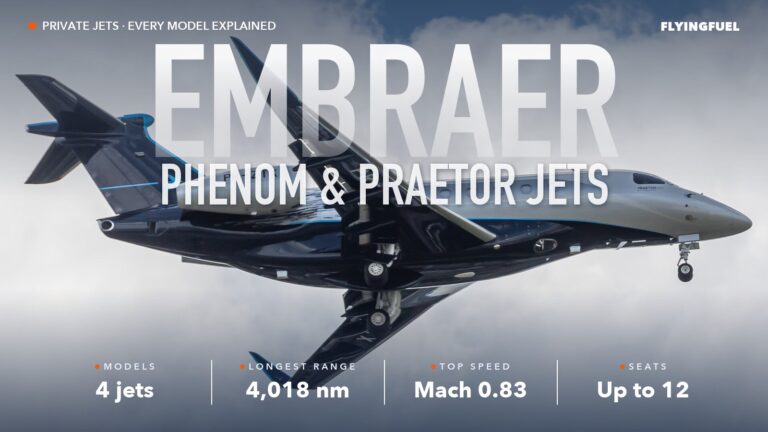 Embraer Executive JetsEmbraer Business Jets: Phenom 100EX, Phenom 300EV, Praetor 500E and 600E Explained (2026)
 NewseasyJet to Fit Starlink Wi-Fi Across Its Airbus Fleet From 2027