
Mumbai’s airport is famous for doing a lot with very little: India’s second-busiest airport squeezed onto two crossing runways in the middle of a city. Since December 2025 it has a partner, Navi Mumbai International, and the 2026 traffic data show passengers already moving. Here is the guide, with the latest official numbers.
Quick answer: Chhatrapati Shivaji Maharaj International Airport (BOM) handled 55.29 million passengers in 2025-26, India’s second-busiest, according to the Airports Authority of India. Terminal 1 (Santacruz) is for low-cost domestic flights; Terminal 2 (Sahar) handles all international and many domestic flights. In April-August 2026 it lost 8.0% of its passengers, while Navi Mumbai handled 2.37 million.
Traffic: AAI, March 2026 (2025-26) and AAI, August 2026 (April-August 2026). Airport facts: the Wikipedia articles on Chhatrapati Shivaji Maharaj International Airport and Navi Mumbai International Airport.
Mumbai Airport at a Glance
| Chhatrapati Shivaji Maharaj International Airport | |
|---|---|
| Code | BOM |
| Location | Santacruz (Terminal 1) and Sahar (Terminal 2), Vile Parle East, Mumbai |
| Passengers 2025-26 | 55,290,095 (+0.3%), 2nd in India |
| International passengers 2025-26 | 16,347,263 (30%), 2nd in India |
| Terminals | T1 (low-cost domestic) and T2 (international + domestic) |
| Runways | Two crossing: 09/27 (3,445 m x 60 m) and 14/32 (2,871 m x 45 m) |
| Operator | Mumbai International Airport Ltd (Adani Group 74%, AAI 26%) |
| Second airport | Navi Mumbai International, commercial flights since 25 December 2025 |
Passengers: AAI. Everything else: Wikipedia.
Terminal 1 or Terminal 2?
| Terminal | Used for | Key facts |
|---|---|---|
| Terminal 1 (Santacruz) | Domestic flights by low-cost airlines only | The original Santacruz building; to be rebuilt, with demolition now planned for 2030 |
| Terminal 2 (Sahar) | All international flights, plus domestic flights | Opened February 2014; designed by SOM, built by L&T; 192 departure check-in counters |
Source: Wikipedia. The terminals share the airfield but are separate on the city side, so allow a 15-20 minute drive if you have to change. Check which terminal your airline uses.
Terminal 2 replaced the old international terminal on 12 February 2014; the first departure was a Jet Airways Boeing 777-300ER to London. It has 60 immigration counters for departing passengers and 76 for arrivals, India’s first transit hotel inside a terminal (the 32-room Niranta) and a multi-level car park for 5,000 cars. MIAL has proposed raising its capacity from 40 to 45 million passengers a year, and the whole airport’s from 55 to 65 million. New international routes keep arriving; in November 2026 IndiGo began daily flights from Mumbai to Dar es Salaam.
Two Crossing Runways
Mumbai has two runways that intersect south of the terminals: 09/27, the main runway, 3,445 m long and 60 m wide, and 14/32, 2,871 m by 45 m, which runs between Terminals 1 and 2. Both were upgraded to Code F for the Airbus A380. Because they cross, the airport mostly works as a single-runway airport: in March 2017 it overtook London Gatwick as the world’s busiest airport using one runway at a time, and on 9 December 2018 it handled a record 1,007 aircraft movements in a day. A second parallel runway is in the master plan, but would need hangars, flight kitchens and a police station to move.
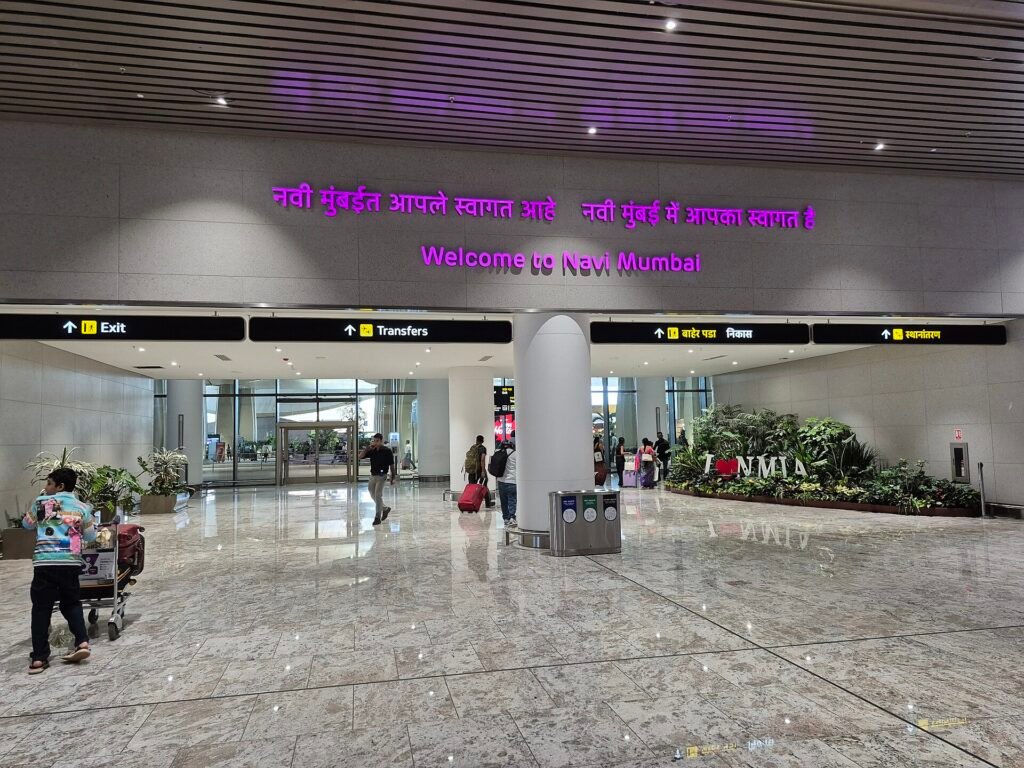
Navi Mumbai International Airport, in Ulwe in Raigad district, was first proposed in 1997 and approved in 2007. It is run by Navi Mumbai International Airport Ltd, an Adani company in partnership with CIDCO, was inaugurated by Prime Minister Narendra Modi on 8 October 2025 and opened to commercial flights on 25 December 2025. It has a single 3,700 m runway and a lotus-shaped terminal for 20 million passengers a year in its first phase, rising to 90 million when all phases are built. Read our full Navi Mumbai International Airport guide.

| Passengers | Apr-Aug 2026 | Apr-Aug 2025 | Change |
|---|---|---|---|
| Mumbai (CSMIA) total | 20,750,280 | 22,545,451 | -8.0% |
| Mumbai (CSMIA) international | 6,236,846 | 6,567,771 | -5.0% |
| Mumbai (CSMIA) domestic | 14,513,434 | 15,977,680 | -9.2% |
| Navi Mumbai total | 2,371,912 | – | New |
| Mumbai region total | 23,122,192 | 22,545,451 | +2.6% |
Source: AAI, August 2026; domestic and region totals are FlyingFuel calculations.
Most of Mumbai’s fall was domestic, and almost all of Navi Mumbai’s traffic was domestic too (4,010 international passengers in April-August 2026), so it looks like domestic flights moving across the harbour. Compare with Delhi airport, which grew 5.5% over the same months, and see the national picture in India air traffic in 2026.
A Short History
Mumbai’s airport began as RAF Santa Cruz, built in the 1930s and home to RAF squadrons during the Second World War. Civil flights started in two converted hangars in 1946, a new terminal opened in 1958, and a separate international terminal at Sahar followed. In 1979-80 the airport handled 5 million passengers, against 3 million at Delhi’s Palam. Management passed to a GVK-led consortium in May 2006, and to the Adani Group in February 2021.
Key Takeaways
- Mumbai’s CSMIA handled 55.29 million passengers in 2025-26, India’s second-busiest airport.
- Terminal 1 is for low-cost domestic flights; Terminal 2 handles all international and many domestic flights.
- Its two runways cross, so it works mostly as a single-runway airport.
- In April-August 2026 it lost 8.0% of passengers while Navi Mumbai handled 2.37 million; the region grew 2.6%.
Frequently Asked Questions
How many passengers does Mumbai airport handle?
55.29 million in 2025-26 (April 2025 to March 2026), up 0.3%, according to the Airports Authority of India. That makes Chhatrapati Shivaji Maharaj International India’s second-busiest airport after Delhi. 16.35 million of the passengers were international.
What is the difference between Terminal 1 and Terminal 2 at Mumbai airport?
Terminal 1, at Santacruz, is used only for domestic flights by low-cost airlines. Terminal 2, at Sahar, handles all international flights and also domestic flights. They share the airfield but are separate on the city side, about a 15-20 minute drive apart.
Is Mumbai airport Terminal 1 closing?
Not yet. The Adani Group announced in March 2024 that Terminal 1 would be demolished and rebuilt. Wikipedia says demolition was pushed back to 2030, with the new terminal expected in 2033-34.
How many runways does Mumbai airport have?
Two crossing runways: 09/27 (3,445 m), the main runway, and 14/32 (2,871 m). Because they intersect, they cannot both be used fully at the same time; in 2017 Mumbai was briefly the world’s busiest airport operating one runway at a time.
Who owns Mumbai airport?
Mumbai International Airport Ltd (MIAL): the Adani Group owns 74% (since February 2021, when it bought out GVK and Bidvest) and the Airports Authority of India 26%.
They are separate airports. Chhatrapati Shivaji Maharaj International (BOM) is in the city, at Santacruz and Sahar. Navi Mumbai International (in Ulwe, Raigad district) opened to commercial flights on 25 December 2025, has one 3,700 m runway and a first-phase capacity of 20 million passengers a year.
It handled 2.37 million passengers from April to August 2026, its first five full months, and 638,394 in its first three months to March 2026 (AAI).
Why is Mumbai airport traffic falling in 2026?
Part of it moved to Navi Mumbai. Mumbai’s main airport handled 8.0% fewer passengers in April-August 2026, but counting Navi Mumbai, the Mumbai region grew about 2.6% (FlyingFuel calculation from AAI data).
Why is it called Chhatrapati Shivaji Maharaj airport?
It is named after Shivaji, the 17th-century Maratha ruler. It was renamed from Sahar Airport in 1999, and the title Maharaj was added on 30 August 2018.
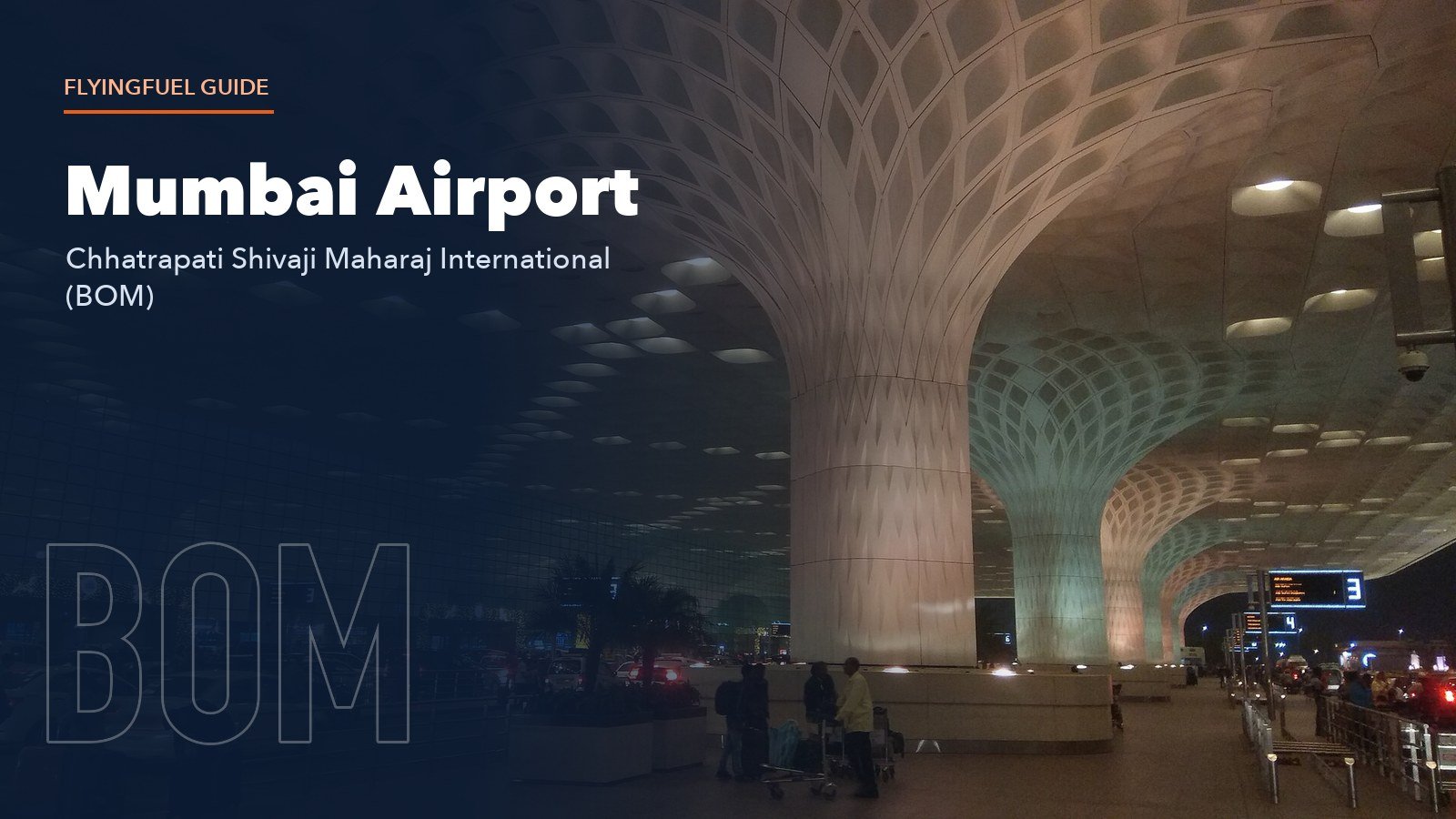
Featured image: FlyingFuel graphic using a photo of Terminal 2 at Mumbai’s Chhatrapati Shivaji Maharaj International Airport by Innocentbunny, CC BY-SA 3.0, via Wikimedia Commons.
 Aircraft ComparisonsBoeing 737 MAX 8 vs 737-800: What Changed and Which Is Better? (2026)
 NewsMalaysia Airlines to Buy 10 Boeing 787-10 Dreamliners to Replace Its Airbus A350s From 2032
 AirportsAirports in Odisha: Bhubaneswar, Jharsuguda, Jeypore and More Ranked (2026 Data)
 NewsNew Visakhapatnam Airport at Bhogapuram to Charge Rs 890 Per Departing Domestic Passenger From 1 December
 AirportsAirports in Karnataka: Bengaluru, Mangaluru, Hubballi, Belagavi and More Ranked (2026 Data)
 Aircraft ComparisonsAirbus A350-900 vs Boeing 777-300ER: Which Long-Haul Jet Is Better? (2026)