

Almost one in every five air passengers in India passes through a single airport: Indira Gandhi International in Delhi. It is the country’s busiest by far, with four runways and three terminals, and in 2026 it is one of the few big Indian airports still growing. Here is the complete guide, with the latest official data.
Quick answer: Indira Gandhi International Airport (DEL) at Palam handled 78.70 million passengers in 2025-26, 18.7% of India’s total and 23.4 million more than Mumbai, according to the Airports Authority of India. Terminal 3 handles all international flights and Air India; Terminal 1 the low-cost domestic airlines such as IndiGo and SpiceJet. Traffic rose 5.5% in April-August 2026.
Traffic: AAI, March 2026 (2025-26) and AAI, August 2026 (April-August 2026). Airport facts: the Wikipedia article on Indira Gandhi International Airport.
Delhi Airport at a Glance
| Indira Gandhi International Airport | |
|---|---|
| Code | DEL |
| Location | Palam, about 15 km south-west of New Delhi railway station |
| Opened | 1943 as RAF Palam; renamed Indira Gandhi International on 2 May 1986 |
| Passengers 2025-26 | 78,701,971 (-0.7%), 1st in India |
| International passengers 2025-26 | 21,549,460 (27%), 1st in India |
| Terminals | T1 (low-cost domestic), T2, T3 (international + full-service domestic) |
| Runways | Four: 4,430 m, 4,400 m, 3,813 m and 2,816 m |
| Area | 5,106 acres |
| Operator | Delhi International Airport Ltd (GMR-led; AAI 26%) |
Passengers: AAI. Everything else: Wikipedia.
Terminal 1, 2 or 3? Which Is Which
| Terminal | Used for | Key facts |
|---|---|---|
| Terminal 1 | Low-cost domestic airlines such as IndiGo and SpiceJet | Rebuilt as one integrated building in 2025, with a new guitar-neck-shaped pier |
| Terminal 2 | Domestic flights | Opened 1 May 1986 as the international terminal; renovation finished by October 2025 |
| Terminal 3 | All international flights, plus Air India and other full-service domestic flights | Opened 3 July 2010; 168 check-in counters, 78 aerobridges, 95 immigration counters |
Source: Wikipedia. Airlines can move flights between Terminals 1 and 2, so always check your booking or boarding pass.
Terminal 3, designed by HOK with Mott MacDonald, was built for the 2010 Commonwealth Games in 37 months and was the world’s eighth-largest passenger terminal when it opened. It can handle 34 million passengers a year. International flights leave from gates 1-26 and domestic flights from gates 27-62.

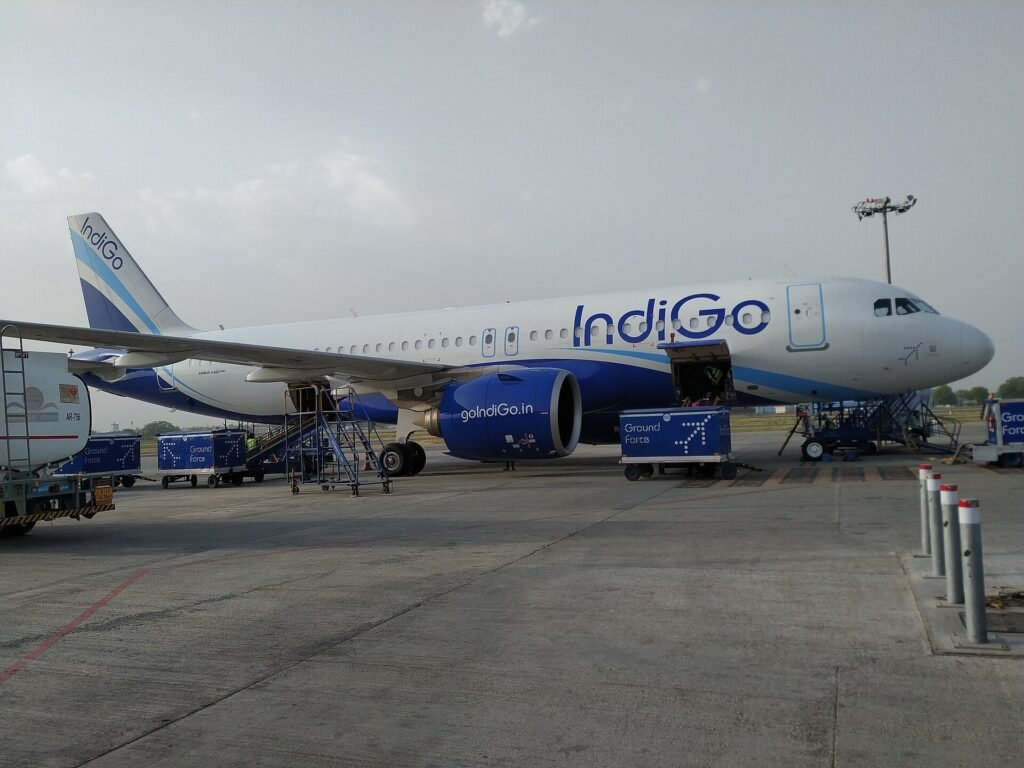
Terminal 1 is the low-cost terminal. Its 1D building opened in 2009, was expanded in 2022 to raise capacity from 18 million to 40 million passengers a year, and in 2025 the old 1A-1D areas were combined into a single integrated terminal. Delhi also has India’s first general aviation terminal for private jets, opened in September 2020.
Four Runways
| Runway | Length x width | Notes |
|---|---|---|
| 11R/29L | 4,430 m x 60 m | Opened 2008; long displaced threshold because of a 263 m statue near the 29L end |
| 11L/29R | 4,400 m x 45 m | Fourth runway, opened July 2023 with the eastern cross taxiways |
| 10/28 | 3,813 m x 46 m | |
| 09/27 | 2,816 m x 45 m | The original runway, built by the British in the Second World War |
Delhi is one of six Indian airports with CAT III-B instrument landing systems, which allow landings in very low visibility. Wikipedia says the 2008 runway raised capacity from 45-60 to up to 100 flights an hour, and the elevated eastern cross taxiways cut taxi times to the southern runways from 9-10 minutes to about two.
From RAF Palam to India’s Busiest Airport
The airport began in 1943 as RAF Palam, a British base for Allied operations in Asia. After independence the Indian Air Force ran it, and in 1962 commercial flights moved there from Safdarjung, Delhi’s first airport. On 2 May 1986 a new international terminal, Terminal 2, opened and the airport was renamed after Indira Gandhi. In May 2006 the Airports Authority of India handed its management to Delhi International Airport Ltd (DIAL), a GMR-led group, and Terminal 3 followed in 2010.
In October 2001 Canada 3000 began India’s first nonstop flight to North America, Delhi to Toronto. Today Wikipedia says Delhi is linked directly to more than 150 airports, a milestone it passed on 16 December 2024. In June 2022 it became India’s first airport to run entirely on hydro and solar power.
Traffic in 2026: Still Growing
| Passengers | Apr-Aug 2026 | Apr-Aug 2025 | Change |
|---|---|---|---|
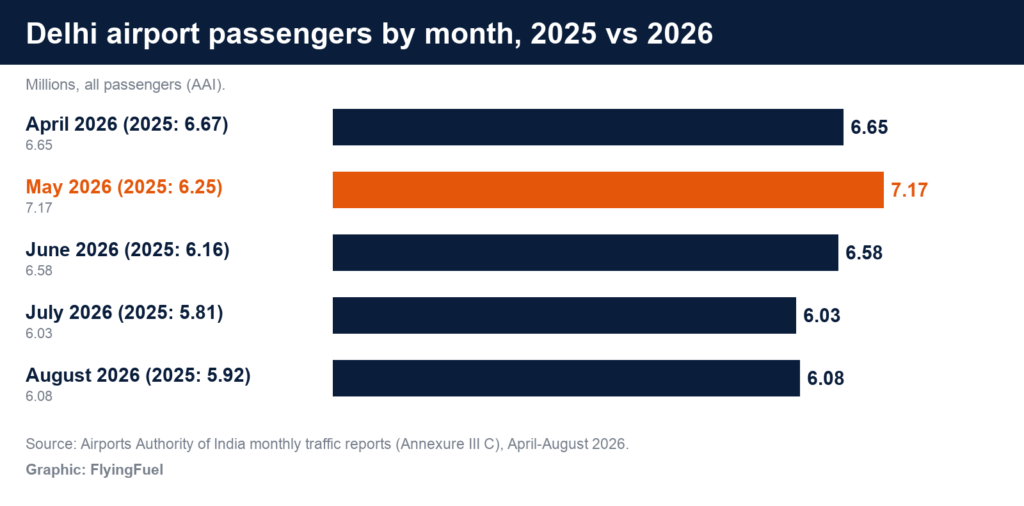
| Total | 32,508,678 | 30,824,482 | +5.5% |
| Domestic | 23,869,404 | 22,274,138 | +7.2% |
| International | 8,639,274 | 8,550,344 | +1.0% |
Source: AAI, August 2026.
While Indian airports as a whole handled 2.4% fewer passengers in April-August 2026, Delhi added 1.7 million. See the national picture in our analysis Is Indian air travel slowing down in 2026? and the full list of the largest airports in India.
Delhi’s Other Airports
The capital region now has three passenger airports. Hindon in Ghaziabad handles regional UDAN flights, and Noida International Airport at Jewar opened to commercial flights on 15 June 2026. Safdarjung, Delhi’s original airport, is now used mainly by VVIP helicopters.
Key Takeaways
- Delhi’s Indira Gandhi International handled 78.70 million passengers in 2025-26, 18.7% of India’s total.
- Terminal 3 handles international flights and Air India; Terminal 1 the low-cost domestic airlines.
- It has four runways, the longest 4,430 m, and CAT III-B landing systems for very low visibility.
- Traffic grew 5.5% in April-August 2026 while India overall fell 2.4%.
Frequently Asked Questions
How many passengers does Delhi airport handle?
78.70 million in 2025-26 (April 2025 to March 2026), according to the Airports Authority of India: almost one in five (18.7%) of all air passengers in India. Of these, 21.55 million were international.
Is Delhi the busiest airport in India?
Yes. Wikipedia says it has been India’s busiest airport by passengers since 2009 and is also the busiest for cargo. In 2025-26 it handled 23.4 million more passengers than Mumbai.
How many terminals does Delhi airport have?
Three passenger terminals: Terminal 1 for low-cost domestic airlines such as IndiGo and SpiceJet, Terminal 2 (reopened after renovation in 2025) and Terminal 3, which handles all international flights and Air India’s domestic flights. Check your booking, because airlines move flights between terminals.
Which terminal is Air India at Delhi?
Terminal 3, for both domestic and international flights, according to Wikipedia.
How many runways does Delhi airport have?
Four near-parallel runways: 11R/29L (4,430 m), 11L/29R (4,400 m), 10/28 (3,813 m) and 09/27 (2,816 m), the original wartime runway. The fourth runway opened in July 2023 together with elevated eastern cross taxiways.
Who owns Delhi airport?
Delhi International Airport Ltd (DIAL), led by the GMR Group, has run it since May 2006. The Airports Authority of India keeps a 26% stake; GMR bought out Malaysia Airports (2015) and Fraport (2024).
Why is Delhi airport called Palam?
It began in 1943 as RAF Palam, a British wartime air base. It was known as Palam Airport until 2 May 1986, when the new Terminal 2 opened and it was renamed after former Prime Minister Indira Gandhi.
How far is Delhi airport from the city centre?
Wikipedia puts it at Palam, about 15 km south-west of New Delhi railway station and about 16 km from the city centre. Terminals 1 and 3 are served by the Delhi Metro.
Is Delhi airport traffic growing in 2026?
Yes. From April to August 2026 it handled 32.51 million passengers, 5.5% more than a year earlier, while Indian airports overall fell 2.4%. Domestic traffic grew 7.2% and international 1.0% (AAI).
Featured image: FlyingFuel graphic using a photo of Terminal 3 at Delhi’s Indira Gandhi International Airport by Ravi Dwivedi, CC BY-SA 4.0, via Wikimedia Commons.
 Aircraft ComparisonsBoeing 737 MAX 8 vs 737-800: What Changed and Which Is Better? (2026)
 NewsMalaysia Airlines to Buy 10 Boeing 787-10 Dreamliners to Replace Its Airbus A350s From 2032
 AirportsAirports in Odisha: Bhubaneswar, Jharsuguda, Jeypore and More Ranked (2026 Data)
 NewsNew Visakhapatnam Airport at Bhogapuram to Charge Rs 890 Per Departing Domestic Passenger From 1 December
 AirportsAirports in Karnataka: Bengaluru, Mangaluru, Hubballi, Belagavi and More Ranked (2026 Data)
 Aircraft ComparisonsAirbus A350-900 vs Boeing 777-300ER: Which Long-Haul Jet Is Better? (2026)