
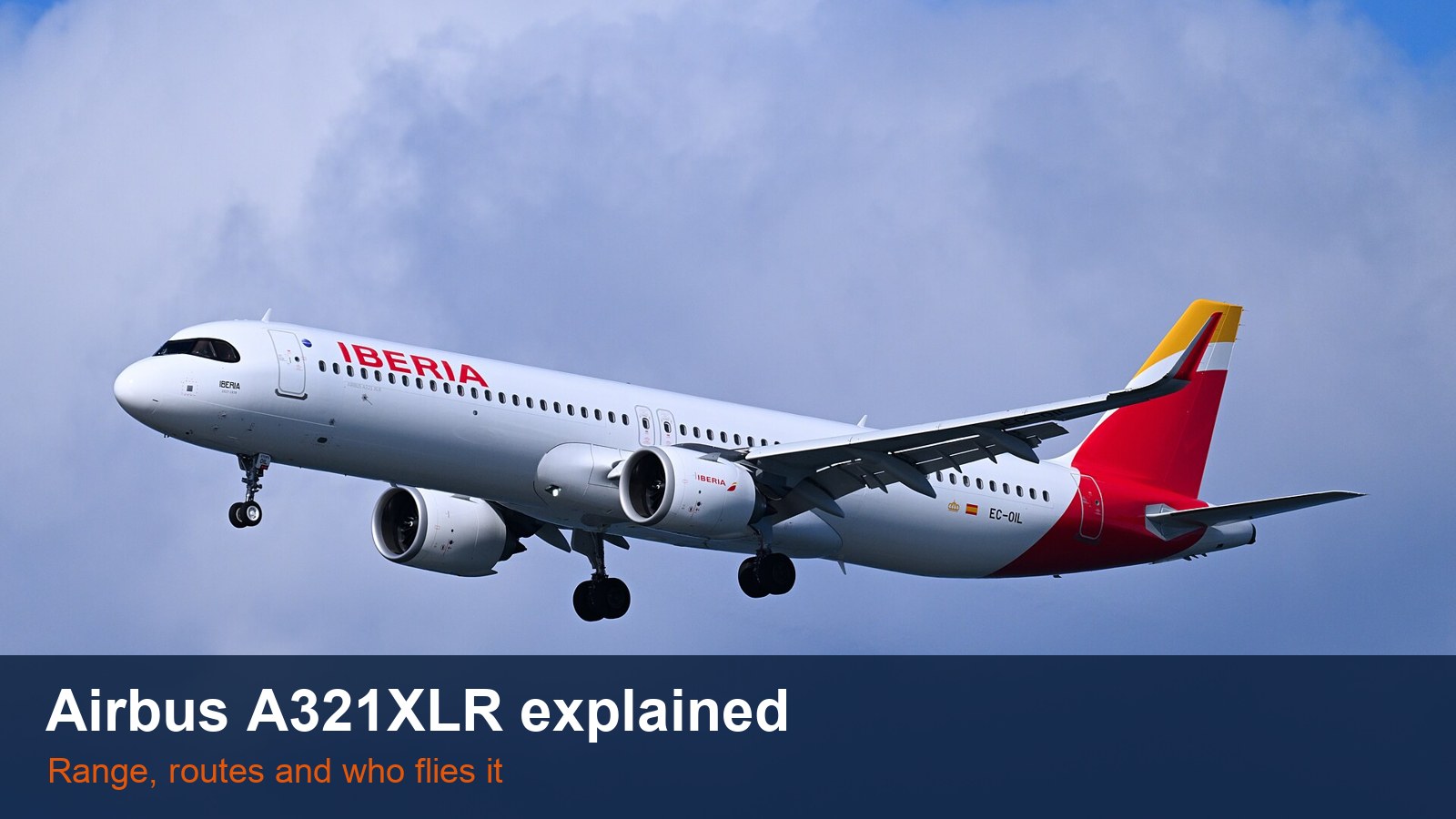
The Airbus A321XLR is the longest-range single-aisle airliner in service. Airbus says it can fly up to 4,700 nautical miles (about 8,700 km) non-stop, for up to 11 hours, which lets airlines fly routes such as India to Europe with a narrowbody jet instead of a widebody.
In India, IndiGo became the first airline to fly the type in January 2026, starting with non-stop flights from Mumbai and Delhi to Athens. This guide explains what the XLR is, how it differs from the A321neo, its range and seats, who flies it, and the routes it opens up.
What Is the Airbus A321XLR?
The A321XLR is the “Xtra Long Range” version of the A321neo, the largest member of the Airbus A320 family. It has the same fuselage, wings and engines as the A321neo, but it carries much more fuel. (The official type name is A321-200NY; see how Airbus names its aircraft.)
The key change is a permanent rear centre tank built into the fuselage. According to the Airbus A321XLR page, it holds 12,900 litres of fuel. The maximum take-off weight also rises to 101.5 tonnes, from 97 tonnes on the standard A321neo.
Airbus claims the XLR burns about 30% less fuel per seat than previous-generation competitor aircraft and has a 50% smaller noise footprint.
A321XLR Range: How Far Can It Fly?
The A321XLR’s range is up to 4,700 nm (about 8,700 km). The Airbus A321neo page lists 4,000 nm (7,400 km) for both the standard A321neo and the long-range A321LR. In its delivery announcement, Airbus said the XLR flies 15% further than the A321LR.
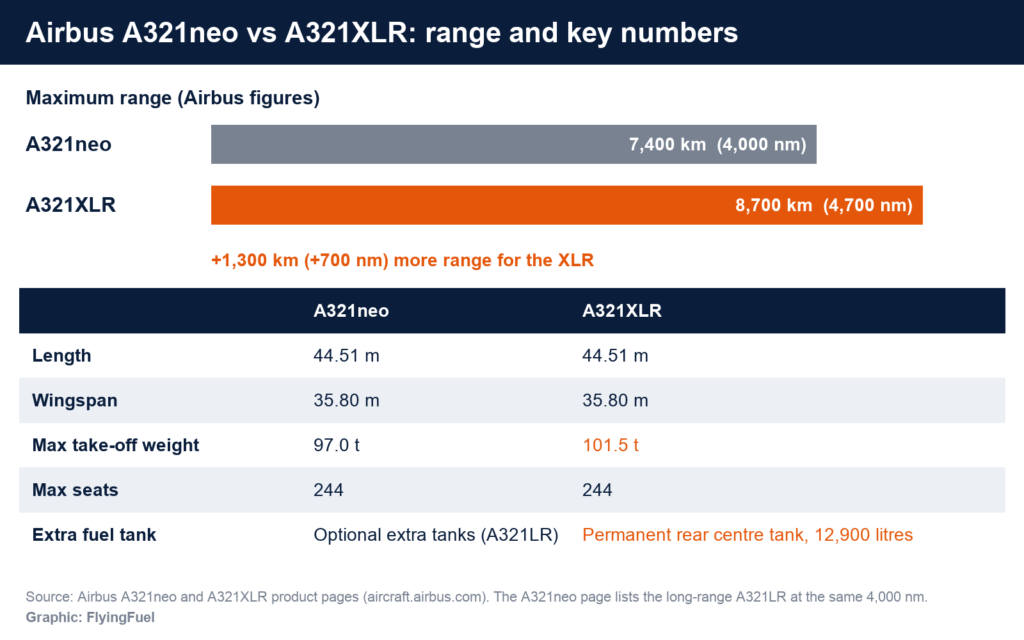
In practice, the real range depends on how many passengers and how much cargo are on board, the winds, and the airline’s fuel reserves. That is why airlines fly the XLR with fewer seats than the 244 maximum.
A321XLR Specifications
| Specification | A321neo | A321XLR |
|---|---|---|
| Length | 44.51 m | 44.51 m |
| Wingspan | 35.80 m | 35.80 m |
| Range | 4,000 nm (7,400 km) | 4,700 nm (8,700 km) |
| Max take-off weight | 97.0 t | 101.5 t |
| Typical seats (2-class) | 180 to 220 | 180 to 220 |
| Max seats | 244 | 244 |
| Extra fuel | Optional additional centre tanks (A321LR) | Permanent rear centre tank, 12,900 litres |
| Engines | CFM LEAP-1A or Pratt & Whitney GTF | CFM LEAP-1A or Pratt & Whitney GTF |
Source: Airbus A321neo and A321XLR product pages. Engine certification: Airbus press releases.
Certification and First Flights
- June 2022: the A321XLR made its first flight, followed by a test campaign with three aircraft.
- 19 July 2024: the European Union Aviation Safety Agency (EASA) certified the CFM LEAP-1A-powered A321XLR, according to Airbus. At that time Airbus had more than 500 orders for the type.
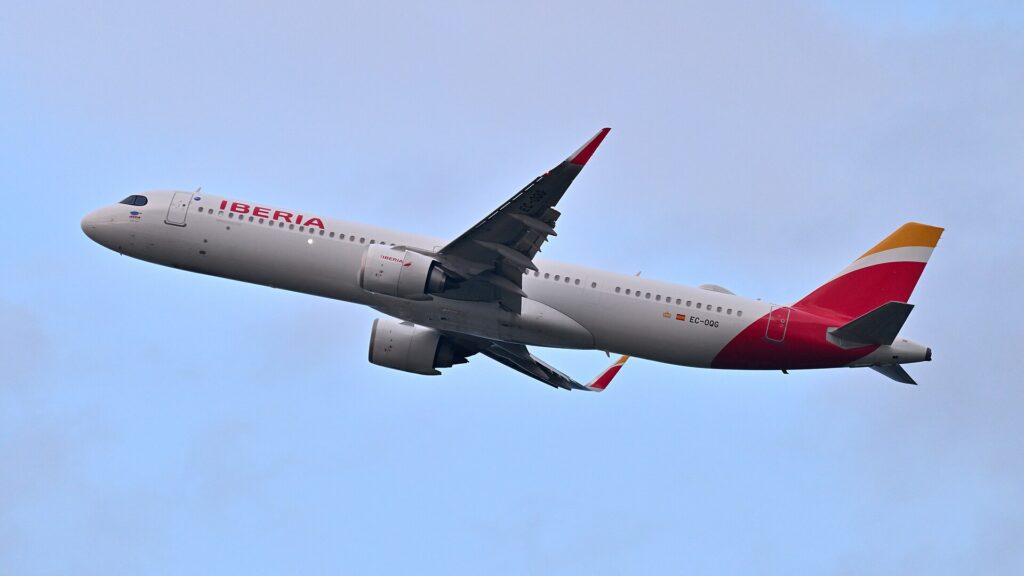
- 30 October 2024: Spain’s Iberia took delivery of the first A321XLR, with 182 seats in two classes.
- 14 November 2024: Iberia flew the first transatlantic A321XLR service, Madrid to Boston, as reported by Aviacionline.
- February 2025: EASA certified the version with Pratt & Whitney GTF engines.
IndiGo and the A321XLR
IndiGo became the first Indian airline to fly the A321XLR. According to IndiGo’s announcement, its first aircraft arrived at Delhi on 7 January 2026. The key points:
- Order: a firm order for 40 A321XLRs, with nine expected to be delivered in 2026.
- Cabin: 12 IndiGoStretch seats and 183 economy seats, all made by RECARO.
- First routes: Mumbai to Athens from 23 January 2026 and Delhi to Athens from 24 January 2026, each three times a week. The flights started on those dates.
- Next: IndiGo said later aircraft would fly existing routes to Istanbul and Denpasar (Bali), and then new long-haul routes in Europe and East Asia.
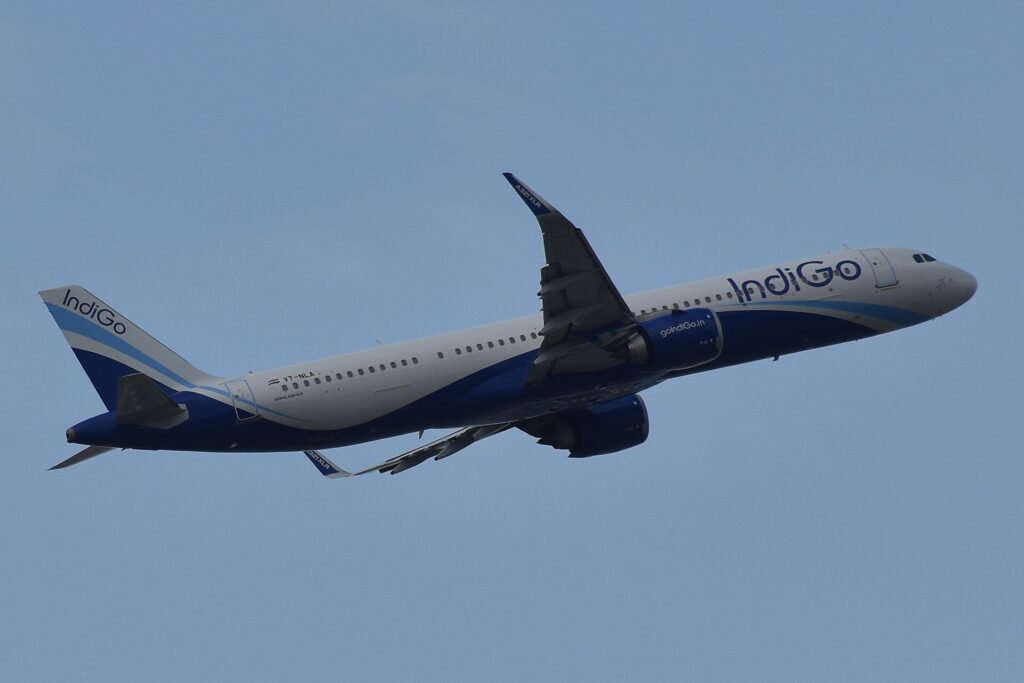
For IndiGo, whose fleet is mostly A320-family aircraft, the XLR means it can reach Europe and East Asia with an aircraft its pilots and engineers already know. For passengers, it means more non-stop flights from Indian cities that may not have enough demand to fill a large widebody.
Which Airlines Fly the A321XLR?
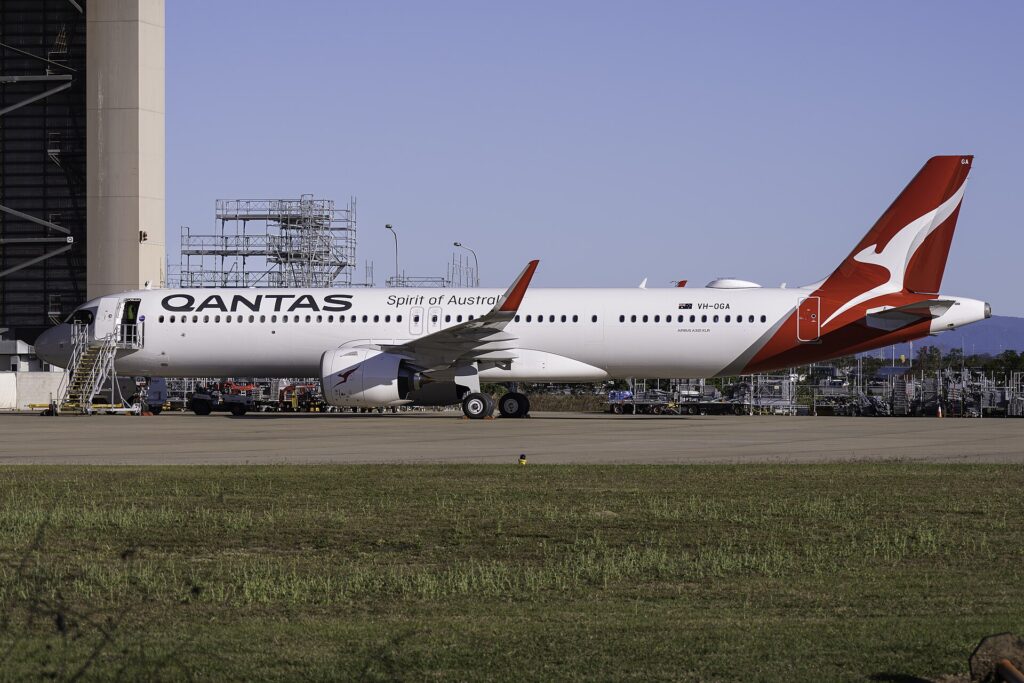
Iberia was the launch operator, and IndiGo was the first in India. Photos of delivered aircraft also show the type in the colours of other airlines, such as Qantas. Airbus said it had more than 500 orders for the A321XLR when it delivered the first one in October 2024.
A321XLR vs Widebody Aircraft
The XLR does not replace widebodies on the busiest long-haul routes. A widebody jet carries far more passengers and cargo and can fly much further. What the XLR changes is the economics of thinner routes. Airbus says it offers roughly half the trip cost of modern widebodies, so an airline can try a new long route with fewer seats to fill.
Long flights over water by twin-engine aircraft are governed by ETOPS rules, and the XLR extends the same trend that saw twin-engine jets took over long-haul flying.
The trade-off for passengers is a single aisle on a flight of up to 11 hours. Airlines respond with better seats: IndiGo has IndiGoStretch, and Iberia has lie-flat business seats with direct aisle access.
A321XLR vs A321neo: How to Tell Them Apart
From the outside, it is very hard. Both aircraft have the same length, wingspan and engines. The extra fuel tank is inside the fuselage, so the easiest way to know is the airline’s seat map or booking page, or the registration of the aircraft. If you want to learn to spot Airbus and Boeing single-aisle jets, see our A320neo vs 737 MAX 8 comparison.
Frequently Asked Questions
What is the range of the A321XLR?
Airbus gives the A321XLR a range of up to 4,700 nautical miles, about 8,700 km, and says it can stay in the air for up to 11 hours. That is about 700 nm more than the standard A321neo.
What does XLR stand for?
XLR stands for Xtra Long Range. It is the longest-range version of the Airbus A321neo, following the A321LR (Long Range).
What is the difference between the A321neo and the A321XLR?
They look the same from outside and have the same length and wingspan. The XLR has a permanent rear centre fuel tank holding 12,900 litres and a higher maximum take-off weight (101.5 tonnes against 97 tonnes), which gives it 4,700 nm of range against 4,000 nm.
How many seats does the A321XLR have?
Airbus lists up to 244 seats in a single-class layout, but airlines flying long routes use far fewer. IndiGo’s A321XLR has 195 seats (12 IndiGoStretch and 183 economy), and Iberia’s has 182 seats in two classes.
Which Indian airline flies the A321XLR?
IndiGo was the first Indian airline to fly the A321XLR. Its first aircraft arrived in Delhi on 7 January 2026, and it has a firm order for 40.
Where does IndiGo fly the A321XLR?
IndiGo started A321XLR flights on Mumbai to Athens on 23 January 2026 and Delhi to Athens on 24 January 2026, three times a week each. It said later aircraft would go to Istanbul and Denpasar (Bali), followed by new routes in Europe and East Asia.
Which airline flew the A321XLR first?
Iberia of Spain was the launch operator. It took delivery of the first A321XLR on 30 October 2024 and flew the first transatlantic A321XLR service, Madrid to Boston, on 14 November 2024.
Is the A321XLR a widebody aircraft?
No. The A321XLR is a single-aisle narrowbody aircraft. What makes it unusual is that it can fly routes that used to need a widebody jet, at a lower cost per trip.
Featured image: 4300streetcar, CC BY 4.0, via Wikimedia Commons.