

Bengaluru’s airport at Devanahalli has quietly become India’s fastest-growing big international gateway. In 2025-26 it passed Chennai on international passengers, and while most large Indian airports lost traffic in early 2026, Bengaluru held steady. Here is the full picture.
Quick answer: Kempegowda International Airport (BLR), about 35 km north of Bengaluru, handled 44.47 million passengers in 2025-26 (up 6.2%), India’s third-busiest airport. International passengers jumped 23.9% to 7.23 million, according to the Airports Authority of India. Terminal 1 is domestic only (IndiGo, Akasa, Alliance Air, SpiceJet); Terminal 2 has all international flights plus Air India, Air India Express and Star Air.
Traffic: AAI, March 2026 (2025-26) and AAI, August 2026 (April-August 2026). Airport facts and route figures: the Wikipedia article on Kempegowda International Airport.
Bengaluru Airport at a Glance
| Kempegowda International Airport | |
|---|---|
| Code | BLR |
| Location | Devanahalli, about 35 km north of Bengaluru, Karnataka |
| Opened | 24 May 2008 (first flight landed late on 23 May) |
| Passengers 2025-26 | 44,470,035 (+6.2%), 3rd in India |
| International passengers 2025-26 | 7,227,399 (+23.9%), 3rd in India |
| Terminals | T1 (domestic, 35 million a year) and T2 (all international + some domestic) |
| Runways | Two, each 4,000 m x 45 m, CAT III |
| Area | About 16 sq km |
| Owner | Bengaluru International Airport Ltd (Fairfax 54%, Siemens 20%, AAI 13%, Karnataka 13%) |
Passengers: AAI. Everything else: Wikipedia.
Terminal 1 or Terminal 2? Which Airline Uses Which
| Terminal | Flights | Airlines (domestic) |
|---|---|---|
| Terminal 1 | Domestic only | IndiGo, Akasa Air, Alliance Air, SpiceJet |
| Terminal 2 | All international flights + some domestic | Air India, Air India Express, Star Air |
Source: Wikipedia, which follows the airport’s own allocation. Airlines can move terminals, so check your booking.
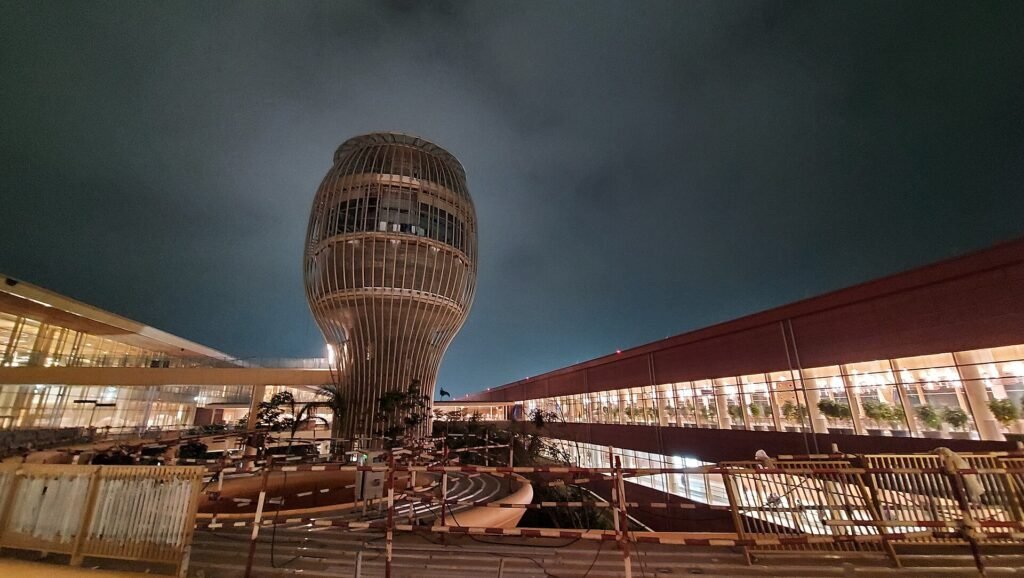
Terminal 1 is the original 2008 building, extended in 2013, and can handle 35 million passengers a year. It has been domestic-only since 12 September 2023, and its gates 41-42 can take an Airbus A380.
Terminal 2 was designed by Skidmore, Owings & Merrill as a tribute to Bengaluru’s “Garden City” name and built by Larsen & Toubro. Prime Minister Narendra Modi inaugurated it on 11 November 2022 and domestic flights started there on 15 January 2023, with Star Air flight S5117 to Kalaburagi. Phase one added capacity for 25 million passengers a year, with 95 check-in counters, 17 security lanes, nine baggage belts and 40 immigration gates (34 conventional and six electronic). A second phase, under construction, will add another 20 million.
Two 4 km Runways
Bengaluru has two parallel runways, each 4,000 m by 45 m. The south runway (09R/27L) opened on 6 December 2019 with IndiGo flight 6E466 to Hyderabad. The original north runway (09L/27R) was then rebuilt and reopened on 31 March 2021, making Bengaluru the first airport in south India with parallel runway operations. Both runways now have CAT IIIB instrument landing systems for very low visibility, and both can handle the biggest Code-F jets such as the Airbus A380 and Boeing 747-8.
Busiest Routes From Bengaluru
| Domestic route (2024-25) | Passengers | International route (2025-26) | Passengers |
|---|---|---|---|
| Delhi | 4,681,042 | Dubai | 873,545 |
| Mumbai | 4,114,574 | Abu Dhabi | 653,230 |
| Kolkata | 2,326,777 | Singapore | 573,298 |
| Hyderabad | 2,293,602 | London Heathrow | 471,747 |
| Pune | 1,881,109 | Kuala Lumpur | 389,709 |
Figures listed in the Wikipedia article on the airport (latest year given for each table).
Bengaluru’s long-haul links have grown in recent years: Wikipedia lists its first nonstop flights to Africa (Ethiopian Airlines to Addis Ababa, October 2019), North America (Air India to San Francisco, January 2021) and Australia (Qantas to Sydney, September 2022), and Emirates began daily Airbus A380 flights to Dubai in October 2022.
India’s Fastest-Growing Big International Airport
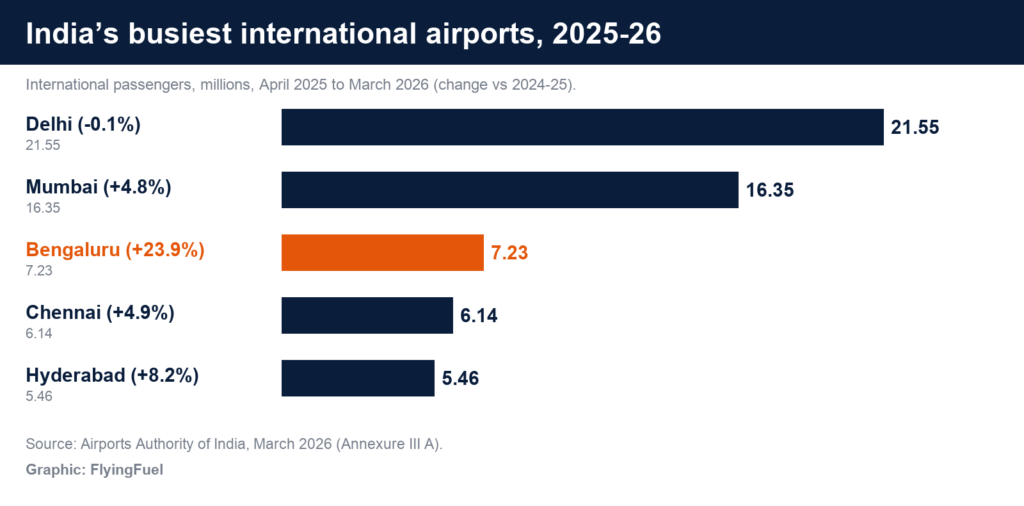
International passengers at Bengaluru rose from 5.83 million in 2024-25 to 7.23 million in 2025-26, up 23.9%. That was the fastest growth of India’s top international airports: Hyderabad grew 8.2%, Chennai 4.9%, Mumbai 4.8% and Delhi was flat (-0.1%). It lifted Bengaluru past Chennai (6.14 million) into third place. See our ranking of the busiest international airports in India.
| Passengers | Apr-Aug 2026 | Apr-Aug 2025 | Change |
|---|---|---|---|
| Total | 18,005,313 | 18,226,218 | -1.2% |
| International | 2,900,539 | 2,900,924 | 0.0% |
Source: AAI, August 2026.
In the first five months of 2026-27 Bengaluru held almost steady, while Hyderabad fell 11.5% and Chennai 10.6% over the same months (AAI). Read our guide to Hyderabad airport, and the full list of the largest airports in India.
History and Ownership
Bengaluru’s first airport was HAL Airport, opened in 1942 for military use, which ran out of room as traffic grew. Devanahalli was chosen for a new airport in the 1990s, and Bengaluru International Airport Ltd (BIAL) was set up in 2001 as a public-private company. Construction began on 2 July 2005 and took 32 months. The first flight, Air India AI609 from Mumbai, landed late on 23 May 2008, the night before the official opening, and HAL Airport closed to scheduled flights. The airport was renamed after Kempe Gowda I, the city’s founder, on 14 December 2013.
Today Fairfax Financial owns 54% of BIAL and Siemens Project Ventures 20%; the Airports Authority of India and the Karnataka State Industrial Investment and Development Corporation own 13% each. The master plan foresees a Terminal 3 in the late 2020s or early 2030s, which would raise capacity to 90-100 million passengers a year. For the state’s other airports, from Mangaluru to Hubballi, see our guide to airports in Karnataka.
Key Takeaways
- Kempegowda International (BLR) handled 44.47 million passengers in 2025-26, India’s third-busiest airport.
- International passengers rose 23.9% to 7.23 million, the fastest growth of India’s big airports, overtaking Chennai.
- Terminal 1 is domestic only (IndiGo, Akasa, Alliance Air, SpiceJet); Terminal 2 has all international flights plus Air India, Air India Express and Star Air.
- Two 4,000 m runways with CAT IIIB landing systems; traffic held almost flat in April-August 2026.
Frequently Asked Questions
How many passengers does Bengaluru airport handle?
44.47 million in 2025-26 (April 2025 to March 2026), up 6.2%, according to the Airports Authority of India. That makes Kempegowda International India’s third-busiest airport after Delhi and Mumbai.
Which airlines use Terminal 1 and Terminal 2 at Bengaluru airport?
Terminal 1 is domestic only and handles IndiGo, Akasa Air, Alliance Air and SpiceJet. Terminal 2 handles all international flights plus the domestic flights of Air India, Air India Express and Star Air (per Wikipedia). Check your airline before you travel.
Are all international flights from Terminal 2 in Bengaluru?
Yes. Since 12 September 2023 all international flights at Kempegowda International use Terminal 2; the first international arrival there was Saudia flight SV867 from Jeddah.
How far is Bengaluru airport from the city?
Wikipedia puts Kempegowda International about 35 km north of Bengaluru, near Devanahalli. The old HAL Airport, which closed to scheduled flights when the new airport opened in May 2008, is much closer to the city.
How many runways does Bengaluru airport have?
Two parallel runways, 09L/27R and 09R/27L, each 4,000 m long and 45 m wide with CAT III approach systems. Both can handle Code-F jets such as the Airbus A380 and Boeing 747-8.
Who owns Bengaluru airport?
Bengaluru International Airport Ltd (BIAL). Private shareholders own 74% (Fairfax Financial 54%, Siemens Project Ventures 20%) and government bodies 26% (the Airports Authority of India and the Karnataka State Industrial Investment and Development Corporation, 13% each).
Why is it called Kempegowda International Airport?
It is named after Kempe Gowda I, the founder of Bengaluru. Opened as Bengaluru International Airport, it was officially renamed on 14 December 2013.
What is the busiest international route from Bengaluru?
Dubai, with 873,545 passengers in 2025-26, ahead of Abu Dhabi (653,230), Singapore (573,298) and London Heathrow (471,747), according to the figures listed on Wikipedia.
Is Bengaluru airport traffic growing in 2026?
Roughly flat. From April to August 2026 it handled 18.01 million passengers, 1.2% fewer than a year earlier, while international passengers were unchanged at 2.90 million (AAI). Most other big Indian airports fell further.
Featured image: FlyingFuel graphic using a photo of the departures side of Terminal 2 at Kempegowda International Airport, Bengaluru by Sameer2905, CC BY-SA 4.0, via Wikimedia Commons.
 Aircraft ComparisonsBoeing 737 MAX 8 vs 737-800: What Changed and Which Is Better? (2026)
 NewsMalaysia Airlines to Buy 10 Boeing 787-10 Dreamliners to Replace Its Airbus A350s From 2032
 AirportsAirports in Odisha: Bhubaneswar, Jharsuguda, Jeypore and More Ranked (2026 Data)
 NewsNew Visakhapatnam Airport at Bhogapuram to Charge Rs 890 Per Departing Domestic Passenger From 1 December
 AirportsAirports in Karnataka: Bengaluru, Mangaluru, Hubballi, Belagavi and More Ranked (2026 Data)
 Aircraft ComparisonsAirbus A350-900 vs Boeing 777-300ER: Which Long-Haul Jet Is Better? (2026)