
Summary
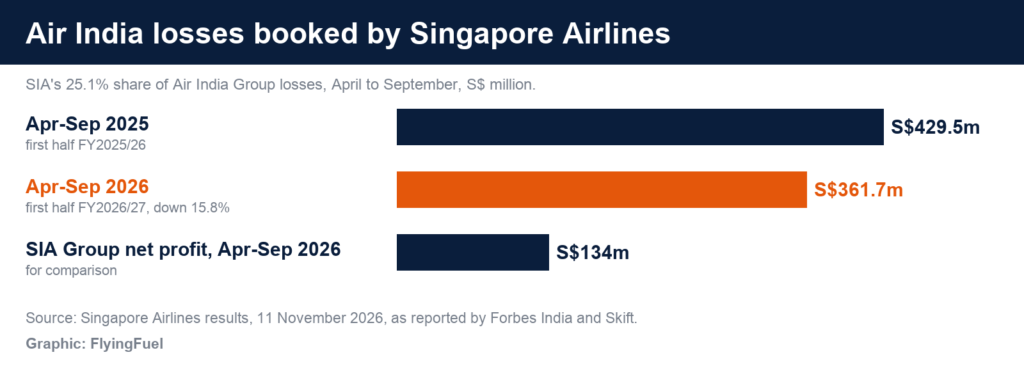
- Singapore Airlines’ share of Air India’s losses fell to S$361.7 million for April to September 2026, from S$429.5 million a year earlier, a drop of about 16%; SIA’s finance chief said this was mainly due to reversed provisions from earlier years
- All of the improvement came in the July-September quarter; SIA says lower losses from associates, mainly Air India, added S$110 million to its quarterly profit
- Air India’s losses were still more than twice SIA’s own half-year net profit of S$134 million, which fell 44% as jet fuel prices stayed high
SINGAPORE, 11 November 2026 – Singapore Airlines (SIA), which owns 25.1% of the Air India Group, booked a smaller share of Air India’s losses in the six months to September, according to its half-year results. SIA booked a S$361.7 million (about US$281.5 million) share of Air India’s losses for April to September 2026, down from S$429.5 million a year earlier, Forbes India and Skift reported from the results.
The lower figure does not mean Air India’s own business improved by the same amount. SIA’s chief financial officer, Tan JoAnn, said at a briefing on 12 November that the smaller share of losses was mainly due to the reversal of provisions made in previous years, The Business Times reported, as cited by Mothership. She did not say how much was reversed. BusinessLine also reported that SIA’s management said on its results call that Air India’s loss had not fallen by 16%.
Air India is owned by Tata Sons, with SIA as the minority partner, and is not listed on a stock exchange, so SIA’s results are one of the few regular public windows into its finances. SIA began equity accounting for Air India in December 2024, after Vistara was fully merged into Air India, according to its results a year ago.
A better second quarter
In its results release, SIA said a lower share of losses from associated companies, mainly Air India, improved its half-year profit by S$68 million. The gain was bigger in the second quarter alone, at S$110 million, which means the April-June quarter was worse than a year earlier and July-September made up the difference, as Skift pointed out.
Skift also reported that the carrying value of SIA’s Air India stake fell to about S$800 million at the end of September, from S$1.135 billion at the end of March. The stake is SIA’s route into India under what it calls a multi-hub strategy, and the release gives no date for Air India to break even.
What SIA says about Air India
According to SIA, Air India has made real progress in its multi-year turnaround, with better customer experience and operations, a rising Net Promoter Score and the Best Airline in India title at the 2026 Skytrax World Airline Awards. SIA and Tata Sons accept that a change of this size takes time, the release says.
The two owners are working with Air India on structural cost savings, on more shared work between Air India and Air India Express, and on a sharper commercial plan to deal with current external pressures, SIA said. Forbes India, citing SIA’s analyst presentation, reported plans to cut unit costs to at least industry level, drop routes that do not contribute cash, build more in-house maintenance, and finish refurbishing 26 Boeing 787-8s and 13 Boeing 777-300ERs by 2028.

Fuel costs hit Singapore Airlines too
SIA’s own numbers show why airlines are under pressure. Group revenue rose 16.8% to a record S$11.3 billion and SIA and Scoot carried 21.8 million passengers, but fuel cost before hedging almost doubled. SIA said jet fuel averaged US$171 a barrel over the six months, 86.7% higher than a year earlier, which it linked to the conflict in the Middle East.
Operating profit fell 29.1% to S$569 million and net profit fell 43.9% to S$134 million. Second-quarter net profit rose to S$210 million from S$52 million, helped by stronger fares and the smaller Air India loss.
What it means for passengers
Nothing changes on tickets or bookings. SIA said the first phase of joint work with Air India started in October 2026, giving customers more flight options between Singapore and eight Indian cities through each airline’s own booking channels. Shared loyalty benefits began in April 2026, and SIA said more are planned for the second quarter of 2027.
Air India’s cost plans matter for its long-haul product. The planned refits cover 26 Boeing 787-8s and 13 Boeing 777-300ERs, two of the widebody types it uses on long-haul routes. See which jets Air India flies in our Air India fleet guide, and our earlier report on the widebody and Mumbai hub plans of its new CEO.
Read more
- Air India fleet explained: every aircraft type and order
- Boeing 777-300ER review: cabin, engines and range
- The longest flights from India, and how Air India flies them
- Air India’s new CEO wants more widebody jets
Sources: Singapore Airlines, half-year results news release, 11 November 2026; Forbes India, 12 November 2026; Skift, 12 November 2026; Singapore Airlines, half-year results release, 13 November 2025; Mothership and BusinessLine, 12 November 2026.
Correction, 14 November 2026: An earlier version of this story said Air India’s losses got smaller in the first half. Singapore Airlines’ chief financial officer said on 12 November that its smaller share of Air India’s losses was mainly due to the reversal of provisions made in earlier years. The headline, summary and opening have been updated.
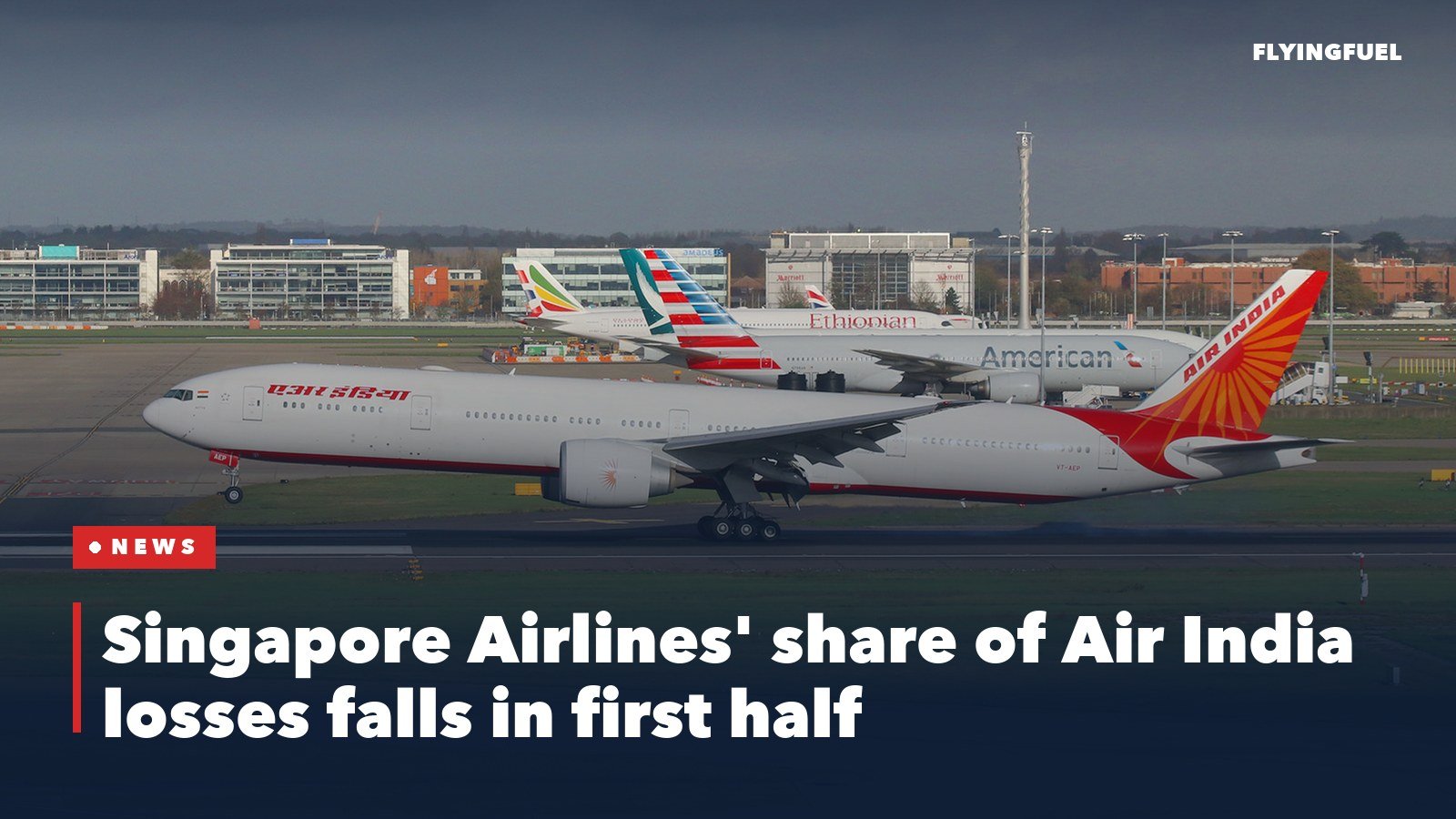
Featured image: FlyingFuel graphic using a photo of Air India Boeing 777-300ER VT-AEP at London Heathrow by Matt Taylor, CC BY-SA 4.0, via Wikimedia Commons.
 Aircraft ComparisonsBoeing 737 MAX 8 vs 737-800: What Changed and Which Is Better? (2026)
 NewsMalaysia Airlines to Buy 10 Boeing 787-10 Dreamliners to Replace Its Airbus A350s From 2032
 AirportsAirports in Odisha: Bhubaneswar, Jharsuguda, Jeypore and More Ranked (2026 Data)
 NewsNew Visakhapatnam Airport at Bhogapuram to Charge Rs 890 Per Departing Domestic Passenger From 1 December
 AirportsAirports in Karnataka: Bengaluru, Mangaluru, Hubballi, Belagavi and More Ranked (2026 Data)
 Aircraft ComparisonsAirbus A350-900 vs Boeing 777-300ER: Which Long-Haul Jet Is Better? (2026)