
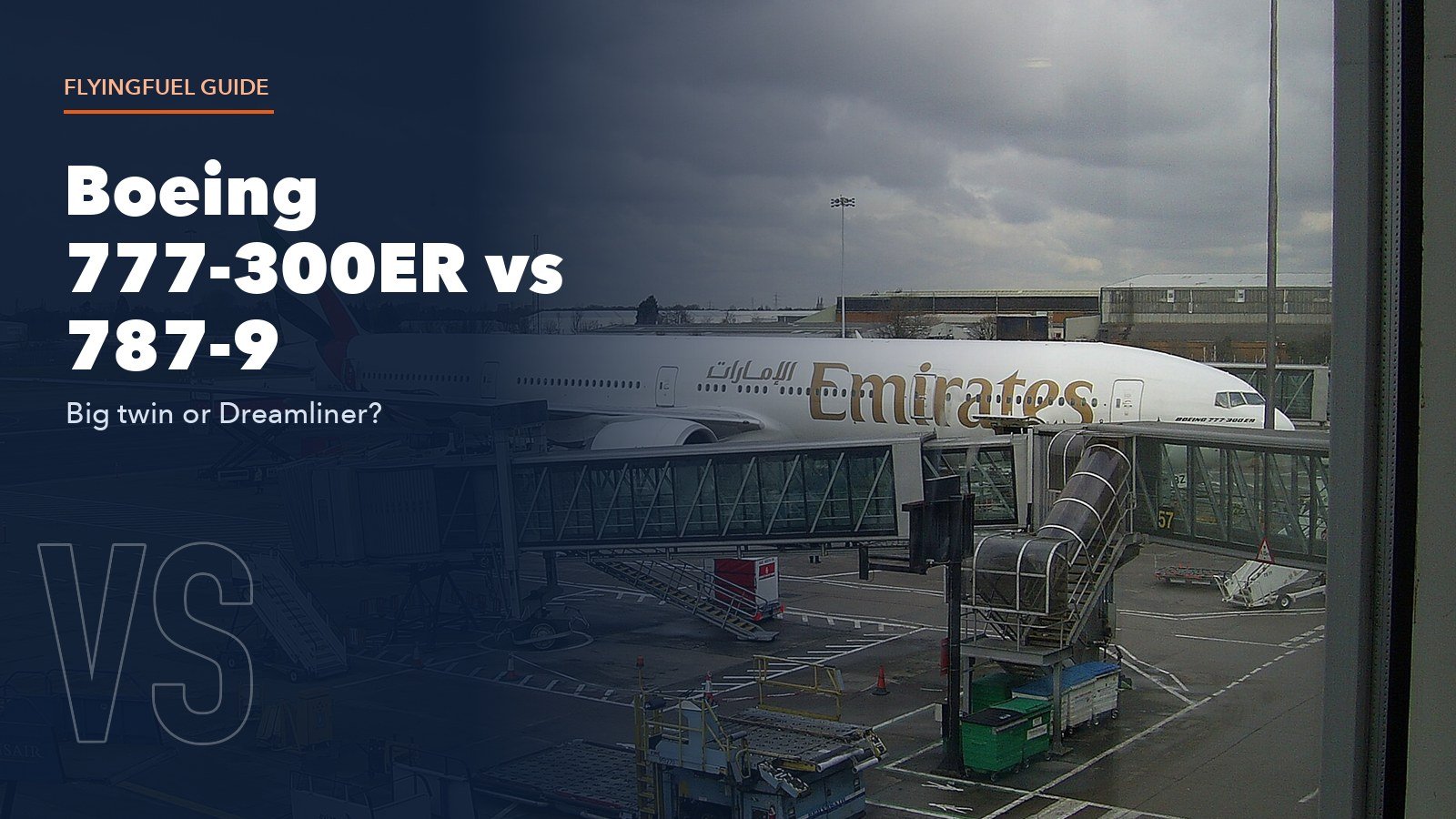
The Boeing 777-300ER and the 787-9 Dreamliner are the two long-haul Boeings you are most likely to board today, and many airlines fly both, including Air India. They look alike at a glance, but they are very different aircraft: one is the big, proven aluminium workhorse of the 2000s, the other the lighter carbon-fibre jet that made long, thin routes profitable. This comparison explains the differences in size, seats, range, engines, cabin comfort and cockpit, how to tell them apart from the ground, and which one is better for airlines and for you.
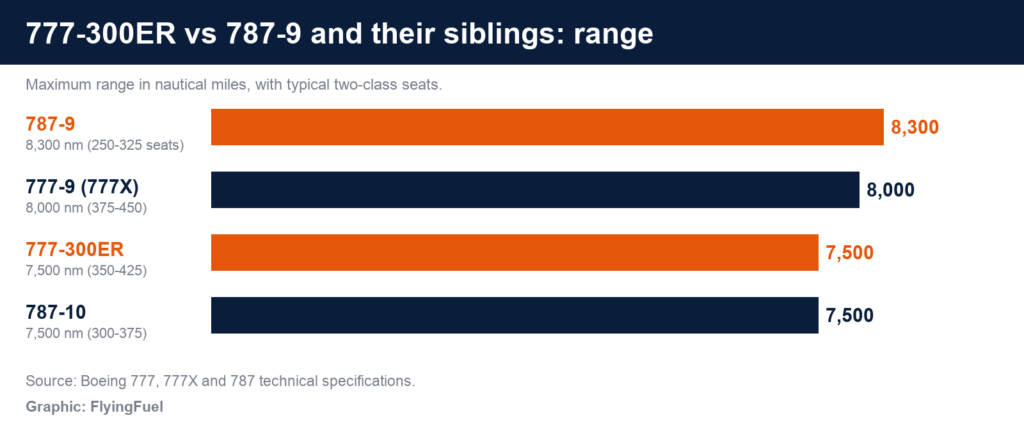
Quick answer: the 777-300ER is much bigger: 11 m longer, about 92 tonnes heavier at take-off and seating 350 to 425 passengers in two classes against 250 to 325. The 787-9 flies further (8,300 nm against 7,500 nm), is lighter and newer, and has the more comfortable cabin technology: lower cabin altitude, more humid air and big dimmable windows. Airlines use the 777-300ER on busy trunk routes and the 787-9 on longer or thinner ones.
Sources: Boeing 777 specifications, Boeing 787 specifications, Wikipedia: Boeing 777 and Wikipedia: Boeing 787, as compiled in our 777-300ER review and 787-9 review. Air India fleet: Air India media kit, September 2026.
Side-by-Side Specifications
| Boeing 777-300ER | Boeing 787-9 | Difference | |
|---|---|---|---|
| Seats (two-class) | 350-425 | 250-325 | 777 about 100 more |
| Range | 7,500 nm (13,890 km) | 8,300 nm (15,370 km) | 787 800 nm more |
| Length | 73.9 m | 62.8 m | 777 11.1 m longer |
| Wingspan | 64.8 m | 60.1 m | 777 4.7 m wider |
| Height | 18.5 m | 17.0 m | 777 1.5 m taller |
| Maximum take-off weight | 351.5 t | 259.2 t | 777 about 92 t heavier |
| Engines | GE90-115B only | GEnx-1B or Trent 1000 | 787 has a choice |
| Economy seats per row | Usually 10 (3-4-3) | Usually 9 (3-3-3) | – |
| Body | Aluminium | About 50% composite | 787 newer |
| First flight | 24 February 2003 | 17 September 2013 | – |
| First delivery | 29 April 2004 (Air France) | 8 July 2014 (Air New Zealand) | – |
Size and Capacity
The 777-300ER is the longest model of the original 777 family and, at 73.9 m, it is 11.1 m longer than the 787-9. Its 351.5 tonne maximum take-off weight is about 92 tonnes more than the 787-9’s 259.2 tonnes. That extra size buys capacity: Boeing lists 350 to 425 seats in two classes, and Air France fits 472 seats in one version. The 787-9 seats 250 to 325 in two classes, with an exit limit of 420.
Below the passengers, both carry cargo. The 787-9 holds 36 LD3 containers (172.4 m³). The 777-300ER’s large lower deck lets airlines carry a full cabin and a large amount of cargo at the same time, which is a big part of why it made money on busy routes; IAI even converts retired 777-300ERs into 777-300ERSF freighters.
Range: The 787-9 Flies Further
Boeing lists the 787-9 at up to 8,300 nm, including a higher maximum take-off weight cleared by the FAA in March 2026 that added more than 300 nm. The 777-300ER is listed at 7,500 nm. Both can fly nonstop from Delhi or Mumbai to anywhere in Europe; the 787-9’s extra reach matters on the very longest routes (see the longest flights in the world). The 777 family member with the longest range is the 777-200LR (8,500 nm), not the -300ER.
Engines: One Giant or a Choice of Two
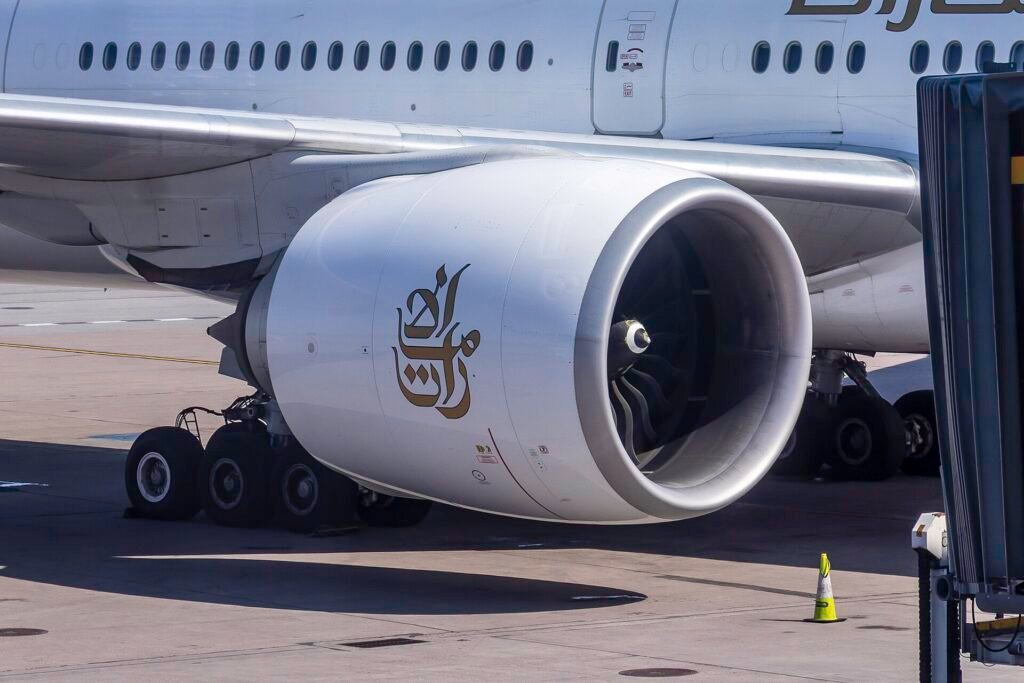
Every 777-300ER flies with two GE Aerospace GE90-115B engines; Boeing agreed with GE to offer only the GE90 on the long-range 777s. Its fan is 128 inches (325 cm) across with 22 carbon-fibre blades, and it is rated at 115,000 lbf. It was the world’s largest jet engine until the GE9X overtook it in 2020 (Wikipedia: GE90). The 787-9 gives airlines a choice: the GEnx-1B, derived from the GE90 with a 111.1-inch fan, or the Rolls-Royce Trent 1000 with a 2.85 m fan. The Trent 1000 had a difficult period from 2016, when turbine blade cracking grounded as many as 44 aircraft.
The 787 is also a “more electric” aircraft: it does not take hot bleed air from the engines to pressurise the cabin, using electric compressors instead, which saves fuel. Together with its composite body, Boeing says this gives a 25% reduction in fuel use compared with the aircraft the 787 typically replaces. The 777-300ER, designed a decade earlier, uses conventional bleed air. See turbofan vs turboprop for how these engines work.
Cabin Comfort: Where the 787-9 Wins (Mostly)
For passengers, the biggest differences are the air and the windows:
- Cabin altitude: the 787 cabin is pressurised to the equivalent of 6,000 ft, against about 8,000 ft on older jets such as the 777, which Boeing says reduces fatigue on long flights.
- Humidity: the 787’s humidity can be raised to about 15%, against about 4% on earlier aircraft; its composite body does not corrode.
- Windows: the 777’s windows (about 15 by 10 inches) were the largest of any airliner until the 787 arrived. The 787’s are bigger still and have electronic dimming instead of pull-down shades.
- Ride: the 787 has smoother-ride technology that senses and counters turbulence.
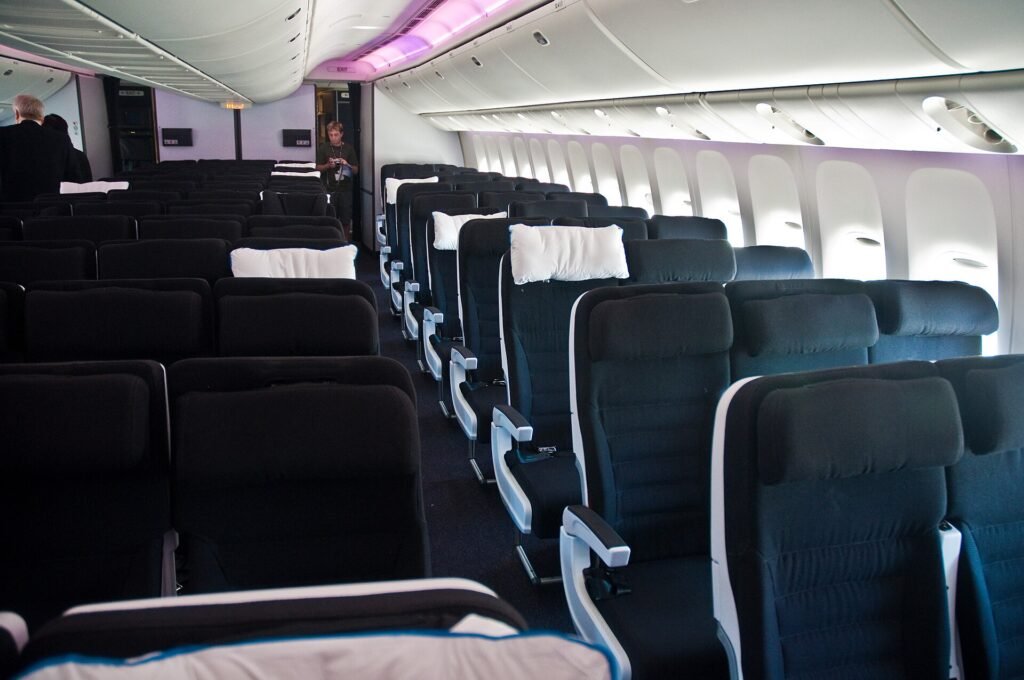
Seat width is where the 777 can fight back. Its wide, circular fuselage was designed for nine seats per row, and a nine-abreast 777 is roomy. But to lower the cost per seat, most airlines moved to ten across: by 2016 more than half of new 777s had ten-abreast economy. The 787’s cabin is about 5.5 m wide at armrest level, and most airlines fit nine (3-3-3), with economy seats up to about 17.5 inches wide. Either way, check your airline’s seat map before booking.
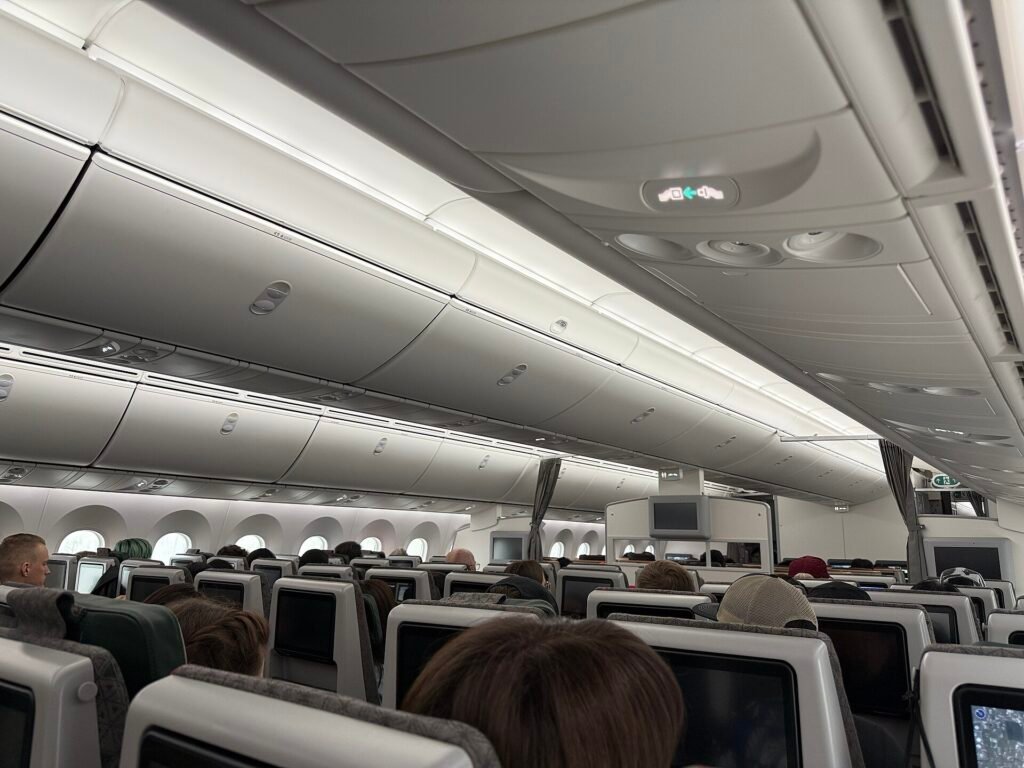
On long flights the 777 also has hidden overhead crew rests above the main cabin, reached by stairs, so pilots and cabin crew can sleep without taking passenger seats. Premium cabins on both depend entirely on the airline’s seat choice.
Cockpit: Designed to Be Similar
The 777 was Boeing’s first fly-by-wire airliner, and the 787 cockpit was designed with a common layout and similar handling. Both use control yokes, not sidesticks. The 787 adds large LCD displays and dual head-up displays. Boeing says pilots can move between the two types with minimal extra training, which helps airlines such as Air India that fly both.
How to Tell Them Apart
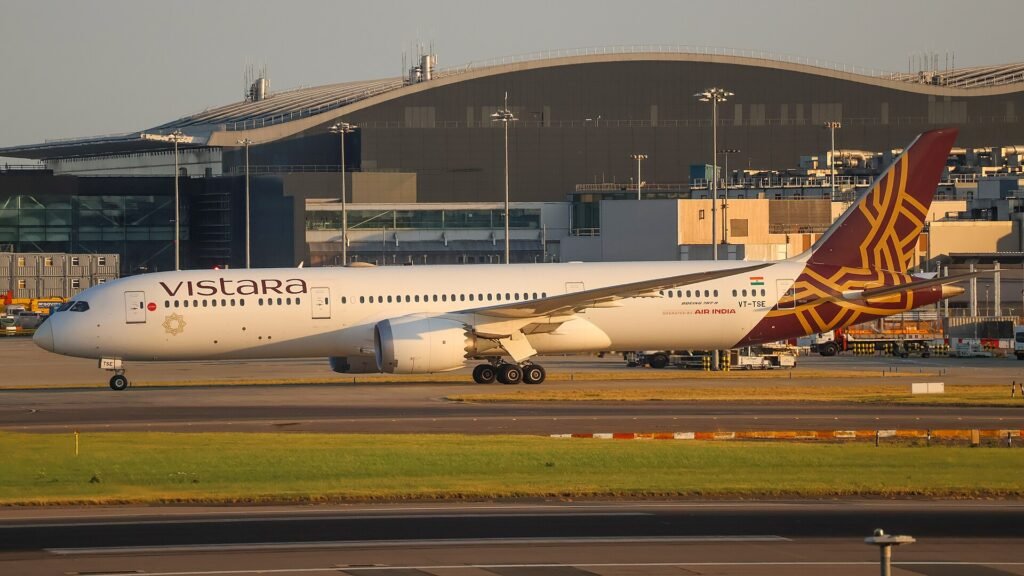
- Main landing gear: six wheels on each main leg on the 777; four on the 787.
- Tail cone: the 777 ends in a flat, vertical blade instead of a round point.
- Cockpit windows: the 787 has a distinctive four-window cockpit.
- Engines: the 787’s nacelles have serrated chevrons on the back edge to cut noise; the 777’s GE90s are enormous, almost half the width of the fuselage.
- Length: the 777-300ER is very long and slim-looking for its size; the 787-9 is shorter and has long, swept-back raked wingtips with no winglet.
For more spotting tips, see Boeing vs Airbus: how to tell the difference.
Safety Record
Both have long records. The 777 has flown for three decades; as of May 2024 it had been involved in 31 accidents and incidents, including eight hull losses, and it was the first airliner to enter service with 180-minute ETOPS approval, in 1995. The 787 flew for nearly 14 years without a fatal accident until Air India Flight 171, a 787-8, crashed at Ahmedabad on 12 June 2025; the preliminary report found the fuel control switches had moved to CUTOFF and did not recommend any action for Boeing or 787 operators. The 787 was also grounded in 2013 over battery fires.
In India: Air India Flies Both
In September 2026 Air India had 19 Boeing 777-300ERs and 10 787-9s, alongside 26 787-8s and its new A350s. Most of the 787-9s came from Vistara, and Air India received its first new-build 787-9 in January 2026, putting it on Mumbai to Frankfurt. In general, the bigger 777-300ER suits the busiest long-haul routes, while 787s fly routes that need range more than seats. Foreign airlines such as Emirates, the world’s largest 777 operator, also fly 777-300ERs to India.
Which Is Better?
For airlines: the 777-300ER wins on capacity and cargo on busy routes, but it is heavy and burns more fuel than newer jets; new orders in its size now go to the 777-9 or the A350-1000. The 787-9 wins on range, efficiency and flexibility: it can open routes a 777 could not fill.
For passengers: the 787-9’s lower cabin altitude, more humid air and big windows make long flights more pleasant. A nine-abreast 777 with modern seats is still comfortable, but on a ten-abreast 777 economy can feel tight. If the seat map shows both options on your route, the 787-9 is usually the better bet in economy.
Compare the 787-9 with its own siblings in 787-9 vs 787-10 and 787-8 vs 787-9, or with Airbus in 787-9 vs A350-900.
Key Takeaways
- The 777-300ER is 11 m longer, about 92 t heavier and seats about 100 more passengers (350-425 vs 250-325).
- The 787-9 flies further: 8,300 nm against 7,500 nm.
- The 777-300ER has one engine option (GE90-115B); the 787-9 has two (GEnx-1B or Trent 1000).
- The 787-9 has a lower cabin altitude, more humid air and bigger dimmable windows; economy seat width depends on the airline.
- Air India flies both: 19 777-300ERs and 10 787-9s (September 2026).
Frequently Asked Questions
Which is bigger, the 777-300ER or the 787-9?
The 777-300ER, by a wide margin. It is 73.9 m long against 62.8 m, has a 64.8 m wingspan against 60.1 m, and a maximum take-off weight of 351.5 tonnes against 259.2 tonnes. It seats 350 to 425 in two classes; the 787-9 seats 250 to 325.
Which has more range, the 777-300ER or the 787-9?
The 787-9: up to 8,300 nautical miles (15,370 km), against 7,500 nm (13,890 km) for the 777-300ER, according to Boeing.
Is the 787-9 more comfortable than the 777-300ER?
In several ways, yes. The 787 cabin is pressurised to 6,000 ft instead of about 8,000 ft on older jets, its air can be kept more humid, and it has the largest windows of any widebody, with electronic dimming. But seat width depends on the airline: a nine-abreast 777 can be roomier than a 787, while a ten-abreast 777 is tighter.
How many seats per row are there on a 777-300ER and a 787-9?
Usually ten (3-4-3) on the 777-300ER, although some airlines still fit nine. Usually nine (3-3-3) on the 787-9, with a few airlines fitting eight (2-4-2).
Which is more fuel-efficient, the 777 or the 787?
The 787 is the newer and lighter design: it is about 50% composite by weight, has no engine bleed air for the cabin, and Boeing says it uses 25% less fuel than the aircraft it typically replaces. The 777-300ER carries about 100 more passengers, so the right comparison depends on how full the airline can fill it.
What engines do the 777-300ER and 787-9 use?
The 777-300ER has only one option, the GE90-115B, with a 128-inch fan and 115,000 lbf of thrust. The 787-9 offers two: the GE Aerospace GEnx-1B (111.1-inch fan) or the Rolls-Royce Trent 1000.
Can the same pilots fly the 777 and the 787?
Boeing designed the 787 cockpit to be similar to the 777’s, with a common layout and similar handling, and says pilots can move between the two types with minimal extra training. Both are fly-by-wire with control yokes.
Does Air India fly both the 777-300ER and 787-9?
Yes. In September 2026 Air India had 19 Boeing 777-300ERs and 10 787-9s, plus 26 787-8s. Most of its 787-9s came from Vistara.
How can you tell a 777 from a 787?
Look at the main landing gear: the 777 has six wheels on each main leg, the 787 four. The 777 is also longer, ends in a flat, blade-shaped tail cone and has enormous engines, while the 787 has a four-window cockpit and serrated chevrons on the back of its engines.
Is the 787 replacing the 777?
Not directly. The 777-300ER’s replacement is the 777-9 (777X), which Boeing expects to deliver from 2027. The 787 family was designed to replace smaller widebodies such as the Boeing 767 and Airbus A330.
Featured image: FlyingFuel graphic using a photo of an Emirates Boeing 777-300ER by Kookaburra125 (talk), CC BY 3.0, via Wikimedia Commons.
 Low-Cost CarriersIndiGo vs Akasa Air: Fleet, Seats, Market Share and Which to Choose (2026)
 AirportsAirports in Uttarakhand: Complete Guide to Dehradun, Pantnagar, Pithoragarh and the Hill Airstrips (2026)
 NewsNavi Mumbai Airport Passes 4.1 Million Passengers in Its First 11 Months
 BoeingBoeing 737 MAX 10 Review: Seats, Range, the Clever Landing Gear and Akasa’s 99 Jets (2026)
 NewsNorse Atlantic Suspends All Flights and Says It Will File for Bankruptcy Without Urgent Funding
 AirportsAirports in Jammu and Kashmir and Ladakh: Complete Guide to Srinagar, Jammu, Leh and Kargil (2026)