
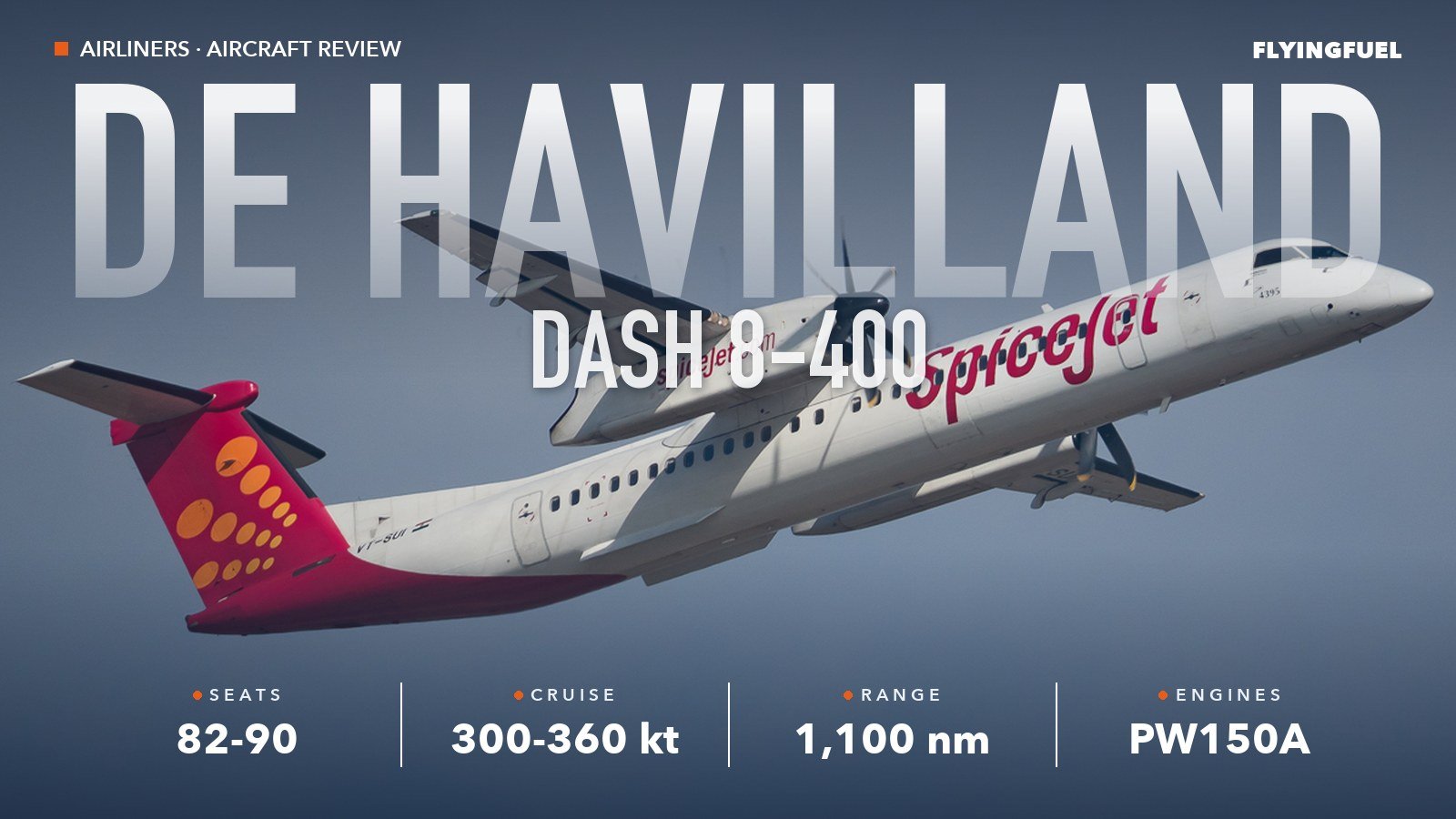
If you have flown SpiceJet between smaller Indian cities, or a regional airline in Canada, Europe or Australia, you may have boarded a De Havilland Canada Dash 8-400, still widely called the Q400. It is the biggest and fastest member of the Dash 8 family: a turboprop that carries up to 90 people at close to jet speeds. This review covers its design, cabin, cockpit, engines, performance, safety and where it flies in India.
Quick answer: the Dash 8-400 seats 82 to 90 passengers four abreast, cruises at 300-360 knots and flies about 1,100 nm on two PW150A engines. Every one has active noise and vibration suppression, hence the Q. It is quick and roomy for a turboprop, but production is paused, and its rival the ATR 72-600 is lighter and needs less runway. In India, SpiceJet flies it.
Sources: Wikipedia: De Havilland Canada Dash 8 (history, design, variants, specifications, safety); De Havilland Canada: Dash 8-400; Wikipedia: SpiceJet (orders and fleet); ATR 72-600 brochure for comparisons.
Dash 8-400 Specs at a Glance
| Item | Dash 8-400 (Q400) |
|---|---|
| Maker | De Havilland Canada (Bombardier until June 2019) |
| Seats | 82 typical at 30 in; up to 90 at 28 in |
| Length / wingspan / height | 32.8 m / 28.4 m / 8.4 m |
| Cabin width / length | 2.52 m / 18.80 m |
| Maximum take-off weight | 30,481 kg |
| Maximum payload | 8,489 kg |
| Fuel capacity | 6,526 litres |
| Engines | 2 x Pratt & Whitney Canada PW150A, 5,071 hp each |
| High-speed cruise | 300-360 kt (556-667 km/h) |
| Range | 1,100 nm (2,040 km) |
| Ceiling | 27,000 ft |
| Take-off / landing distance | 1,425 m / 1,289 m |
| Entered service | 2000 |
| Unit cost | US$32.2 million (2017) |
Source: Wikipedia: Dash 8 specification table and variants section.
History: From Dash 8 to Q400
The Dash 8 family began as a 37-seat regional turboprop in the 1980s. In the mid-1990s, when airlines again wanted new turboprops, the maker answered with the Series 400: stretched 6.83 m over the Series 300 and 10.26 m over the original Series 100/200, with a bigger inboard wing, a stouter T-tail and room for 68 to 90 passengers. It entered service in 2000.
Every Dash 8 delivered from 1996 has an Active Noise and Vibration Suppression system, and Bombardier renamed its turboprops the Q-Series to stress how quiet they were. The older Q100, Q200 and Q300 went out of production by 2009, leaving the Q400 as the only Dash 8 being built. The Q400 NextGen brought new cabins, lighting, windows, overhead bins and landing gear with lower fuel and maintenance costs; an 86-seat Extra Capacity version followed in 2013 and a 90-seat layout in 2016.
In November 2018 Bombardier sold the programme and the de Havilland name to Longview Aviation Capital, owner of Viking Air, and the sale closed on 3 June 2019 with the creation of De Havilland Canada. Wikipedia says 585 Q400s had been delivered by then, at 30 to 35 a year.
Design: Why It Looks the Way It Does
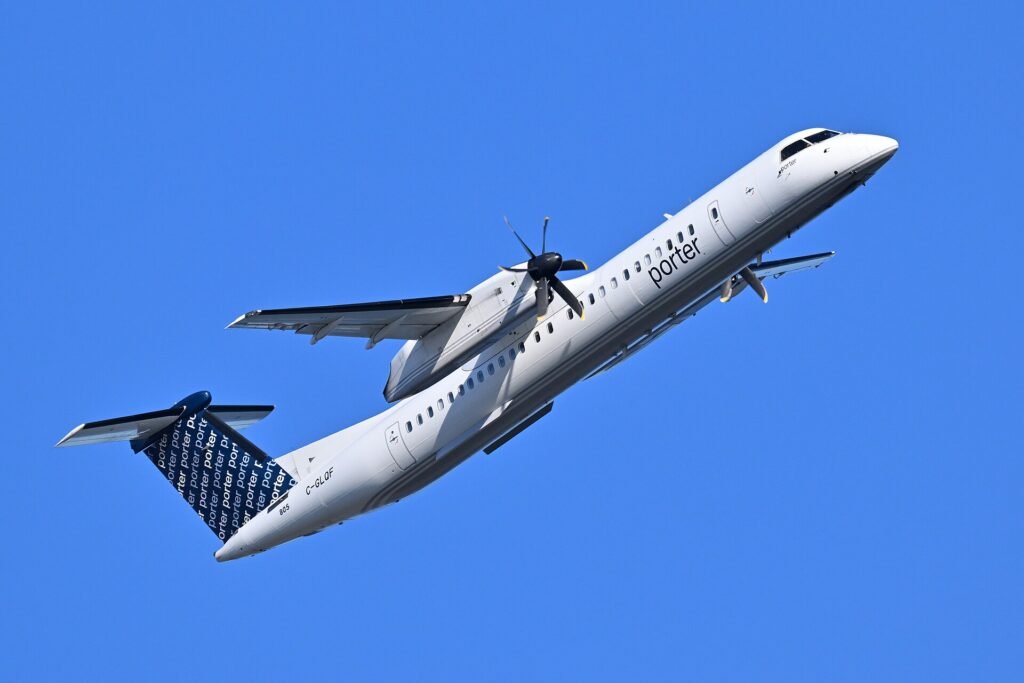
The Dash 8’s shape is easy to spot: a tall T-tail that keeps the tailplane out of the propellers’ wash on take-off, a long, slender high wing with an aspect ratio of about 12:1, long engine nacelles that also hold the rearward-folding main landing gear, and a pointed nose.
Inside the Cabin
The cabin is 2.52 m wide and 18.80 m long, with two seats on each side of the aisle, so there is no middle seat. Most airlines fit about 82 seats at a 30-inch pitch. For the 90-seat version, launched by SpiceJet, Bombardier moved the rear pressure bulkhead back and changed the front right door to fit one more row at a 28-inch pitch, adding 2,000 lb (about 900 kg) of payload.
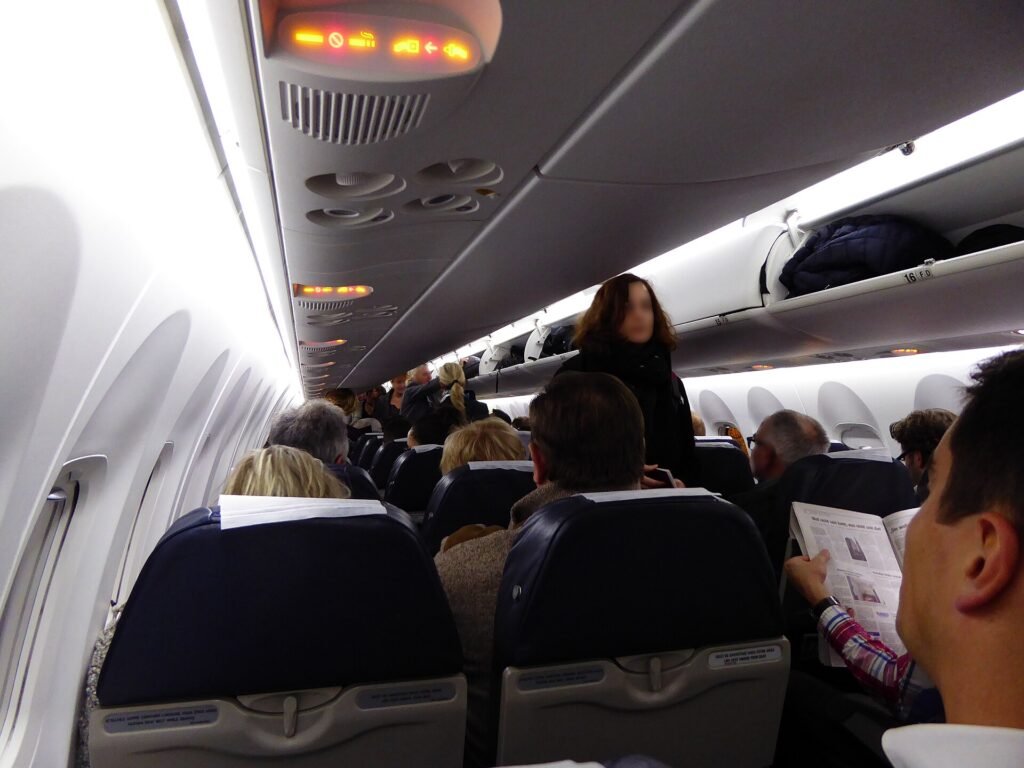
Noise was the reason for the Q in Q400. Wikipedia says the suppression system brings cabin noise and vibration close to those of jet airliners.
Cockpit
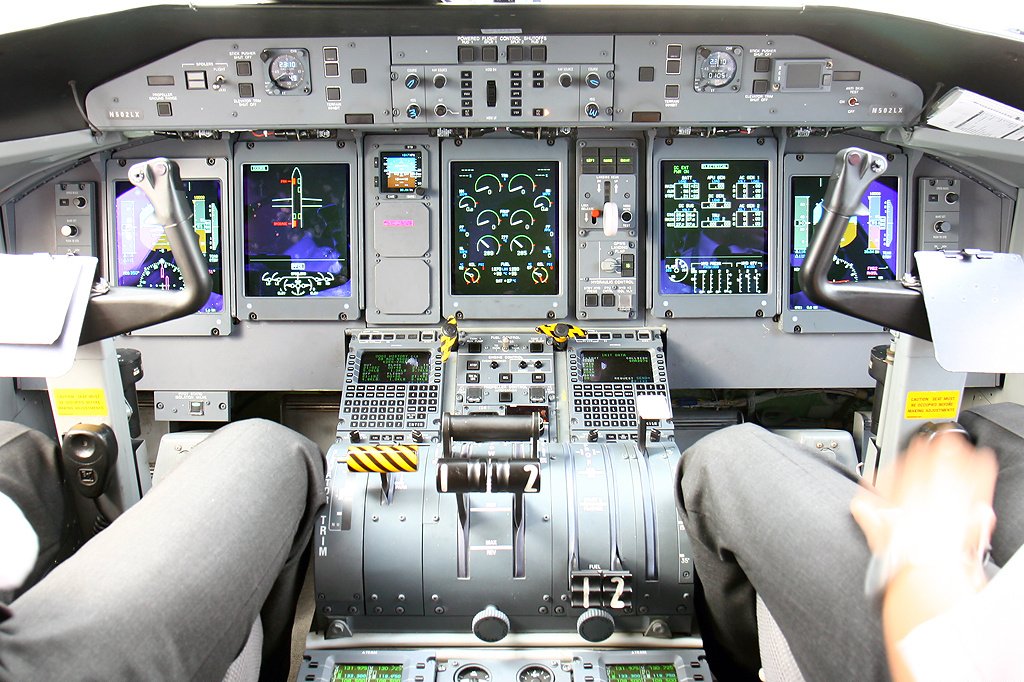
Two pilots fly the Q400 from a glass cockpit with five large flat-panel displays and conventional control columns, rather than the sidesticks of an Airbus. A modern Q400 flight deck looks very different from the dial-filled cockpits of the early Dash 8-100 and -300.
Engines
Two Pratt & Whitney Canada PW150A turboprops are listed at 5,071 hp each, more than twice the power of the Series 300’s engines (2,380 to 2,500 hp). Our turbofan vs turboprop guide explains how a turboprop turns jet power into propeller thrust.
Speed, Range and Runways

Speed is the Q400’s big selling point. Its high-speed cruise of 300-360 knots is 60 to 90 knots faster than earlier Dash 8s, and Wikipedia says it is close to most regional jets. It flies about 1,100 nm. The standard aircraft is limited to 25,000 ft; a version with drop-down oxygen masks can go to 27,000 ft.
It needs 1,425 m to take off at maximum weight and 1,289 m to land, more than the lighter ATR 72-600 (1,304 m and 915 m). Wikipedia notes that turboprops in general use 30 to 60% less fuel than regional jets, and longer maintenance intervals on the 90-seat version (800 hours between A-checks instead of 600) cut running costs. See our ATR 72-600 vs Dash 8-400 comparison.
Safety Record
Wikipedia lists 80 accidents and incidents for the whole Dash 8 family, with 31 hull losses. Two fatal crashes involved the Q400: Colgan Air Flight 3407, which stalled and crashed near Buffalo, New York, in February 2009, killing 49 on board and one person on the ground, and US-Bangla Airlines Flight 211, which crashed on landing at Kathmandu in March 2018, killing 51, the deadliest Dash 8 accident. Both were attributed to pilot error.
The Q400’s most damaging problem was its landing gear. In September and October 2007 three SAS Q400s had main-gear failures, at Aalborg, Vilnius and Copenhagen. SAS grounded its 33 Q400s and later withdrew the type, and Bombardier recommended grounding Q400s with more than 10,000 flights, about 60 of the 140 then flying, while the gear was inspected.
The Dash 8-400 in India: SpiceJet
SpiceJet is India’s Q400 airline. It ordered 15 in December 2010 and another 25 in September 2017, made Hyderabad the main base for the fleet, and in September 2018 became the launch customer for the 90-seat version. Wikipedia’s SpiceJet fleet table lists 24 Dash 8-400s with 78 seats. The airline has been grounding aircraft and cancelling flights in 2026; see our report on its fundraise and cancellations. IndiGo’s regional turboprop is the ATR 72-600; see regional airlines in India.
Production, Orders and the Future
By March 2019, 645 Series 400s had been ordered and 587 delivered. By 2017 the fleet had flown 7 million hours with 60 operators and carried more than 400 million passengers. De Havilland Canada decommissioned the Downsview factory in Toronto in August 2022 and in 2023 confirmed it would restart Dash 8 production in Wheatland County, Alberta, by 2033. Meanwhile it is refurbishing used Q400s (it had bought 28 for the programme by July 2024), offering freighter and combi conversions, and announced seven Series 400 orders at Farnborough in July 2024. More in our De Havilland Canada guide.
The Q400 has other jobs too. More than 16 have been converted into firefighting airtankers that carry 10,000 litres of retardant, and in May 2023 ZeroAvia unveiled a Q400 donated by Alaska Airlines as a testbed for hydrogen-electric engines.
Dash 8-400 vs Its Rivals
| Item | Dash 8-400 | ATR 72-600 |
|---|---|---|
| Seats | 82-90 | Up to 78 |
| Cruise | 300-360 kt | 270 kt maximum |
| Range | 1,100 nm | 683 nm (maximum passengers) |
| Take-off / landing | 1,425 m / 1,289 m | 1,304 m / 915 m |
| In production | Paused | Yes |
Sources: Wikipedia: Dash 8; ATR 72-600 brochure; Wikipedia: ATR 72.
Pros and Cons
- Pros: faster than the ATR 72-600 (300-360 kt against 270 kt); up to 90 seats; 1,100 nm range; no middle seat; noise and vibration suppression; proven, with 587 delivered by 2019
- Cons: production paused since 2022; heavier and needs more runway than the ATR 72-600; landing-gear problems in 2007
Our Verdict
The Dash 8-400 is the turboprop for airlines that want speed and seats: on a 90-minute route it can almost keep pace with a regional jet while carrying up to 90 people. Its weaknesses are its heavier weight and the production pause. For passengers it is a good ride: four abreast, a quiet cabin for a turboprop and a view under the high wing.
Frequently Asked Questions
Is the Q400 the same as the Dash 8-400?
Yes. Bombardier called it the Q400, Q for quiet, after the noise and vibration suppression system fitted to every Dash 8 since 1996. Since De Havilland Canada took over the programme in June 2019 it is sold as the Dash 8-400.
How many seats does a Dash 8-400 have?
Typically 82 at a 30-inch pitch and up to 90 at 28 inches, according to Wikipedia. Wikipedia’s SpiceJet fleet table lists its Dash 8-400s with 78 seats. All are four abreast, two on each side of the aisle.
How fast is the Dash 8-400?
Its high-speed cruise is 300 to 360 knots (556 to 667 km/h), 60 to 90 knots faster than earlier Dash 8s and close to some regional jets. That is faster than the ATR 72-600’s 270-knot maximum cruise.
What is the range of the Dash 8-400?
About 1,100 nm (2,040 km), according to the Wikipedia specification table.
Which engines does the Dash 8-400 use?
Two Pratt & Whitney Canada PW150A turboprops, listed at 5,071 hp each in the Wikipedia specification table.
Is the Dash 8-400 still in production?
Not at the moment. De Havilland Canada closed the Downsview factory in Toronto in August 2022 and in 2023 confirmed plans to restart Dash 8 production in Wheatland County, Alberta, by 2033. It still sells refurbished Q400s and announced seven Series 400 orders at Farnborough in July 2024.
Which Indian airline flies the Q400?
SpiceJet. It ordered 15 Q400s in December 2010 and 25 more in September 2017, made Hyderabad the main base for its Q400 fleet, and was the launch customer for the 90-seat version in September 2018.
Is the Dash 8-400 safe?
It flies with major airlines worldwide. Wikipedia lists 80 accidents and incidents for all Dash 8 series, with 31 hull losses. The two deadliest Q400 crashes, Colgan Air Flight 3407 (2009) and US-Bangla Airlines Flight 211 (2018), were attributed to pilot error.
Why did SAS stop flying the Q400?
After three landing-gear accidents on its Q400s in September and October 2007, Scandinavian Airlines withdrew the type from its fleet. Bombardier recommended grounding Q400s with more than 10,000 flights, about 60 of the 140 then in service, while the gear was inspected.
Featured image: FlyingFuel graphic using a photo of a SpiceJet Bombardier Q400, VT-SUI, at Bengaluru by Venkat Mangudi, CC0, via Wikimedia Commons.
 AirportsAirports in Punjab, Haryana and Himachal Pradesh: Complete Guide to Chandigarh, Amritsar, Kangra, Halwara and More (2026)
 AirbusAirbus A320neo vs A320ceo: What Changed and How to Tell Them Apart (2026)
 NewsUS Proposes 10% Tariff on Aircraft Imported From Brazil, Putting Embraer’s Exemption at Risk
 NewsCabinet Approves Rs 2,014 Crore Airport at Doloo to Replace Silchar’s Air Force Civil Enclave
 AirportsAirports in Bihar and Jharkhand: Complete Guide to Patna, Ranchi, Darbhanga, Gaya, Deoghar and More (2026)
 Aircraft ComparisonsBoeing 737 MAX 8 vs 737-800: What Changed and Which Is Better? (2026)