
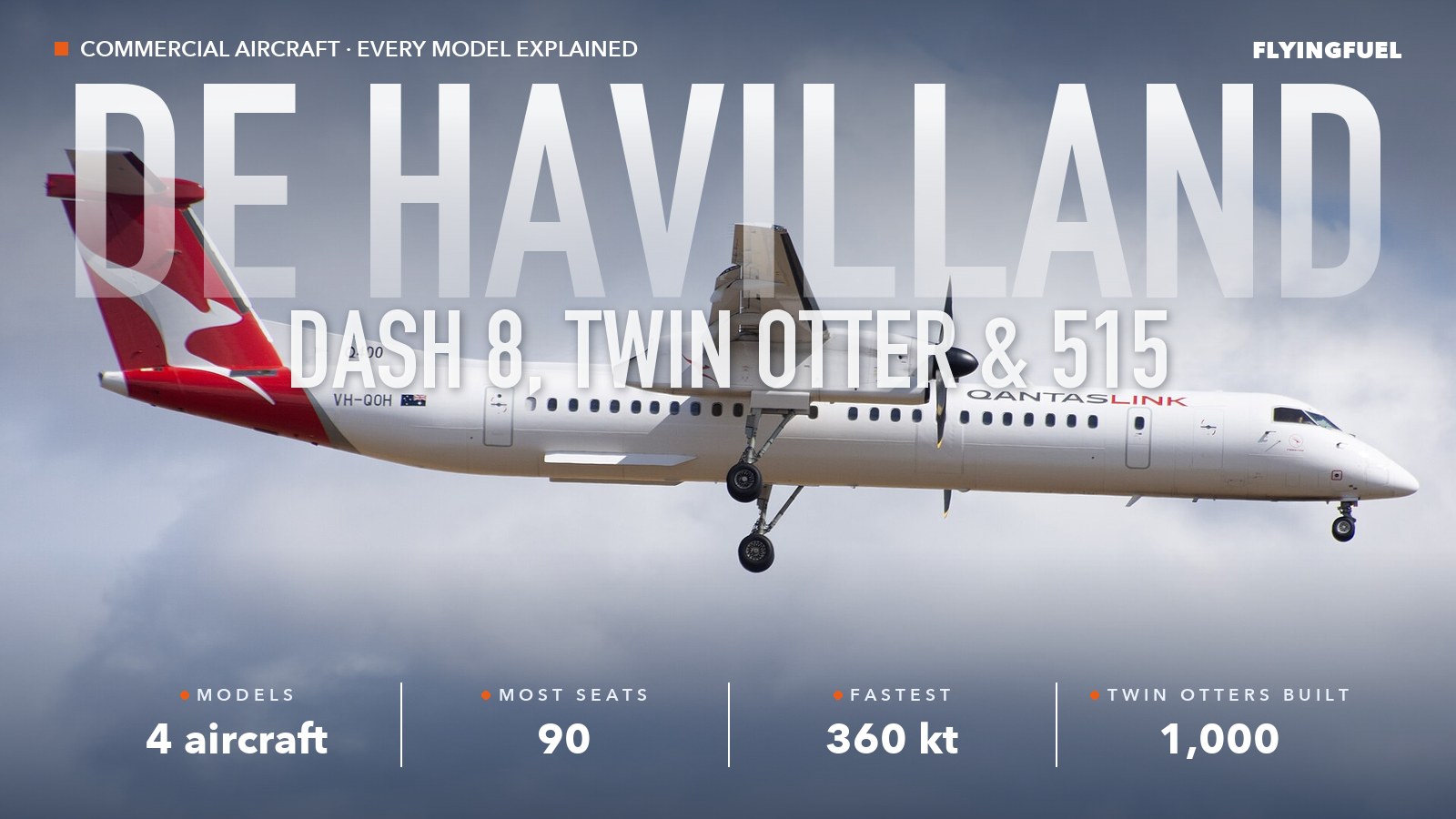
De Havilland Canada builds rugged aircraft for hard jobs: the Dash 8-400 regional turboprop, the Twin Otter that lands on floats, skis or gravel, and the DHC-515 water bomber that scoops lakes to fight wildfires. In this guide we explain every De Havilland Canada aircraft in 2026, with the same facts for each: seats, speed, range, engines and who flies it.
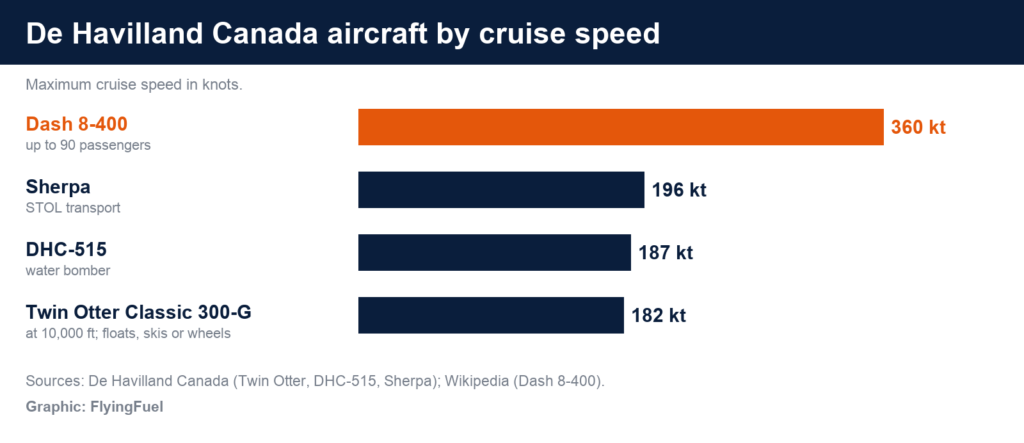
Quick answer: the Dash 8-400 seats up to 90 and cruises at up to 360 kt, but production is paused until a new factory opens. The Twin Otter Classic 300-G is a 19-seat utility plane, with 1,000 Twin Otters delivered by March 2026. The DHC-515 water bomber is on order for several European countries, and the Sherpa is a STOL transport.
De Havilland Canada Aircraft at a Glance
| Aircraft | Role | Capacity | Max cruise | Range | Engines |
|---|---|---|---|---|---|
| Dash 8-400 | Regional airliner | Up to 90 seats | Up to 360 kt | 1,100 nm | 2 x Pratt & Whitney Canada PW150A |
| Twin Otter Classic 300-G | Utility / commuter | 19 seats (Series 300) | 182 KTAS (10,000 ft) | 871 nm (no payload) | 2 x PT6A-27 (PT6A-34 optional) |
| DHC-515 | Firefighting amphibian | 6,137 L water | 187 kt | 1,260 nm (ferry) | Not stated by DHC |
| Sherpa | STOL transport | 7,280 lb payload | 196 kt | 650 nm with 5,000 lb | 2 x PT6A-65AR |
Sources: De Havilland Canada pages for the Dash 8-400, Twin Otter Classic 300-G, DHC-515 and Sherpa; Dash 8-400 speed, range and engines from Wikipedia: Dash 8; Twin Otter seats from Wikipedia: Twin Otter.
De Havilland Canada: The Company in Brief
According to Wikipedia, the original de Havilland Canada was set up in Toronto in 1928 as a subsidiary of Britain’s de Havilland. Its famous designs were later sold to other companies, and in 2019 Longview Aviation Capital bought the Dash 8 programme from Bombardier and revived the de Havilland Canada name. It has also taken over the Canadair CL-415 water bomber programme, which became the DHC-515. In 2022 it announced a new factory, De Havilland Field in Wheatland County, Alberta, which broke ground on 15 May 2026 and will build the DHC-515, Twin Otter and Dash 8-400.
| Company fact | Detail |
|---|---|
| Original company | Founded 1928, Toronto |
| Current company | Formed 2019 (Longview Aviation Capital) |
| New factory | De Havilland Field, Wheatland County, Alberta (ground broken May 2026) |
| Aircraft | Dash 8-400, Twin Otter, DHC-515, Sherpa |
| Dash 8-400s delivered | More than 620, to 70+ operators |
Sources: Wikipedia: De Havilland Aircraft of Canada; De Havilland Canada: Dash 8-400.
1. Dash 8-400: The 90-Seat Turboprop
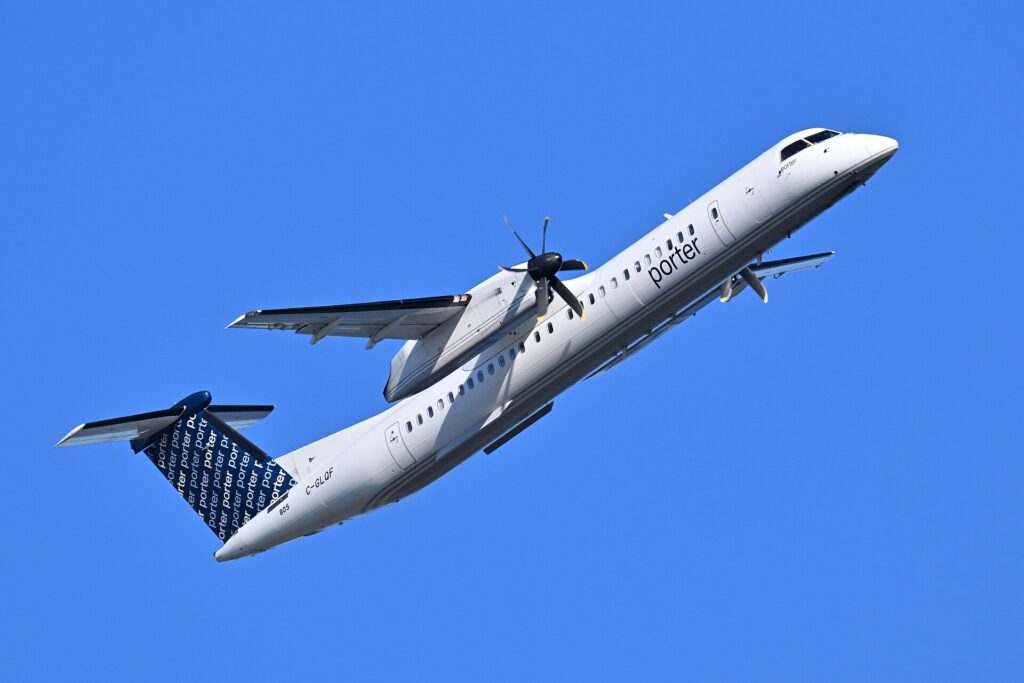
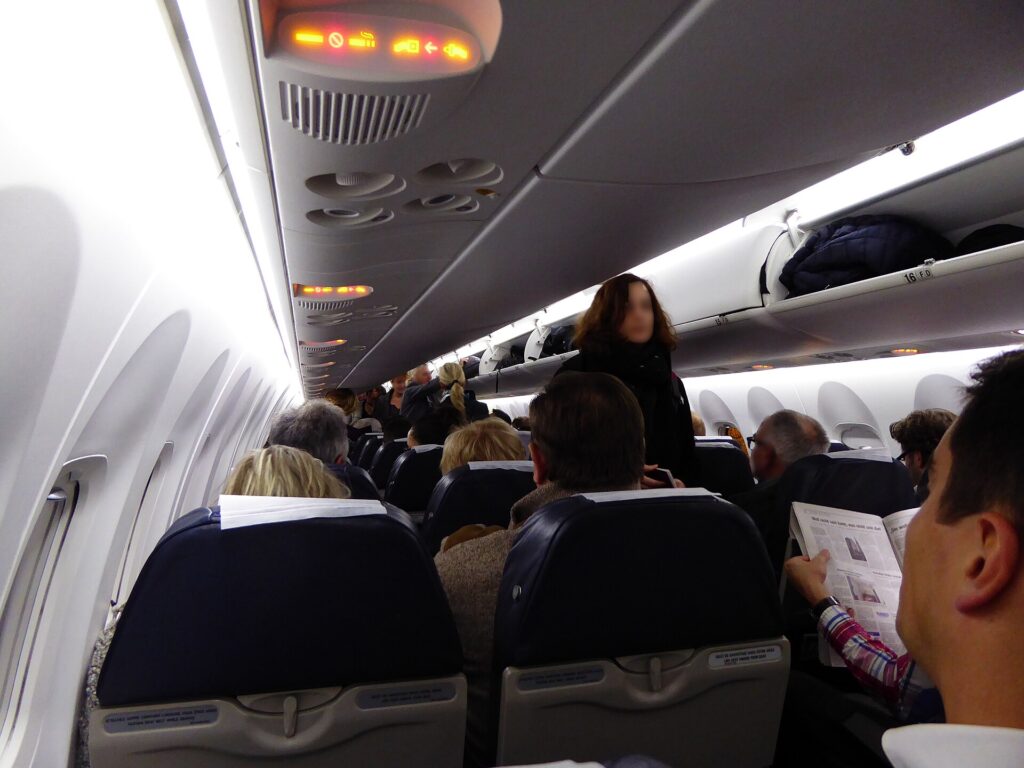
The Dash 8-400, often called the Q400, is a large, fast regional turboprop: up to 360 kt, against 270 to 289 KTAS for the ATR 72-600 and 42-600. De Havilland Canada says it seats up to 90, the highest capacity of any turboprop on the market, flies 40% further and 30% faster than conventional turboprops, and can use unpaved runways and hot, high airports. More than 620 have been delivered to over 70 operators. Wikipedia says it entered service in 2000, cruises at up to 360 kt and flies about 1,100 nm.
Dash 8-400 specifications
| Dash 8-400 | Figure |
|---|---|
| Seats | 82 typical at 30 in; up to 90 at 28 in |
| Cruise speed | Up to 360 kt |
| Range | 1,100 nm (2,040 km) |
| Engines | 2 x Pratt & Whitney Canada PW150A, 4,850 shp each |
| Maximum take-off weight | 67,200 lb (30,481 kg) |
| Length / wingspan | 107 ft 9 in / 93 ft 3 in (32.8 / 28.4 m) |
| Entry into service | 2000 |
| Delivered | More than 620 |
Sources: De Havilland Canada: Dash 8-400; speed, range, engines, weight and dimensions from Wikipedia: Dash 8.
Wikipedia names QantasLink, WestJet Encore, Widerøe and Voyageur Airways among its main users, and says SpiceJet in India was the launch customer for the 90-seat version in September 2018. Production, however, is paused: DHC announced a pause in 2021 for lack of orders, and production has been suspended since 2022 pending the new Alberta factory. It announced orders for seven aircraft in July 2024. Best for: busy regional routes where speed matters, up to about 1,000 nm.
2. Twin Otter Classic 300-G: The Go-Anywhere Plane
The DHC-6 Twin Otter is a 19-seat utility turboprop. The current Classic 300-G can be fitted with wheels, floats, amphibious floats, skis or wheel-skis, and can take off in just 1,200 ft and land in 1,050 ft in STOL operations. Wikipedia says the Twin Otter first flew on 20 May 1965, is a staple of Antarctic transport and flies with Maldives operators, and that production of the Classic 300-G began in June 2023. On 20 March 2026, De Havilland Canada delivered the 1,000th Twin Otter, to Colombia’s SATENA.
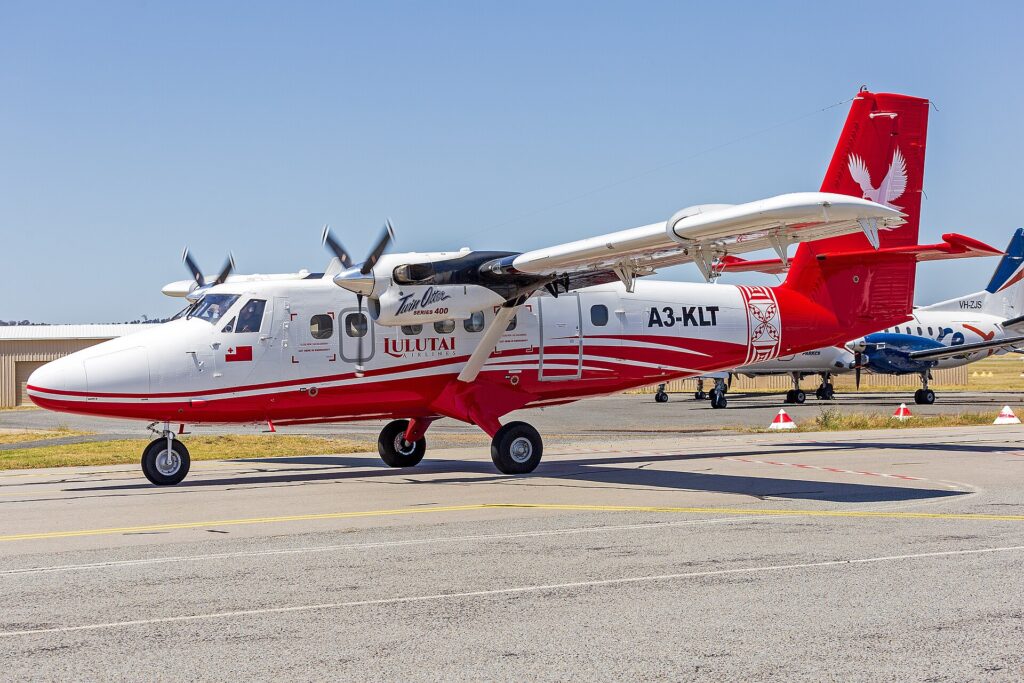
Twin Otter Classic 300-G specifications
| Twin Otter Classic 300-G | Figure |
|---|---|
| Seats | 19 (Series 300), with passenger, cargo, VIP and other layouts |
| Maximum cruise speed | 170 KTAS at sea level; 182 KTAS at 10,000 ft |
| Range | 871 nm with no payload; 803 nm with 2,270 lb |
| Payload | 4,328 lb for 100 nm; 3,868 lb for 250 nm |
| Take-off / landing (STOL) | 1,200 ft / 1,050 ft over 50 ft |
| Engines | 2 x Pratt & Whitney Canada PT6A-27 (PT6A-34 optional) |
| Maximum take-off weight | 12,500 lb (5,670 kg) |
| Landing gear | Wheels, floats, amphibious floats, skis, wheel-skis |
| Cockpit | Garmin G1000 NXi |
Sources: De Havilland Canada: Twin Otter Classic 300-G; seats and history from Wikipedia: Twin Otter.
Best for: island hops, seaplane resort transfers, polar research and remote strips where nothing else can land.
3. DHC-515: The Water Bomber
The DHC-515 is a modernised version of the famous Canadair CL-415 firefighting amphibian. It skims a lake or sea to fill its 6,137-litre tank in 12 seconds, then drops the water on a fire. Forecast International reports that DHC launched it in March 2022 and that Greece ordered seven and Croatia two, with EU plans for 12 aircraft for the rescEU reserve and 12 more for Croatia, France, Greece, Italy, Portugal and Spain; Greek deliveries are due between 2027 and 2030. Indonesia signed for six in 2019.
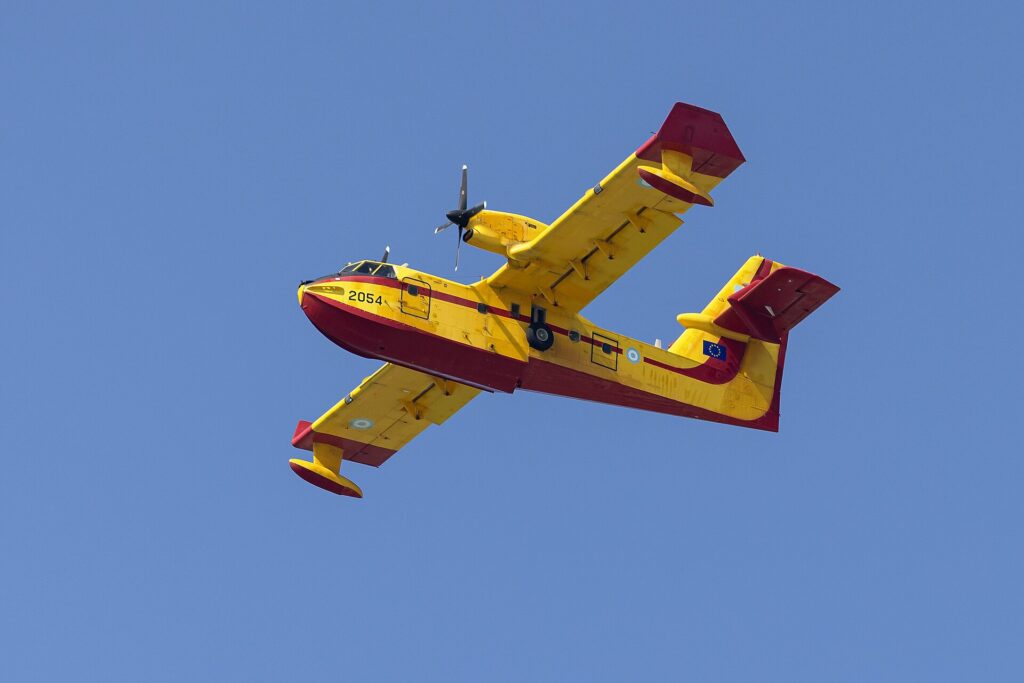
| DHC-515 | Figure |
|---|---|
| Water tank | 6,137 L (1,621 US gal) |
| Scooping time | 12 seconds for a full tank |
| Cruise speed | 187 kt maximum; 180 kt normal; 140 kt long range |
| Ferry range | 1,260 nm (2,333 km) |
Sources: De Havilland Canada: DHC-515; orders from Forecast International.
4. Sherpa: The STOL Transport
De Havilland Canada added the Sherpa to its line-up in 2019 as a rugged short take-off and landing transport for cargo, troops, evacuations and humanitarian aid. It carries a design payload of 7,280 lb, flies 650 nm with 5,000 lb, cruises at 196 kt and is powered by two PT6A-65AR turboprops with five-blade propellers. Its cabin is 29.82 ft long and its maximum take-off weight is 25,600 lb.
Which De Havilland Canada Aircraft Does Which Job?
| If you need to… | Choose | Why |
|---|---|---|
| Carry up to 90 passengers fast on short routes | Dash 8-400 | Up to 360 kt |
| Land on water, snow or gravel | Twin Otter Classic 300-G | Floats, skis, STOL |
| Fight wildfires from lakes and seas | DHC-515 | 6,137 L, 12-second scoop |
| Move cargo into short strips | Sherpa | 7,280 lb payload |
Rivals
The Dash 8-400’s main rival is the ATR 72-600, which is slower but very fuel-efficient, and still in production. See our guide to ATR turboprops and our explainer on turbofan vs turboprop engines.
Pros and Cons
Pros
- The Dash 8-400 seats up to 90, which DHC calls the highest capacity of any turboprop, and cruises at up to 360 kt
- The Twin Otter can operate on floats, skis or gravel
- The DHC-515 has strong European demand
- A new factory is under construction in Alberta
Cons
- Dash 8-400 production has been paused since 2022
- DHC-515 deliveries are only due from about 2027
- De Havilland Canada publishes few detailed figures on its website
Key Takeaways
- De Havilland Canada builds the Dash 8-400, Twin Otter, DHC-515 and Sherpa.
- The Dash 8-400 seats up to 90 and cruises at up to 360 kt, but production is paused.
- The 1,000th Twin Otter was delivered in March 2026.
- The DHC-515 water bomber is on order for Greece, Croatia and other EU countries.
Frequently Asked Questions
What aircraft does De Havilland Canada make?
The Dash 8-400 regional turboprop, the DHC-6 Twin Otter Classic 300-G, the DHC-515 firefighting amphibian and the Sherpa STOL transport, plus special-mission versions of the Dash 8 and Twin Otter.
Is the Dash 8-400 still being built?
Production has been paused. Wikipedia says De Havilland Canada announced a pause in 2021 because of a lack of orders and that production has been suspended since 2022 pending a new factory in Wheatland County, Alberta, which broke ground in May 2026. It announced orders for seven Dash 8-400s in July 2024.
How many seats does a Dash 8-400 have?
Up to 90, De Havilland Canada says, making it the highest-capacity turboprop on the market. Wikipedia gives a typical 82 seats at 30-inch pitch.
Does an Indian airline fly the Dash 8-400?
Yes. Wikipedia says SpiceJet was the launch customer for the 90-seat version, delivered in September 2018.
Can the Twin Otter land on water?
Yes. De Havilland Canada offers the Twin Otter Classic 300-G on wheels, floats, amphibious floats, skis or wheel-skis, and Wikipedia lists Maldives operators among its major users.
How many Twin Otters have been built?
Wikipedia says De Havilland Canada delivered the 1,000th Twin Otter to Colombia’s SATENA on 20 March 2026, counting 844 built by the original company and 156 by Viking.
How much water does the DHC-515 carry?
Its tank holds 6,137 litres (1,621 US gallons), which De Havilland Canada says it can refill by scooping from a lake or sea in 12 seconds.
Which countries are buying the DHC-515?
Forecast International reports orders from Greece (seven) and Croatia (two), EU plans for 12 rescEU aircraft plus 12 for Croatia, France, Greece, Italy, Portugal and Spain, and a 2019 deal with Indonesia for six.
Who owns De Havilland Canada?
The current company was formed in 2019, when Longview Aviation Capital bought the Dash 8 programme from Bombardier. The original de Havilland Canada was founded in Toronto in 1928.
Featured image: FlyingFuel graphic using a photo of a QantasLink Dash 8-400 in flight by Fly45yt, CC BY 4.0, via Wikimedia Commons.
 Aircraft ComparisonsBoeing vs Airbus: How to Tell the Difference (Nose, Windows, Wings, Engines)
 Aircraft ComparisonsPilatus PC-24 vs Embraer Phenom 300E: Which Light Jet Is Better? (2026)
 PilatusPilatus PC-24 Review: The Jet That Lands on Grass and Gravel (2026)
 Aircraft ComparisonsBombardier Global 6500 vs Gulfstream G600: Same Range, Different Jets (2026)
 BombardierBombardier Global 6500 Review: Range, Cabin, Speed and Price (2026)
 Aircraft ComparisonsEmbraer Praetor 600E vs Bombardier Challenger 3500: Which Super-Midsize Jet Wins? (2026)