
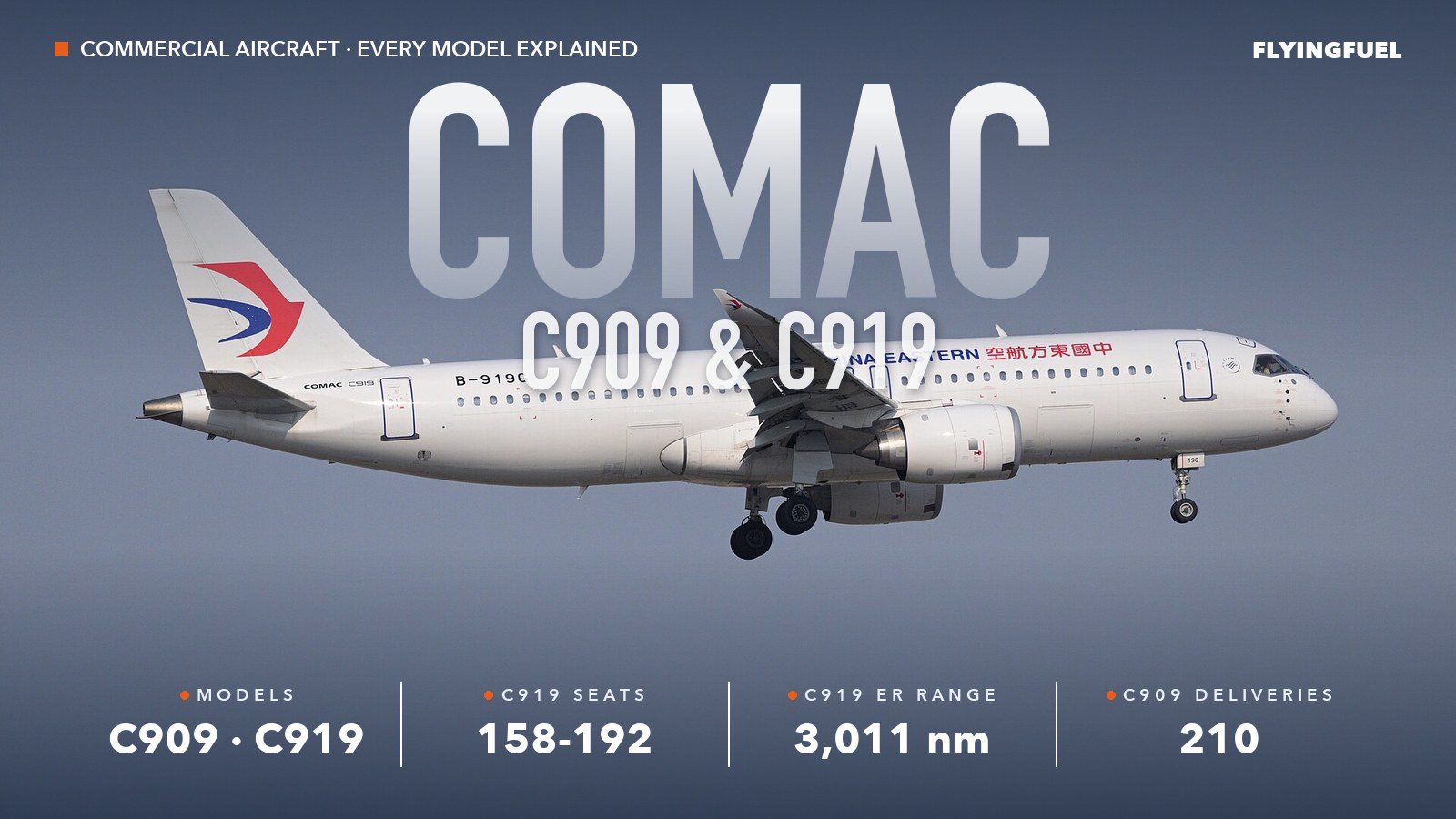
COMAC is China’s answer to Airbus and Boeing. It builds the C919, a single-aisle jet in the same class as the A320neo and 737 MAX 8, and the smaller C909 regional jet, and is designing a widebody called the C929. In this guide we explain every COMAC aircraft in 2026, with the same facts for each: seats, range, engines, deliveries and where it can fly.
Quick answer: the C919 seats 158 to 192 and flies up to about 3,000 nm in its extended-range version; 40 had been delivered by May 2026, all in China. The C909 (formerly ARJ21) seats 78 to 90 and has passed 210 deliveries, with a few foreign operators. The C929 widebody is still in design. Both flying aircraft are certified only in China so far.
COMAC Aircraft at a Glance
| Aircraft | Class | Seats | Range | Cruise | Engines | Status |
|---|---|---|---|---|---|---|
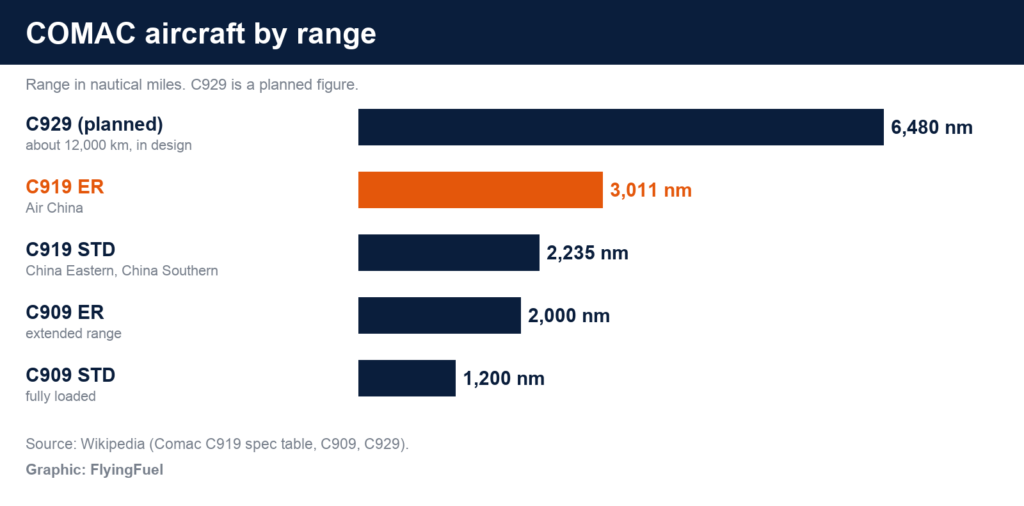
| C919 | Single-aisle airliner | 158-192 | 2,235 nm (STD); 3,011 nm (ER) | Mach 0.785 | 2 x CFM LEAP-1C | 40 delivered (May 2026) |
| C909 (ex-ARJ21) | Regional jet | 78 (2-class) to 90 | 1,200 nm (STD); 2,000 nm (ER) | Mach 0.78 | 2 x GE CF34-10A | 210 delivered (March 2026) |
| C929 | Twin-aisle widebody | 280-400 (2024 plan) | About 12,000 km (plan) | Not announced | Not chosen | In design |
Sources: Wikipedia: Comac C919 (spec table); Wikipedia: Comac C909; Wikipedia: Comac C929. COMAC’s own English website did not show product specifications when we checked on 26 October 2026.
COMAC: The Company in Brief
According to Wikipedia, the Commercial Aircraft Corporation of China (COMAC) was established in Shanghai on 11 May 2008. It is state-owned: its founders include China’s State-owned Assets Supervision and Administration Commission (SASAC), aircraft maker AVIC, Aluminum Corporation of China, Baosteel, Sinochem and Shanghai Guosheng. Its headquarters is in Pudong, Shanghai. The C919 airframe is built by AVIC, while many systems come from joint ventures with Western suppliers, much as Airbus and Boeing buy from outside suppliers.
| Company fact | Detail |
|---|---|
| Full name | Commercial Aircraft Corporation of China (COMAC) |
| Founded | 11 May 2008, Shanghai |
| Headquarters | Pudong, Shanghai |
| Ownership | State-owned |
| Aircraft in service | C909, C919 |
| In design | C929 widebody |
Sources: Wikipedia: Comac; Wikipedia: Comac C919.
1. C919: China’s A320neo and 737 MAX Rival
The C919 is a single-aisle twinjet with a 3-3 seat layout, seating 158 in two classes (8 business, 150 economy) up to 192 in a high-density layout. Wikipedia says it first flew on 5 May 2017, received its CAAC type certificate on 29 September 2022 and was delivered to launch customer China Eastern on 9 December 2022. China Eastern flew the first commercial C919 service, MU9191 from Shanghai Hongqiao to Beijing Capital, on 28 May 2023.

C919 specifications
| C919 | C919-100 STD | C919-100 ER |
|---|---|---|
| Seats | 158 (8J + 150Y) to 192 | 158 (8J + 150Y) to 192 |
| Range | 2,235 nm (4,139 km) | 3,011 nm (5,576 km) |
| Cruise speed | Mach 0.785 at 37,000 ft | Mach 0.785 at 37,000 ft |
| Engines | 2 x CFM LEAP-1C28, 29,220 lbf | 2 x CFM LEAP-1C30, 30,821 lbf |
| Maximum take-off weight | 165,600 lb (75,100 kg) | 173,900 lb (78,900 kg) |
| Maximum payload | 41,700 lb (18,900 kg) | 41,700 lb (18,900 kg) |
| Take-off distance (MTOW, ISA) | 6,732 ft (2,052 m) | 6,972 ft (2,125 m) |
| Ceiling | 39,800 ft | 39,800 ft |
| Length / wingspan / height | 127 ft 7 in / 117 ft 5 in / 39 ft 2 in (38.9 / 35.8 / 11.95 m) | Same |
| Fuselage width | 13 ft (3.96 m) | Same |
Source: Wikipedia: Comac C919 specifications table. Note that the article’s design section gives a slightly smaller wingspan (33.6 m, or 35.4 m with winglets) than its spec table.
Who flies it
Wikipedia‘s delivery table totals 40 aircraft by May 2026: China Eastern 17 (standard version), China Southern 11 (standard), Air China 11 (extended range) and one for COMAC’s own charter operator, Comac Express. COMAC reported more than 1,200 orders in January 2023, though other counts are lower; Wikipedia’s company article lists 1,005 orders at the end of 2025. Brunei start-up GallopAir announced an order for 15 C919s and 15 ARJ21s in September 2023.
Engines and cockpit
The C919 is powered by two CFM International LEAP-1C engines, a version of the engine family used on the A320neo and 737 MAX. Wikipedia says the United States suspended LEAP-1C sales to China in May 2025 and lifted the suspension in July 2025, a reminder that the programme depends on Western parts. China is developing its own CJ-1000A engine as an alternative. The C919 has an Ethernet-based integrated modular avionics system, and in 2018 its flight deck was re-evaluated against US FAR Part 25.1302, which would be needed for FAA certification.
Certification outside China
The C919 is certified only by China’s CAAC. Wikipedia reports that EASA test pilots began verification flights in January 2026, but EASA’s executive director estimated that certification would likely come between 2028 and 2031. Until then, it cannot be flown by European airlines.
Best for: Chinese domestic and short regional routes of up to about 3,000 nm with 158 to 192 passengers.
2. C909: The Regional Jet (Formerly ARJ21)
The C909 is COMAC’s first jetliner, known until November 2024 as the ARJ21. Wikipedia says it was renamed at the Zhuhai Air Show to match the naming of the C919 and C929. It first flew on 28 November 2008, was certified by the CAAC on 30 December 2014 and entered service with Chengdu Airlines on 28 June 2016. By March 2026, 210 had been delivered.
C909 specifications
| C909 | Figure |
|---|---|
| Seats | 90 (one class) or 78 (two classes) |
| Range, fully loaded | 1,200 nm (2,200 km) STD; 2,000 nm (3,700 km) ER |
| Cruise speed | Mach 0.78 (447 kt) |
| Engines | 2 x GE CF34-10A, 17,057 lbf each |
| Maximum take-off weight | 89,300 lb (40,500 kg) STD; 95,900 lb (43,500 kg) ER |
| Take-off run at MTOW | 5,600 ft (1,700 m) STD; 6,200 ft (1,900 m) ER |
| Service ceiling | 39,000 ft |
| Length / wingspan / height | 109 ft 9 in / 89 ft 6 in / 27 ft 8 in (33.46 / 27.28 / 8.44 m) |
| Entry into service | 28 June 2016 (Chengdu Airlines) |
Source: Wikipedia: Comac C909.

Operators and versions
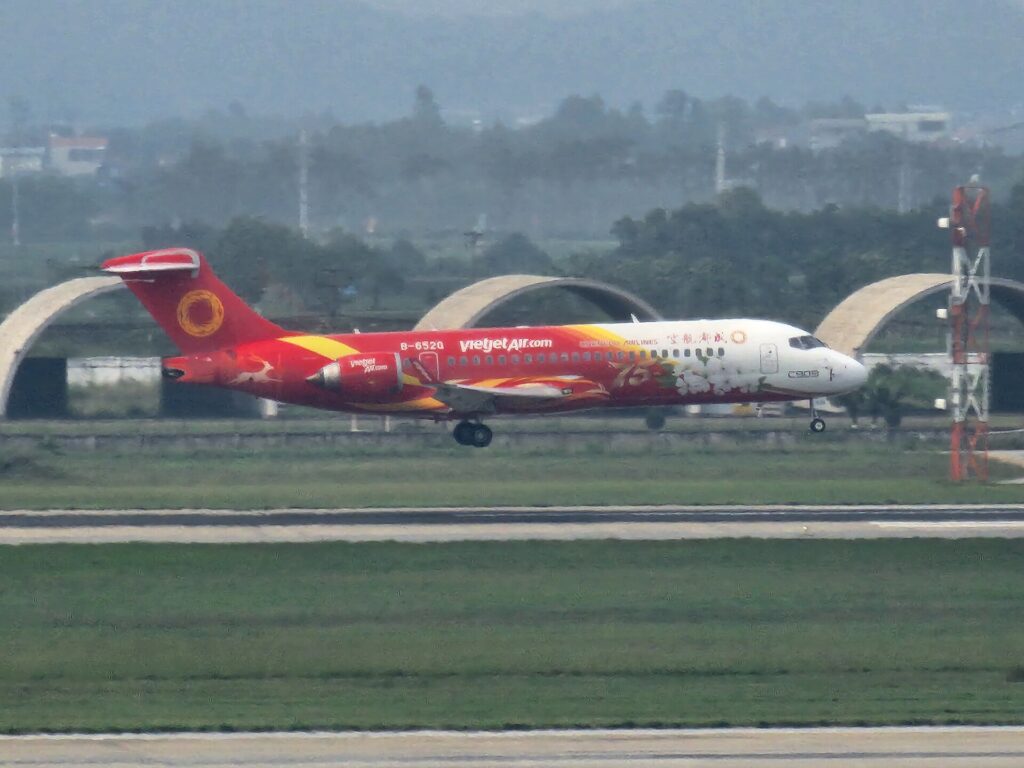
In China the C909 flies with Chengdu Airlines, Air China, China Eastern and China Southern. Wikipedia lists three foreign operators: TransNusa of Indonesia, Lao Airlines, and VietJet, which flies C909s wet-leased from Chengdu Airlines. Besides the standard (STD) and extended-range (ER) airliners, COMAC offers a corporate jet (CBJ), a converted freighter (CCF), an emergency-management version (EMJ) and a medical version (MSJ), and is developing a firefighting version (FFJ). Like the C919, the C909 is certified only by the CAAC.

Best for: short regional routes with 78 to 90 passengers, mostly within China and South-East Asia.
3. C929: The Planned Widebody
The C929 is COMAC’s twin-aisle, long-range jet, still in design. Wikipedia says it began in 2017 as a 50-50 joint venture with Russia’s United Aircraft Corporation (the CR929), but Russia withdrew, and in November 2023 COMAC said China was developing it alone. In March 2024 COMAC said it would seat 280 to 400 with a range of about 12,000 km (about 6,480 nm). The engine has not been chosen. Air China was named launch customer in November 2024, without a published order size or delivery date.

Timing is the big question. Aviation Week reported in 2022 that the first flight had slipped to 2030, and in 2025 US aviation journalists said a prototype was unlikely before 2029. We will update this guide when COMAC publishes firm dates.
Which COMAC Aircraft for Which Route?
| If an airline needs to… | Choose | Why |
|---|---|---|
| Fly 78-90 passengers on short regional routes | C909 | Up to 1,200 nm (STD) or 2,000 nm (ER) |
| Fly 158-192 passengers on trunk routes | C919 STD | About 2,235 nm range |
| Fly a narrowbody on longer domestic routes | C919 ER | About 3,011 nm range |
| Fly 280+ passengers long-haul | Not yet available | The C929 is still in design |
Rivals
The C919’s rivals are the Airbus A320neo and the Boeing 737 MAX 8, which are certified and flown by airlines around the world. See our Airbus A320neo review, our Boeing 737 MAX 8 review and our A320neo vs A321neo comparison. The C909 competes with regional jets such as the Embraer E-Jets; see our guide to Embraer commercial jets.
Pros and Cons
Pros
- The C919 is now flying with China’s three biggest airlines
- The C909 has passed 210 deliveries and has three foreign operators
- Western engines on both jets (CFM LEAP-1C and GE CF34-10A)
- A large home market and order book in China
Cons
- Certified only in China; EASA certification is estimated for 2028-2031
- Dependence on US engines and parts, shown by the 2025 engine sale suspension
- The C929 widebody is years away
- COMAC publishes few detailed specifications in English
Key Takeaways
- COMAC is China’s state-owned airliner maker, founded in Shanghai in 2008.
- The C919 seats 158-192 and flies up to about 3,000 nm; 40 had been delivered by May 2026.
- The C909 (ex-ARJ21) has passed 210 deliveries and flies with three foreign airlines.
- The C929 widebody is still in design, and neither flying jet is certified in Europe or the US yet.
Frequently Asked Questions
What aircraft does COMAC make?
Two airliners are in service: the C909 regional jet (formerly the ARJ21, 78-90 seats) and the C919 narrowbody (158-192 seats). A widebody, the C929, is in design.
Is the C919 a copy of the A320?
It is the same type of aircraft: a single-aisle twinjet with six seats per row, sized like the A320neo and 737 MAX 8. It uses Western engines (CFM LEAP-1C) and many Western-supplied systems, but the airframe is built in China by AVIC.
How many C919s have been delivered?
Wikipedia’s delivery table totals 40 by May 2026: 17 at China Eastern, 11 at China Southern, 11 at Air China and one at COMAC’s charter operator Comac Express.
Can you fly on a C919 outside China?
Not on a regular foreign airline yet. The C919 is certified only by China’s CAAC. Europe’s EASA has not certified it; its executive director estimated certification between 2028 and 2031.
What engines does the C919 use?
Two CFM International LEAP-1C engines: the LEAP-1C28 (29,220 lbf) on the standard version and the LEAP-1C30 (30,821 lbf) on the extended-range version. China is developing its own CJ-1000A engine as an alternative.
What is the C909?
It is the new name, announced in November 2024, for the ARJ21 regional jet. It seats 78 in two classes or 90 in one, and Wikipedia says 210 had been delivered by March 2026.
Which airlines outside China fly the C909?
Wikipedia lists TransNusa of Indonesia, Lao Airlines and VietJet, which flies C909s wet-leased from Chengdu Airlines.
When will the C929 fly?
Not soon. It is still in design. Aviation Week reported in 2022 that its first flight had slipped to 2030, and in 2025 US aviation journalists said a prototype was unlikely before 2029. Air China was named launch customer in November 2024.
Who owns COMAC?
COMAC (Commercial Aircraft Corporation of China) is state-owned. It was set up in Shanghai on 11 May 2008 by China’s SASAC, AVIC and other state companies, and is based in Pudong, Shanghai.
Featured image: FlyingFuel graphic using a photo of a China Eastern C919 on approach by 4300streetcar, CC BY 4.0, via Wikimedia Commons.
 Aircraft ComparisonsBoeing vs Airbus: How to Tell the Difference (Nose, Windows, Wings, Engines)
 Aircraft ComparisonsPilatus PC-24 vs Embraer Phenom 300E: Which Light Jet Is Better? (2026)
 PilatusPilatus PC-24 Review: The Jet That Lands on Grass and Gravel (2026)
 Aircraft ComparisonsBombardier Global 6500 vs Gulfstream G600: Same Range, Different Jets (2026)
 BombardierBombardier Global 6500 Review: Range, Cabin, Speed and Price (2026)
 Aircraft ComparisonsEmbraer Praetor 600E vs Bombardier Challenger 3500: Which Super-Midsize Jet Wins? (2026)