

The Bombardier Global 8000 is the fastest business jet in service and one of the longest-ranged. It can carry up to 19 passengers 8,000 nm nonstop, cruise at up to Mach 0.92, and keeps its cabin pressurised to feel like just 2,691 ft. In this review we look at it the way we review airliners: the looks, the cabin, the engines, the cockpit, the range, the price, the safety record and how it compares with its rivals.
Quick answer: the Global 8000 is Bombardier’s flagship, a faster, longer-range version of the Global 7500. It entered service in December 2025, costs about US$81 million equipped (2023 figure), and competes with the Gulfstream G800 and G700. Its strengths are speed, a four-suite cabin and the lowest cabin altitude in business aviation; the G800 flies slightly further.
Bombardier Global 8000 Quick Facts
| Global 8000 | Figure |
|---|---|
| Maker | Bombardier (Montreal, Canada) |
| Class | Ultra-long-range business jet |
| Top speed (MMO) | Mach 0.95 |
| Cruise speeds | Mach 0.92 ultra-high speed; 0.90 high speed; 0.85 typical |
| Maximum range | 8,000 nm (14,816 km), 8 passengers + 4 crew, NBAA IFR reserves |
| Passengers | Up to 19 |
| Cabin (L x H x W) | 54 ft 5 in x 6 ft 2 in x 8 ft (16.59 x 1.88 x 2.44 m) |
| Cabin altitude | 2,691 ft at 41,000 ft |
| Engines | 2 x GE Passport, 18,920 lbf (84.16 kN) each |
| Maximum altitude | 51,000 ft; initial cruise altitude 43,000 ft at MTOW |
| Take-off / landing distance | 5,760 ft (1,756 m) / 2,220 ft (677 m) |
| Length / wingspan / height | 111 ft / 104 ft / 27 ft (33.8 / 31.7 / 8.2 m) |
| Certified | Transport Canada 5 Nov 2025; FAA 19 Dec 2025; EASA by Jan 2026 |
| First delivery | 8 December 2025 |
| Price | About US$81 million equipped (2023) |
Sources: Bombardier: Global 8000; certification from AVweb and Military & Aerospace Electronics; first delivery from AIN; price from Wikipedia: Bombardier Global 7500.
What Is the Global 8000?
The Global 8000 is the top of Bombardier’s large-cabin Global family, above the Global 6500 and Global 5500 (see our guide to every Bombardier business jet). It is not a clean-sheet design. Wikipedia explains that Bombardier launched it at EBACE in May 2022 as a longer-range version of the Global 7500, which had entered service in December 2018. Originally the name Global 8000 belonged to a shorter version of the earlier Global 7000 programme; that plan was dropped, and the name was reused for the faster, longer-range jet.
Compared with the 7500, the 8000 adds 300 nm of range (8,000 nm against 7,700), a higher maximum speed (Mach 0.95 against Mach 0.925), more fuel, up to 7% more engine thrust, a lower cabin altitude and avionics changes, according to Wikipedia. The cabin length and layout stay the same. Bombardier now lists the Global 8000 in place of the 7500, and existing 7500 owners can upgrade.
The first prototype, converted from a 7500, flew a 7.1-hour maiden flight in May 2023. Even before the launch, a modified test aircraft (FTV5) had flown at Mach 1.015 in May 2021, briefly faster than sound. NetJets was named launch customer in November 2022, ordering four Global 8000s for US$312 million and converting eight Global 7500 orders. AVweb reported that Transport Canada certified the jet on 5 November 2025 and the FAA on 19 December 2025, and EASA certification followed by January 2026.
How the Global 8000 Looks: Exterior Design

From the outside the Global 8000 is almost impossible to tell apart from a Global 7500. It is a big aircraft: 111 ft (33.8 m) long with a 104 ft (31.7 m) wingspan, about the size of a small airliner. Two engines sit on the rear fuselage under a T-tail, and the long cabin has a row of very large, rounded windows.
The Smooth Flĕx Wing
The wing is the key to the Global 8000. Bombardier calls it the Smooth Flĕx Wing and describes it as “two wings in one”: a high-lift wing for slow flight near airports, and a high-speed wing for cruise. It has leading-edge slats, which Bombardier says give the jet access to 30% more airports. Wikipedia adds that the wing has a 35.3° sweep, double-slotted inboard Fowler flaps that give up to 30% better low-speed lift, and that the airframe uses aluminium-lithium alloy. The wing was redesigned in 2015, which delayed the original 7500 programme by more than two years.
How to recognise a Global 8000 at the airport
- A long business jet with two rear-mounted engines and a T-tail
- Very large, rounded cabin windows; Bombardier fits six per suite
- A long, swept wing with slats on the leading edge
- A Global 7500 looks the same; check the registration or the type on a flight tracker

The GE Passport Engine, Explained Simply
The Global 8000 has two GE Passport turbofans, each rated at 18,920 lbf (84.16 kN) of thrust and flat-rated to ISA +15°C, so they keep their rated thrust on warmer days. Wikipedia says the Passport first ran on 24 June 2013 and was FAA-certified in April 2016 after 3,380 hours of testing. Its 52-inch fan is a single blisk, a fan disc and blades machined from one piece of metal, the first time this was done on an engine of this size. It has a 5.6:1 bypass ratio and a 45:1 overall pressure ratio, and uses ceramic matrix composite parts that withstand 1,000°C.
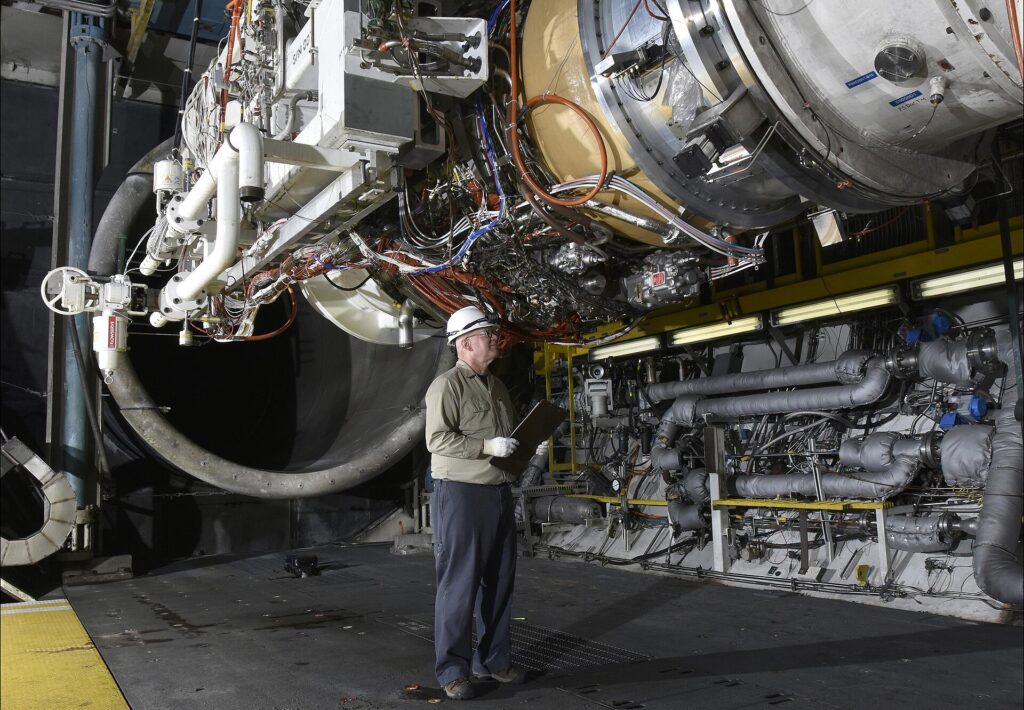
In plain words: most of the air the fan pushes goes around the engine core, not through it, which is quieter and more efficient. Wikipedia says the Passport makes the Global 7500 8% more fuel-efficient than the earlier Global Express XRS. For the Global 8000, Bombardier increased thrust by up to 7% over the 7500, which helps the higher top speed. If you want to know more about how jet engines work, read our turbofan vs turboprop explainer.
Inside the Cabin: Four Suites
The cabin is 54 ft 5 in (16.59 m) long, 8 ft (2.44 m) wide and 6 ft 2 in (1.88 m) high, measured from the cockpit divider to the rear of the cabin, not counting the baggage area. Most adults can stand up straight. Bombardier divides it into four equal-size living spaces, plus an entrance area and an en-suite bathroom. The typical layout is:
| Zone | What it has (Bombardier typical layout) |
|---|---|
| Entrance / crew area | Galley (kitchen) and crew space by the door |
| Club suite | Four Nuage seats facing each other in pairs |
| Conference suite | A dining or meeting table |
| Entertainment suite | A three-place Nuage divan that converts into a bed; optional 55-inch 4K TV |
| Principal suite | A private room with a bed and an en-suite bathroom |
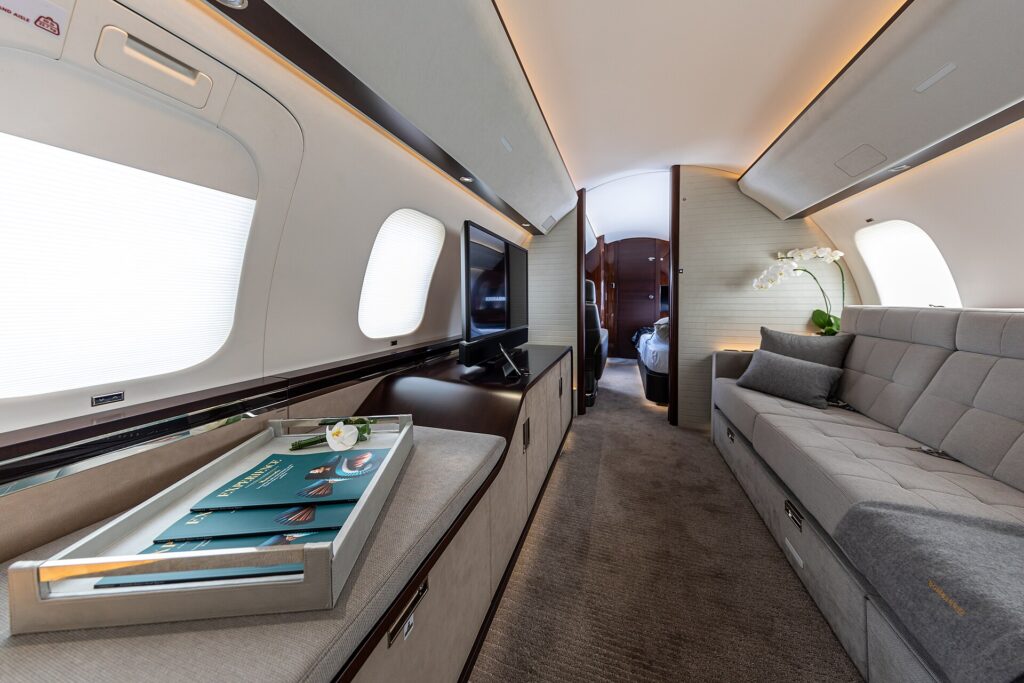
1. The lowest cabin altitude in business aviation
An aircraft cabin is pressurised, but not to sea level. On most airliners the cabin feels like 6,000 to 8,000 ft. On the Global 8000, Bombardier says the cabin feels like 2,691 ft when the jet is cruising at 41,000 ft, the lowest in the industry. That means more oxygen in your blood, fewer headaches and less fatigue at the end of a 15-hour flight. We explain why jets cruise so high in why planes fly at 35,000 feet.
2. Nuage seats
Bombardier says its Nuage seat is the first new business jet seat design in 30 years. The seat tilts its base as it reclines, into what Bombardier calls a “zero-gravity” position, and it swivels and glides. The club suite has four of them, and the entertainment suite has a three-seat Nuage divan that can be made into a bed.

3. Light that fights jet lag
The Soleil lighting system is linked to the flight management system. Bombardier calls it aviation’s first circadian-rhythm cabin lighting: it changes the colour and brightness of the cabin light to match the time of day at your destination, so your body clock starts adjusting before you land.
4. Clean air, a big kitchen and fast Wi-Fi
The Pũr Air system uses a HEPA filter that Bombardier says captures up to 99.99% of particles, plus an activated carbon filter for odours and volatile organic compounds. Bombardier also claims the industry’s largest business-jet kitchen, with two convection/microwave ovens, a sink and chilled storage. For connectivity the jet is built with JetWave hardware, and Starlink and Gogo Galileo are offered. Entertainment includes the optional 55-inch 4K TV and Bombardier’s l’Opéra sound system, which focuses audio on each seat.
5. A real bedroom

The principal suite at the back can be fitted with a full bed and an en-suite bathroom, and Wikipedia says a shower is optional. With the divan and seats made into beds, the cabin can sleep eight passengers, and there is an optional crew rest area, which matters on flights long enough to need a relief pilot.
The Cockpit: Bombardier Vision
Pilots fly the Global 8000 from the Bombardier Vision flight deck. It has four large displays, fly-by-wire controls with side-sticks instead of a yoke, a head-up display (HUD), an Enhanced Vision System (an infrared camera image that helps in fog and at night), a Synthetic Vision System (a computer-drawn view of terrain), a MultiScan weather radar with windshear detection, and CPDLC datalink for text messages with air traffic control.
Wikipedia says the fly-by-wire system is based on the one Bombardier developed for its CSeries airliner (today the Airbus A220) and includes active load alleviation, which damps the effect of turbulence. Bombardier says this gives the smoothest ride in the industry.
Range and Performance
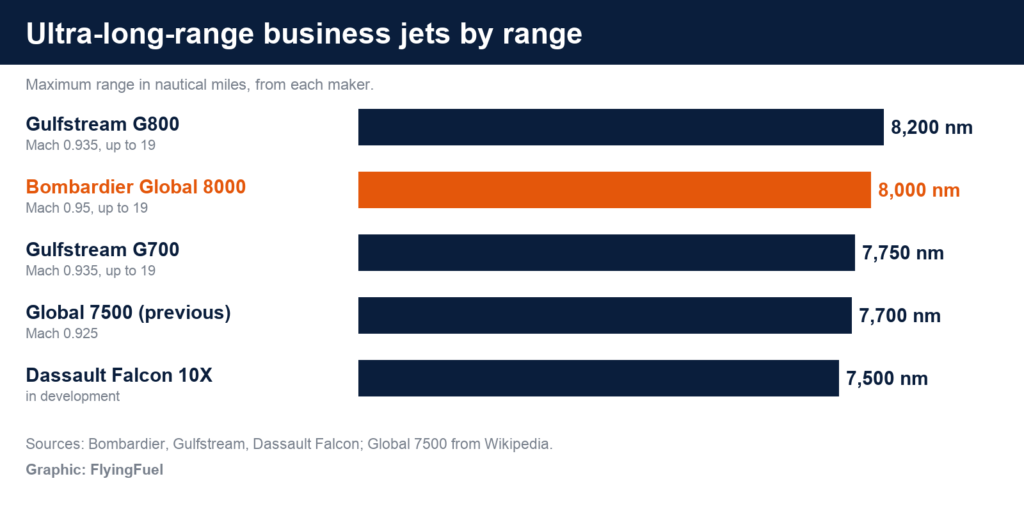
Bombardier quotes a maximum range of 8,000 nm (14,816 km), with 8 passengers and 4 crew at Mach 0.85, in standard conditions with NBAA IFR fuel reserves. That is enough for city pairs such as London to Perth, Singapore to Los Angeles or Mumbai to New York without a stop. In real life, range depends on weather, payload and how fast you fly.
The Global 8000’s parent has already shown what the airframe can do. Wikipedia lists a Global 7500 flight of 8,152 nm from Singapore to Tucson in March 2019, about 16 hours, and an 8,225 nm flight from Sydney to Detroit in October 2019. It also flew the longest nonstop flight ever from London City Airport, to Van Nuys in California, in May 2019; London City has a short runway and a steep approach, so this shows how well the wing works at low speed.
| Performance | Global 8000 |
|---|---|
| Take-off distance (sea level, ISA, MTOW) | 5,760 ft (1,756 m) |
| Landing distance (sea level, ISA, typical) | 2,220 ft (677 m) |
| Initial cruise altitude at MTOW | 43,000 ft |
| Maximum altitude | 51,000 ft (15,545 m) |
| Fuel capacity (Global 7500) | 51,503 lb (23,361 kg); the 8000 carries more |
Sources: Bombardier: Global 8000; fuel capacity from Wikipedia: Bombardier Global 7500.
Global 8000 vs Global 7500
| Global 7500 | Global 8000 | |
|---|---|---|
| Maximum range | 7,700 nm | 8,000 nm |
| Top speed (MMO) | Mach 0.925 | Mach 0.95 |
| Ultra-high-speed cruise | Not offered | Mach 0.92 |
| Cabin length | 54 ft 5 in | 54 ft 5 in |
| Engines | GE Passport, 18,920 lbf | GE Passport, up to 7% more thrust (Wikipedia) |
| Entered service | 20 December 2018 | December 2025 |
| Equipped price (2023) | About US$78 million | About US$81 million |
Source: Wikipedia: Bombardier Global 7500. More than 200 Global 7500s had been delivered by December 2024, so the 8000 inherits a well-proven design.
Safety and Reliability
The Global 7500, which the 8000 is built on, has no fatal accidents listed by Wikipedia. The only event it records is from testing: on 15 August 2017 the second prototype had an in-flight shutdown of its right engine at 41,000 ft and returned to Wichita on one engine. The aircraft is certified to the same standards as airliners by Transport Canada, the FAA and EASA. Bombardier also points to its customer support, which ranked first in AIN’s Product Support surveys in 2024, 2025 and 2026.
Price and Who Buys It
Bombardier does not publish list prices. Wikipedia gives an equipped price of about US$81 million in 2023, and NetJets’ order for four aircraft was valued at US$312 million in 2022. The real price depends on the interior and options. NetJets, the fractional ownership company, is the launch customer, and the Global 7500 family is also flown by charter firm VistaJet and by governments, including Switzerland’s Federal Air Transport Service.
Global 8000 vs Its Rivals
| Bombardier Global 8000 | Gulfstream G800 | Gulfstream G700 | Dassault Falcon 10X | |
|---|---|---|---|---|
| Status | In service (2025) | In service (2025) | In service (2024) | In development (2029) |
| Range | 8,000 nm | 8,200 nm | 7,750 nm | 7,500 nm |
| Top speed | Mach 0.95 | Mach 0.935 | Mach 0.935 | Mach 0.925 |
| Passengers | Up to 19 | Up to 19 | Up to 19 | Up to 19 |
| Cabin length | 54 ft 5 in | 46 ft 10 in | 56 ft 11 in | 53.1 ft |
| Engines | 2 x GE Passport | 2 x Rolls-Royce Pearl 700 | 2 x Rolls-Royce Pearl 700 | 2 x Rolls-Royce Pearl 10X |
Sources: makers’ pages for the Global 8000, G800, G700 and Falcon 10X.
Global 8000 vs Gulfstream G800
The G800 flies 200 nm further, but the Global 8000 is faster and has a cabin 7 ft 7 in longer, with room for four full living areas. If maximum range is all that matters, the G800 wins on paper; if you want speed and space, the Global 8000 does. Both use different engines (GE against Rolls-Royce). See our Gulfstream jets guide. See our full Global 8000 vs G800 comparison.
Global 8000 vs Gulfstream G700
The G700 has the longest cabin of the three in-service jets (56 ft 11 in, which Gulfstream says is the largest in the industry), but less range (7,750 nm) and a lower top speed. It is the closest rival for buyers who care most about cabin space.
Global 8000 vs Dassault Falcon 10X
The Falcon 10X is not flying in service yet; Dassault expects it around 2029. Its selling point is the widest cabin of the group (about 9 ft 1 in / 2.77 m wide). See our Dassault Falcon guide.
Pros and Cons
Pros
- Fastest business jet in service, with a Mach 0.95 top speed
- 8,000 nm range: almost any two major cities nonstop
- Lowest cabin altitude in the industry (2,691 ft)
- Four true living areas, including a bedroom and optional shower
- Short-field ability from the slatted Smooth Flĕx Wing
- Based on the proven Global 7500, with 200+ delivered
Cons
- The Gulfstream G800 has 200 nm more range
- The G700 has a longer cabin
- Very expensive: about US$81 million equipped (2023)
- Looks identical to the cheaper Global 7500 from outside
- Bombardier publishes few weights and fuel figures for the 8000
Our Verdict
The Global 8000 is the business jet for people who value time above all. No other jet in service flies faster, very few fly further, and none has a lower cabin altitude, which makes the long flights it is built for noticeably less tiring. It is an evolution, not a revolution: it shares its cabin and airframe with the Global 7500, so the risk is low and the support network is already in place. If range alone decides, the G800 edges it; if cabin length decides, the G700 does. For the best all-round mix of speed, range and comfort, the Global 8000 is the jet to beat in 2026.
Key Takeaways
- The Global 8000 is Bombardier’s flagship: Mach 0.95 top speed, 8,000 nm range, up to 19 passengers.
- It is a faster, longer-range development of the Global 7500, certified in late 2025 and early 2026.
- Its four-suite cabin has a 2,691 ft cabin altitude, Nuage seats and Soleil jet-lag lighting.
- Its main rivals are the Gulfstream G800 (more range) and G700 (longer cabin).
Frequently Asked Questions
How fast is the Bombardier Global 8000?
Its top speed is Mach 0.95, and Bombardier calls it the world’s fastest business jet and the fastest civil aircraft since Concorde. It cruises at Mach 0.92 at ultra-high speed, Mach 0.90 at high speed and Mach 0.85 typically. A test aircraft flew at Mach 1.015 in May 2021.
What is the range of the Global 8000?
8,000 nm (14,816 km), with 8 passengers and 4 crew at Mach 0.85 and NBAA IFR reserves. That is 300 nm more than the Global 7500. Bombardier notes that actual range varies with conditions.
How many passengers can the Global 8000 carry?
Up to 19, according to Bombardier. Wikipedia says the four-zone cabin of the Global 7500, which the 8000 shares, can sleep eight passengers.
How much does a Global 8000 cost?
Wikipedia lists an equipped price of about US$81 million in 2023. NetJets’ 2022 order for four Global 8000s was valued at US$312 million. Bombardier does not publish list prices.
When did the Global 8000 enter service?
Transport Canada certified it on 5 November 2025, the FAA on 19 December 2025 and EASA by January 2026. AIN reported that Bombardier delivered the first one on 8 December 2025.
What engines does the Global 8000 have?
Two GE Passport turbofans, each rated at 18,920 lbf (84.16 kN). Wikipedia says the Passport has a 52-inch fan made as a single blisk and a 5.6:1 bypass ratio.
What is the cabin altitude of the Global 8000?
2,691 ft when cruising at 41,000 ft, which Bombardier calls the lowest in the industry. A lower cabin altitude means more oxygen and less tiredness on long flights.
Can a Global 7500 be upgraded to a Global 8000?
Yes. Wikipedia says existing Global 7500s can be brought to the 8000 standard through a Bombardier service bulletin.
Global 8000 vs Gulfstream G800: which flies further?
Gulfstream lists the G800 at 8,200 nm, 200 nm more than the Global 8000. The Global 8000 is faster (Mach 0.95 against Mach 0.935) and has a longer cabin (54 ft 5 in against 46 ft 10 in).
Featured image: FlyingFuel graphic using a photo of the Bombardier Global 8000 N100BD at the 2026 Farnborough Airshow by Oren Rozen, CC BY-SA 4.0, via Wikimedia Commons.
 Aircraft ComparisonsBoeing vs Airbus: How to Tell the Difference (Nose, Windows, Wings, Engines)
 Aircraft ComparisonsPilatus PC-24 vs Embraer Phenom 300E: Which Light Jet Is Better? (2026)
 PilatusPilatus PC-24 Review: The Jet That Lands on Grass and Gravel (2026)
 Aircraft ComparisonsBombardier Global 6500 vs Gulfstream G600: Same Range, Different Jets (2026)
 BombardierBombardier Global 6500 Review: Range, Cabin, Speed and Price (2026)
 Aircraft ComparisonsEmbraer Praetor 600E vs Bombardier Challenger 3500: Which Super-Midsize Jet Wins? (2026)