

The Cessna Citation Longitude is the biggest and fastest jet Cessna builds. It flies 3,500 nm, cruises at up to 483 ktas and carries up to 12 people in a flat-floor cabin tall enough to stand up in. Textron Aviation, Cessna’s parent company, claims it has the quietest cabin and the lowest direct operating costs in the super-midsize class. In this review we look at it the way we review airliners: the looks, the cabin, the engines, the cockpit, range, running costs, safety, price and how it compares with its rivals.
Quick answer: the Citation Longitude is a super-midsize twinjet that entered service in October 2019. It seats up to 12, costs about US$30 million equipped (2023) and flies 3,500 nm, enough for any nonstop trip across the United States. NetJets is its best-known customer. Its rivals are the Bombardier Challenger 3500 and the Embraer Praetor 600E.
Cessna Citation Longitude Quick Facts
| Citation Longitude | Figure |
|---|---|
| Maker | Cessna (Textron Aviation), Wichita, Kansas, USA |
| Model number | Model 700 |
| Class | Super-midsize business jet |
| Maximum range | 3,500 nm (6,482 km) |
| Maximum cruise speed | 483 ktas (895 km/h) |
| Maximum limit speed | Mach 0.84 |
| Occupants | Up to 12 (2 pilots + passengers) |
| Cabin (L x H x W) | 25 ft 2 in x 72 in x 77 in (7.67 x 1.83 x 1.96 m) |
| Baggage | 112 cu ft (3.17 m3), up to 1,115 lb (506 kg), reachable in flight |
| Engines | 2 x Honeywell HTF7700L, 7,665 lb (34.10 kN) each |
| Maximum altitude | 45,000 ft (13,716 m) |
| Take-off / landing distance | 4,810 ft / 3,170 ft (1,466 / 966 m) |
| Length / wingspan / height | 73 ft 2 in / 68 ft 11 in / 19 ft 5 in (22.3 / 21.01 / 5.9 m) |
| Maximum take-off weight | 39,500 lb (17,917 kg) |
| First flight / FAA certification | 8 October 2016 / 21 September 2019 |
| Price | About US$30 million equipped (2023) |
Sources: Textron Aviation: Citation Longitude; dates, model number and price from Wikipedia: Cessna Citation Longitude.
What Is the Citation Longitude?
The Longitude sits at the top of the Citation family, above the midsize Citation Latitude and the light CJ jets (see our guide to every Cessna Citation). Wikipedia says Cessna announced it at the EBACE show in Geneva in May 2012. It followed the cancelled Citation Columbus, a larger design, and it borrowed the round fuselage of the Latitude, stretched by one row of seats.
Development took longer than planned. The first Longitude flew on 8 October 2016, and Textron first aimed for certification in 2017. Five test aircraft eventually flew more than 4,000 hours, and the FAA gave the jet a provisional type certificate in December 2018. Full FAA type certification came on 21 September 2019, after 6,000 flight hours, 11,000 test points and a 31,000 nm world tour, and the first customer aircraft was delivered in early October 2019. Europe’s EASA certified it in July 2021.

The engines changed along the way. Cessna first picked the Safran (then Snecma) Silvercrest, but the production jet uses Honeywell engines. The Silvercrest was then planned for a larger Citation, the Hemisphere, which Textron suspended in July 2019 because the engine missed its targets. That left the Longitude as Cessna’s flagship, and the 100th Longitude was delivered in May 2023.

How the Longitude Looks: Exterior Design
The Longitude is 73 ft 2 in (22.3 m) long with a 68 ft 11 in (21.01 m) wingspan, a little longer than its main rival, the Bombardier Challenger 3500 (68 ft 8 in). Wikipedia describes an all-aluminium airframe with a T-tail, winglets and “area rule” shaping of the fuselage, where the body is contoured to reduce drag near the speed of sound.
Its wing is new for Cessna. Wikipedia says the wing and tail are similar to those of the Hawker 4000 (Hawker is now a Textron brand), with winglets that add 5.3 ft (1.6 m) of span. The wing is swept back 28.6 degrees on its outer part (Textron quotes the same figure) and 26.8 degrees closer to the body, which helps it cruise fast. Wing area is 537 sq ft (49.91 m2).

How to recognise a Citation Longitude at the airport
- A T-tail, with the horizontal tail on top of the fin
- Two engines mounted at the back of the fuselage
- Swept wings with small upturned winglets
- A long row of large oval windows; Wikipedia says it is one seat row longer than the Latitude
- NetJets aircraft, such as N807QS and N833QS, have registrations ending in “QS”
The HTF7700L Engine, Explained Simply
Two Honeywell HTF7700L turbofans each give 7,665 lb (34.10 kN) of thrust. They belong to Honeywell’s HTF7000 family, the same family that powers the Bombardier Challenger 3500 and Embraer Praetor 600E, so all three rivals have closely related engines. Like airliner engines, they are turbofans: a big fan at the front pushes most of the air around the hot core, which saves fuel and noise. Our turbofan vs turboprop guide explains how they work.
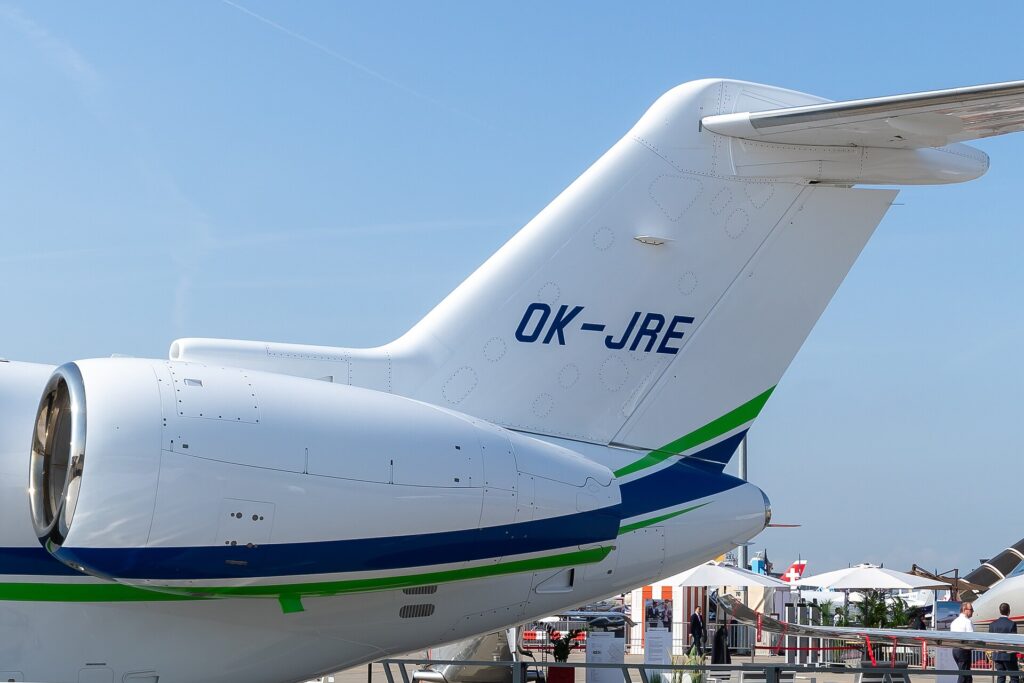
How much fuel does it burn? Figures quoted by Wikipedia from pilot reports give an idea. An AIN report in 2018 measured about 860 to 880 lb per engine per hour at Mach 0.83 and 43,000 ft. A FlightGlobal test in 2021 gave about 1,820 lb an hour in total at its Mach 0.79 long-range cruise and about 2,122 lb an hour at Mach 0.84. Another AIN report gave about 2,400 lb for the first hour and 1,600 to 1,800 lb an hour in cruise. Actual burn depends on weight, altitude and weather.
Inside the Cabin: Stand-Up Room and Quiet
The cabin is 25 ft 2 in (7.67 m) long, 72 in (1.83 m) tall and 77 in (1.96 m) wide, with a flat floor. Textron calls it a “six-foot stand up cabin”: most adults can walk through it without stooping, which is not true of light jets such as the Citation CJ4 (57 in tall). The cabin has the same cross-section as the Latitude’s, and Wikipedia says the extra length lets it seat eight people in a double club layout, two sets of four facing seats.

1. A quiet cabin
Textron calls it “the world’s quietest super-midsize cabin”. It does not publish a decibel figure on its model page, so treat this as the maker’s claim. Noise matters on a five- or six-hour flight, because a quieter cabin makes it easier to talk, work and sleep.
2. More legroom
Textron says the Longitude has “best-in-class legroom”, with up to 11% more legroom than the competition. The seats are fully berthable, meaning they can be laid flat to form beds. Options include an aft couch and a side-facing seat, and buyers can choose from several interior colour schemes.

3. Baggage you can reach in flight
The baggage compartment holds 112 cu ft (3.17 m3) and up to 1,115 lb (506 kg), and Textron says passengers can reach it at any time during the flight. Its door is just over four feet tall, which makes loading large cases easier.
4. Cabin technology and connectivity
Passengers control the window shades, lighting, temperature, films and music from their own phone or tablet through a wireless cabin management system. Textron also mentions global connectivity through a Gogo Galileo system.
5. Cabin altitude
Textron does not list the cabin altitude on its page. Wikipedia gives 5,950 ft. That is good for a business jet, though Bombardier quotes a lower 4,850 ft for the Challenger 3500. A lower cabin altitude means more oxygen in the air and less tiredness on long flights.
The Cockpit: Garmin G5000
The Longitude has a Garmin G5000 flight deck with three large high-resolution screens and four touchscreen controllers, which pilots use for navigation and radios instead of rows of knobs. Standard equipment includes Garmin Synthetic Vision, which draws a 3D picture of the terrain ahead, fully integrated autothrottles, system diagrams on the screens, and ADS-B Out and In for traffic information.

Options include a head-up display (HUD) with an enhanced flight vision system (EFVS), an infrared camera view that helps pilots see the runway in poor visibility, which Textron calls “eyes-up flying”. Other options are Category II approaches, satellite datalink with air traffic control (FANS 1/A+ and CPDLC) and precise RNP AR approaches into difficult airports.
Textron also highlights LinxUs, a diagnostics system that watches the aircraft all the time. The standard version sends fault reports by Wi-Fi after landing; LinxUs Air sends them by satellite during the flight, so a mechanic can be ready with the right part.
Range and Performance

Textron quotes a maximum range of 3,500 nm (6,482 km) but does not say with how many passengers or which reserves, so it is not directly comparable with figures from Bombardier or Embraer. In practice, 3,500 nm covers any nonstop trip across the continental United States, such as New York to Los Angeles, and Textron describes the jet as having “transatlantic range”.
It also climbs and lands well for its size. Textron lists a maximum climb rate of 4,892 ft a minute and a maximum operating altitude of 45,000 ft; Wikipedia quotes an AIN test that reached 43,000 ft in 16 minutes. It needs 4,810 ft of runway to take off at maximum weight and 3,170 ft to land.
| Performance and weights | Citation Longitude |
|---|---|
| Maximum climb rate | 4,892 ft/min (1,491 m/min) |
| Take-off field length | 4,810 ft (1,466 m) |
| Landing distance | 3,170 ft (966 m) |
| Maximum operating altitude | 45,000 ft (13,716 m) |
| Maximum take-off / landing weight | 39,500 lb / 33,500 lb (17,917 / 15,195 kg) |
| Usable fuel | 14,500 lb (6,577 kg) |
| Maximum payload / full-fuel payload | 3,200 lb / 1,600 lb (1,451 / 726 kg) |
Source: Textron Aviation: Citation Longitude.
One number to note: with full fuel tanks it can carry 1,600 lb (726 kg) of payload. Carry more and you need to take less fuel, which cuts the range. Learn what weight limits like these mean in our guide to MTOW.
Running Costs
Running costs are a big part of the Longitude’s pitch. Textron lists an hourly operating cost of US$2,903 and claims “the lowest direct operating costs of any super-midsize jet”, with up to 6% savings over five years. Scheduled maintenance is every 800 hours or 18 months, which Textron calls the longest intervals in the segment. These are the maker’s figures; real costs depend on how many hours an owner flies, crew salaries, hangar and insurance.
Citation Longitude vs Citation Latitude
The Latitude is the Longitude’s smaller sister. They share the same 72 in tall, 77 in wide cabin cross-section and the Garmin G5000 cockpit. The Longitude adds a cabin about 3 ft 5 in longer (25 ft 2 in against 21 ft 9 in), room for up to 12 instead of 9, a new swept wing, a T-tail and more powerful Honeywell engines. In return it flies 3,500 nm instead of 2,700 nm and cruises at 483 ktas instead of 446. Choose the Latitude for shorter trips from shorter runways (it needs only 3,580 ft); choose the Longitude for coast-to-coast flights with more people.
Safety and Reliability
The Longitude is certified by the FAA (2019) and EASA (2021). Wikipedia’s Longitude article lists no accidents. During certification, Textron received a temporary FAA exemption from fuel tank flammability rules and later fitted a permanent solution to delivered aircraft. Synthetic vision, autothrottles and the optional HUD with EFVS help pilots on difficult approaches, and LinxUs helps catch technical faults early.
Governments use it too. Wikipedia says the Japan Civil Aviation Bureau received a Longitude equipped to check airport navigation and landing aids in June 2022, and Turkey’s airports authority ordered one for the same flight-inspection job.
Price and Who Flies It
Wikipedia lists an equipped price of about US$29.995 million in 2023, from Business & Commercial Aviation’s purchase planning handbook. That is far below large-cabin jets such as the Falcon 6X (about US$54 million).
The biggest customer is NetJets, the fractional ownership company. In October 2018 it announced a deal for up to 175 Longitudes, and it took delivery of its first on 31 December 2019, according to Wikipedia.
Citation Longitude vs Its Rivals
| Cessna Citation Longitude | Bombardier Challenger 3500 | Embraer Praetor 600E | |
|---|---|---|---|
| Range | 3,500 nm | 3,400 nm | 4,018 nm (4 passengers) |
| Passengers | Up to 12 occupants | Up to 10 | 8 standard, up to 12 |
| Cabin height / width | 6 ft / 6 ft 5 in (72 / 77 in) | 6 ft / 7 ft 2 in | 6 ft / 6 ft 10 in |
| Cabin length | 25 ft 2 in | 25 ft 2 in | Not stated |
| Top speed | Mach 0.84 | Mach 0.83 | Mach 0.83 |
| Engines | 2 x Honeywell HTF7700L | 2 x Honeywell HTF7350 | 2 x Honeywell HTF7500E |
| Take-off distance | 4,810 ft | 4,835 ft | 4,717 ft |
Sources: Textron Aviation: Citation Longitude, Bombardier: Challenger 3500, Embraer Praetor 600E brochure and Wikipedia: Praetor 500/600 for its cabin size. Each maker measures range its own way.
Citation Longitude vs Bombardier Challenger 3500
These two are very close: the same cabin length, similar range and similar runway needs. The Longitude carries more people (up to 12 against 10) and Textron says it has more legroom. The Challenger 3500 has a wider cabin, a lower cabin altitude of 4,850 ft and a 24-inch 4K screen. See our Bombardier guide. See our full Challenger 3500 vs Citation Longitude comparison.
Citation Longitude vs Embraer Praetor 600E
The Praetor 600E flies further, 4,018 nm with 4 passengers, and Embraer says it can fly London to New York nonstop. It also has full fly-by-wire controls and a slightly wider cabin (6 ft 10 in against 6 ft 5 in), with the same 6 ft height. The Longitude carries up to 12 occupants and Textron claims more legroom and a quieter cabin. See our Embraer guide.
Pros and Cons
Pros
- Flat-floor stand-up cabin, 72 in tall
- Up to 12 occupants, more than the Challenger 3500
- Textron claims the quietest cabin and most legroom in its class
- Baggage reachable during the flight
- Low operating cost (US$2,903 an hour, Textron) and 800-hour maintenance intervals
- Large NetJets fleet and strong US support network
Cons
- Shorter range than the Praetor 600E (3,500 nm against 4,018 nm)
- Textron does not publish range conditions or cabin altitude
- Only 1,600 lb of payload with full fuel
- Narrower cabin than the Challenger 3500 and Praetor 600E
Our Verdict
The Citation Longitude does what Cessna promised: a big, quiet, stand-up cabin for up to 12 people, 3,500 nm of range and low running costs, from a maker with the largest business jet fleet in the world behind it. It took a long time to arrive, but NetJets, the biggest fractional operator, ordered up to 175. If you need to cross the Atlantic nonstop with a full cabin, the Praetor 600E flies further, and if cabin width matters most, the Challenger 3500 is roomier. For coast-to-coast trips in the US, it is one of the best super-midsize jets you can buy.
Key Takeaways
- The Citation Longitude is Cessna’s flagship: 3,500 nm, 483 ktas and up to 12 occupants.
- Its flat-floor cabin is 72 in tall and 77 in wide, the same cross-section as the Citation Latitude.
- It entered service in October 2019 after a long test programme; NetJets is its largest customer.
- It costs about US$30 million equipped (2023) and US$2,903 an hour to run, according to Textron.
Frequently Asked Questions
How far can a Cessna Citation Longitude fly?
3,500 nm (6,482 km), according to Textron Aviation, which does not state the payload or reserves for that figure. It is Cessna’s longest-range jet.
How fast is the Citation Longitude?
Textron lists a maximum cruise speed of 483 ktas (895 km/h) and a maximum limit speed of Mach 0.84. It can climb to 45,000 ft.
How many passengers does a Citation Longitude carry?
Textron lists up to 12 occupants. Wikipedia gives a capacity of 8 to 12 passengers, with two pilots and an optional third crew member.
Can you stand up in a Citation Longitude?
Yes. The cabin is 72 in (1.83 m) tall, which Textron calls a six-foot stand-up cabin, with a flat floor. It is 77 in (1.96 m) wide and 25 ft 2 in (7.67 m) long.
How much does a Citation Longitude cost?
Wikipedia lists an equipped price of US$29.995 million in 2023, from Business & Commercial Aviation’s purchase planning handbook.
How much does a Citation Longitude cost per hour?
Textron’s Longitude page lists an hourly operating cost of US$2,903 and maintenance intervals of 800 hours or 18 months, which it calls the longest in the super-midsize segment.
What engines does the Citation Longitude have?
Two Honeywell HTF7700L turbofans, each rated at 7,665 lb (34.10 kN) of thrust.
What is the difference between the Citation Longitude and Latitude?
They share the same 72 in tall, 77 in wide cabin cross-section, but the Longitude is stretched by a row of seats (25 ft 2 in against 21 ft 9 in), has a new swept wing, a T-tail and more powerful Honeywell engines, and flies 3,500 nm against the Latitude’s 2,700 nm.
Citation Longitude vs Challenger 3500: which is better?
The Longitude flies slightly further (3,500 nm against 3,400 nm) and carries up to 12 occupants against 10. The Challenger 3500 has a wider cabin (7 ft 2 in against 6 ft 5 in) and a lower cabin altitude (4,850 ft against the 5,950 ft listed by Wikipedia for the Longitude).
Featured image: FlyingFuel graphic using a photo of a NetJets Cessna Citation Longitude landing at John Wayne Airport, California by Sewageboy, CC BY 4.0, via Wikimedia Commons.
 Aircraft ComparisonsBoeing vs Airbus: How to Tell the Difference (Nose, Windows, Wings, Engines)
 Aircraft ComparisonsPilatus PC-24 vs Embraer Phenom 300E: Which Light Jet Is Better? (2026)
 PilatusPilatus PC-24 Review: The Jet That Lands on Grass and Gravel (2026)
 Aircraft ComparisonsBombardier Global 6500 vs Gulfstream G600: Same Range, Different Jets (2026)
 BombardierBombardier Global 6500 Review: Range, Cabin, Speed and Price (2026)
 Aircraft ComparisonsEmbraer Praetor 600E vs Bombardier Challenger 3500: Which Super-Midsize Jet Wins? (2026)