
Summary
- The National Academies of Sciences, Engineering, and Medicine published a report requested by Congress on the January 2025 midair collision near Reagan Washington National Airport (DCA)
- It finds that both the FAA and the US Army failed to spot and fix recurring collision risks, and says changes made since then still need to be checked
- The report urges Congress to require a public safety and capacity assessment before any increase in flights at DCA
WASHINGTON, D.C., United States, 18 November 2026 – The FAA and the US Army still have gaps in how they find and manage collision risks around Ronald Reagan Washington National Airport, according to a report released on Wednesday by the National Academies of Sciences, Engineering, and Medicine. Congress asked for the study after the collision of 29 January 2025, when an American Airlines regional jet and an Army Black Hawk helicopter collided over the Potomac River, killing all 67 people on board the two aircraft.
The report, titled Aviation Safety in the National Capital Region, Report 1: Managing Risk in the Reagan National Airport Airspace, was sponsored by the US Department of Transportation. It builds on the National Transportation Safety Board (NTSB) investigation and is the first of two reports Congress requested.
What the report found
According to the National Academies, the FAA did not consistently use the safety information it had to spot new hazards or to check whether its fixes worked, and its responses often focused on procedural noncompliance. The Army’s safety processes did not give a complete picture of recurring hazards at DCA, and its preflight risk assessment for the accident helicopter did not list a midair collision with a civilian aircraft as a hazard.
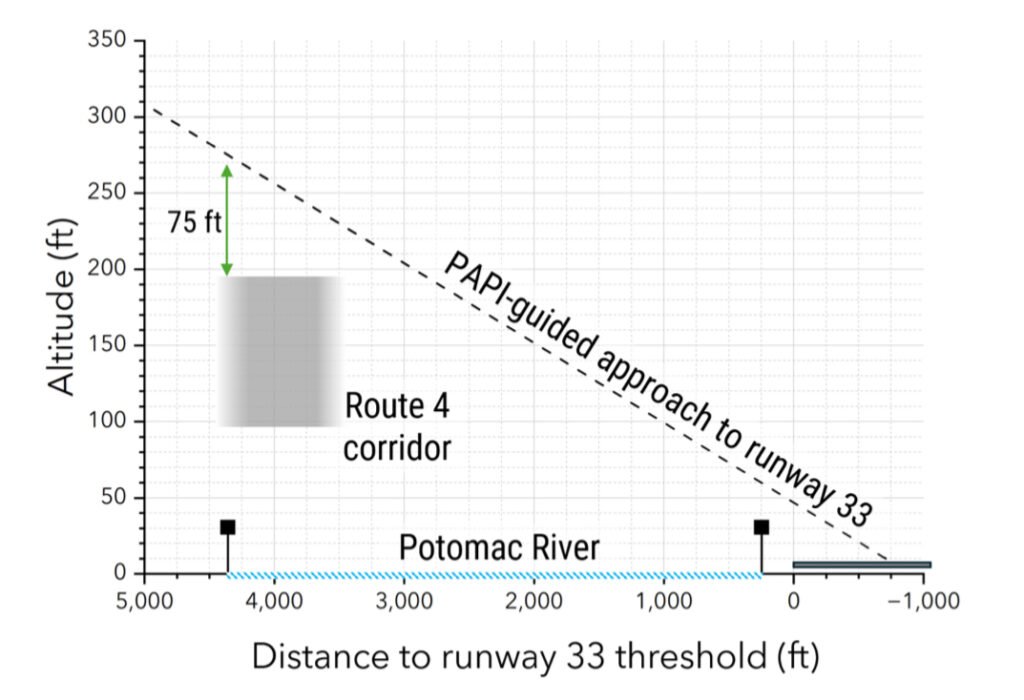
The report also notes that existing collision-avoidance systems have limits at low altitude and that many helicopters carry no system that tells pilots how to maneuver away from a collision. As Flying magazine reports, it points to a 2013 near midair collision at the same spot, after which an informal working group suggested moving helicopter Route 4 away from the approach to runway 33. The FAA removed Route 4 only after the 2025 accident. The NTSB had identified 85 close calls between helicopters and airplanes near the airport from October 2021 to December 2024, Flying adds.
What it recommends
The committee, chaired by former NASA astronaut James P. Bagian of the University of Michigan, makes 25 recommendations, AeroTime reports. The FAA should strengthen its safety management, clarify guidance for helicopter routes and air traffic control procedures, and spread flights more evenly through each hour to avoid bursts of traffic. The Defense Department should set standard training and recurring proficiency checks for military helicopter crews in the Washington area, and the FAA and Army should coordinate regularly on shared risks.
On technology, the report asks for faster standards for helicopter collision-avoidance systems, followed by a requirement to fit them, and for priority on traffic-awareness tools such as ADS-B In displays for aircraft without collision-avoidance guidance. Most directly for airlines and passengers, it says Congress should direct the FAA to carry out, and publish, a full safety and capacity assessment before allowing any more flights at DCA. Bagian said effective safety management “cannot operate in an isolated and siloed manner”.
Changes since the collision
The FAA cut DCA’s hourly arrival limit from 36 to 26 after the collision and restricted helicopter traffic, then raised the limit to 30 in January 2026, saying the increase could be handled safely and that it had added staff at the control tower, AeroTime reports. In May 2026 the FAA said it had stopped allowing visual separation between helicopters and airplanes near busy airports. The National Academies says these changes need to be tracked to show whether they actually reduce risk.

Congress is also moving. On 17 November senators announced an agreement in principle to require ADS-B In traffic equipment on civilian aircraft that already need ADS-B Out, AeroTime reports, although rules for military aircraft are still unresolved and the House and Senate must still agree a final bill. An NTSB simulation found that an ADS-B-based alert could have warned the airliner’s crew about the helicopter 59 seconds before impact. The second National Academies report will look at military close-call records, civil-military coordination and wider safety oversight; no release date has been given.
Read more
- The busiest airports in the US
- FAA lifts four-hour nationwide ground stop after ATC outage
- What is a go-around, and why do pilots do it?
- Air India Express jet entered Goa runway as Navy fighter took off, AAIB finds
Sources: National Academies news release and report page, 18 November 2026; AeroTime, 18 November 2026; AeroTime, 17 November 2026; Flying magazine via Yahoo News, 18 November 2026.
Featured image: FlyingFuel graphic using a photo of the historic terminal at Washington National Airport by formulanone, CC BY-SA 2.0, via Wikimedia Commons.
 Aircraft ComparisonsBoeing 737 MAX 8 vs 737-800: What Changed and Which Is Better? (2026)
 NewsMalaysia Airlines to Buy 10 Boeing 787-10 Dreamliners to Replace Its Airbus A350s From 2032
 AirportsAirports in Odisha: Bhubaneswar, Jharsuguda, Jeypore and More Ranked (2026 Data)
 NewsNew Visakhapatnam Airport at Bhogapuram to Charge Rs 890 Per Departing Domestic Passenger From 1 December
 AirportsAirports in Karnataka: Bengaluru, Mangaluru, Hubballi, Belagavi and More Ranked (2026 Data)
 Aircraft ComparisonsAirbus A350-900 vs Boeing 777-300ER: Which Long-Haul Jet Is Better? (2026)