
“Light jet”, “super-midsize”, “heavy jet”: charter brokers and manufacturers use these size labels all the time, but rarely explain what they mean. The difference between them decides how many people you can take, whether you can stand up inside, how far you can fly without a fuel stop, which airports you can use and, of course, the price.
Quick answer: private jets are usually grouped into six sizes. Entry-level and light jets carry about 4 to 10 people up to roughly 1,200 to 2,200 nm. Midsize and super-midsize jets add a stand-up cabin and 2,700 to 4,000 nm of range. Large-cabin and ultra-long-range jets seat up to 19 and fly 5,300 to 8,200 nm, far enough for New York to Dubai or Tokyo nonstop.
This guide uses real, current jets from Bombardier, Gulfstream, Dassault, Embraer, Cessna, Pilatus and HondaJet, with figures from the makers’ own model pages and prices from Wikipedia. Route distances are FlyingFuel great-circle calculations.
How Are Private Jets Grouped by Size?
There is no official size standard. Regulators certify each aircraft type, not a size class, and the labels come from manufacturers, charter firms and the industry press. They are based mainly on three things:
- Cabin size: length, width and above all height. Can a passenger stand up and walk to the back?
- Range: how far the jet can fly nonstop, usually with a few passengers and the fuel reserves used in business aviation (NBAA IFR reserves).
- Seats: the maximum number of passengers the cabin is certified or configured for.
Because the labels are informal, makers do not always agree. Bombardier, for example, lists its Challenger 650 as "large / super-midsize", while its cabin length (25 ft 7 in) is close to super-midsize jets like the Challenger 3500 (25 ft 2 in). Treat the classes as a rough guide and always compare the actual numbers.
Private Jet Sizes at a Glance
| Size | Example jets | Passengers | Max range | Cabin height | Price guide* |
|---|---|---|---|---|---|
| Entry-level (very light) | HondaJet Elite II, Citation M2 Gen3, Phenom 100EX | Up to 6-7 | 1,178-1,550 nm | About 4 ft 9 in (M2) | From about US$6.95M |
| Light | Phenom 300E, Citation CJ4 Gen3, Pilatus PC-24 | Up to 9-10 | 2,010-2,165 nm | 4 ft 9 in-5 ft 1 in | About US$11-12M |
| Midsize | Citation Latitude, Citation Ascend, Praetor 500E | Up to 9-12 | 1,940-3,340 nm | Up to 6 ft | About US$19M (Praetor 500) |
| Super-midsize | Challenger 3500, Citation Longitude, Praetor 600E | Up to 10-12 | 3,400-4,018 nm | 6 ft | About US$22-30M |
| Large cabin | Falcon 6X, Falcon 8X, Global 5500/6500, G500/G600 | 12-19 | 5,300-6,600 nm | Up to 6 ft 6 in (Falcon 6X) | About US$54-63M (Falcons) |
| Ultra-long-range | Global 8000, Gulfstream G700, G800 | Up to 19 | 7,750-8,200 nm | 6 ft 2 in-6 ft 3 in | About US$72.5-81M |
*Equipped prices listed by Wikipedia, mostly 2023 figures; makers do not publish list prices for most jets, and the final price depends on the interior and options. Ranges are from the makers and assume ideal conditions.
Entry-Level Jets (Very Light Jets)
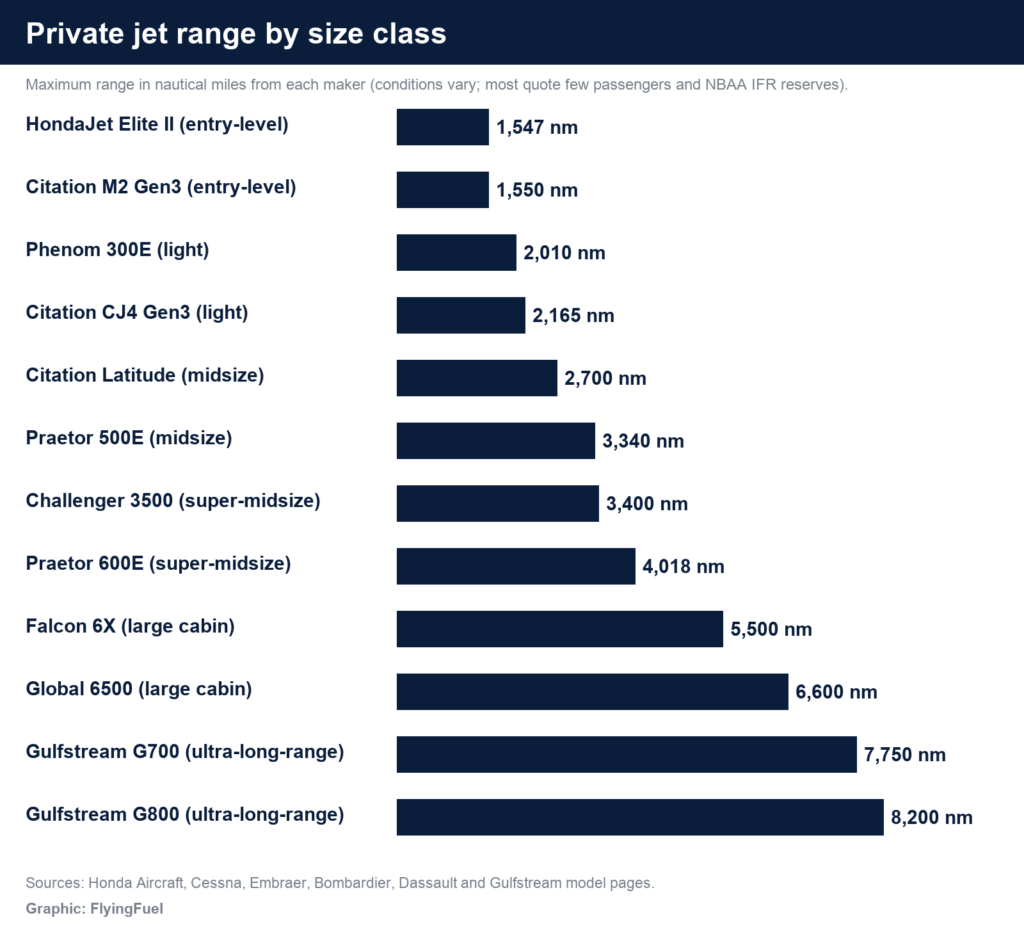
The smallest jets are built for short trips with a few people, and many can be flown by a single pilot. Cessna calls the Citation M2 Gen3 entry-level: up to 7 occupants, 1,550 nm (2,871 km) and 404 ktas. The HondaJet Elite II flies 1,547 nm at up to 422 KTAS with up to 6 passengers plus crew, and the Embraer Phenom 100EX flies 1,178 nm with up to 7.
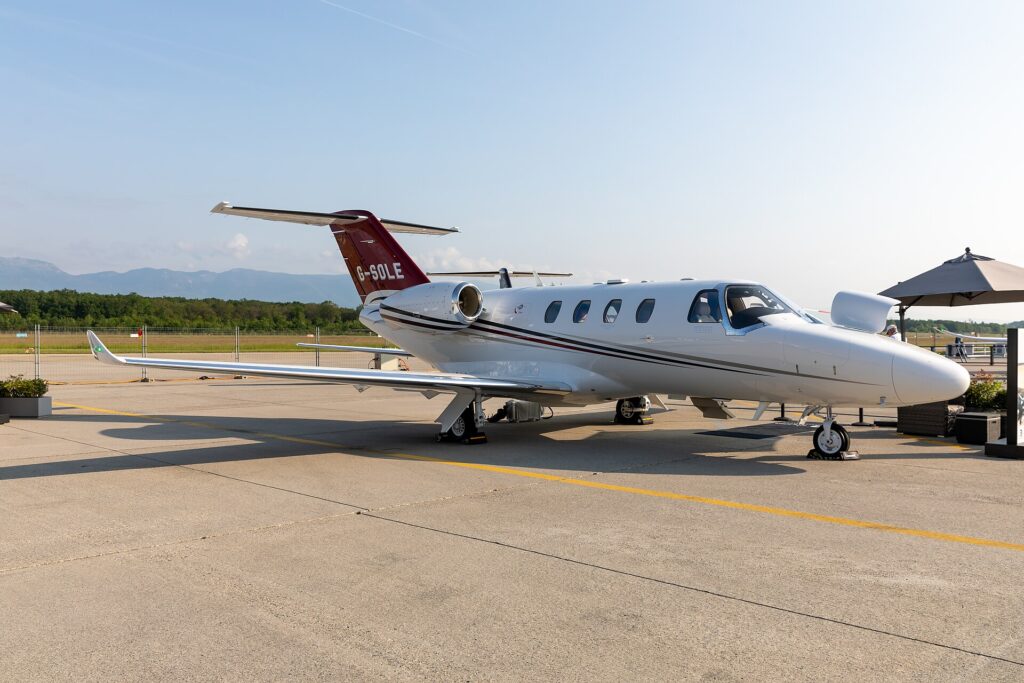
- Cabin: small. The M2 cabin is 11 ft long, 57 in (4 ft 9 in) high and 58 in wide, so you sit, not stand.
- Good for: one to four people on trips like New York to Palm Beach (about 902 nm) or London Farnborough to Nice (about 560 nm).
- Price: Wikipedia gives US$6.95 million for the HondaJet Elite II at its 2022 launch.
Light Jets
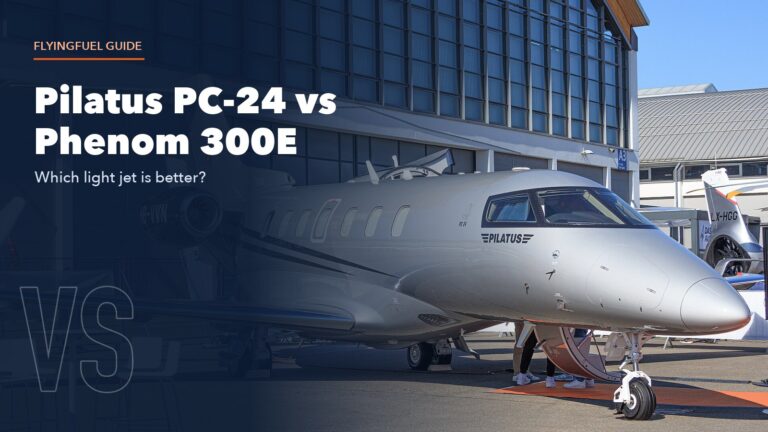
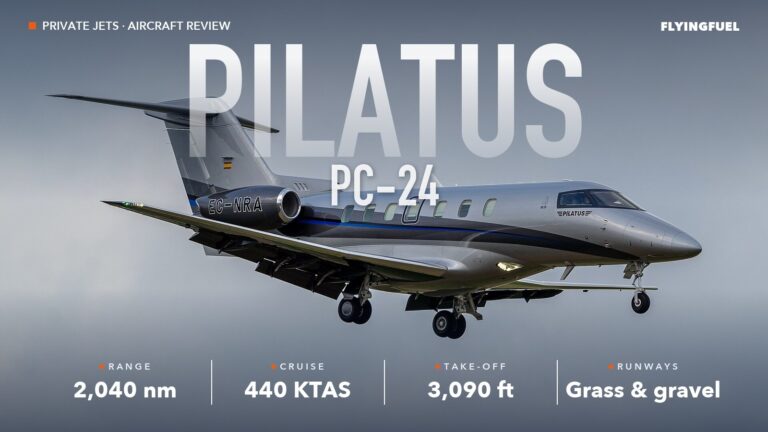
Light jets carry more people further and faster. The Embraer Phenom 300E, single-pilot certified, flies 2,010 nm at a high-speed cruise of 464 kt and seats 6 to 8 people typically, up to 10 with one pilot. Cessna’s Citation CJ4 Gen3 flies 2,165 nm with up to 10 occupants. The Pilatus PC-24 flies 2,040 nm with 4 passengers and, unusually for a jet, is approved for grass, gravel, earth and snow runways.

- Cabin: still too low to stand: 4 ft 11 in (1.50 m) in the Phenom 300E, 5 ft 1 in in the PC-24. The Phenom 300E still has 84 cu ft of baggage space.
- Runways: short. The Phenom 300E needs 3,209 ft (978 m) to take off at maximum weight, and the PC-24 3,090 ft to clear a 50 ft obstacle.
- Good for: 2 to 6 people on flights of up to roughly four hours (2,010 nm at 464 kt is about 4.3 hours), such as Sydney to Melbourne (about 381 nm) or Sydney to Perth (about 1,770 nm).
- Price: about US$10.995 million for a Phenom 300E (early 2023) and about US$12.2 million for a PC-24 (2023), according to Wikipedia.
Midsize Jets
Midsize is where most passengers can stand up. The Cessna Citation Latitude has a cabin 72 in (6 ft) tall and 77 in wide, carries up to 9 occupants and flies 2,700 nm. Embraer’s Praetor 500E flies 3,340 nm with up to 9 passengers. Cessna also lists the new Citation Ascend as a midsize jet (1,940 nm, up to 12 passengers), which shows how loose the labels are.

- Good for: coast-to-coast US trips. Teterboro (New York) to Van Nuys (Los Angeles) is about 2,129 nm, within the Latitude’s range on paper.
- Price: Wikipedia lists about US$18.995 million for the Praetor 500 (2023).
Super-Midsize Jets
Super-midsize jets offer a wider, 6 ft tall cabin and enough range for many transatlantic trips, at a much lower price than large-cabin jets. The three best-known models today:
| Jet | Max range | Passengers | Cabin width | Price (Wikipedia, 2023) |
|---|---|---|---|---|
| Bombardier Challenger 3500 | 3,400 nm | Up to 10 | 7 ft 2 in (2.19 m) | About US$27.2M |
| Cessna Citation Longitude | 3,500 nm | Up to 12 occupants | 77 in (1.96 m) | About US$30M |
| Embraer Praetor 600E | 4,018 nm | 8 standard, up to 12 | 6 ft 10 in (2.08 m) | About US$21.995M (Praetor 600) |

- Good for: 4 to 8 people on long domestic trips or the North Atlantic. Teterboro to London Luton is about 2,989 nm, inside all three published ranges, though winter headwinds and full cabins reduce the margin.
- Runways: about 4,700 to 4,850 ft at maximum take-off weight (Praetor 600E 4,717 ft, Longitude 4,810 ft, Challenger 3500 4,835 ft).
- Cabin pressure: the Challenger 3500 keeps a cabin altitude of 4,850 ft at 41,000 ft, compared with 6,600 ft at 45,000 ft in the light Phenom 300E.
Large-Cabin Jets (Heavy Jets)
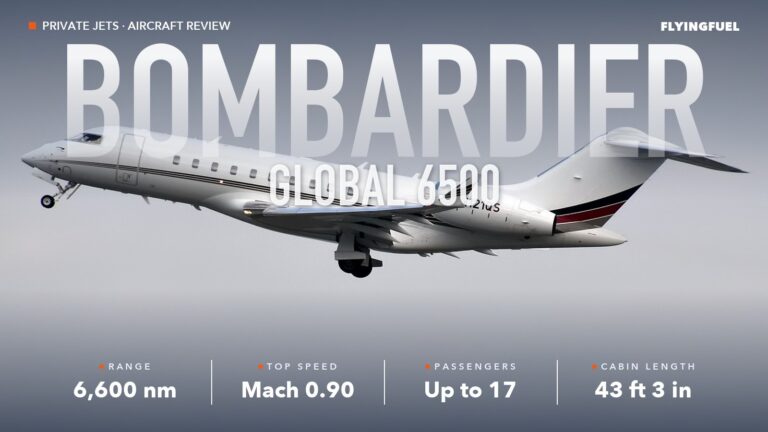
Large-cabin jets, often called heavy jets by charter firms, have cabins of about 40 to 45 ft (Falcon 6X 40.3 ft, Global 6500 43 ft 3 in, G600 45 ft 2 in) and room for 12 to 19 passengers. Dassault’s Falcon 6X has one of the widest and tallest cabins: 102 in (2.58 m) wide and 78 in (6 ft 6 in) tall, and flies 5,500 nm. The Falcon 8X flies 6,450 nm on three engines (3 x PW307D). Bombardier’s Global 5500 and 6500 fly 5,900 and 6,600 nm, and Gulfstream‘s G500 and G600 fly 5,300 and 6,600 nm.
- Good for: London to Dubai (about 2,978 nm) or London to Mumbai (about 3,892 nm) with a full cabin; Los Angeles to London (about 4,705 nm) nonstop.
- Altitude: the Falcon 6X is certified to 51,000 ft, like the G700 and Global 8000.
- Price: Wikipedia lists about US$54 million for the Falcon 6X (2023) and US$62.5 million for the Falcon 8X (2022).
Ultra-Long-Range Jets
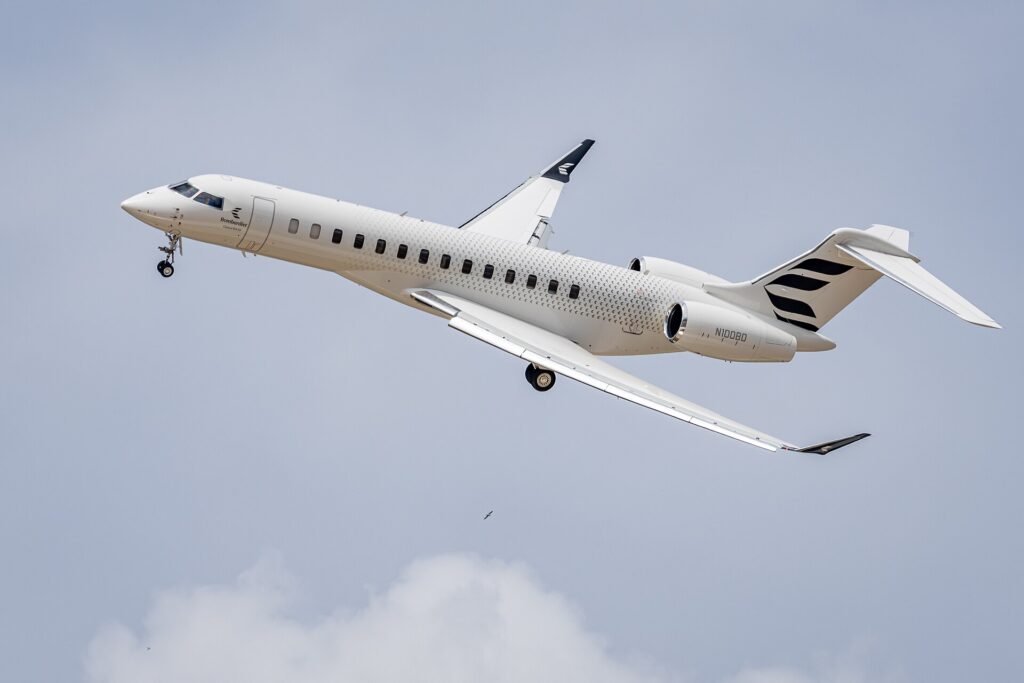
At the top are the jets that link almost any two major cities nonstop. The Gulfstream G800 flies 8,200 nm, the Bombardier Global 8000 8,000 nm with a top speed of Mach 0.95, and the Gulfstream G700 7,750 nm with the longest cabin, 56 ft 11 in (17.35 m).
| Global 8000 | Gulfstream G700 | Gulfstream G800 | |
|---|---|---|---|
| Max range | 8,000 nm | 7,750 nm | 8,200 nm |
| Passengers | Up to 19 | Up to 19 (sleeps 13) | Up to 19 (sleeps 10) |
| Cabin length | 54 ft 5 in (16.59 m) | 56 ft 11 in (17.35 m) | 46 ft 10 in (14.27 m) |
| Cabin altitude | 2,691 ft at 41,000 ft | 2,840 ft at 41,000 ft | 2,840 ft at 41,000 ft |
| Take-off distance | 5,760 ft | 5,995 ft | 5,812 ft |
| Price (Wikipedia, 2023) | About US$81M | About US$79.9M | About US$72.5M |
- Good for: New York to Dubai (about 5,951 nm), New York to Tokyo (about 5,855 nm) or Los Angeles to Sydney (about 6,517 nm) nonstop.
- Cabin: up to four or five living areas, a principal suite with a bed and, in some Gulfstream layouts, a dedicated crew compartment.
- Runways: about 5,760 to 6,000 ft at maximum take-off weight.
Can You Stand Up? Cabin Height and Width by Size
Cabin height is the single biggest comfort difference between the classes. Here are the makers’ figures:
| Jet | Size | Cabin height | Cabin width |
|---|---|---|---|
| Citation M2 Gen3 | Entry-level | 57 in (4 ft 9 in) | 58 in (4 ft 10 in) |
| Phenom 300E | Light | 4 ft 11 in (1.50 m) | 5 ft 1 in (1.55 m) |
| Pilatus PC-24 | Light | 5 ft 1 in | 5 ft 7 in |
| Citation Latitude | Midsize | 72 in (6 ft) | 77 in (6 ft 5 in) |
| Challenger 3500 | Super-midsize | 6 ft (1.83 m) | 7 ft 2 in (2.19 m) |
| Praetor 600E | Super-midsize | 6 ft (1.83 m) | 6 ft 10 in (2.08 m) |
| Global 8000 | Ultra-long-range | 6 ft 2 in (1.88 m) | 8 ft (2.44 m) |
| Gulfstream G700 | Ultra-long-range | 6 ft 3 in (1.91 m) | 8 ft 2 in (2.49 m) |
| Falcon 6X | Large cabin | 78 in (6 ft 6 in) | 102 in (8 ft 6 in) |
The jump comes between light and midsize: below it you stoop, above it most adults can walk upright. Above midsize, extra size mostly buys width (wider seats and aisle) and length (more separate zones).
Which Size for Which Trip?
The table below shows straight-line (great-circle) distances between popular private jet airports, calculated by FlyingFuel from OurAirports coordinates, and the smallest class whose published range covers them. Real flights are longer because of routing and winds, so leave a margin, especially with a full cabin.
| Route | Distance | Smallest size that covers it on paper |
|---|---|---|
| Sydney to Melbourne | 381 nm | Entry-level |
| London Farnborough to Nice | 560 nm | Entry-level |
| New York (Teterboro) to Palm Beach | 902 nm | Entry-level |
| Sydney to Perth | 1,770 nm | Light |
| New York (Teterboro) to Los Angeles (Van Nuys) | 2,129 nm | Light (tight) / midsize |
| Los Angeles (Van Nuys) to Honolulu | 2,217 nm | Midsize |
| London Luton to Dubai | 2,978 nm | Midsize (longest-range models) / super-midsize |
| New York (Teterboro) to London Luton | 2,989 nm | Super-midsize |
| Sydney to Singapore | 3,398 nm | Super-midsize (tight) / large cabin |
| London Luton to Mumbai | 3,892 nm | Large super-midsize / large cabin |
| London Luton to Los Angeles (Van Nuys) | 4,705 nm | Large cabin |
| New York (Teterboro) to Tokyo Haneda | 5,855 nm | Large cabin (long-range models) |
| New York (Teterboro) to Dubai (Al Maktoum) | 5,951 nm | Large cabin (long-range models) |
| Los Angeles (Van Nuys) to Sydney | 6,517 nm | Large cabin (6,600 nm models) / ultra-long-range |
Great-circle distances; published ranges usually assume four to eight passengers and NBAA IFR reserves, so a full cabin, strong headwinds or a cold-weather diversion plan can mean a fuel stop.
What About Turboprops?
Many private flyers start with a turboprop rather than a jet. The Pilatus PC-12 PRO, a single-engine turboprop, flies 1,765 nm with 4 passengers at up to 290 KTAS and 30,000 ft, compared with 440 KTAS and 45,000 ft for the PC-24 jet. Its cabin (16 ft 11 in long, 4 ft 9 in high) is similar to an entry-level jet’s, it can use grass, gravel and snow strips, and Wikipedia lists about US$6.0 million (2023) for the PC-12 NGX, the previous version.
Price by Size
Makers rarely publish list prices, so the figures below are equipped prices listed by Wikipedia. They are a guide to the gap between classes, not quotes:
| Size | Example | Equipped price |
|---|---|---|
| Entry-level | HondaJet Elite II | US$6.95 million (2022 launch) |
| Light | Embraer Phenom 300E | About US$10.995 million (early 2023) |
| Light | Pilatus PC-24 | About US$12.2 million (2023) |
| Midsize | Embraer Praetor 500 | About US$18.995 million (2023) |
| Super-midsize | Embraer Praetor 600 | About US$21.995 million (2023) |
| Super-midsize | Bombardier Challenger 3500 | About US$27.2 million (2023) |
| Super-midsize | Cessna Citation Longitude | About US$30 million (2023) |
| Large cabin | Dassault Falcon 6X | About US$54 million (2023) |
| Ultra-long-range | Gulfstream G800 / G700 | About US$72.5 / 79.9 million (2023) |
| Ultra-long-range | Bombardier Global 8000 | About US$81 million (2023) |
In short: about US$7 to 12 million for entry-level and light jets, about US$19 to 30 million for midsize and super-midsize, and US$54 to 81 million for large and ultra-long-range jets.
How to Choose the Right Size
- Start with your longest regular trip, not your dream trip. A jet sized for one long-haul flight a year costs more to buy and fly the rest of the time; you can charter a bigger jet for the rare long trip.
- Count real passengers and bags. Published range usually assumes four to eight passengers. A full cabin cuts range.
- Check the runways you use. Light jets like the Phenom 300E and PC-24 need around 3,100 to 3,200 ft; ultra-long-range jets need nearer 6,000 ft at maximum weight.
- Decide if standing matters. If you often fly several hours at a time, a 6 ft cabin (midsize and up) lets you stand and walk.
- Compare actual numbers, not labels. A large midsize jet can outfly a small super-midsize, and makers label models differently.
Key Takeaways
- Private jets are commonly grouped as entry-level, light, midsize, super-midsize, large-cabin and ultra-long-range, but there is no official standard.
- Entry-level and light jets carry up to about 10 people 1,200 to 2,200 nm; you cannot stand up inside.
- Midsize and super-midsize jets have 6 ft cabins and 2,700 to 4,000 nm of range, enough for US coast to coast and, on paper, New York to London.
- Large-cabin and ultra-long-range jets seat up to 19 and fly 5,300 to 8,200 nm.
- Equipped prices run from about US$7 million (HondaJet Elite II) to about US$81 million (Global 8000).
Frequently Asked Questions
What are the main private jet sizes?
The usual groups are entry-level (also called very light), light, midsize, super-midsize, large-cabin (often called heavy) and ultra-long-range jets. There is no official standard, so makers sometimes label the same jet differently.
What is the smallest private jet size?
Entry-level jets such as the HondaJet Elite II, Cessna Citation M2 Gen3 and Embraer Phenom 100EX. They carry up to about 6 or 7 people and fly about 1,200 to 1,550 nm.
Which private jet size can fly across the Atlantic?
New York Teterboro to London Luton is about 2,989 nm in a straight line. Super-midsize jets like the Challenger 3500 (3,400 nm) and Citation Longitude (3,500 nm) can do it on paper with a light load; large-cabin and ultra-long-range jets do it with plenty of margin.
Can you stand up in a private jet?
In most midsize and larger jets, yes: the Citation Latitude, Challenger 3500 and Praetor 600E have 6 ft (1.83 m) tall cabins, and the Falcon 6X is 6 ft 6 in. Light jets are lower, for example 4 ft 11 in in the Phenom 300E and 4 ft 9 in in the Citation M2.
What is the difference between a light jet and a midsize jet?
Mainly cabin size and range. Light jets like the Phenom 300E fly about 2,000 nm with cabins under 5 ft 2 in tall. Midsize jets like the Citation Latitude fly about 2,700 nm and usually have a stand-up cabin.
What is a super-midsize jet?
A jet between midsize and large-cabin, such as the Bombardier Challenger 3500, Cessna Citation Longitude and Embraer Praetor 600E: about 3,400 to 4,000 nm of range, 10 to 12 seats and a 6 ft tall cabin.
What is the biggest private jet you can buy new?
Among purpose-built business jets, the largest cabins today are on the Gulfstream G700 (56 ft 11 in long) and Bombardier Global 8000 (54 ft 5 in). Both seat up to 19. Airliner-based VIP jets are bigger but are a separate market.
How much does each private jet size cost?
Wikipedia lists equipped prices of about US$6.95 million for a HondaJet Elite II (2022), US$10.995 million for a Phenom 300E, US$27.2 million for a Challenger 3500, US$54 million for a Falcon 6X and US$72.5 to 81 million for the G800, G700 and Global 8000 (2023 figures).
Is a turboprop a private jet?
No. A turboprop like the Pilatus PC-12 PRO uses a propeller driven by a turbine engine. It is slower (290 KTAS) and flies lower (30,000 ft) than jets, but it can use short and unpaved runways and costs much less.
Featured image: FlyingFuel graphic using a photo of a Gulfstream G700 by Airwolfhound from Hertfordshire, UK, CC BY-SA 2.0, via Wikimedia Commons.
 Aircraft ComparisonsBoeing vs Airbus: How to Tell the Difference (Nose, Windows, Wings, Engines)
 Aircraft ComparisonsPilatus PC-24 vs Embraer Phenom 300E: Which Light Jet Is Better? (2026)
 PilatusPilatus PC-24 Review: The Jet That Lands on Grass and Gravel (2026)
 Aircraft ComparisonsBombardier Global 6500 vs Gulfstream G600: Same Range, Different Jets (2026)
 BombardierBombardier Global 6500 Review: Range, Cabin, Speed and Price (2026)
 Aircraft ComparisonsEmbraer Praetor 600E vs Bombardier Challenger 3500: Which Super-Midsize Jet Wins? (2026)