
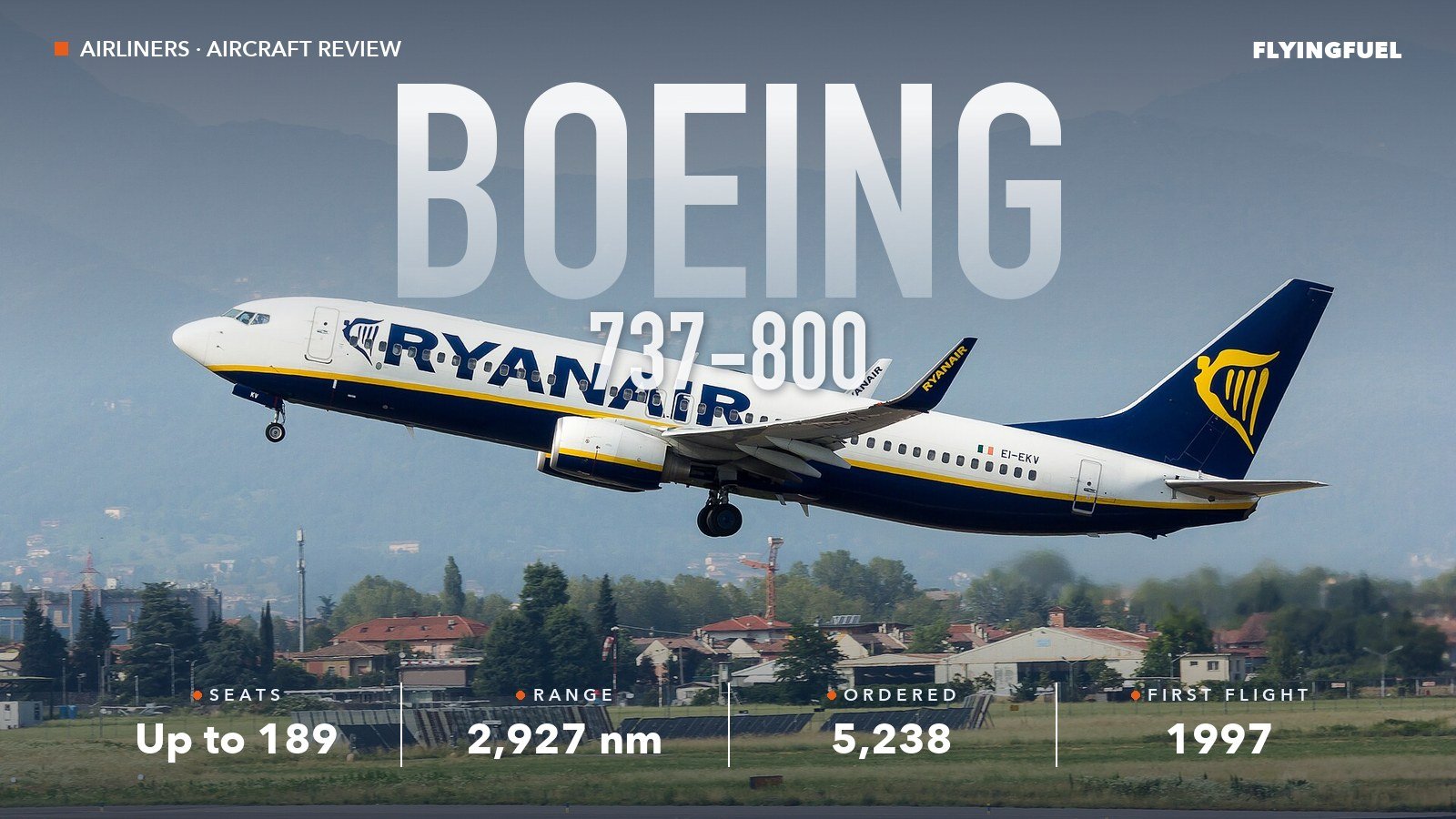
If you have flown on a low-cost airline in Europe, the US or India in the last 25 years, there is a good chance it was on a Boeing 737-800. With 5,238 ordered, it is the best-selling version of the 737 Next Generation family, and thousands still fly, including 26 in the Air India Express fleet.
Our verdict in one line: the 737-800 is a proven, simple and cheap-to-buy workhorse with up to 189 seats and about 2,900 nm of range; its weakness is that the newer 737 MAX 8 and A320neo burn less fuel and fly further, which is why production ended in 2020.
This review explains where the 737-800 came from, how to recognise it, the cabin and cockpit, its engines and range, its safety record, freighter and military versions, and how it compares with the 737 MAX 8 and A320neo. For a side-by-side look at its successor, see 737 MAX 8 vs 737-800.
Boeing 737-800 Quick Facts
| Item | Boeing 737-800 |
|---|---|
| Type | Single-aisle (narrowbody) twin-engine airliner |
| Seats | About 160 (two-class); up to 189 (exit limit) |
| Range | About 2,927 nm (5,420 km) |
| Length | 39.47 m (129 ft 6 in) |
| Wingspan | 35.79 m with winglets (34.32 m without) |
| Fuselage width | 3.76 m (12 ft 4 in) |
| Maximum take-off weight | 79,016 kg (174,200 lb) |
| Operating empty weight | 41,413 kg (91,300 lb) |
| Fuel capacity | 26,022 litres |
| Lower-deck cargo | 44.1 m3 (1,555 cu ft) |
| Engines | 2 x CFM International CFM56-7B (CFM56-7B26: 26,300 lbf) |
| Cruise | 452 kt at 39,000 ft (long-range cruise); maximum Mach 0.82 |
| First flight | 31 July 1997 |
| First delivery | April 1998, Hapag-Lloyd Flug |
| Last deliveries | 5 January 2020, China Eastern |
| ICAO type code | B738 |
Source: Wikipedia: Boeing 737 Next Generation (specifications for the 737-800 with CFM56-7B26 engines, from Boeing’s airport planning document).
Where the 737-800 Came From
In the early 1990s United Airlines, a long-time Boeing customer, bought the Airbus A320 with its fly-by-wire controls. Boeing answered with the 737 Next Generation (737NG): the 737-600, -700, -800 and -900, each with a new, larger wing, new engines and a glass cockpit. The 737-800, a stretch of the 737-700, was launched on 5 September 1994. The prototype rolled out on 30 June 1997, first flew on 31 July 1997, and the first aircraft went to the German charter airline Hapag-Lloyd Flug in April 1998.
It replaced the 737-400 and was aimed squarely at the A320. In the US it also replaced ageing Boeing 727-200 trijets and filled the gap left when Boeing, after merging with McDonnell Douglas, stopped building the MD-80 and MD-90. Wikipedia says it burns about 850 US gallons (3,220 litres) of fuel an hour, about 80% of an MD-80 on a comparable flight while carrying more passengers.
How to Recognise a 737-800
The 737NG wing is about 25% larger than the 737 Classic’s and holds 30% more fuel. Most 737-800s carry tall blended winglets, and from 2014 some airlines added Split Scimitar winglets from Aviation Partners, which look similar to the 737 MAX’s split tips; Wikipedia says they save up to 5.5% fuel. For the differences from Airbus jets, see how to tell a Boeing from an Airbus.
- Winglets: most have tall blended winglets; split-tip winglets on a 737-800 are the Split Scimitar retrofit, not the MAX design.
- Engines: CFM56-7B engines, smaller than the LEAP-1B on the 737 MAX.
- Length: the 737-800 and 737 MAX 8 are almost exactly the same length, 39.5 m, so length alone does not separate them.
- Exits: its emergency exit layout limits it to 189 seats; the longer 737-900 kept the same exits and the same limit.
Inside the Cabin
The economy cabin has six seats per row (3-3) in a fuselage 3.76 m wide. The original 737NG interior borrowed the curved panels and bigger bins of the Boeing 777. In 2010 Boeing added the Boeing Sky Interior as an option, taken from the 787: sculpted sidewalls, pivoting overhead bins (a first for a Boeing narrowbody) and LED mood lighting. Its later “Space Bins” hold 50% more, which Wikipedia says lets a 737-800 carry 174 carry-on bags.
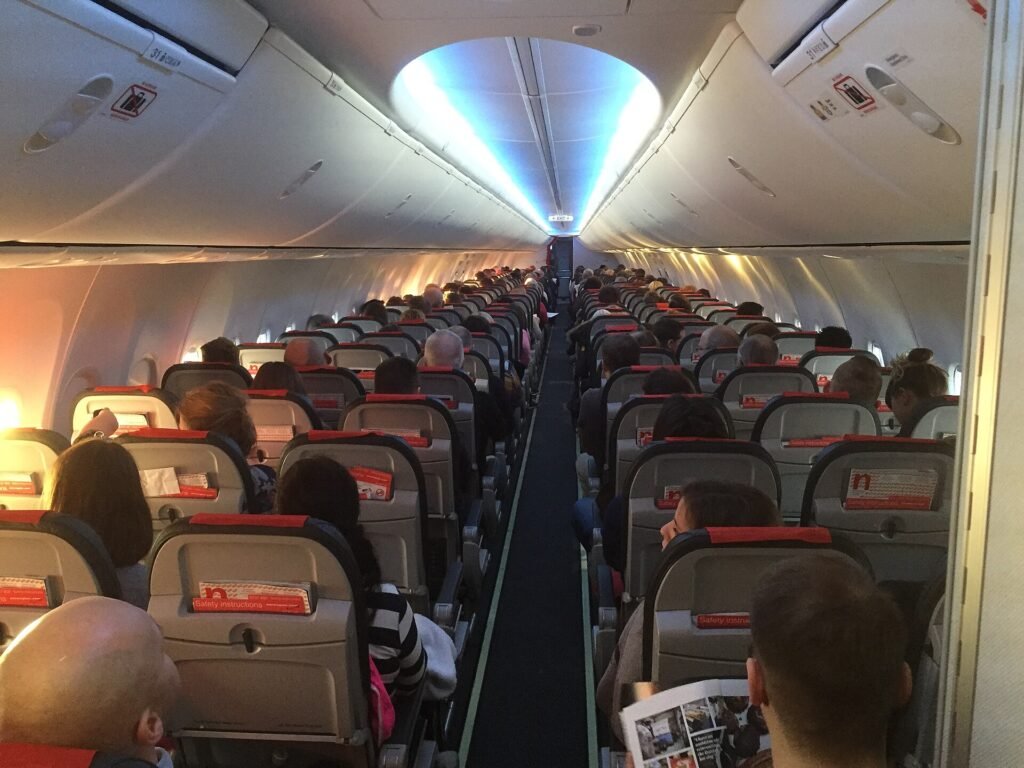
What you get depends on the airline. Air India Express uses 189 seats, the maximum. A typical two-class layout has about 160 seats.
Cockpit
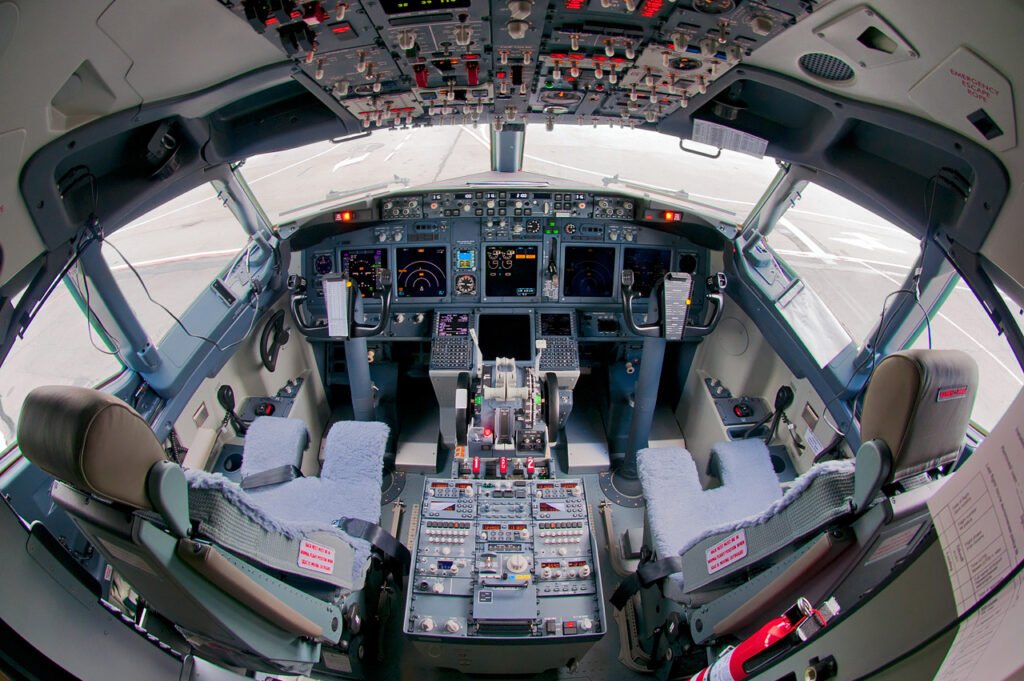
The 737NG brought a glass cockpit with modern avionics to the 737, while keeping the control yokes and, as Wikipedia puts it, commonality with previous 737 models. The 737NG also updated the Speed Trim System of the Classic with a stall identification function. The cockpit was developed further for the 737 MAX.
Engines
Every 737-800 uses two CFM International CFM56-7B turbofans. The CFM56-7B26 listed in the Wikipedia specification table gives 26,300 lbf of thrust. From 2011 Boeing offered the improved CFM56-7BE as part of a performance improvement package, which with aerodynamic changes was claimed to cut fuel burn by about 2% on longer flights. The 737 MAX replaced the CFM56 with the larger LEAP-1B; see our turbofan explainer for how these engines work.
Range and Performance

With full passengers, the 737-800 can fly about 2,927 nm (5,420 km). It cruises at about 452 knots at 39,000 ft on a long-range setting, with a maximum speed of Mach 0.82 and a ceiling of 41,000 ft. Its maximum take-off weight is 79,016 kg; see what MTOW means. Wikipedia gives a take-off distance of 2,316 m and a landing distance of 1,600 m at maximum weights.
| Boeing 737-800 | Boeing 737 MAX 8 | Airbus A320neo | |
|---|---|---|---|
| Seats (two-class) | About 160 | 160-180 | 150-180 |
| Maximum seats | 189 | 210 | 194 |
| Range | 2,927 nm | 3,500 nm | 3,400 nm |
| Length | 39.47 m | 39.5 m | 37.57 m |
| Max take-off weight | 79,016 kg | 82,640 kg | 79.0 t |
| Engines | CFM56-7B | CFM LEAP-1B | CFM LEAP-1A or PW1100G |
| In production | No (ended 2019-2020) | Yes | Yes |
Sources: Wikipedia (737-800); our 737 MAX 8 and A320neo reviews (Boeing and Airbus data).
Safety Record
Boeing’s analysis of commercial jet accidents from 1959 to 2017 gave the 737 Next Generation a hull-loss rate of 0.17 per million departures, against 0.71 for the 737 Classic and 1.75 for the original 737. In 2019 inspections found fatigue cracks in the “pickle fork”, a part joining the wing to the fuselage, on some high-cycle aircraft, and the FAA ordered checks across the fleet. In November 2026 the FAA also ordered repeated flight control tests on about 300 US 737NGs over an autothrottle monitor.
The deadliest 737-800 accident is Jeju Air Flight 2216, which made a belly landing at Muan in South Korea on 29 December 2024 and hit an embankment, killing 179 of the 181 on board. In India, Air India Express lost two 737-800s on table-top runways: Flight 812 at Mangalore in 2010 and Flight 1344 at Kozhikode in 2020, both covered in our Kerala airports guide and go-around explainer.
The 737-800 in India
Air India Express had 26 Boeing 737-800s in October 2026, each with 189 seats, alongside 53 newer 737 MAX 8s, according to the Wikipedia fleet table. The airline is replacing older jets with the 737 MAX; see the Air India Express fleet guide and Indian airline aircraft orders. India is also among the countries that ordered the P-8, a maritime patrol aircraft based on the 737-800.
Freighters, Business Jets and the P-8
- 737-800BCF: Boeing’s passenger-to-freighter conversion, launched in February 2016; the first went to West Atlantic in April 2018.
- 737-800SF: a rival conversion by Aeronautical Engineers Inc, certified by the FAA in early 2019; Amazon Air is among the users.
- BBJ2: the Boeing Business Jet version, with 25% more cabin space than the 737-700-based BBJ; 23 were delivered.
- P-8 Poseidon: a maritime patrol aircraft based on the 737-800 with the stronger 737-900 wing and raked wingtips; still in production for the US Navy and others, including India.
737-800 vs Its Rivals
737-800 vs 737 MAX 8
The MAX 8 is the direct successor: same length and cabin, but LEAP-1B engines, split-tip winglets and a heavier maximum weight give it about 570 nm more range. Airlines such as Air India Express and Ryanair are replacing 737-800s with MAX 8s. Our 737 MAX 8 review covers its MCAS history and grounding.
737-800 vs Airbus A320
The A320 has a wider fuselage (3.95 m against 3.76 m) and fly-by-wire controls with a sidestick. The 737-800 is longer and can carry more passengers (189 against 180 on Air India Express’s A320-200s). Its modern replacement is compared in our A320neo review.
Pros and Cons
Pros
- Up to 189 seats in a simple, proven airframe
- Huge fleet: 5,238 ordered, so spares, pilots and engineers are easy to find
- Cheap to buy or lease second-hand (about $9.5 million for a 17-year-old aircraft in 2025)
- Much in common with earlier 737s, so crews and engineers know it well
- Strong safety record across the 737NG family (0.17 hull losses per million departures)
Cons
- Out of production since 2020; fleets are ageing
- Burns more fuel and flies about 570 nm less than the 737 MAX 8
- Narrower cabin than the A320 family
- Older cabins without the Sky Interior feel dated
- High-cycle aircraft needed pickle-fork crack inspections in 2019
Our Verdict
The 737-800 is the aircraft that built the modern low-cost airline. It is not the most comfortable or the most efficient narrowbody any more, but it is reliable, well understood and cheap to own, which is why thousands are still flying more than five years after the last delivery, and why many will end their lives as freighters. For passengers, the experience depends on the airline: a 189-seat 737-800 is tight, while a Sky Interior 737-800 with about 160 seats is pleasant on short and medium flights.
Frequently Asked Questions
How many seats does a Boeing 737-800 have?
About 160 to 162 in a typical two-class layout and up to 189 in one class, which is the limit set by its emergency exits, according to Wikipedia. Air India Express uses the 189-seat layout.
What is the range of the 737-800?
About 2,927 nautical miles (5,420 km) with CFM56-7B26 engines, according to the Wikipedia specification table. That is about 570 nm less than the 737 MAX 8.
Is the Boeing 737-800 still being made?
No. Boeing stopped assembling passenger 737 Next Generation aircraft in 2019; the last one assembled was a 737-800 for KLM, and the final deliveries went to China Eastern on 5 January 2020. The military P-8 Poseidon, based on the 737-800, is still built.
What is the difference between the 737-800 and the 737 MAX 8?
They are almost the same length (39.5 m), but the MAX 8 has newer CFM LEAP-1B engines, split-tip winglets and a higher maximum take-off weight (82,640 kg against 79,016 kg), giving it about 3,500 nm of range against 2,927 nm. See our 737 MAX 8 review for the full comparison.
How many 737-800s were built?
Wikipedia lists 5,238 ordered: 4,991 commercial, 224 military and 23 corporate. It is the best-selling version of the 737 Next Generation family, which totalled 7,159 orders.
Which Indian airlines fly the 737-800?
Air India Express had 26 Boeing 737-800s in October 2026, each with 189 seats, alongside 53 737 MAX 8s, according to the Wikipedia fleet table.
What engines does the 737-800 use?
Two CFM International CFM56-7B turbofans; the version in the Wikipedia specification table, the CFM56-7B26, gives 26,300 lbf of thrust. An improved CFM56-7BE arrived in 2011 as part of a performance package.
Is the 737-800 safe?
Boeing’s analysis of accidents from 1959 to 2017 gave the 737 Next Generation a hull-loss rate of 0.17 per million departures, against 0.71 for the 737 Classic before it. The deadliest 737-800 accident was Jeju Air Flight 2216 in South Korea in December 2024, which killed 179 of the 181 people on board.
How much does a 737-800 cost?
A new 737-800 was valued at $48.3 million in early 2017. By 2025, a 17-year-old 737-800 with winglets was expected to be worth about $9.5 million and lease for about $140,000 a month, according to figures quoted on Wikipedia.
Featured image: FlyingFuel graphic using a photo of Ryanair Boeing 737-800 EI-EKV taking off from Bergamo by Raimond Spekking, CC BY-SA 4.0, via Wikimedia Commons.
 Aircraft ComparisonsBoeing 737 MAX 8 vs 737-800: What Changed and Which Is Better? (2026)
 NewsMalaysia Airlines to Buy 10 Boeing 787-10 Dreamliners to Replace Its Airbus A350s From 2032
 AirportsAirports in Odisha: Bhubaneswar, Jharsuguda, Jeypore and More Ranked (2026 Data)
 NewsNew Visakhapatnam Airport at Bhogapuram to Charge Rs 890 Per Departing Domestic Passenger From 1 December
 AirportsAirports in Karnataka: Bengaluru, Mangaluru, Hubballi, Belagavi and More Ranked (2026 Data)
 Aircraft ComparisonsAirbus A350-900 vs Boeing 777-300ER: Which Long-Haul Jet Is Better? (2026)