
While Heathrow’s third runway is still being argued over, London’s second airport has quietly won its own battle. Gatwick’s second runway has been approved by the government and has now survived two rounds of legal challenges. Here is what is being built, what it means for flights and passengers, and what happens next.
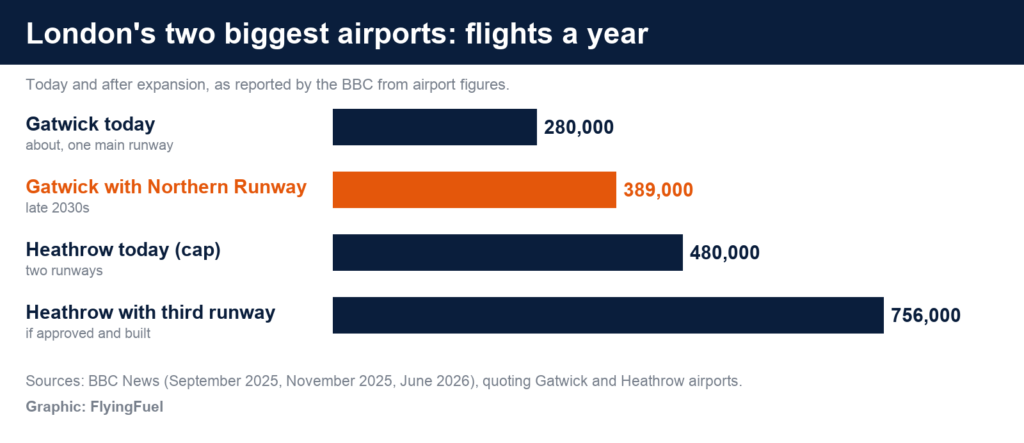
Quick answer: Gatwick plans to move its emergency Northern Runway 12 metres north so it can be used every day, in a £2.2bn privately financed project. The BBC reports it would allow about 100,000 more flights a year, from about 280,000 today to around 389,000 by the late 2030s. Transport Secretary Heidi Alexander approved it in September 2025, the High Court dismissed a challenge in June 2026, and the Court of Appeal refused permission to appeal in August 2026.
For the bigger project at London’s other hub, read our guide to the Heathrow third runway.
Gatwick Second Runway at a Glance
| Item | Details (October 2026) |
|---|---|
| Airport | London Gatwick, West Sussex; the UK’s second-busiest airport |
| Today | Europe’s busiest single-runway airport, more than 40 million passengers a year |
| The plan | Move the emergency Northern Runway 12 m (39 ft) north to use it for regular flights |
| Cost | About £2.2bn, privately financed, including terminal extensions |
| Flights | About 280,000 a year now; around 389,000 by the late 2030s |
| Passengers | Could rise to about 80 million a year, according to Gatwick |
| Approved | September 2025, by Transport Secretary Heidi Alexander |
| Legal status | High Court challenge dismissed (June 2026); appeal permission refused (August 2026) |
| Owner | Gatwick Airport Limited |
Sources: BBC News, 21 September 2025, 3 November 2025 and 4 August 2026.
Why Is It Called a “Second Runway”?
Gatwick is Europe’s busiest single-runway airport. It does have a second strip, the Northern Runway, but today that is only an emergency runway, not used for regular flights alongside the main one.
Gatwick’s plan is to move the Northern Runway 12 metres (39 ft) north, which the BBC says will let it be used for about 100,000 more flights a year. So instead of building a brand-new runway on fresh land, as Heathrow plans to do, Gatwick is upgrading one it already has. That is the main reason its cost, about £2.2bn, is so much lower than Heathrow’s.
Timeline
| Date | What happened |
|---|---|
| July 2023 | Gatwick Airport Limited applies for development consent |
| 21 September 2025 | Transport Secretary Heidi Alexander approves the plan |
| October to November 2025 | Campaign group Cagne files a judicial review claim at the High Court |
| 9 December 2025 | Judge sets a four-day hearing from 20 January 2026 |
| 20 to 23 January 2026 | High Court hearing |
| June 2026 | Mr Justice Mould dismisses the challenges |
| 4 August 2026 | Court of Appeal refuses permission to appeal; grounds called “unarguable” |
Sources: BBC News reports linked in this article.
The Legal Challenge, Explained
Communities Against Gatwick Noise Emissions (Cagne) and Peter Barclay, chair of the Gatwick Area Conservation Campaign, took the Department for Transport to court. According to the BBC, Cagne argued there had been an unlawful failure to weigh noise harms, an unlawful requirement concerning wastewater treatment, and a failure to properly evaluate the significance of inbound flight emissions. At the January 2026 hearing, their lawyers said the government had not assessed emissions making up “roughly two-thirds of aviation’s historical climate impacts”, having considered only carbon dioxide; Gatwick’s lawyer called that claim “simply wrong”.
In June 2026 Mr Justice Mould dismissed the challenges, finding it was “neither illogical nor contradictory” for the Transport Secretary not to refuse the scheme on carbon grounds, and rejecting arguments about need given Heathrow’s proximity. On 4 August 2026, two Court of Appeal judges refused permission to appeal, calling every ground “unarguable”, the BBC reported.
The Climate Debate
When the runway was approved, the BBC noted that the UK’s Climate Change Committee had warned that emissions from flying pose a risk to the UK’s emissions targets, and that aviation emissions had risen 9% the year before, driven by international leisure flights, which are Gatwick’s main type of flight. The Green Party called the project a “disaster”, while the Chancellor said it would create “thousands of jobs and billions in investment”.
Aviation’s non-CO2 effects, central to the court case, include contrails. Our guide to why planes leave contrails explains the science.
Can the UK Expand Airports and Meet Climate Targets?
Gatwick is one of several UK airport expansions. The BBC calculated in 2025 that Gatwick’s runway could add 100,000 flights a year, a Heathrow third runway another 276,000, and an approved expansion of Luton tens of thousands more. To square that with the UK’s legally binding target of net zero by 2050, aircraft emissions would have to fall sharply.
- Newer aircraft: the BBC noted that a current-generation Airbus A320neo is 15-20% more fuel efficient than its predecessor, but said this alone will not go nearly far enough.
- Cleaner fuels and technology: the government’s “Jet Zero” strategy assumes big improvements, which campaigners challenged in court.
- Managing demand: the Climate Change Committee did not rule out airport expansion, but cautioned that the government should look at measures to reduce demand for flights.
For more on the aircraft that make flights more efficient, see our Airbus A320neo review.
What It Means for Travellers
- More flights and destinations: about 100,000 extra flights a year by the late 2030s.
- Bigger terminals: the project includes extending the terminals.
- More passengers: Gatwick says up to about 80 million a year, roughly double today.
- Cargo: Gatwick has also said cargo could double with expansion.
- If delays happen: your rights are explained in our guide to UK flight delay compensation.
Gatwick vs Heathrow Expansion
| Gatwick second runway | Heathrow third runway | |
|---|---|---|
| What | Move existing Northern Runway 12 m | New 3,500 m runway, M25 in a tunnel |
| Cost | About £2.2bn | About £33bn (runway), £49bn wider expansion |
| Extra flights | About 100,000 a year | From 480,000 cap to 756,000 |
| Status (Oct 2026) | Approved; legal challenges dismissed | Planning framework consultation; Parliament vote and planning still to come |
| Opening | Government source in 2025: possibly before 2029 | Heathrow: within a decade of a 2029 planning decision |
What Happens Next?
With the Court of Appeal refusing permission in August 2026, the legal route used by campaigners has, for now, been closed, and Gatwick has said it is keen to begin the development. Gatwick’s lawyer told the court that it first applied for consent in July 2023 and that unmeritorious litigation should not delay national infrastructure. When the plan was approved, a government source told the BBC that planes could be using the new runway before the next general election, which would mean by 2029. Watch for Gatwick’s construction timetable.
Key Takeaways
- Gatwick will move its Northern Runway 12 m north to use it for daily flights.
- The £2.2bn, privately financed scheme adds about 100,000 flights a year by the late 2030s.
- Approved in September 2025; challenges dismissed by the High Court (June 2026) and refused by the Court of Appeal (August 2026).
- Gatwick says passengers could rise to about 80 million a year.
- It is far cheaper and simpler than Heathrow’s proposed third runway.
Frequently Asked Questions
Has Gatwick’s second runway been approved?
Yes. Transport Secretary Heidi Alexander approved the plan in September 2025. Campaigners’ High Court challenge was dismissed in June 2026, and in August 2026 the Court of Appeal refused permission to appeal.
What exactly is Gatwick’s second runway?
Gatwick will move its existing emergency runway, the Northern Runway, 12 metres (39 ft) north so it can be used for regular flights alongside the main runway.
How much does the Gatwick second runway cost?
About £2.2 billion, privately financed, including other works such as extending the terminals.
How many more flights will Gatwick handle?
About 100,000 more flights a year. Gatwick handles about 280,000 flights a year now and says this could rise to around 389,000 by the late 2030s.
How many passengers could Gatwick handle?
Gatwick says passenger numbers could rise to about 80 million a year. It currently handles more than 40 million passengers a year as Europe’s busiest single-runway airport.
When will the Gatwick second runway open?
No firm date has been announced in the sources we used. When it was approved in September 2025, a government source said planes could be taking off from it before the next general election, which would mean by 2029.
Why did campaigners challenge the Gatwick runway?
Groups including Communities Against Gatwick Noise Emissions (Cagne) argued the government had not properly assessed climate impacts, including non-CO2 emissions, as well as noise and wastewater. The courts rejected those arguments.
Is Gatwick bigger than Heathrow?
No. Gatwick is the UK’s second-busiest airport. Heathrow handles about twice as many passengers and has a 480,000 flight cap.
Does the Gatwick runway affect Heathrow’s third runway?
They are separate projects. Gatwick’s is approved and cleared by the courts; Heathrow’s third runway is still going through the planning process.
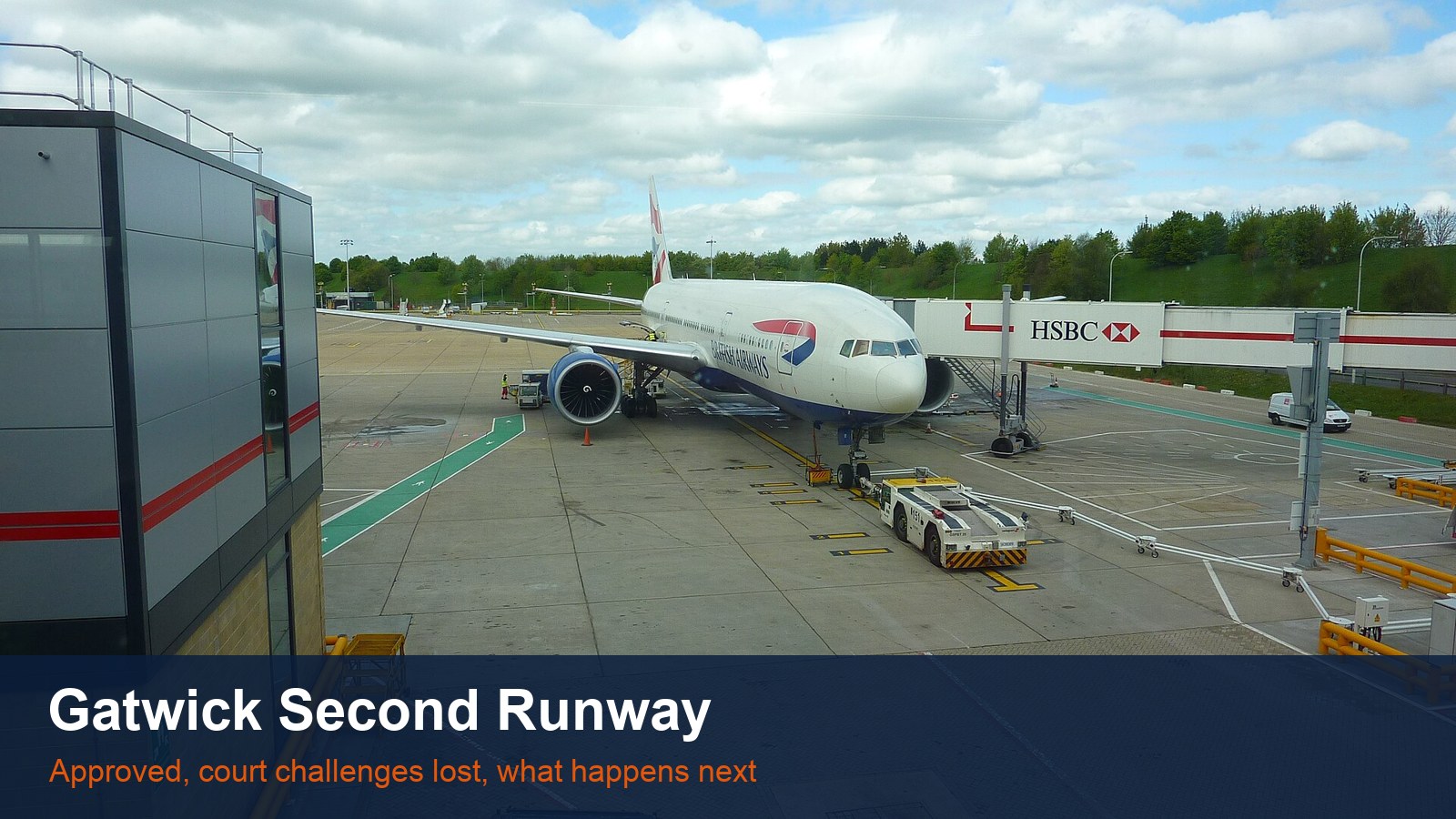
Featured image: FlyingFuel graphic using a photo of a British Airways Boeing 777-200ER at Gatwick by Richard Cooke, CC BY-SA 2.0, via Wikimedia Commons.
 GulfstreamGulfstream Business Jets: Every Model From the G300 to the G800 Explained (2026)
 NewsBombardier to Hire 800 in the US and Spend $270 Million on First Phase of Expansion
 NewsAll Passengers Flying to the US Must Sign an Ebola Travel Attestation From 3 November
 BombardierBombardier Business Jets: Every Global and Challenger Model Explained (2026)
 NewsSafran LEAP Engine Deliveries Rise 26% to 1,565 in First Nine Months of 2026
 NewsEmbraer Order Backlog Hits Record $35.7 Billion as E2 Jet Orders Grow