
You are seconds from landing. The runway is right there. Suddenly the engines roar, the nose lifts and the aircraft climbs back into the sky. Many passengers think something has gone badly wrong. In fact, the pilots have just done one of the most important safety manoeuvres in flying: a go-around.
Quick answer: SKYbrary explains that a go-around happens when the crew decide not to continue an approach or a landing, and follow procedures to fly another approach or divert to another airport. Air traffic control can also order one. It can happen at any point from the final approach until wheels are on the runway, before brakes, spoilers or thrust reversers are used.
Below we explain why go-arounds happen, the stabilised approach rule behind most of them, what you feel in the cabin, and why investigators say more go-arounds would have prevented two of India’s worst runway accidents. For related topics, see our guides to tail strikes and flight diversions.
What Is a Go-Around?
An aircraft lands at the end of a carefully planned approach: it lines up with the runway many kilometres out, slows down, extends flaps and landing gear, and descends on a steady path. A go-around is the decision to stop that process and climb away instead of landing.
SKYbrary describes a go-around as two parts: the decision to go around, weighed against continuing the approach, and the execution of that decision, which must be flown with minimum risk. Pilots add thrust, raise the nose, retract some flaps and the landing gear, and climb on a set path.
Go-around vs missed approach vs rejected landing
| Term | What it means |
|---|---|
| Go-around | The general action of abandoning an approach or landing and climbing away |
| Missed approach | The published procedure for an instrument approach: where the missed approach begins, the route and the altitude to climb to |
| Rejected or balked landing | A go-around started very low, close to or even just after touchdown |
| Aborted landing | The everyday term passengers and media use for any of the above |
According to SKYbrary, every precision and non-precision instrument approach has a missed approach procedure that keeps the aircraft clear of terrain, obstacles and other traffic. Pilots normally follow it unless air traffic control gives other instructions or safety requires something different.
Why Do Pilots Go Around?
SKYbrary lists the main reasons for discontinuing an approach or landing:
- No runway in sight: the required visual references are not seen by the decision height (or minimum descent height), or are seen and then lost, for example in fog or heavy rain.
- Unstable approach: the aircraft is too high, too fast, not lined up or not configured for landing.
- Wrong touchdown point: the aircraft cannot touch down in the runway touchdown zone, with a risk of damage or running off the runway.
- Runway obstructed: another aircraft, vehicle or animal is on the runway.
- No landing clearance: clearance was not received, or was given and then cancelled.
- Training: a planned go-around with air traffic control approval.
Other common triggers include sudden wind changes, wind shear and gusts close to the ground. Air traffic control may also order a go-around when the aircraft ahead has not left the runway in time.
The Stabilised Approach Rule
Most go-arounds come back to one idea: the stabilised approach. SKYbrary quotes the Flight Safety Foundation’s ALAR Briefing Note 7-1, which says all flights must be stabilised by 1,000 ft above the airport in instrument conditions and 500 ft in visual conditions. An approach is stabilised when all of the following are true:
- the aircraft is on the correct flight path;
- only small changes in heading or pitch are needed to stay on it;
- the airspeed is not more than VREF + 20 knots and not less than VREF (the reference landing speed);
- the aircraft is in the correct landing configuration (gear and flaps);
- the sink rate is no more than 1,000 ft per minute (a special briefing is needed if more is required);
- the power setting suits the configuration and is not below the minimum for the approach;
- all briefings and checklists are done.
Extra rules apply to some approaches: an ILS approach must stay within one dot of the glideslope and localiser, and on a circling approach the wings should be level on final by 300 ft above the airport. The key line is simple: an approach that becomes unstable below these gates requires an immediate go-around.
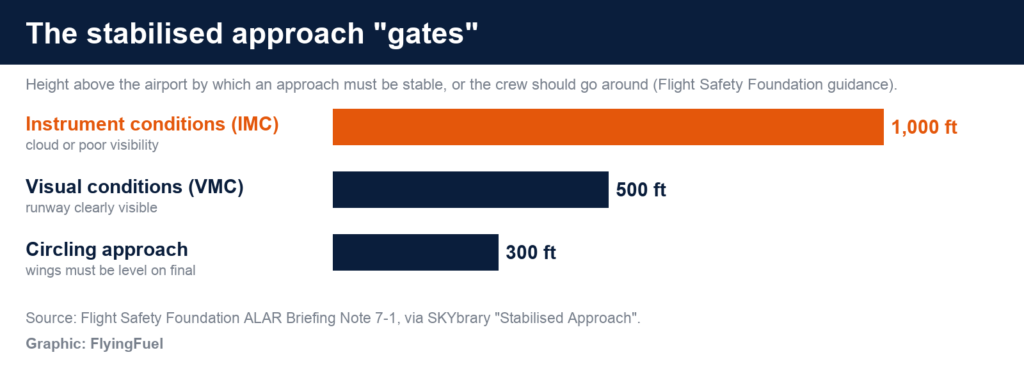
Some airlines use two gates: a “should” gate, often at 1,000 ft, where the crew must correct any problem, and a “must” gate, often at 500 ft, where an approach that is still not stable must end in a go-around.
The Big Problem: Pilots Who Do Not Go Around
Here is the surprising part. SKYbrary notes that data from millions of flights show more than 9 of every 10 unstable approaches continue to a landing, even though procedures call for a go-around. Most of these landings end safely, which can make crews think it is fine to continue.
Studies have looked at why pilots are reluctant to go around. SKYbrary lists several reasons:
- Normalisation of deviance: when small breaks in the rules become routine because nothing bad happened before.
- Continuation bias: the strong human urge to finish a plan once started, especially near the end of a flight.
- Perceived pressure from the airline or from peers, such as keeping to the schedule or saving fuel.
An unstable approach that continues can lead to an aircraft arriving at the runway too high, too fast, off the centreline or badly configured. That can mean a hard landing, damage, a tail strike or a runway excursion, where the aircraft runs off the end or side of the runway.
Lessons From India: Mangalore and Kozhikode
India has two tragic examples of what can happen when an unstable approach is continued to land on a tabletop runway, a runway on a plateau with steep drops at the ends.
Air India Express Flight 812, Mangalore (2010)
On 22 May 2010, an Air India Express Boeing 737-800 from Dubai overran the runway at Mangalore and fell down a hillside. According to Wikipedia, 158 of the 166 people on board died and 8 survived. The inquiry found that the captain did not discontinue an unstabilised approach despite three calls to go around from the first officer and warnings from the ground proximity warning system. Contributing factors included the captain’s long sleep during the flight, which may have caused sleep inertia, and a descent clearance closer to the airport than normal.
Air India Express Flight 1344, Kozhikode (2020)
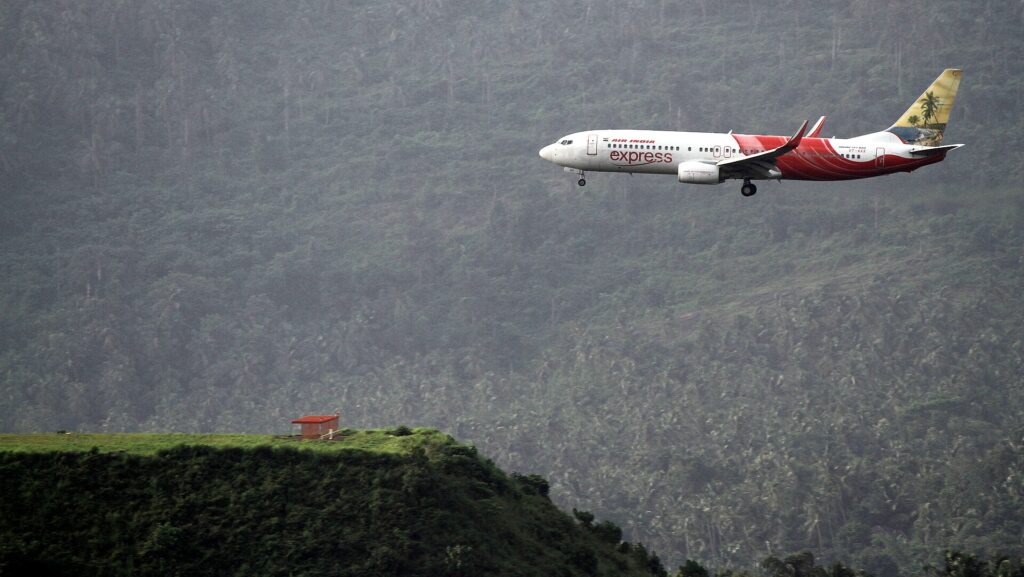
On 7 August 2020, an Air India Express Boeing 737-800 on a Vande Bharat repatriation flight from Dubai landed at Kozhikode (Calicut) in monsoon rain. According to Wikipedia, after at least one earlier aborted approach, the aircraft touched down about 1,000 m beyond the runway threshold on a wet runway with a tailwind, ran off the end and fell into a gorge. Of 190 people on board, 21 died, including both pilots, and 169 survived.
India’s Aircraft Accident Investigation Bureau (AAIB) said in its final report in September 2021 that the probable cause was the pilot flying’s failure to follow standard procedures, which led to an unstabilised approach and a landing beyond the touchdown zone. It also said the first officer should have taken control and gone around when the captain did not.
Both cases point to the same lesson: when in doubt, go around. A go-around costs a few minutes and some fuel; continuing an unstable approach can cost lives.
What Makes a Go-Around Tricky for Pilots
A go-around is safe when flown well, but it is not easy. It is often unexpected and comes at a busy, low-altitude moment. SKYbrary highlights areas pilots must study, including flying a manual go-around, starting one from low speed or low thrust, switching to instrument flying, crew coordination and monitoring, and watching the first level-off altitude, pitch and thrust. They must also keep track of fuel and their options.
A study by France’s accident investigation agency, the BEA, cited by SKYbrary, found common factors in go-around accidents: night or instrument conditions, cockpit distraction, breakdowns in crew resource management, and poor monitoring by the pilot not flying. That is why airlines train go-arounds regularly in the simulator, including with an engine failure.
What Passengers Feel During a Go-Around
- Sudden engine noise: the pilots set go-around thrust, so the engines become much louder.
- Climb: the nose rises and you feel pushed into your seat as the aircraft climbs.
- Noises from below: the landing gear retracts and flaps move, with thumps and whirring.
- A turn and a wait: the aircraft follows the missed approach path, then is sequenced for another approach.
- An announcement: once the workload drops, the pilots usually explain what happened.
If it happens on your flight, stay seated with your seatbelt fastened. It is a sign that the crew is putting safety first. After a go-around, the crew may try again or divert if the problem continues; our flight diversion guide explains what happens then. For other unsettling but usually safe moments in the air, see our turbulence guide.
Key Takeaways
- A go-around is when the crew abandon an approach or landing and climb away to try again or divert.
- Common reasons are an unstable approach, no runway in sight, an obstructed runway, no clearance, wind shear or ATC instructions.
- Flight Safety Foundation guidance says approaches must be stable by 1,000 ft (instrument conditions) or 500 ft (visual), or the crew should go around.
- More than 9 in 10 unstable approaches still continue to land, and that is a known safety problem.
- In the Mangalore (2010) and Kozhikode (2020) accidents, investigators said a go-around was needed and not flown.
- For passengers, a go-around is loud and surprising but safe and normal.
Frequently Asked Questions
What is a go-around in aviation?
A go-around is when the pilots decide not to continue an approach or landing, add power and climb away. They then fly another approach or divert to another airport. It can happen any time from the final approach until just after touchdown, before brakes, spoilers or reversers are used.
Is a go-around dangerous?
No. A go-around is a normal, trained safety procedure. It is chosen precisely because continuing to land would be riskier. Pilots practise it regularly in the simulator.
Why would a plane abort a landing?
Common reasons are an unstable approach (too high, too fast or badly lined up), not seeing the runway at the decision height, a runway that is not clear, no landing clearance, strong winds or wind shear, or an instruction from air traffic control.
What is the difference between a go-around and a missed approach?
The terms are often used together. A missed approach is the published procedure to fly when an instrument approach cannot be completed; a go-around is the general action of abandoning the approach or landing and climbing away.
What is a stabilised approach?
An approach where the aircraft is on the right path, at the right speed and configuration, with a normal sink rate and power setting. Flight Safety Foundation guidance says flights must be stable by 1,000 ft above the airport in cloud or poor visibility and 500 ft in good visibility; otherwise the crew should go around.
What does a go-around feel like for passengers?
The engines suddenly get louder, the nose rises and the aircraft climbs. You may hear the landing gear and flaps move. It can feel dramatic, but it is a controlled manoeuvre, and the pilots usually explain it soon after.
How many times can a plane go around?
There is no fixed number. After a go-around, the crew decide whether to try again or divert, based on the reason, the weather and the fuel remaining. Flights carry extra fuel for this.
Who decides on a go-around?
Either pilot can call for it, and air traffic control can instruct it. Airline procedures usually require a go-around whenever the stabilised approach criteria are not met.
Did go-arounds play a part in Indian air accidents?
Yes. Investigators found that in Mangalore (2010) the captain did not abandon an unstabilised approach despite three go-around calls, and in Kozhikode (2020) the approach was unstabilised and no go-around was flown. Both aircraft overran tabletop runways.
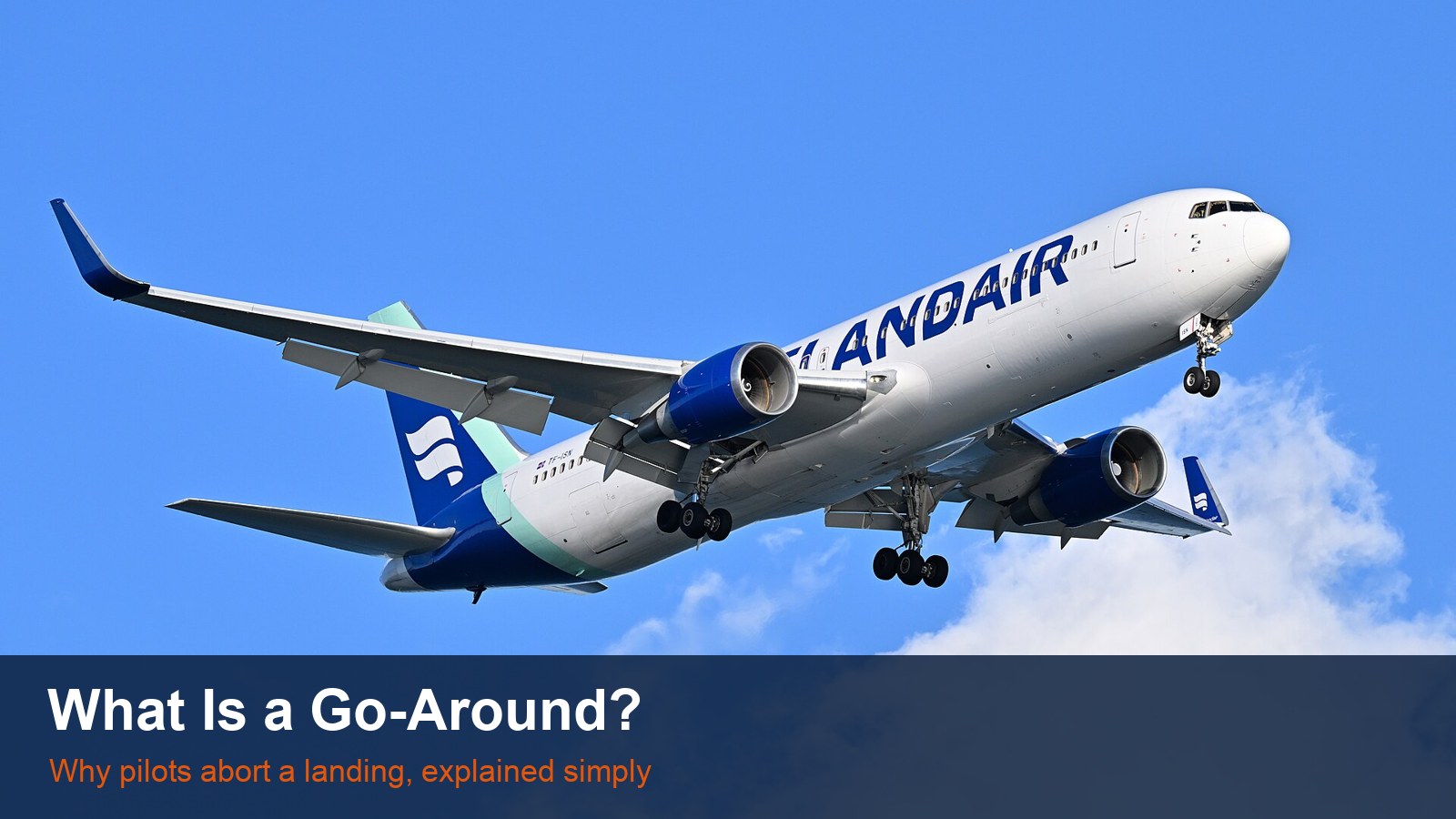
Featured image: FlyingFuel graphic using a photo of an Icelandair Boeing 767-300ER on final approach to Boston by 4300streetcar, CC BY 4.0, via Wikimedia Commons.
 GulfstreamGulfstream Business Jets: Every Model From the G300 to the G800 Explained (2026)
 NewsBombardier to Hire 800 in the US and Spend $270 Million on First Phase of Expansion
 NewsAll Passengers Flying to the US Must Sign an Ebola Travel Attestation From 3 November
 BombardierBombardier Business Jets: Every Global and Challenger Model Explained (2026)
 NewsSafran LEAP Engine Deliveries Rise 26% to 1,565 in First Nine Months of 2026
 NewsEmbraer Order Backlog Hits Record $35.7 Billion as E2 Jet Orders Grow