
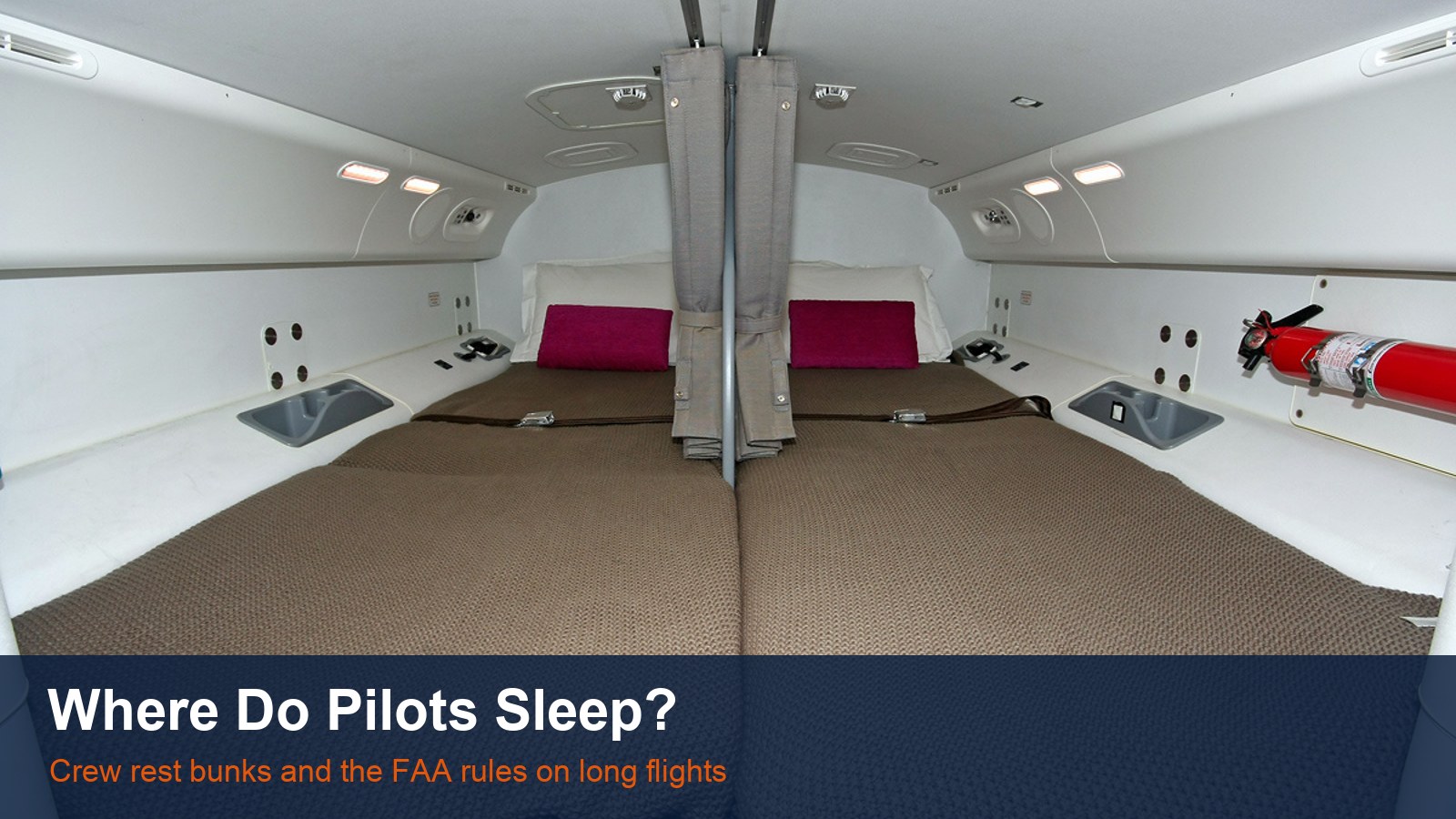
On a 15-hour flight, the pilots who take off are not the only ones flying. Somewhere above or around the cabin, hidden behind a door that looks like a closet, other pilots are asleep in narrow bunks, waiting for their turn. So where exactly do pilots sleep on long-haul flights, and what are the rules?
Quick answer: on long flights, airlines carry three or four pilots instead of two. They take turns resting in a crew rest compartment, a small private area with flat bunks that passengers cannot enter. In the US, the FAA Part 117 rules define three classes of rest facility and link the type of rest area to how long the pilots can be on duty, up to 19 hours with four pilots and proper bunks.
Below we explain what the rest areas look like, how the FAA classes work, how long pilots can fly, the rules for rest before a flight, and how flight attendants rest too. If you like long flights, see our list of the longest flights in the world.
What Is a Crew Rest Compartment?
Wikipedia describes a crew rest compartment as a section of an airliner set aside for breaks and sleeping by crew members during off-duty periods. US regulations require crew rest areas so that airlines can fly long-haul flights using several crew shifts.
- Hidden from passengers: regulations restrict passengers from entering. Entrances may be locked, and some need a ladder.
- Separate areas: there are usually separate compartments for the pilots and for the cabin crew.
- Not for take-off and landing: many crew rest areas cannot be used during taxi, take-off or landing unless they have a standard seat.
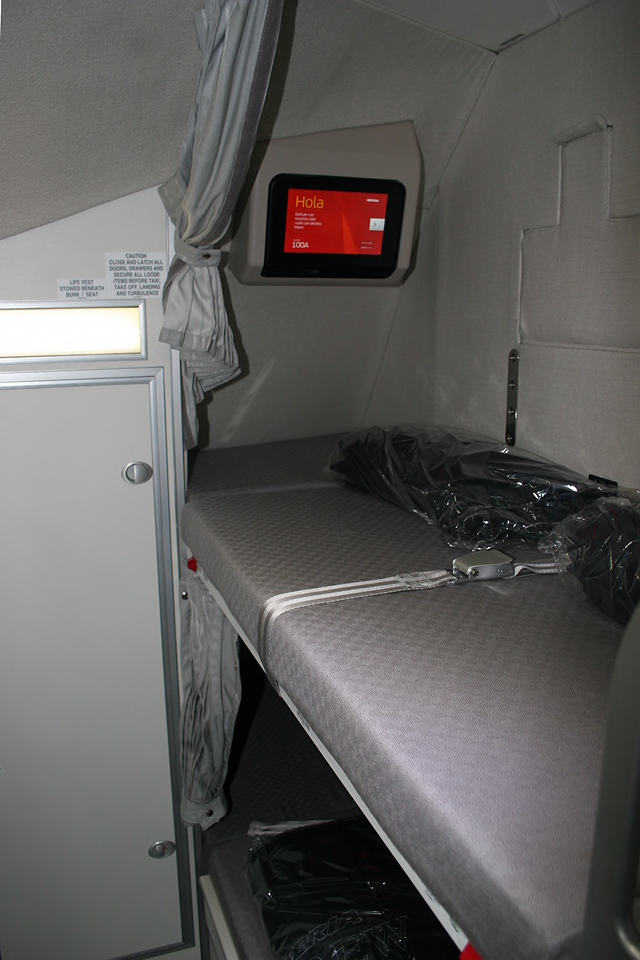
- Basic but private: a flat bunk, a pillow and blanket, a curtain or door, reading light and often a small screen or phone to call the cockpit.
The FAA’s Three Classes of Rest Facility
The FAA rules in 14 CFR Part 117 define a rest facility as a bunk or seat installed in an aircraft that gives a pilot a sleep opportunity. There are three classes:
| Class | What it is (FAA definition, simplified) | Example |
|---|---|---|
| Class 1 | A bunk or other surface for a flat sleeping position, separate from both the cockpit and the passenger cabin, temperature-controlled, with light control and isolation from noise and disturbance | A dedicated crew rest compartment with bunks |
| Class 2 | A seat in the cabin that lies flat or near flat, separated from passengers by at least a curtain for darkness and some sound reduction, and reasonably free from disturbance | A blocked-off business class flat seat |
| Class 3 | A seat in the cabin or cockpit that reclines at least 40 degrees and has leg and foot support | A reclining premium seat or cockpit jump seat |
The better the rest facility, the longer the pilots are allowed to be on duty, because they can sleep more deeply.
How Many Pilots Fly a Long-Haul Flight?
Most flights have two pilots: a captain and a first officer. When a flight is too long for two pilots to stay within the duty limits, airlines add one or two more qualified pilots. This is called an augmented crew.
- Two pilots: normal short and medium flights.
- Three pilots: longer flights, where each pilot can take a break in turn.
- Four pilots: the longest, ultra-long-haul flights, usually flown in two teams that take turns.
The FAA rules for augmented crews add some important conditions:
- the pilot who will fly the landing must get two consecutive hours of in-flight rest in the second half of the duty period;
- the pilot monitoring during landing must get 90 consecutive minutes of in-flight rest;
- an augmented crew can fly no more than three flight segments in that duty period;
- at least one qualified pilot must be at the controls at all times.
How Long Can Pilots Be on Duty?
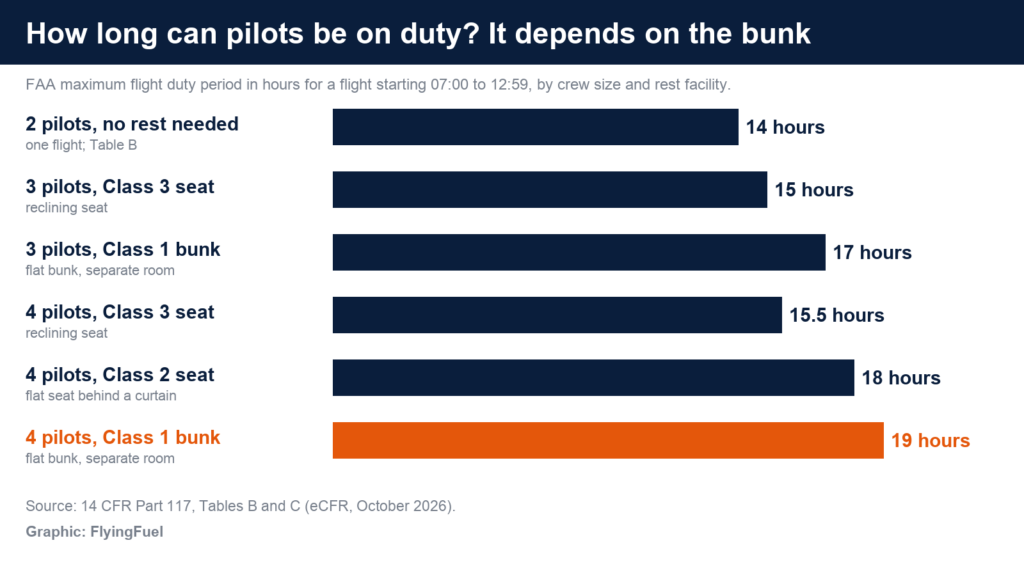
Under Part 117, a pilot’s flight duty period starts when they report for work and ends when the aircraft stops after the last flight. The limit depends on the start time (pilots are less alert at night), the number of flights and, for augmented crews, the number of pilots and the class of rest facility.
Two-pilot crews (no in-flight rest)
For a normal two-pilot crew, Table B of Part 117 allows a flight duty period between 9 and 14 hours. The longest, 14 hours, applies to a morning start (07:00 to 11:59) with one or two flights. Starts in the early hours of the morning (00:00 to 03:59) are limited to 9 hours. The actual flying time is also limited, to 8 or 9 hours depending on the report time.
Augmented crews (with bunks)
| Start time | 3 pilots, Class 1 | 4 pilots, Class 1 | 4 pilots, Class 2 | 4 pilots, Class 3 |
|---|---|---|---|---|
| 00:00 to 05:59 | 15 h | 17 h | 15.5 h | 13.5 h |
| 06:00 to 06:59 | 16 h | 18.5 h | 16.5 h | 14.5 h |
| 07:00 to 12:59 | 17 h | 19 h | 18 h | 15.5 h |
| 13:00 to 16:59 | 16 h | 18.5 h | 16.5 h | 14.5 h |
| 17:00 to 23:59 | 15 h | 17 h | 15.5 h | 13.5 h |
Source: 14 CFR Part 117, Table C. Times are the pilot’s acclimated local time. If the pilots are not acclimated, the limits are 30 minutes shorter.
If something unexpected happens before take-off, the captain and the airline can extend these limits by up to 2 hours, and any extension of more than 30 minutes must be reported to the FAA within 10 days.
Rest Before and After the Flight
In-flight naps are only part of the story. The FAA rest rules also control rest on the ground:
- 10 hours before every duty period: pilots must get at least 10 consecutive hours of rest, including at least 8 uninterrupted hours of sleep opportunity. If a pilot will not get 8 hours of sleep opportunity, they must tell the airline.
- 30 hours off every week: pilots must have at least 30 consecutive hours free from all duty in any 168-hour (7-day) period.
- Longer rest after big time-zone trips: after travelling more than 60 degrees of longitude and being away from base for more than 168 hours, pilots get at least 56 consecutive hours of rest at home, including three nights’ sleep.
- Acclimatisation: a pilot who has had 36 consecutive hours of rest in a new time zone counts as acclimated to it.
Here is a simple, illustrative example of how rest can work on a 16-hour flight with four pilots: two captains and two first officers, split into Team A and Team B. Real schedules vary by airline, route and the pilots’ body clocks.
| Phase | At the controls | Resting |
|---|---|---|
| Take-off and climb | Team A | Team B seated, ready |
| Hours 1 to 7 | Team A | Team B in the crew rest bunks |
| Hours 7 to 14 | Team B | Team A in the crew rest bunks |
| Descent and landing | Team A, fresh from its rest | Team B seated |
Why does Team A rest second? Under Part 117, the pilot who flies the landing must get two consecutive hours of in-flight rest in the second half of the duty period, and the pilot monitoring the landing needs 90 consecutive minutes. Planning the breaks this way means the landing team is the one that rested most recently.
Common Myths About Pilots Sleeping
- “The pilots sleep while the autopilot flies.” On augmented flights, resting pilots are replaced by other qualified pilots; FAA rules require at least one qualified pilot at the controls at all times.
- “Pilots sleep in business class.” Sometimes a Class 2 or Class 3 seat in the cabin is used, but long-haul aircraft built for ultra-long routes usually have dedicated bunks.
- “Crew rests are luxurious.” They are private but small: narrow bunks, curtains and basic bedding.
- “Pilots can fly as long as they like.” No. Every duty period has a hard limit, and extensions are capped and must be reported to the FAA.
Where Do Flight Attendants Sleep?
Cabin crew work just as long, and they also have rest areas, usually separate from the pilots’ compartment. In the US, 14 CFR 121.467 sets their limits:
- a normal duty period is limited to 14 hours, followed by at least 10 consecutive hours of rest;
- it can be 14 to 16 hours if at least one extra flight attendant is on board;
- it can be 16 to 18 hours with at least two extra flight attendants;
- longer duty periods of up to 20 hours are allowed only under further conditions, with even more extra crew.
The extra flight attendants let the team take turns resting during the flight, just like the pilots.
What Is It Like Inside a Crew Rest?
Crew rest compartments are functional rather than luxurious, as the photos in this article show: narrow flat bunks with bedding, a curtain for privacy, small lights and, in some cases, a small screen. Under the FAA definition, a Class 1 area must also be temperature-controlled, let the crew control the light, and keep out noise and disturbance.
Rest compartments are a design choice for each aircraft and airline. Long-range widebodies such as the Boeing 787 and Airbus A350-1000 can be fitted with crew rest compartments, as the photo of a 787 crew rest at the top of this article shows. You can read more about such routes in our list of the longest flights from India.
Is It Safe When Pilots Sleep?
Yes. Rest is planned, not improvised. The pilots at the controls are fully qualified and awake, and the resting pilots can be called back at any time. The whole point of these rules is safety: a well-rested pilot makes better decisions. Part 117 links duty time directly to rest opportunities and to the time of day.
For other things that happen behind the scenes on your flight, read our guides to go-arounds, flight diversions and turbulence.
Key Takeaways
- On long flights, pilots sleep in crew rest compartments: private bunks that passengers cannot enter.
- The FAA defines Class 1 (flat bunk in a separate room), Class 2 (flat seat behind a curtain) and Class 3 (reclining seat) rest facilities.
- Long flights carry three or four pilots who take turns flying and resting.
- With four pilots and Class 1 bunks, a duty period can reach 19 hours for a morning start.
- Pilots need at least 10 hours of rest, with 8 hours of sleep opportunity, before each duty period.
- Flight attendants have their own rest areas and duty limits.
Frequently Asked Questions
Where do pilots sleep on long-haul flights?
In a crew rest compartment: a small, private area with flat bunks, separate from the cabin and cockpit. Passengers cannot enter it; it may be locked and some are reached by a ladder. On some aircraft, pilots rest in a special seat behind a curtain instead.
Do pilots sleep during the flight?
Yes, on long flights with extra pilots. The extra pilots take turns flying, so each one can rest in the bunks. FAA rules say at least one qualified pilot must be at the controls at all times.
How many pilots are on a long-haul flight?
Two pilots fly most flights. Long flights use an “augmented” crew of three or four pilots, so they can take turns resting. Under FAA rules, more pilots and better rest areas allow longer duty days.
What are the FAA classes of crew rest?
Class 1 is a flat bunk in a separate, quiet, temperature-controlled space with light control. Class 2 is a flat or near-flat seat in the cabin, separated from passengers by at least a curtain. Class 3 is a seat that reclines at least 40 degrees with leg and foot support.
How long can a pilot be on duty?
Under FAA Part 117, a two-pilot crew can be on duty for 9 to 14 hours depending on start time and number of flights. With four pilots and Class 1 bunks, the limit can reach 19 hours for a morning start.
How much rest do pilots need before a flight?
FAA rules require at least 10 consecutive hours of rest before a flight duty period, including at least 8 uninterrupted hours of sleep opportunity.
Do flight attendants sleep on long flights?
Yes. Cabin crew have their own rest areas, usually separate from the pilots’. US rules allow flight attendant duty periods of more than 14 hours only if extra flight attendants are carried, so they can take turns resting.
Can passengers see the crew rest area?
No. Regulations restrict passengers from crew rest compartments. The entrances are usually hidden behind ordinary-looking doors and may be locked.
Do pilots sleep in the cockpit?
Under FAA rules, at least one qualified pilot must always be at the controls. On long flights with extra pilots, the resting pilots leave the cockpit and use the crew rest area instead.
Featured image: FlyingFuel graphic using a photo of the crew rest compartment of a Boeing 787 by Shahram Sharifi, GFDL 1.2, via Wikimedia Commons.
 GulfstreamGulfstream Business Jets: Every Model From the G300 to the G800 Explained (2026)
 NewsBombardier to Hire 800 in the US and Spend $270 Million on First Phase of Expansion
 NewsAll Passengers Flying to the US Must Sign an Ebola Travel Attestation From 3 November
 BombardierBombardier Business Jets: Every Global and Challenger Model Explained (2026)
 NewsSafran LEAP Engine Deliveries Rise 26% to 1,565 in First Nine Months of 2026
 NewsEmbraer Order Backlog Hits Record $35.7 Billion as E2 Jet Orders Grow