
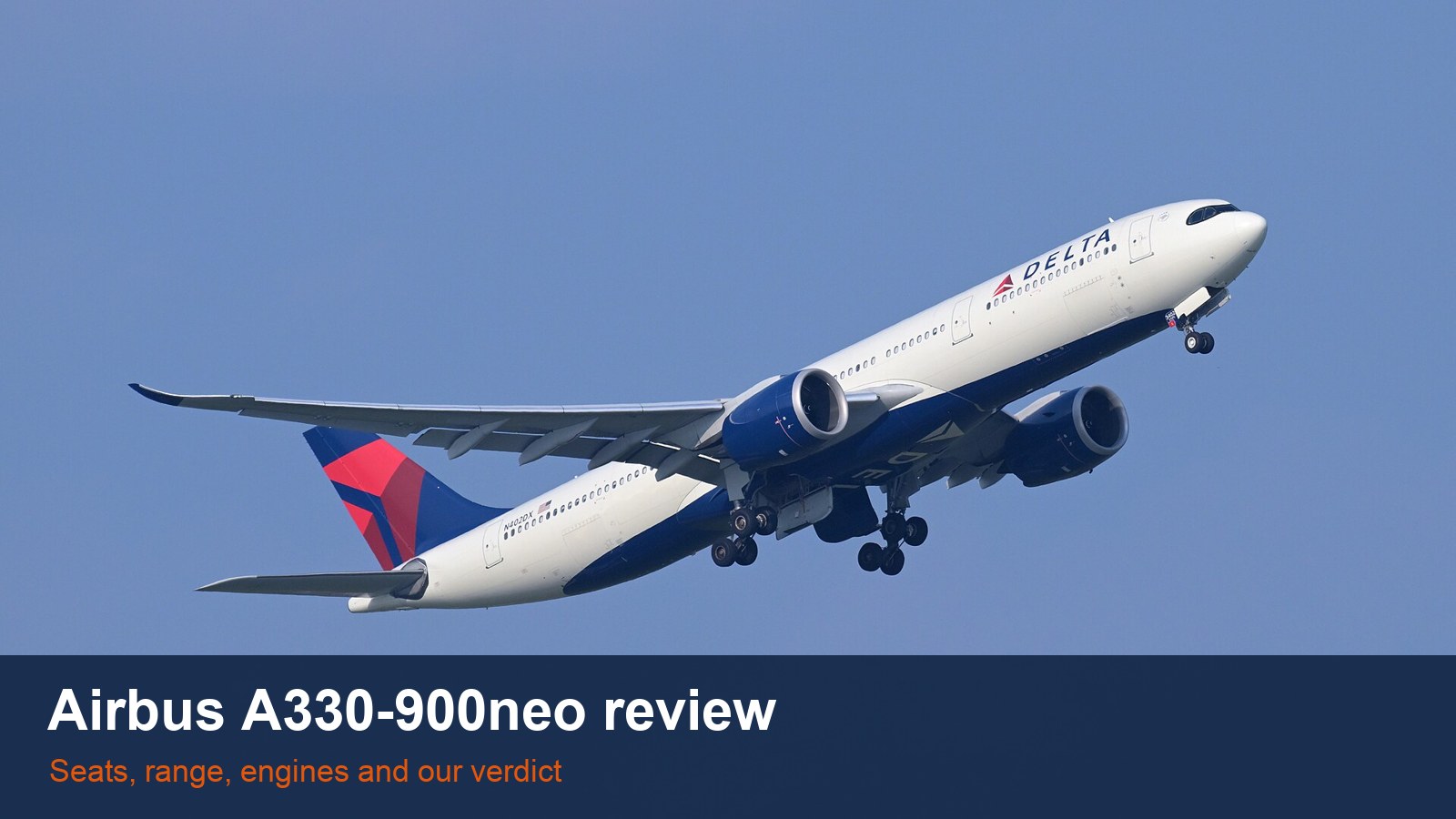
The Airbus A330-900neo is the most popular version of Airbus’s updated A330 family. It takes the proven A330-300 fuselage and adds new Rolls-Royce Trent 7000 engines, a longer wing with A350-style Sharklets and a new “Airspace” cabin. It is Airbus’s lower-cost answer to the Boeing 787.
Our verdict in one line: the A330-900neo is a cost-effective, mid-size long-haul jet, seating up to 287 people with a range of up to 7,350 nm, and Airbus says it burns 25% less fuel per seat than previous-generation aircraft. It is not as advanced as the 787 or A350, but it is cheaper to buy and easy to add to fleets that already fly A330s or A350s.
In this review we explain everything step by step: what changed from the original A330, how to recognise the neo, the Trent 7000 engine in simple words, what you get in the Airspace cabin and cockpit, range and weights, who flies it, and how it compares with the Boeing 787-9.
Airbus A330-900neo Quick Facts
| Item | Airbus A330-900neo |
|---|---|
| Type | Twin-aisle (widebody) twin-engine airliner |
| Typical seats | Up to 287 (Airbus); 310 with an optimised cabin |
| Range | Up to 7,350 nm (13,250 km) |
| Length | 63.69 m |
| Height | 16.79 m |
| Maximum take-off weight | 251 tonnes |
| Fuel capacity | 139,090 litres |
| Maximum payload | 46 tonnes |
| Cargo hold | 33 LD3 containers, or 9 pallets + 5 LD3 |
| Engines | 2 x Rolls-Royce Trent 7000 (68,000 to 72,000 lbf) |
| Fuel per seat | 25% lower than previous-generation aircraft (Airbus) |
| First flight | 19 October 2017 |
| Entered service | 15 December 2018, TAP Air Portugal |
| Orders | 524 A330neo ordered, 199 delivered (September 2026) |
Sources: Airbus A330 Family page; Wikipedia: Airbus A330neo; Wikipedia: Rolls-Royce Trent 7000.
What Is the A330neo?
The original Airbus A330 entered service in 1994 and became one of the most successful widebodies ever. When Boeing launched the 787 in 2004, Airbus’s first answer was an improved A330, but after negative feedback from airlines it designed the all-new A350 XWB instead. After the A320neo was launched in 2010, A330 operators asked for a version with modern engines like the 787’s, and Airbus agreed.
Airbus launched the A330neo on 14 July 2014 at the Farnborough Airshow, promising 14% better fuel burn per seat. “neo” means New Engine Option, and the older models became the A330ceo. There are two versions: the A330-800, based on the shorter A330-200, and the A330-900, based on the A330-300, according to its history.
The A330-900 first flew on 19 October 2017, a 4 hour 15 minute flight that reached 30,125 ft. EASA certified it on 26 September 2018, and TAP Air Portugal received the first one on 26 November 2018, flying its first service on 15 December 2018. By September 2026, more than 30 customers had ordered 524 A330neos and 199 had been delivered.
What Changed From the A330ceo
- New engines: Rolls-Royce Trent 7000s with a 112-inch fan, replacing the 97.5-inch Trent 700.
- Longer wing: new A350-style Sharklets widen the span by 3.7 m while staying within the ICAO Code E airport category, so it fits the same gates as older A330s.
- Aerodynamic tweaks: a re-twisted wing, optimised slats, reshaped fairings and new engine pylons. With the Sharklets, Airbus estimates these improve aerodynamics by about 4%.
- Higher weight: a maximum take-off weight of 251 tonnes, introduced in 2021 (Corsair took the first one on 31 March 2021), adding 700 to 1,000 nm of range compared with earlier versions.
- New cabin: the Airspace interior, with larger bins and new lighting, plus Space-Flex and Smart-Lav options that free room for about ten more seats.
Wikipedia breaks the fuel saving down simply: the Trent 7000 alone gives about 11% better fuel burn, the extra weight and engine drag take away 3 to 4%, and the Sharklets and aero changes add back 4%, for about 12% less fuel per flight. The rearranged cabin adds another 2% per seat, for a 14% saving per seat over the older 235-tonne A330-300.
How to recognise an A330neo
- Wingtips: tall, curved Sharklets like the A350’s, which give a 3.7 m wider span than the A330ceo.
- Engines: larger Trent 7000 engines with a 112-inch fan.
- Shape: otherwise the same as the A330-300: a long, slim twin-aisle fuselage with a rounded Airbus nose.
The Trent 7000 Engine
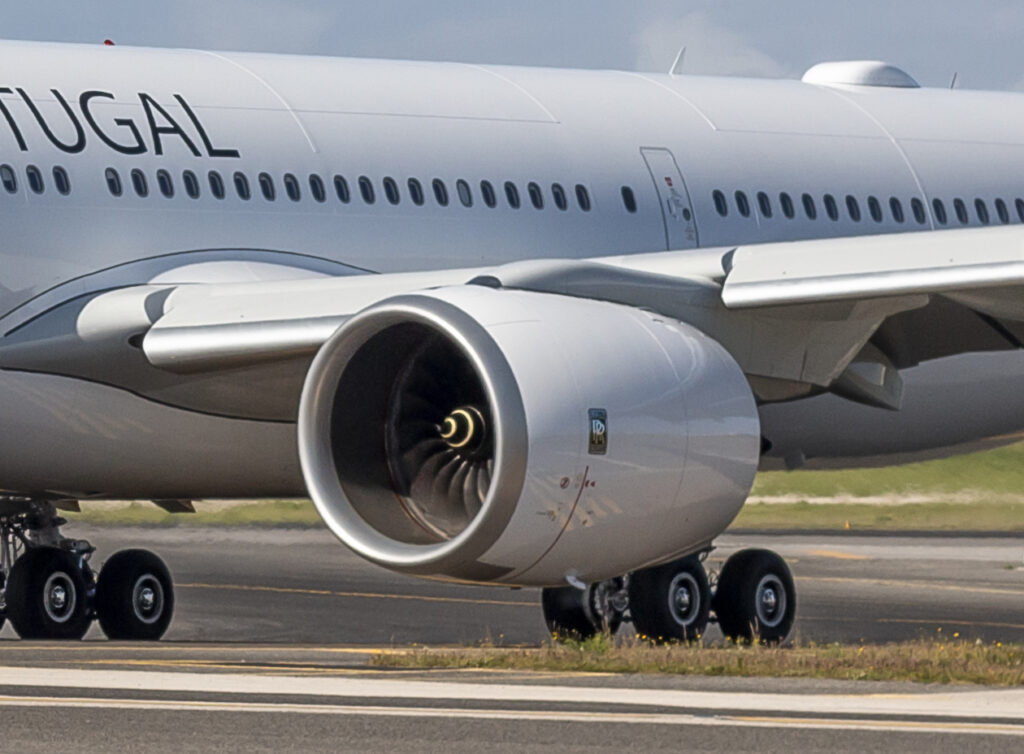
Every A330neo uses the Rolls-Royce Trent 7000; there is no second engine choice. It is a development of the Trent 1000 used on the Boeing 787, adapted for the A330.
| Engine detail | Trent 7000 (A330neo) | Trent 700 (A330ceo) |
|---|---|---|
| Fan diameter | 112 in (284 cm) | 97.5 in |
| Bypass ratio | 10:1 (double) | About 5:1 |
| Overall pressure ratio | 50:1 | Lower |
| Thrust | 68,000 to 72,000 lbf | – |
| Fuel consumption | 11% better | Baseline |
| Noise | About half | Baseline |
Source: Wikipedia: Rolls-Royce Trent 7000.
In simple words: the bigger fan pushes far more air around the hot engine core, which is more efficient and much quieter. Unlike the Trent 1000 on the 787, the Trent 7000 still supplies traditional bleed air to the aircraft, because the A330 was designed around a bleed-air system. The engine was certified in July 2018 and cleared for ETOPS 330 minutes by December 2018, letting A330neos fly long routes far from diversion airports; see what is ETOPS. For engine basics, read our turbofan vs turboprop guide.
Inside the Airspace Cabin
The A330neo has Airbus’s Airspace cabin, unveiled in 2016, with many design ideas taken from the A350. Airbus says it offers quieter interiors, full LED mood lighting and larger overhead bins, and that the cabin air is fully refreshed with HEPA-filtered air every two to three minutes. New ceiling panels can carry custom patterns chosen by the airline.
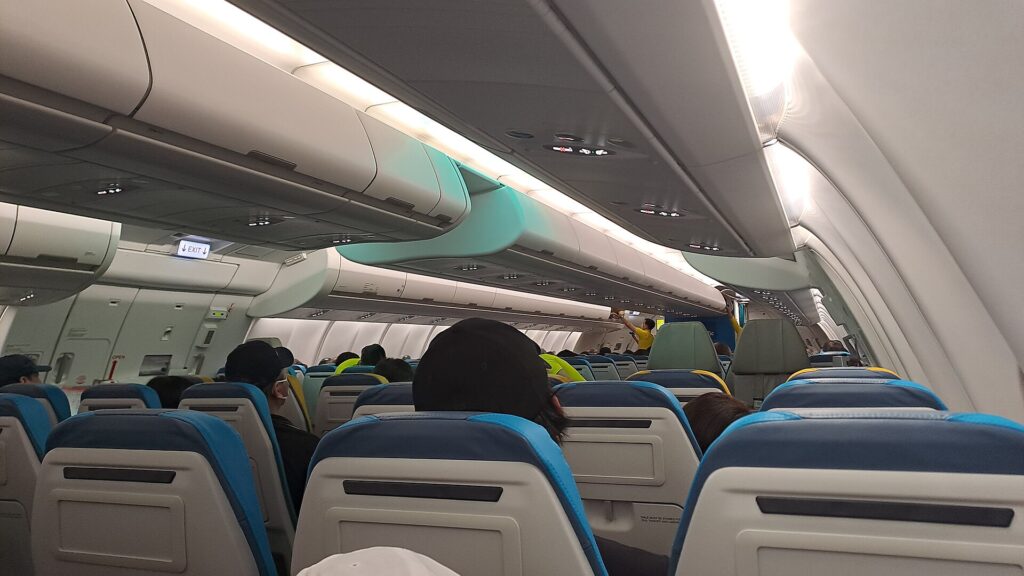
In economy, airlines fit eight or nine seats per row, depending on how dense they want the cabin. Airbus’s optimised layouts allow 18-inch-wide economy seats. An updated interior, announced in September 2024 for delivery from 2027 to 2028, adds new lighting and sidewalls that give 5 mm more shoulder room and 50 mm more foot space at the window seats, according to Wikipedia.
Capacity varies hugely by airline. Cebu Pacific has the densest A330-900 in the world, with 459 economy seats. Airbus says the A330 family can carry up to 465 passengers in a single-class layout. As always, seat pitch, screens and service depend on the airline.
The Cockpit and Pilot Commonality
The A330neo flight deck is the familiar A330 cockpit: fly-by-wire controls with a sidestick beside each pilot. Its biggest advantage is commonality. Airbus says its A330 Common Type Rating lets pilots move from the A330 to the A350 in only eight days, without full flight simulator sessions. That lets airlines run one pool of pilots across both types; see our Airbus A350-900 review.
Range and Performance
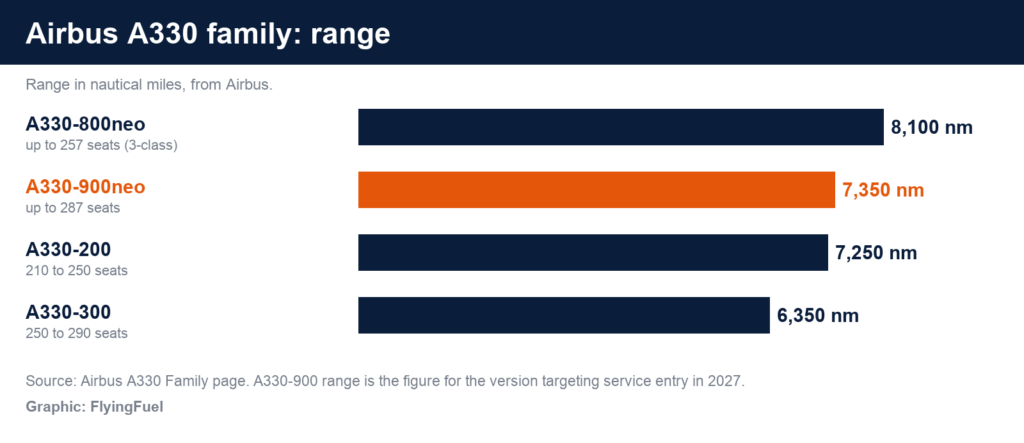
Airbus lists the A330-900neo at up to 7,350 nm (13,250 km) for the version targeting service entry in 2027. Airbus says the A330 family flies routes as short as Manila to Puerto Princesa and as long as Rome to Los Angeles, which shows how flexible it is. With a 251-tonne maximum take-off weight, a 46-tonne maximum payload and room for 33 LD3 cargo containers, it can carry a full cabin and plenty of cargo on medium and long routes.
| Model | Type | Seats | Range |
|---|---|---|---|
| A330-200 | Original (ceo) | 210 to 250 | About 7,250 nm |
| A330-300 | Original (ceo) | 250 to 290 | Up to 6,350 nm |
| A330-800neo | New engine, A330-200 length | Up to 257 (three-class) | Up to 8,100 nm |
| A330-900neo | New engine, A330-300 length | Up to 287 | Up to 7,350 nm |
Source: Airbus A330 Family page.
Within the family, the A330-800 flies further (8,100 nm) with fewer seats, while the A330-900 carries more people. Airbus also says the A330 family is certified to fly with up to a 50% blend of sustainable aviation fuel.
Flying on an A330-900neo: Passenger Tips
- Check the layout: the same aircraft can have anything from a premium two- or three-class cabin to 459 economy seats, so look at your airline’s seat map.
- Eight across is roomier: if your airline flies a 2-4-2 economy layout, window and aisle pairs are easier for couples, and seats are wider than at nine across.
- Quieter ride: with engines about half as noisy as the older Trent 700, the neo is noticeably quieter than older A330s, especially at take-off.
- Fresh air: Airbus says cabin air is refreshed with HEPA-filtered air every two to three minutes.
Who Flies the A330-900neo?
- Delta Air Lines is the largest operator.
- TAP Air Portugal was the launch operator in December 2018.
- Condor and ITA Airways are among the other main operators.
- Cebu Pacific flies the densest version, with 459 economy seats.
No Indian airline flies the A330neo: the 2026 fleet lists in our Air India fleet and IndiGo fleet guides do not include it. Indian travellers are most likely to meet it on foreign airlines.
A330-900neo vs Its Rivals
A330-900neo vs Boeing 787-9
| Airbus A330-900neo | Boeing 787-9 | Better | |
|---|---|---|---|
| Length | 63.69 m | 62.8 m | About equal |
| Seats | Up to 287 typical | 250-325 (two-class) | Similar |
| Range | Up to 7,350 nm | Up to 8,300 nm | 787-9 |
| Maximum take-off weight | 251 t | 259 t | Similar |
| Body | Mostly aluminium | About 50% composite | 787-9 |
| Engine choice | 1 (Trent 7000) | 2 (GEnx-1B or Trent 1000) | 787-9 |
| Price | Lower (see below) | Higher | A330neo |
| Pilot commonality | A330 and A350 | 777 | Depends on fleet |
Sources: Airbus and Boeing specifications; Wikipedia: Airbus A330neo.
The 787-9 is the more advanced aircraft, with a composite body, longer range and two engine options. The A330neo’s main weapon is price: Airbus’s then sales chief John Leahy estimated the A330-900 would have operating costs on par with the 787-9 at about 25% lower capital cost, and one 2018 valuation put an A330-900 at US$115 million against US$145 million for a new 787-9. Boeing dismissed the A330neo as a “2004 revamp”. Read our Boeing 787-9 review for the other side.
A330-900neo vs A350-900
The A350-900 is Airbus’s more advanced, mostly carbon-fibre widebody, with more seats and range (up to 8,500 nm). The A330neo is the cheaper option for airlines that do not need the A350’s range. Because the two share a common type rating, many airlines fly both. See our A350 vs 787 comparison and our A350-900 review.
Pros and Cons
Pros
- 25% lower fuel burn per seat than previous-generation aircraft (Airbus)
- Up to 287 seats with 7,350 nm of range
- Cheaper to buy than the 787-9 or A350
- Easy pilot transition to the A350 (about eight days)
- Trent 7000 is about half as noisy as the Trent 700
- Proven A330 design flying since 1994
- Airspace cabin with large bins and LED lighting
Cons
- Shorter range than the 787-9 and A330-800neo
- Only one engine choice (Trent 7000)
- Mostly aluminium airframe, less advanced than the 787 or A350
- Relatively few orders compared with the 787
- Not flown by any Indian airline
Our Verdict
The A330-900neo takes a proven airframe and adds new engines, a longer wing, a new cabin and a big efficiency gain. It is not as advanced as the 787 or the A350, and it cannot match their range, but it does not need to: for many medium and long routes it does the job well at a lower price.
For airlines that already fly A330s or A350s, it is a smart, low-risk choice thanks to shared pilots and parts. For passengers, the Airspace cabin is pleasant and quiet, but comfort depends heavily on the airline, from Delta’s premium cabins to Cebu Pacific’s 459-seat layout. Compare it with Airbus’s flagship in our A350-900 review.
Frequently Asked Questions
How many seats does the A330-900neo have?
Airbus lists up to 287 seats in a typical layout, and Wikipedia says an optimised cabin allows 310 with 18-inch-wide economy seats. Cebu Pacific flies the densest version, with 459 economy seats.
What is the range of the A330-900neo?
Airbus lists up to 7,350 nm (13,250 km) for the version targeting service entry in 2027. The smaller A330-800neo flies up to 8,100 nm.
What engine does the A330neo use?
Only the Rolls-Royce Trent 7000. It has a 112-inch fan, double the bypass ratio of the older Trent 700 (10:1), and Rolls-Royce says it burns 11% less fuel.
What does neo mean in A330neo?
New Engine Option. The original A330s are now called A330ceo, for Current Engine Option.
How much more efficient is the A330neo?
Airbus says the A330neo burns 25% less fuel and emits 25% less CO2 per seat than previous-generation aircraft. At launch in 2014 Airbus promised 14% better fuel burn per seat than the A330ceo.
Which airlines fly the A330-900neo?
Delta Air Lines is the largest operator. Others include TAP Air Portugal, the launch operator, Condor, ITA Airways and Cebu Pacific.
Do Indian airlines fly the A330neo?
No. Air India’s and IndiGo’s 2026 fleet lists do not include the A330neo. You are most likely to fly one with a foreign airline on a route to or from India.
Is the A330-900neo better than the Boeing 787-9?
The 787-9 flies further and has a more modern composite body. The A330-900neo is cheaper to buy; Airbus estimated similar operating costs to the 787-9 at about 25% lower capital cost. It also suits airlines that already fly A330s or A350s.
Can A330 pilots fly the A350?
Yes. Airbus says its A330 Common Type Rating lets pilots move from the A330 to the A350 in about eight days, without full flight simulator sessions.
Featured image: FlyingFuel graphic using a photo of Delta Air Lines Airbus A330-900 N402DX by 4300streetcar, CC BY 4.0, via Wikimedia Commons.
 GulfstreamGulfstream Business Jets: Every Model From the G300 to the G800 Explained (2026)
 NewsBombardier to Hire 800 in the US and Spend $270 Million on First Phase of Expansion
 NewsAll Passengers Flying to the US Must Sign an Ebola Travel Attestation From 3 November
 BombardierBombardier Business Jets: Every Global and Challenger Model Explained (2026)
 NewsSafran LEAP Engine Deliveries Rise 26% to 1,565 in First Nine Months of 2026
 NewsEmbraer Order Backlog Hits Record $35.7 Billion as E2 Jet Orders Grow