
For fifty years, “jumbo jet” meant one aircraft: the Boeing 747. Then in 2007 Airbus put the A380 into service, a jet with two full passenger decks that was built to beat it. Today both are out of production, but hundreds still fly, and passengers still ask which one is bigger, which is better and which one to choose.
Quick answer: the Airbus A380 is the bigger aircraft: heavier (575 t against 448 t), with a much wider wing and two full-length decks that give about 40% more cabin floor space. The Boeing 747-8, the last 747, is the longer aircraft (76.3 m against 72.72 m). The A380 carries more people and is quieter inside; the 747-8 is lighter per seat and sold mostly as a freighter.
We compare the A380 with the 747-8 Intercontinental, the final passenger 747 and the version Boeing built to compete with it, and mention the older 747-400 where it matters. Figures come from Wikipedia: Boeing 747-8 and Wikipedia: Airbus A380, which list the makers’ data.
Boeing 747-8 vs Airbus A380 at a Glance
| Boeing 747-8 Intercontinental | Airbus A380-800 | |
|---|---|---|
| Length | 76.3 m (250 ft 2 in) | 72.72 m (238 ft 7 in) |
| Wingspan | 68.4 m (224 ft 5 in) | 79.75 m (261 ft 8 in) |
| Height | 19.5 m (64 ft) | 24.09 m (79 ft) |
| Wing area | 554 m2 | 845 m2 |
| Max take-off weight | 448 t (987,000 lb) | 575 t (1,268,000 lb) |
| Empty weight | 220 t (485,300 lb) | 285 t |
| Fuel capacity | 191,565 kg (usable) | 253,983 kg |
| Passenger decks | Main deck + short upper deck | Two full-length decks |
| Typical seats | 467 (three classes) | 525 (three classes) |
| Maximum seats | – | 853 (certified) |
| Range | 7,730 nm with 410 passengers | About 8,000 nm (14,800 km) |
| Engines | 4 x GE GEnx-2B67 | 4 x Rolls-Royce Trent 900 or Engine Alliance GP7200 |
| Ceiling | 43,100 ft | 43,100 ft |
| First flight | 20 March 2011 (passenger version) | 27 April 2005 |
| Entered service | 1 June 2012, Lufthansa | 25 October 2007, Singapore Airlines |
| Built | 155 (48 passenger, 107 freighter) | 251 delivered |
Sources: Wikipedia: Boeing 747-8 (Boeing specifications) and Wikipedia: Airbus A380. Weights in tonnes are rounded.
Size: Which Is Bigger?
It depends on how you measure, but overall the answer is the A380.
- Length: the 747-8 wins by 3.6 m. Boeing stretched the 747-400 by 18 ft (5.6 m) to make it the longest airliner in service when it arrived.
- Wingspan: the A380 wins by more than 11 m. Its 845 m2 wing is about 50% larger than the 747-8 wing, and Airbus designed the aircraft to fit the 80 m x 80 m box used at major airport gates.
- Height: the A380 is about 4.6 m taller, because both of its decks run the whole length of the fuselage.
- Weight: the A380 can take off at 575 t, about 127 t more than the 747-8. The 747-8 is still the heaviest aircraft Boeing has ever built.
Wikipedia also notes that the A380 is about 30% larger in overall size than the 747-400. It is the only airliner in the “Super” wake turbulence category, which means air traffic controllers leave extra space behind it on take-off and landing.
Seats and Cabin
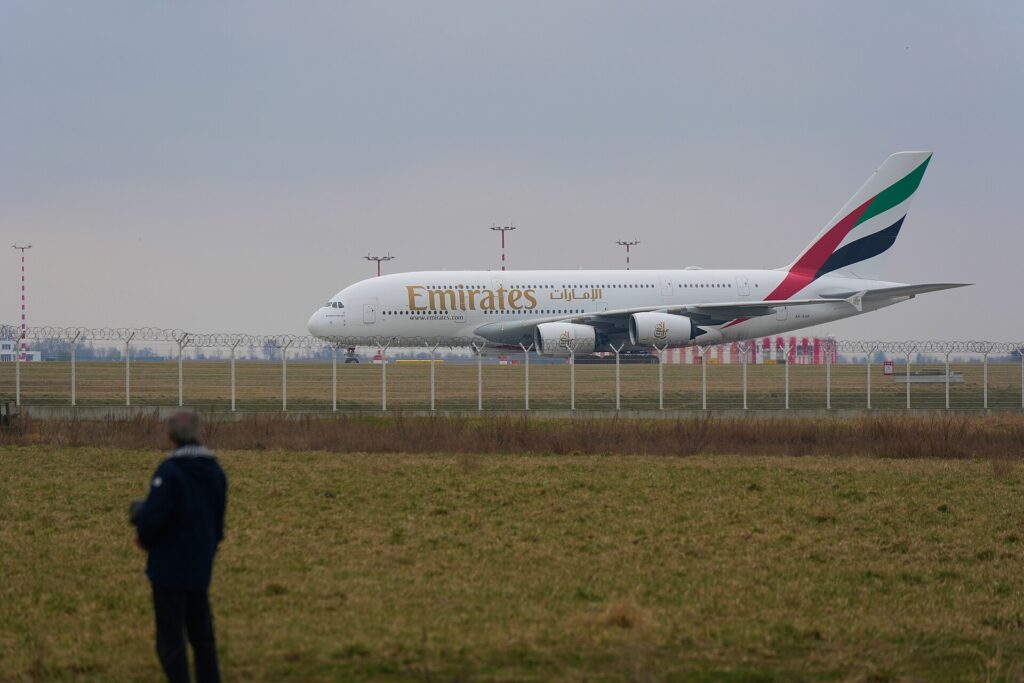
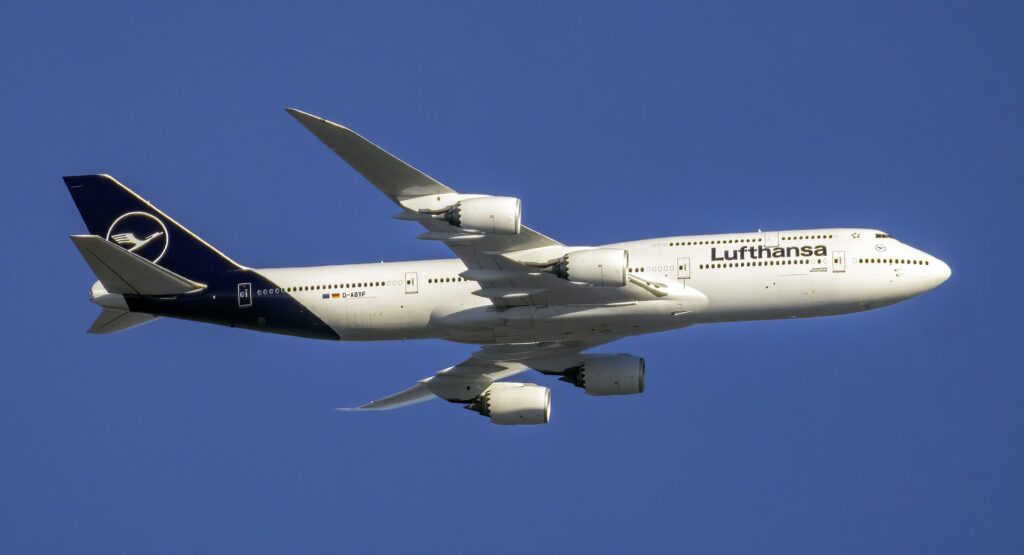
This is where the two designs differ most. The 747 has its famous hump: a main deck along the whole aircraft and a shorter upper deck at the front. The A380 has two full decks, linked by wide stairways at the front and back.
| Cabin | Boeing 747-8I | Airbus A380 |
|---|---|---|
| Typical seats | 467 in three classes | 525 in three classes |
| Highest layout | – | 853 certified; 615 with Emirates (two classes) |
| Floor space | Baseline | 550 m2, about 40% more than the 747-8 |
| Economy seat width (10 across) | 44.5 cm typical on the 747-400 | Up to 48 cm |
| Cabin noise | Baseline (747-400) | 50% lower than the 747-400 |
| Upper deck | Short, behind the cockpit | Full length |
Airlines used the extra A380 space for things no other airliner offers: Emirates installed first-class “shower spas”, and Etihad and Qatar Airways have bar lounges on the upper deck. On the 747, the upper deck is usually a quiet business-class cabin, which many frequent flyers love for its small size and private feel.
For economy passengers, the A380 is generally the more comfortable aircraft: its main deck is wide enough for 10-across seats up to 48 cm wide, and Wikipedia says it has 60 cm more headroom and half the cabin noise of the 747-400.
Range and Speed
Both aircraft were built for the longest routes in the world, and both have the same 43,100 ft ceiling.
- A380: about 8,000 nm (14,800 km), cruising at Mach 0.85 at 43,000 ft. It needs about 3,000 m of runway to take off at maximum weight.
- 747-8 Intercontinental: Boeing launched it with 8,000 nm at Mach 0.855; Wikipedia’s specification table gives 7,730 nm with 410 passengers. Its maximum speed is Mach 0.9, one of the fastest of any airliner.
In practice the difference is small. Both can fly almost any long-haul route airlines operate today. For the very longest flights, airlines now prefer twin-engine jets: see our list of the longest flights in the world.
Engines and Fuel Use
Both are four-engine jets, which is the main reason both went out of production.
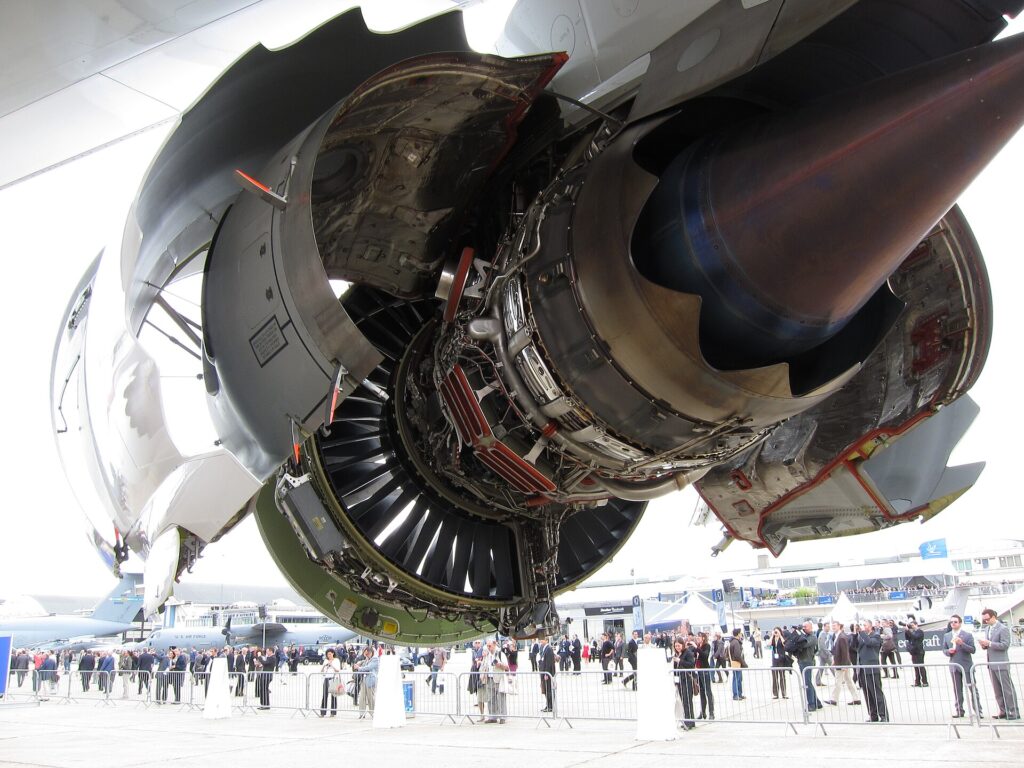
- 747-8: four General Electric GEnx-2B67 engines, a version of the engine on the 787 Dreamliner, with chevrons (serrated edges) on the nacelle to cut noise. An engine improvement package later cut fuel burn by a further 2%.
- A380: four Rolls-Royce Trent 900 or Engine Alliance GP7200 engines of about 330 to 340 kN (74,700 to 76,800 lbf) each.
Which uses less fuel per passenger? Each maker claimed to win:
- Boeing said the 747-8 is more than 10% lighter per seat and burns 11% less fuel per passenger than the A380, giving a 21% lower trip cost and over 6% lower cost per seat-mile.
- Singapore Airlines said in 2008 that its A380s burned 20% less fuel per seat-mile than its 747-400s, the older 747 the A380 was designed to replace.
- AirInsight estimates quoted by Wikipedia (2015) put the A380 at about US$50 per seat-hour, against US$90 for the 747-400 and US$44 for a twin-engine 777-300ER.
The real answer depends on how many seats the airline fits. What both makers agree on is that big twin-engine jets are cheaper still, which is why twin-engine jets took over long-haul flying.
Noise
The A380 is the quieter neighbour. Wikipedia says Lufthansa’s A380s produce half the noise of a Boeing 747-200 while carrying 160 more passengers, and the A380 won a Noise Abatement Society award in 2012. At London Heathrow it falls below the QC/2 departure and QC/0.5 arrival limits of the airport’s Quota Count system. The 747-8’s GEnx engines are much quieter than older 747 engines, but the A380 remains quieter inside the cabin, too.
Safety
Both aircraft have excellent safety records:
- A380: no hull-loss accident. By December 2021 the fleet had flown more than 800,000 flights and 7.3 million block hours with no fatalities. Its most serious event was Qantas Flight 32 in November 2010, when an engine failed uncontained after take-off from Singapore; the crew landed safely and nobody was hurt.
- 747-8: no fatal accident in passenger service. Older 747 versions, flying since the early 1970s, have a longer history that includes several fatal accidents.
For passengers, the airline and its maintenance matter far more than the aircraft type.
Sales: Why the 747 Won the Long Game but Lost the Last Round
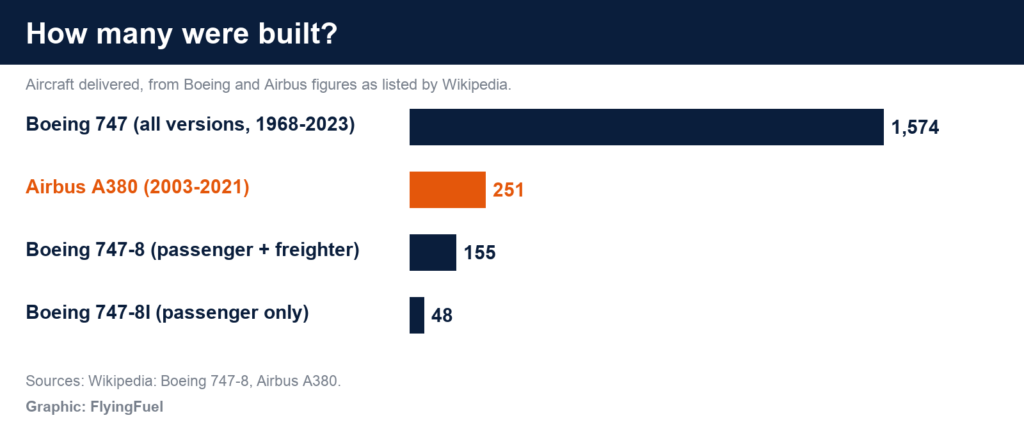
Across all versions, Boeing built 1,574 747s from the late 1960s to 2023, which made the 747 one of the most successful widebodies ever. But the final version sold poorly: only 48 passenger 747-8s were built, for Lufthansa, Korean Air and Air China, plus 107 freighters.
The A380 sold 251, more than five times as many passenger aircraft as the 747-8, but still far below what Airbus hoped. Emirates alone took 116 of the 189 in service in May 2025. Airlines that needed huge capacity, such as Emirates, preferred the A380; most others chose cheaper twinjets such as the 777-300ER. Read why Airbus stopped making the A380.
The 747-8 has one more role: the US Air Force chose it in 2015 to replace the current Air Force One aircraft, as the VC-25B.
Which Airlines Still Fly Them?
| Boeing 747-8 Intercontinental | Airbus A380 | |
|---|---|---|
| Main passenger operators | Lufthansa (19 ordered), Korean Air (10), Air China (7) | Emirates (116), British Airways (12), Singapore Airlines (12), Qantas (10) in May 2025 |
| Total in service | 48 passenger aircraft built | 189 with 12 operators (May 2025) |
| Freighters | Yes: UPS, Cargolux, Cathay Pacific Cargo and others | No freighter was built |
If you fly between the US, UK or Australia and Europe or Asia, you are most likely to meet the A380 on Emirates, British Airways, Qantas or Singapore Airlines, and the 747-8 on Lufthansa (mostly from Frankfurt) or Korean Air. For how its biggest user plans to keep flying the A380, see our Emirates A380 story.
Which Is Better to Fly On?
- In economy: usually the A380, thanks to its wider main deck, quieter cabin and more headroom. Ask for the upper deck on airlines that put economy there, as those cabins are often smaller and quieter.
- In business class: both are excellent. The 747 upper deck is a small, private cabin; the A380 upper deck often holds the whole business class, sometimes with a bar.
- Boarding and arrival: the A380’s 500-plus passengers can mean longer waits at immigration and baggage, although many airports use extra jet bridges to the upper deck.
- For aviation fans: the 747 is the icon. With so few passenger 747s left, a flight on one is becoming rare.
Our Verdict
The A380 is the bigger, roomier and quieter aircraft, and passengers generally prefer it. The 747-8 is the longer, lighter-per-seat and more versatile one: its freighter version kept the line open until 2023, and it will carry the next Air Force One. In the end, neither won. Airlines moved to large twinjets such as the 777-300ER and A350-1000 and the coming Boeing 777-9, which carry slightly fewer people on two engines instead of four. For the full list of giants, see the largest passenger aircraft in the world and our Boeing 747-8 review.
Key Takeaways
- The Airbus A380 is bigger: 575 t, a 79.75 m wing and two full-length decks with about 40% more floor space than the 747-8.
- The Boeing 747-8 is longer: 76.3 m against 72.72 m.
- Typical seats: 467 on the 747-8I, 525 on the A380 (853 maximum).
- Both are out of production: the last A380 was delivered in 2021 and the last 747 in 2023.
- Boeing built 1,574 747s of all versions but only 48 passenger 747-8s; Airbus built 251 A380s.
Frequently Asked Questions
Which is bigger, the Boeing 747 or the Airbus A380?
The A380. It is shorter (72.72 m against 76.3 m for the 747-8), but it has a much wider wing (79.75 m against 68.4 m), weighs far more at take-off (575 t against 448 t) and has two full-length passenger decks with 550 m2 of floor space, about 40% more than the 747-8.
Which is longer, the 747 or the A380?
The Boeing 747-8 is longer: 76.3 m (250 ft 2 in) against 72.72 m for the A380. The 747-8 was the longest airliner in service until the 777-9, which is 76.7 m long, enters service.
How many passengers does a 747 carry compared with an A380?
Boeing lists 467 seats in three classes for the 747-8 Intercontinental. Airbus lists 525 typical seats for the A380 and certified it for up to 853. Real A380 layouts range from 407 seats (Korean Air) to 615 (Emirates, two classes).
Can a 747 fly farther than an A380?
No. The A380 flies about 8,000 nm (14,800 km). Wikipedia gives the 747-8 Intercontinental 7,730 nm with 410 passengers; Boeing originally quoted 8,000 nm. In practice both can fly almost any long-haul route.
Is the 747 or the A380 more fuel efficient?
Per seat, it depends on how many seats the airline fits. Boeing said the 747-8 is more than 10% lighter per seat and burns 11% less fuel per passenger than the A380. Singapore Airlines said its A380s burned 20% less fuel per seat-mile than its older 747-400s. Big twin-engine jets beat both.
Is the A380 quieter than the 747?
Yes, inside and outside. Wikipedia says the A380 cabin is 50% quieter than the 747-400, and Lufthansa’s A380s produce half the noise of a 747-200 while carrying 160 more passengers.
Are the 747 and A380 still being made?
No. Airbus delivered the last A380 to Emirates on 16 December 2021. Boeing delivered the last 747, a 747-8 Freighter, to Atlas Air on 31 January 2023.
Which airlines still fly the 747-8 and the A380?
The passenger 747-8 was ordered by Lufthansa (19), Korean Air (10) and Air China (7). The A380 had 189 aircraft with 12 operators in May 2025, led by Emirates (116), British Airways (12), Singapore Airlines (12) and Qantas (10).
Which is safer, the 747 or the A380?
Both have very good records. The A380 has never had a hull-loss accident; by December 2021 it had flown more than 800,000 flights with no fatalities. The 747-8 has also had no fatal passenger accident. Safety depends far more on the airline than on the aircraft type.
Featured image: FlyingFuel graphic using a photo of Emirates Airbus A380 A6-EVS, the last A380 built, departing London Heathrow by BWard 1997, CC BY 4.0, via Wikimedia Commons.
 PilatusPilatus PC-24 and PC-12 PRO Explained: The Swiss Planes That Land Almost Anywhere (2026)
 Cessna CitationCessna Citation Jets: Every Model From the M2 to the Longitude Explained (2026)
 NewsAeromexico to Fly Mexico City to Orange County, Fort Lauderdale and Portland From January 2027
 NewsBoeing Narrows Q3 Loss to $116 Million, Still Targets First 777X Delivery in 2027
 Embraer Executive JetsEmbraer Business Jets: Phenom 100EX, Phenom 300EV, Praetor 500E and 600E Explained (2026)
 NewseasyJet to Fit Starlink Wi-Fi Across Its Airbus Fleet From 2027