
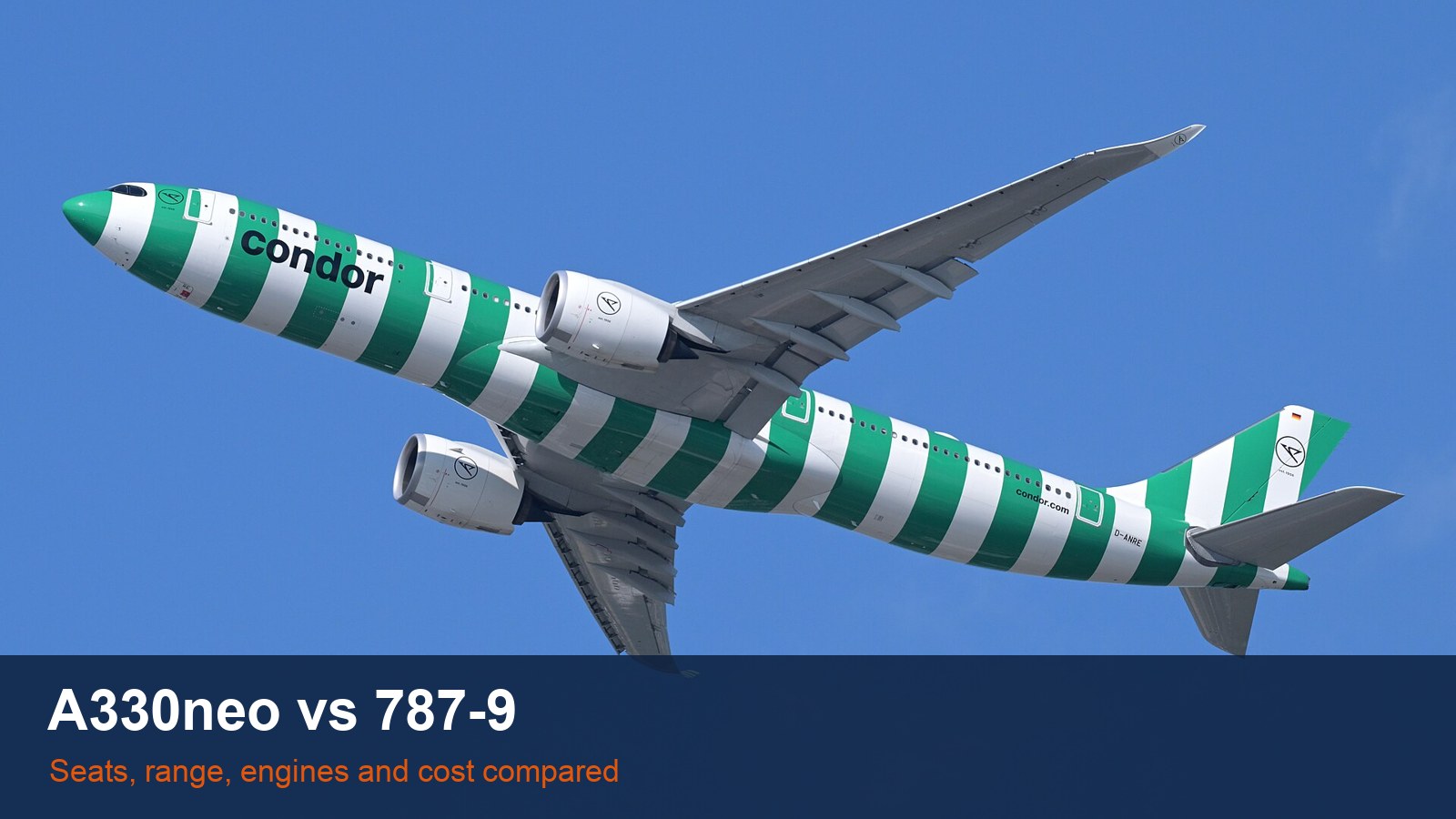
The Airbus A330-900neo and the Boeing 787-9 Dreamliner compete for the same job: flying around 280 to 300 passengers on long routes with two engines and two aisles. They are almost exactly the same size, but they come from very different ideas. The 787 is an all-new, carbon-fibre aircraft. The A330neo is a proven 1990s design with new engines, a new wing tip and a new cabin, sold at a lower price.
Quick verdict: the 787-9 is the more advanced and longer-range aircraft, with up to 8,300 nm against 7,350, a composite body, two engine choices and a more comfortable cabin environment. The A330-900neo is cheaper to buy, has a slightly wider wing for efficient cruising, and is the easy choice for airlines that already fly A330s or A350s.
In this comparison we go step by step: size, seats, cabin comfort, engines, cockpit, range, fuel burn, price, who flies them and India. For each aircraft on its own, see our detailed A330-900neo review and 787-9 Dreamliner review.
A330-900neo vs 787-9: Quick Comparison
| Item | Airbus A330-900neo | Boeing 787-9 |
|---|---|---|
| Seats | Up to 287 typical (310 optimised) | 250 to 325 (two-class) |
| Maximum seats | Up to 465 (A330 family, single class) | 420 (exit limit) |
| Range | Up to 7,350 nm (13,250 km) | Up to 8,300 nm (15,370 km) |
| Length | 63.69 m | 62.8 m |
| Wingspan | 64 m | 60.1 m |
| Height | 16.79 m | 17.0 m |
| Maximum take-off weight | 251 tonnes | 259.2 tonnes |
| Fuel capacity | 139,090 litres | 126,429 litres |
| Body | Mostly aluminium | About 50% composite by weight |
| Engines | Rolls-Royce Trent 7000 only | GEnx-1B or Rolls-Royce Trent 1000 |
| Cabin altitude | Conventional | 6,000 ft |
| First flight | 19 October 2017 | 17 September 2013 |
| In service | December 2018 (TAP Air Portugal) | August 2014 (Air New Zealand) |
Sources: Airbus A330 Family page; Wikipedia: Airbus A330neo; Boeing 787 specifications; Boeing 787 by design; Wikipedia: Boeing 787.
Two Different Ideas
When Boeing launched the 787 in 2004, it built a new aircraft from scratch around light carbon-fibre composites, more electric systems and new engines. Boeing says about 50% of the 787 airframe by weight is composite and that the 787 uses 25% less fuel than the aircraft it typically replaces. The 787-9, a 6.1 m stretch of the original 787-8, first flew in 2013 and entered service with Air New Zealand in August 2014.
Airbus took a different route. Its all-new answer to the 787 was the A350, but A330 operators kept asking for a cheaper upgrade with modern engines. So on 14 July 2014 Airbus launched the A330neo: the A330 fuselage with Rolls-Royce Trent 7000 engines, a longer wing with A350-style Sharklets and the new Airspace cabin. According to its history, Airbus’s sales chief John Leahy said it would have operating costs on par with the 787-9 at about 25% lower capital cost. Boeing dismissed it as a “2004 revamp”.
So the question is simple: is a newer, more advanced aircraft worth paying more for? The answer depends on the airline.
Size and Looks: How to Tell Them Apart
The two are almost the same length: 63.69 m for the A330-900neo and 62.8 m for the 787-9. Here is how to tell them apart at the airport:
- Wingtips: the A330neo has tall, curved Sharklets like the A350’s. The 787 has long wings that sweep back into a smooth raked tip, with no winglet.
- Cockpit windows: the 787 has a distinctive four-window cockpit.
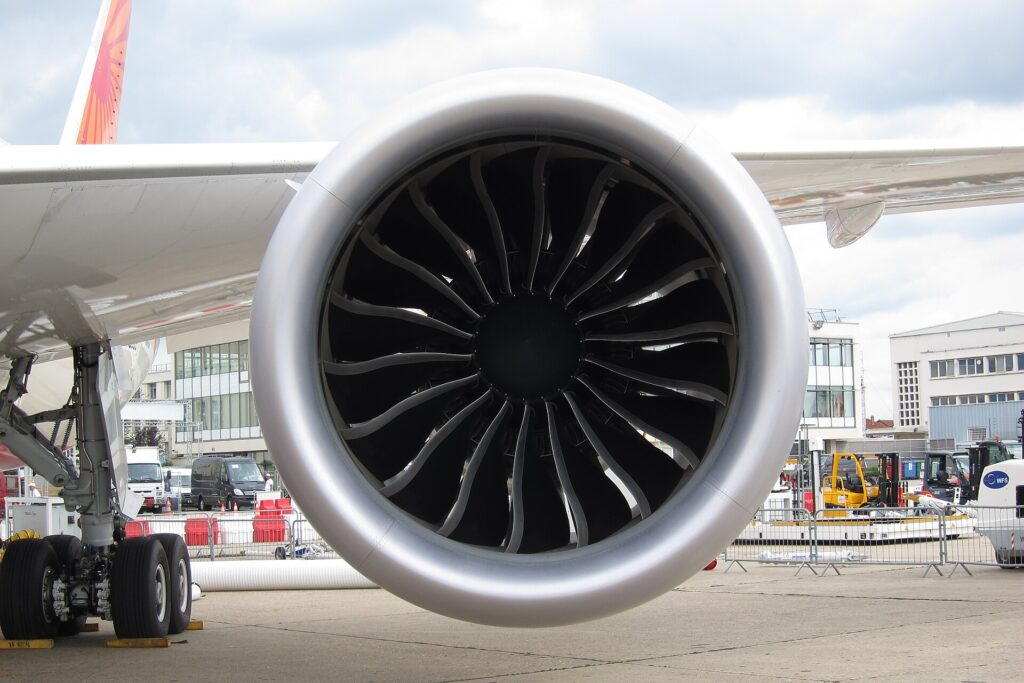
- Engines: the 787’s engines have serrated chevrons on the back edge of the nacelle. The A330neo’s Trent 7000s have a smooth rear edge.
The A330neo’s wing is about 4 m wider than the 787-9’s, yet it still fits ICAO Code E airport gates, the same category as the 787. That longer wing is one reason Airbus claims a small fuel advantage, as explained below.
Seats and Cabin Comfort
Airbus lists the A330-900neo at up to 287 seats in a typical layout and 310 with an optimised cabin. Boeing lists the 787-9 at 250 to 325 in two classes, with an exit limit of 420. In real airline service they carry a similar number of people. At the extreme, Cebu Pacific flies an A330-900 with 459 economy seats.
Seat width: eight or nine across
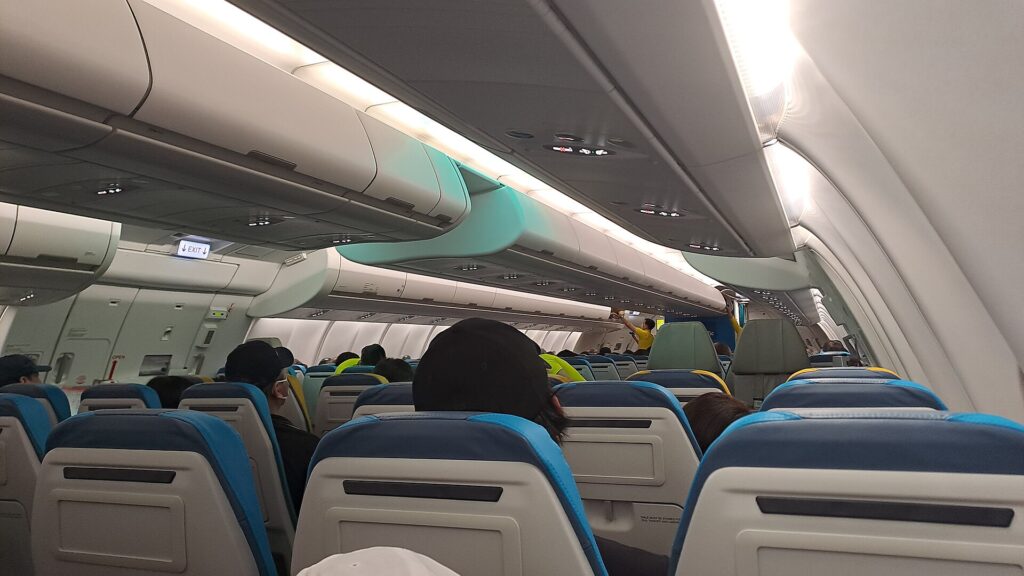
This is where the A330neo can surprise you. Its cabin is narrower than the 787’s; Boeing’s 787 cabin is about 15 inches wider than the A330’s. But many airlines fit the A330neo with eight seats per row (2-4-2), while most 787-9s have nine (3-3-3). At nine across, 787 economy seats can be up to 17.5 inches wide; at eight across, up to 19 inches. A 2-4-2 A330neo is also great for couples, who get a pair of seats by the window. Always check your airline’s seat map.
Air, pressure and windows
The 787 has some clear passenger advantages, according to Boeing:
- Lower cabin altitude: the cabin is pressurised to the equivalent of 6,000 ft, instead of the 8,000 ft typical of older jets. Boeing says this reduces tiredness and jet lag.
- More humid air: about 15% humidity, against about 4% on earlier aircraft, because carbon fibre does not corrode.
- The biggest windows: Boeing says the 787 has the largest windows of any widebody flying, and they dim electronically at the press of a button instead of using a shade.
The A330neo answers with the Airspace cabin, which borrows ideas from the A350. Airbus says it is quieter, has full LED mood lighting and larger overhead bins, and that cabin air is fully refreshed with HEPA-filtered air every two to three minutes. Its Trent 7000 engines are about half as noisy as the older Trent 700, so the neo is much quieter than older A330s.

Engines Explained
Both aircraft use large high-bypass turbofans: a big fan pushes most of the air around the hot engine core, which saves fuel and noise. Our turbofan vs turboprop guide explains the basics.
| Engine detail | A330-900neo | 787-9 |
|---|---|---|
| Engine options | 1: Rolls-Royce Trent 7000 | 2: GE Aerospace GEnx-1B or Rolls-Royce Trent 1000 |
| Fan diameter | 112 in (284 cm) | GEnx-1B: 111.1 in; Trent 1000: 2.85 m |
| Bypass ratio | 10:1 | GEnx-1B: about 9:1; Trent 1000: over 10:1 |
| Thrust | 68,000 to 72,000 lbf | GEnx-1B: 69,800 to 76,100 lbf; Trent 1000: 62,264 to 81,028 lbf |
| Air system | Traditional bleed air | Bleedless; electric compressors supply cabin air |
| Known issues | – | Trent 1000 turbine-blade cracking from 2016 grounded up to 44 aircraft |
Sources: Wikipedia: Rolls-Royce Trent 7000; Wikipedia: General Electric GEnx; Wikipedia: Rolls-Royce Trent 1000.
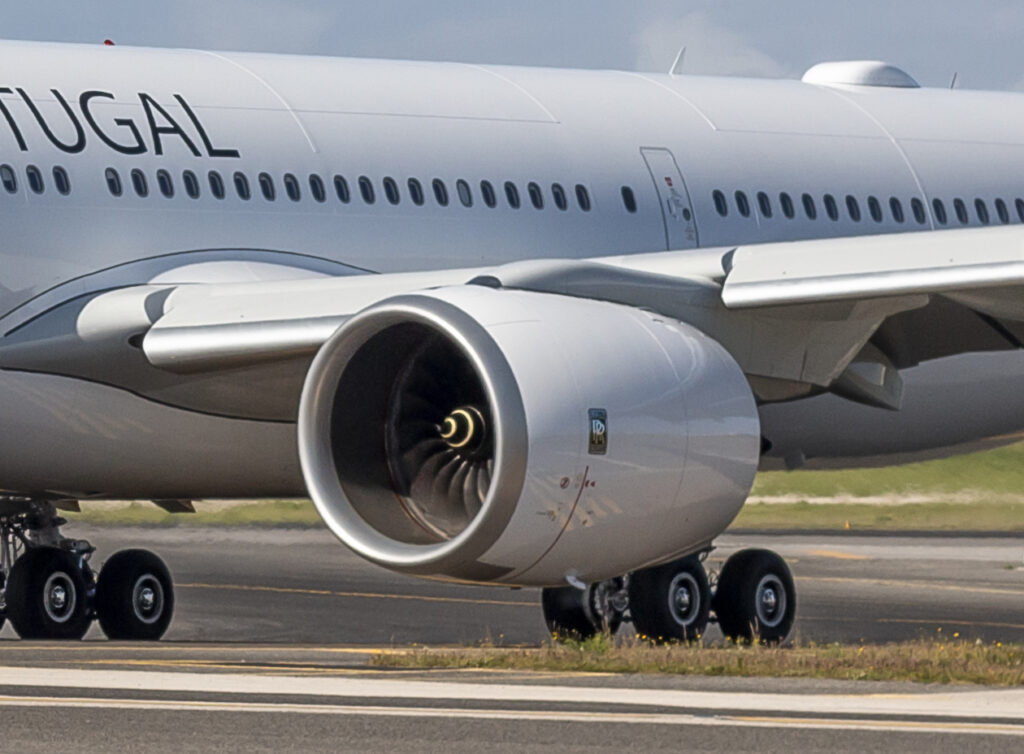
The interesting part: the A330neo’s Trent 7000 is a development of the Trent 1000 used on the 787. The big difference is air. The 787 is a “more electric”, bleedless aircraft that powers cabin pressure and most hydraulics electrically, taking less energy from the engines. The A330 was designed around bleed air, so the Trent 7000 still supplies it the traditional way.
The 787’s choice of two engine makers lets airlines bargain on price. Airbus gave Rolls-Royce exclusivity on the A330neo, and some customers complained: Air Lease Corporation’s Steven Udvar-Hazy said he wants a choice of engines. Airbus replied that supporting two engine types would add several hundred million dollars to development cost.
Cockpit and Pilots
Both have fly-by-wire controls, but they feel different. The A330neo has a sidestick beside each pilot, like every Airbus since the A320. Airbus says its A330 Common Type Rating lets pilots move from the A330 to the A350 in about eight days, without full flight simulator sessions.
The 787 keeps a control yoke and adds dual head-up displays. Its cockpit is similar to the 777’s, and Boeing says pilots can move between the two types with minimal extra training.
For an airline, this commonality is often decisive. An airline that already flies A330s or A350s can add the A330neo with almost no new pilot training. An airline with 777s, such as Air India, gets the same benefit from the 787.
Range: Where Each Can Fly
The 787-9 flies further. Boeing lists it at up to 8,300 nm (15,370 km), including a higher maximum take-off weight cleared by the FAA in March 2026. Airbus lists the A330-900neo at up to 7,350 nm (13,250 km) for the version targeting service entry in 2027. The smaller A330-800neo reaches 8,100 nm, close to the 787-9, but with fewer seats.
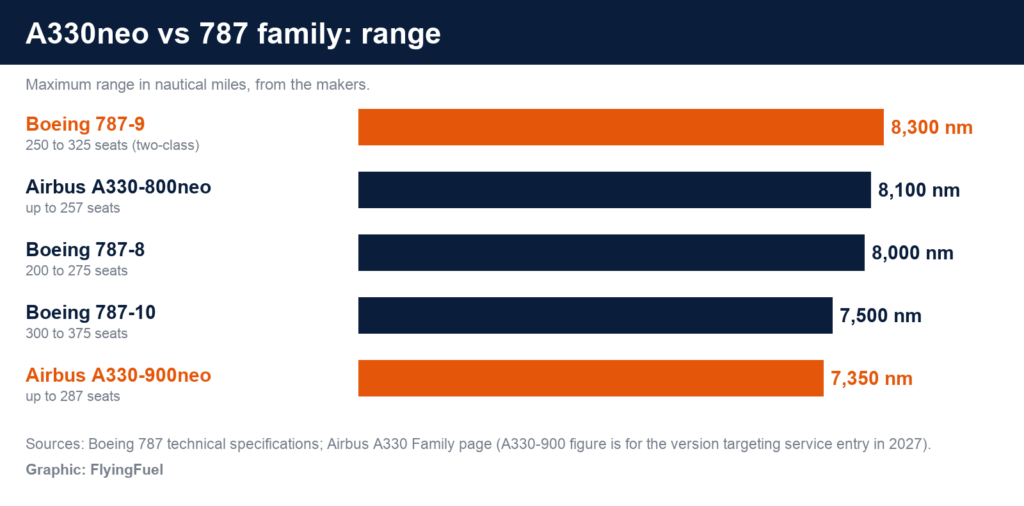
What does a 950 nm gap mean? Both aircraft can easily fly from India to anywhere in Europe, the Gulf or East Asia. The 787-9’s extra range matters mainly on the very longest routes. For the longest routes that twin-engine jets now fly, see our longest flights in the world list, and for the rules that let twins fly far from land, see what is ETOPS.
The A330neo makes up for it with flexibility. Airbus says the A330 family flies routes as short as Manila to Puerto Princesa and as long as Rome to Los Angeles, and its cargo hold takes 33 LD3 containers. The 787-9 holds 36 LD3s.
Fuel Burn: Who Really Wins?
Both makers claim an advantage, so here is what the published figures say:
- Airbus’s claim: compared with a 283-seat, nine-across 787-9, Airbus says the A330-900 burns about 1% less fuel per trip. The A330neo is 4 to 5 tonnes heavier, which costs 3%, but its 4 m wider wingspan saves 4%. Per seat, Airbus claims 3% lower fuel burn with 287 seats at eight across, and 7% with 303 seats at nine across. (Wikipedia: Airbus A330neo)
- Boeing’s claim: the 787 uses 25% less fuel than the aircraft it typically replaces, thanks to its composite structure, aerodynamics and engines.
- Against the old A330: Airbus says the A330neo burns 25% less fuel per seat than previous-generation aircraft. At launch it promised 14% better fuel burn per seat than the A330ceo.
The honest answer: on paper the two are very close, and each maker picks the cabin layout that flatters its own aircraft. Real fuel burn depends on the airline’s seats, engines and routes, and airlines do not publish that data.
Price and Orders
Here the A330neo has a real edge. One 2018 valuation, quoted by Wikipedia, put a new A330-900 at about US$115 million, against US$145 million for a new 787-9. For a leasing company or a low-cost long-haul airline, a lower price means lower monthly costs.
| Airbus A330neo (both models) | Boeing 787 (all models) | |
|---|---|---|
| Orders | 524 (September 2026) | More than 2,450 from 90 customers (Boeing) |
| Deliveries | 199 (September 2026) | More than 1,300 (Boeing) |
| Biggest operators | Delta (largest A330-900 operator), TAP, Condor, ITA Airways, Cebu Pacific | Airlines worldwide; launch customer of the -9 was Air New Zealand |
Sources: Wikipedia: Airbus A330neo; Boeing 787 page. The 787 figure covers all three models, not just the -9.
The 787 family has sold far more, and Wikipedia notes that apart from Delta, industry-leading airlines preferred the 787. But the A330neo found its own niche. Between January 2014 and November 2019, the A330 and A330neo together had 477 net orders, more than the 407 for all 787 models in the same period, and the A330neo was Airbus’s best-selling widebody in those years.
India: Who Flies Them?
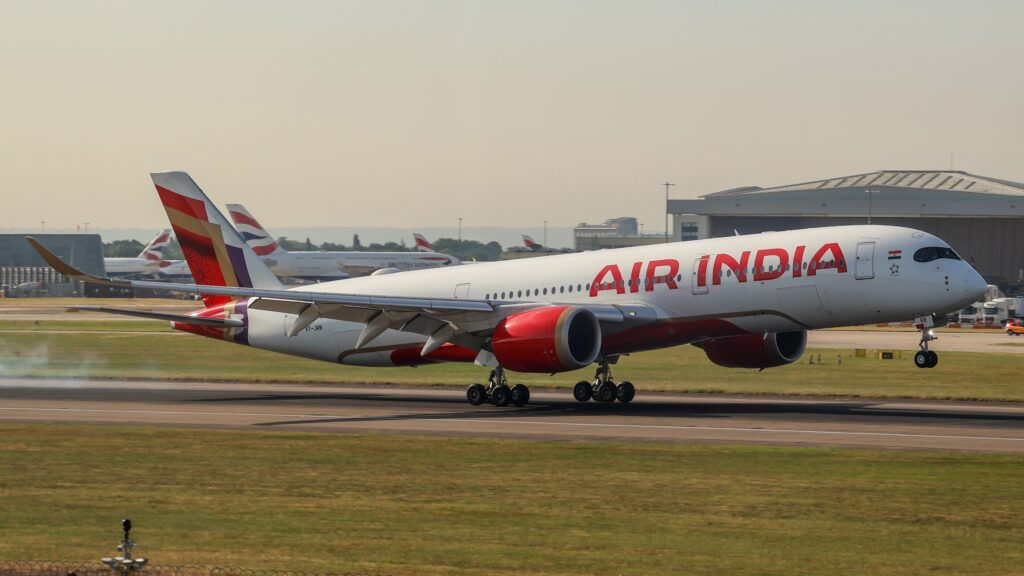
Air India had 10 Boeing 787-9s in September 2026, alongside 26 787-8s. Most of its 787-9s came from Vistara, and it received its first brand-new 787-9 in January 2026 for the Mumbai to Frankfurt route. See our Air India fleet guide.
No Indian airline flies the A330neo. It does not appear in the 2026 fleet lists of Air India or IndiGo; IndiGo’s long-haul plans are covered in our IndiGo fleet guide. Indian travellers are most likely to meet an A330neo on a foreign airline, for example on routes to Europe or Southeast Asia.
Which Is Better? Head to Head
| Area | A330-900neo | 787-9 | Better |
|---|---|---|---|
| Range | 7,350 nm | 8,300 nm | 787-9 |
| Typical seats | Up to 287 | 250 to 325 | Similar |
| Cabin environment | Airspace cabin, quiet | 6,000 ft altitude, humid air, dimmable windows | 787-9 |
| Economy seat width | Often 8 across | Usually 9 across | A330neo (when 8 across) |
| Structure | Aluminium, proven since 1994 | About 50% composite | 787-9 |
| Engine choice | One | Two | 787-9 |
| Fuel per trip (Airbus claim) | About 1% lower | Baseline | Close; disputed |
| Purchase price | About US$115 million (2018) | About US$145 million (2018) | A330neo |
| Pilot commonality | A330 and A350 | 777 | Depends on fleet |
| Orders | 524 | More than 2,450 (all 787s) | 787 |
Sources: Airbus and Boeing specifications; Wikipedia: Airbus A330neo.
Pros and Cons
Airbus A330-900neo
- Pros: cheaper to buy; wide wing helps cruise efficiency; quiet Trent 7000 engines; eight-across economy gives wider seats; easy pilot move to and from the A350; proven A330 design.
- Cons: shorter range; only one engine choice; older aluminium airframe; no 6,000 ft cabin altitude or dimmable windows; far fewer orders.
Boeing 787-9
- Pros: up to 8,300 nm; carbon-fibre body; most passenger-friendly cabin environment; two engine choices; a large worldwide fleet.
- Cons: more expensive; most airlines fit nine narrower seats per row; production problems and Trent 1000 blade issues hurt airlines in the past.
Our Verdict
The 787-9 is the better aircraft if you judge by technology, range and passenger comfort. It flies about 950 nm further, gives passengers lower cabin altitude, humid air and big windows, and lets airlines choose between two engines. That is why most of the world’s big long-haul airlines bought it.
The A330-900neo is the better deal for some airlines. It is cheaper to buy, very close in fuel burn on the routes most airlines fly, and fits neatly into fleets that already have A330s or A350s. For an airline that does not need 8,300 nm of range, saving tens of millions of dollars per aircraft is hard to ignore.
As a passenger, look at the seat map: an eight-across A330neo can be more comfortable in economy than a nine-across 787-9, even though the 787 has the better cabin air and windows. For more widebody match-ups, read our A350 vs 787 and 787-9 vs 787-10 comparisons.
Frequently Asked Questions
Which is bigger, the A330-900neo or the 787-9?
They are almost the same size. The A330-900neo is 63.69 m long with a 64 m wingspan; the 787-9 is 62.8 m long with a 60.1 m wingspan. Airbus lists the A330-900 at up to 287 seats in a typical layout; Boeing lists the 787-9 at 250 to 325 in two classes.
Which has more range, the A330neo or the 787-9?
The 787-9. Boeing lists it at up to 8,300 nm (15,370 km), while Airbus lists the A330-900neo at up to 7,350 nm (13,250 km). The smaller A330-800neo flies up to 8,100 nm.
Which is more fuel efficient, the A330-900neo or the 787-9?
It depends on the layout. Airbus claims the A330-900 burns about 1% less fuel per trip than a 283-seat, nine-across 787-9, and 3% to 7% less per seat in its own 287- and 303-seat layouts. Boeing says the 787 uses 25% less fuel than the aircraft it typically replaces. Independent airline data is not public, so treat both claims with care.
Which is cheaper, the A330neo or the 787-9?
The A330neo. Airbus’s sales chief John Leahy said it would cost about 25% less to buy than a 787-9 with similar operating costs, and one 2018 valuation put an A330-900 at US$115 million against US$145 million for a new 787-9.
Which is more comfortable, the A330neo or the 787-9?
For many passengers the 787-9: it has a lower cabin altitude (6,000 ft), more humid air and large dimmable windows. The A330neo’s Airspace cabin is quiet and, at eight seats across, gives wider economy seats than a nine-across 787. Your airline’s seat layout matters most.
What engines do the A330neo and 787-9 use?
The A330neo uses only the Rolls-Royce Trent 7000. The 787-9 can have either the GE Aerospace GEnx-1B or the Rolls-Royce Trent 1000. The Trent 7000 is a development of the Trent 1000.
Do Indian airlines fly the A330neo or 787-9?
Air India had 10 Boeing 787-9s in September 2026, most of them from Vistara. No Indian airline flies the A330neo.
Why is the A330neo cheaper than the 787?
It is a new-engine version of the A330, which first flew passengers in 1994, so Airbus reused most of the design and tooling. The 787 is an all-new, mostly carbon-fibre design that cost far more to develop and build.
Which airlines fly both the A330neo and the 787-9?
Many airlines choose one or the other. Wikipedia noted that in 2018, 19% of A330 operators also flew the 787, and that apart from Delta, most leading airlines preferred the 787.
Featured image: FlyingFuel graphic using a photo of Condor Airbus A330-900 D-ANRE by 4300streetcar, CC BY 4.0, via Wikimedia Commons.
 GulfstreamGulfstream Business Jets: Every Model From the G300 to the G800 Explained (2026)
 NewsBombardier to Hire 800 in the US and Spend $270 Million on First Phase of Expansion
 NewsAll Passengers Flying to the US Must Sign an Ebola Travel Attestation From 3 November
 BombardierBombardier Business Jets: Every Global and Challenger Model Explained (2026)
 NewsSafran LEAP Engine Deliveries Rise 26% to 1,565 in First Nine Months of 2026
 NewsEmbraer Order Backlog Hits Record $35.7 Billion as E2 Jet Orders Grow