
If you read about aircraft, you will often see the letters MTOW: “the A380 has an MTOW of 575 tonnes”, or “Boeing raised the 787-9’s MTOW to add range”. MTOW stands for maximum takeoff weight, and it is one of the most important numbers about any aircraft. It decides how much fuel, passengers and cargo the aircraft can carry, how far it can fly, and even how much the airline pays in airport fees.
In one line: MTOW is the heaviest weight at which an aircraft is allowed to start its take-off run. It is fixed during certification and never changes, but on any given day the actual allowed take-off weight can be lower because of heat, altitude, runway length and other factors.
In this guide we explain MTOW and the other aircraft weights step by step, with real examples. If you are new to aviation terms, our guides to widebody and narrowbody aircraft are a good place to start.
What Does MTOW Mean?
According to Wikipedia, the maximum takeoff weight (MTOW), also called maximum gross takeoff weight (MGTOW) or maximum takeoff mass (MTOM), is “the maximum weight at which the pilot is allowed to attempt to take off, due to structural or other limits”. It is the heaviest weight at which the aircraft has been shown to meet all the airworthiness requirements that apply to it.
Three things are important to understand:
- It is measured at the start of the take-off run, when the pilots release the brakes.
- It is fixed: the MTOW does not change with altitude, air temperature or runway length.
- It is usually set by the structure: the aircraft must be strong enough to handle all the loads it may face during take-off and flight at that weight.
MTOW is normally given in kilograms or tonnes, or in pounds for American aircraft. For example, Boeing lists the 737 MAX 8 at 82,640 kg (182,200 lb).
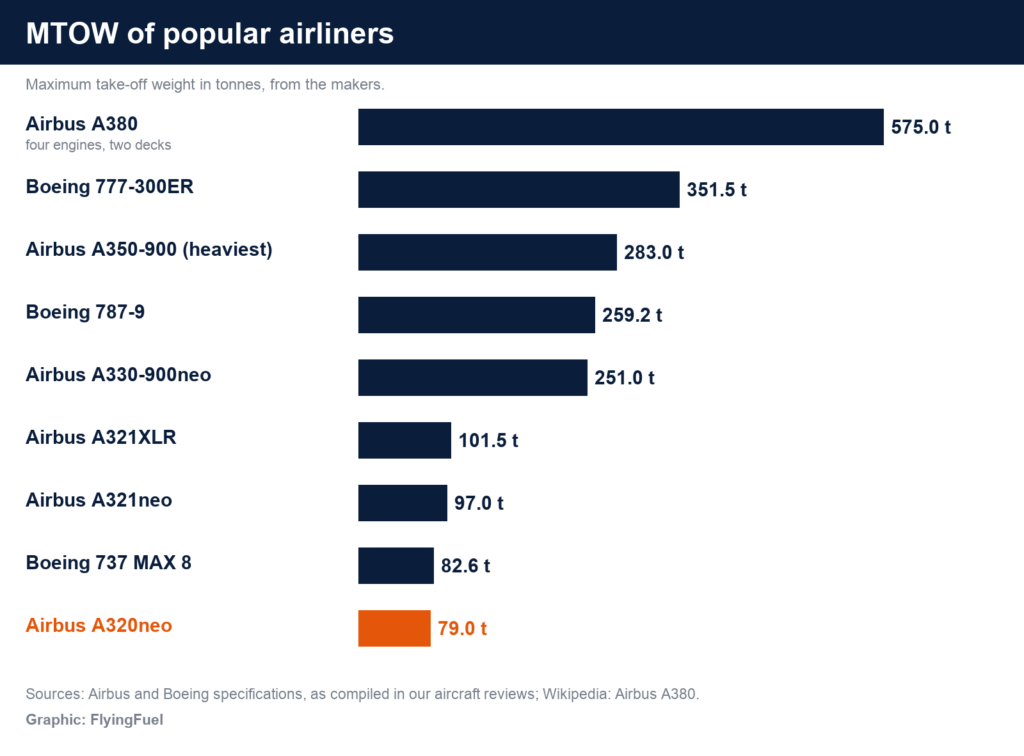
MTOW of Popular Airliners
| Aircraft | MTOW | Type |
|---|---|---|
| Airbus A320neo | 79.0 t | Single-aisle |
| Boeing 737 MAX 8 | 82.64 t | Single-aisle |
| Boeing 737 MAX 10 | 89.76 t | Single-aisle |
| Airbus A321neo | 97 t | Single-aisle |
| Airbus A321XLR | 101.5 t | Single-aisle, long range |
| Airbus A330-900neo | 251 t | Widebody |
| Boeing 787-9 | 259.2 t | Widebody |
| Airbus A350-900 | Up to 283 t | Widebody |
| Airbus A350-1000 | 308 to 322 t | Widebody |
| Boeing 777-300ER | 351.5 t | Widebody |
| Boeing 747-8 | 442 t | Four-engine widebody |
| Airbus A380 | 575 t | Four-engine, double-deck |
Sources: Airbus and Boeing specifications, as compiled in our A320neo, 737 MAX 8, 787-9, 777-300ER and other reviews; Wikipedia: Airbus A380.
The jump from single-aisle to widebody is huge: an A350-900 can weigh more than three A320neos at take-off. At the top, the A380 weighs 575 tonnes, the most of any airliner; see our list of the largest passenger aircraft.
The Weights That Make Up Take-Off Weight
An aircraft’s weight on any flight is built up in layers. Wikipedia gives a simple formula:
Take-off weight = Operating empty weight + Payload + Fuel on board
| Term | What it means |
|---|---|
| Operating empty weight (OEW) | The aircraft itself, with its fluids, standard equipment, crew and their bags, but no passengers, cargo or usable fuel |
| Payload (PL) | What earns money: passengers, their bags and cargo |
| Zero-fuel weight (ZFW) | OEW plus payload: everything except usable fuel |
| Fuel on board (FOB) | The fuel loaded for the trip, reserves and extra |
| Take-off weight (TOW) | ZFW plus fuel; it must not exceed the MTOW or the regulated take-off weight |
| Maximum landing weight (MLW) | The heaviest weight at which the aircraft may land |
Sources: Wikipedia: Operating empty weight; Wikipedia: Zero-fuel weight; Wikipedia: Maximum landing weight.
This explains the airline’s everyday trade-off. With the MTOW fixed, every extra tonne of passengers or cargo means one tonne less fuel, and less fuel means less range. On a long flight, an aircraft may reach its MTOW before its seats or cargo hold are full, so the airline has to leave some payload behind. That is why aircraft makers keep raising MTOWs, as we show below.
MTOW vs Regulated Take-Off Weight
The MTOW is a fixed limit, but on many days the aircraft is not allowed to take off at it. The actual limit for a particular take-off is called the maximum permissible take-off weight, the maximum allowed take-off weight or the regulated take-off weight. It changes from one take-off to the next, and it can never be higher than the MTOW.
Wikipedia lists the factors that can lower it:
- Flap setting: the wing configuration chosen for take-off.
- Airport altitude: thinner air at high airports reduces engine thrust.
- Air temperature: hot air is less dense, which also reduces thrust and lift.
- Runway length: a short runway gives less distance to reach take-off speed.
- Wind: a strong headwind helps; a tailwind is the worst case.
- Runway condition: a dry, paved runway is best; snow or an unpaved surface slows the aircraft.
- Obstacles: the aircraft must climb high enough to clear terrain and buildings beyond the runway.
Pilots and dispatchers calculate a series of limits, such as the field-limited, runway-limited, obstacle-limited and climb-limited weights, and the lowest one becomes the regulated take-off weight for that flight. This is why a fully loaded long-haul flight may need to carry less on a very hot summer afternoon than on a cool night.
Hot weather can even change an airline’s choice of aircraft. Wikipedia reports that Emirates considered cancelling its Boeing 787-10 order in 2019 because the engine margins were not enough for Dubai’s summer heat, and ordered 787-9s instead. See our 787-10 vs A350-900 comparison.
MTOW vs Maximum Landing Weight
An aircraft can usually take off heavier than it can land. The maximum landing weight (MLW) is the heaviest weight at which it may land, and it is almost always lower than the MTOW, because the aircraft burns fuel during the flight. According to Wikipedia, if an aircraft lands too heavy it may suffer structural damage or even break apart.
This matters when a flight has to return soon after take-off, still heavy with fuel. Some aircraft can dump fuel to get down to their MLW; others cannot. Wikipedia describes Air Canada Flight 837, a Boeing 767-300, which suffered a tyre failure and engine fire on take-off from Madrid on 3 February 2020. Because the 767-300 cannot dump fuel, it flew in a holding pattern on one engine for over four hours to burn fuel before landing safely. In a real emergency, pilots may make an overweight landing, after which the aircraft needs a structural inspection.
Why Airlines Want Higher MTOWs
Because a higher MTOW means the aircraft can carry more fuel, more payload, or both. Aircraft makers often strengthen an aircraft over its life to raise its MTOW:
| Aircraft | MTOW change | What it gave airlines |
|---|---|---|
| Boeing 787-9 | About +10,000 lb (FAA approval March 2026) | About 3 tonnes more payload or 300+ nm more range |
| Boeing 787-10 | About +14,000 lb (FAA approval March 2026) | About 5 tonnes more payload or 400+ nm more range |
| Airbus A330-900neo | Raised to 251 t (first delivered 2021) | 700 to 1,000 nm more range than earlier versions |
| Airbus A350-900 | From 268 t to 280 t, then up to 283 t | Up to 8,500 nm range on the heaviest version |
| Airbus A350-1000 | From 308 t in steps to 322 t (2023) | Range raised from 7,950 to 8,400 nm at 316 t |
Sources: Wikipedia: Boeing 787; our A330-900neo, A350-900 and A350-1000 reviews.
Sometimes a higher MTOW needs new materials. Wikipedia notes that the Airbus A330’s 242-tonne version and the A330neo use a scandium-aluminium alloy so the structure can take the extra weight without adding much empty weight. For the extreme case of adding fuel, see how the A321XLR reached 101.5 tonnes with a permanent extra fuel tank.
Why an Airline Might Choose a Lower MTOW
It sounds strange, but airlines sometimes certify their aircraft with a lower MTOW than the structure allows. The reason is money: Wikipedia explains that some costs, such as insurance premiums, landing fees and air traffic control fees, are based on MTOW. An airline flying short routes does not need the full weight, so a lower certified MTOW saves fees. Some operators can even vary a “maximum declared take-off weight” for each aircraft under a scheme.
Boeing’s new higher 787 weights are an example: Wikipedia notes that all 787-9s and 787-10s built since December 2025 can use the higher MTOW, but airlines may choose a lower certified weight because the operating weights can affect airport fees.
MTOW and Wake Turbulence Categories
MTOW also decides how far apart aircraft must be when they take off and land. Heavier aircraft leave stronger wake vortices, swirling air behind the wings that can upset a following aircraft; our turbulence guide explains more. ICAO sets four wake turbulence categories by maximum certified take-off mass:
| Category | MTOW | Examples |
|---|---|---|
| Light (L) | 7,000 kg or less | Small private aircraft |
| Medium (M) | More than 7,000 kg but less than 136,000 kg | A320neo, A321neo, 737 MAX |
| Heavy (H) | 136,000 kg or more | Most widebodies: 787, A350, 777 |
| Super (J) | Types listed by ICAO | Only the Airbus A380 (575 t) |
Source: Wikipedia: Wake turbulence category.
That is why you may hear pilots of big jets add “heavy” or “super” to their call sign on the radio, so air traffic control and other pilots leave extra space. ICAO’s distance minimum behind a Super aircraft is 13 km for a following Medium aircraft, against 9.3 km behind a Heavy.
Key Takeaways
- MTOW is the maximum weight at which an aircraft may start its take-off run; it is fixed at certification.
- The regulated take-off weight for a given flight can be lower, because of heat, altitude, runway, wind and obstacles.
- Take-off weight = empty weight + payload + fuel, so more payload means less fuel and less range.
- Maximum landing weight is usually lower than MTOW, which is why heavy aircraft may dump or burn fuel before an early landing.
- MTOW also sets landing fees and wake turbulence categories; the A380 is the only Super.
Frequently Asked Questions
What is MTOW in simple words?
MTOW stands for maximum takeoff weight: the heaviest weight at which an aircraft is allowed to start its take-off run. It is set during certification, mainly by the strength of the structure, and it never changes with weather or runway.
What is the full form of MTOW?
Maximum Take-Off Weight. It is also called maximum gross takeoff weight (MGTOW) or maximum takeoff mass (MTOM). It is usually given in kilograms, tonnes or pounds.
Can an aircraft always take off at its MTOW?
No. On a hot day, at a high-altitude airport, on a short or wet runway, or with obstacles beyond the runway, the allowed take-off weight can be lower. That lower limit is called the regulated or maximum permissible take-off weight, and it can never be higher than the MTOW.
What is the difference between MTOW and MLW?
MTOW is the maximum weight for take-off; MLW, the maximum landing weight, is the maximum weight for landing. MLW is almost always lower, because the aircraft burns fuel during the flight. Landing too heavy can damage the structure.
What is zero-fuel weight?
The weight of the aircraft and everything in it except usable fuel: the empty aircraft plus crew, passengers, bags and cargo. Take-off weight equals zero-fuel weight plus the fuel on board.
Which airliner has the highest MTOW?
Among passenger aircraft, the Airbus A380, at 575 tonnes. It is the only aircraft in ICAO’s “Super” wake turbulence category.
What is the MTOW of the Airbus A320neo?
79 tonnes. The longer A321neo is 97 tonnes and the long-range A321XLR is 101.5 tonnes.
Why would an airline choose a lower MTOW?
Because some charges, such as landing fees, insurance and air traffic control fees, are based on MTOW. An airline that does not need the full weight can certify a lower MTOW to pay less.
Why does MTOW affect wake turbulence rules?
ICAO groups aircraft into Light, Medium, Heavy and Super categories by MTOW. Heavier aircraft leave stronger wake vortices, so air traffic control keeps more distance behind them.
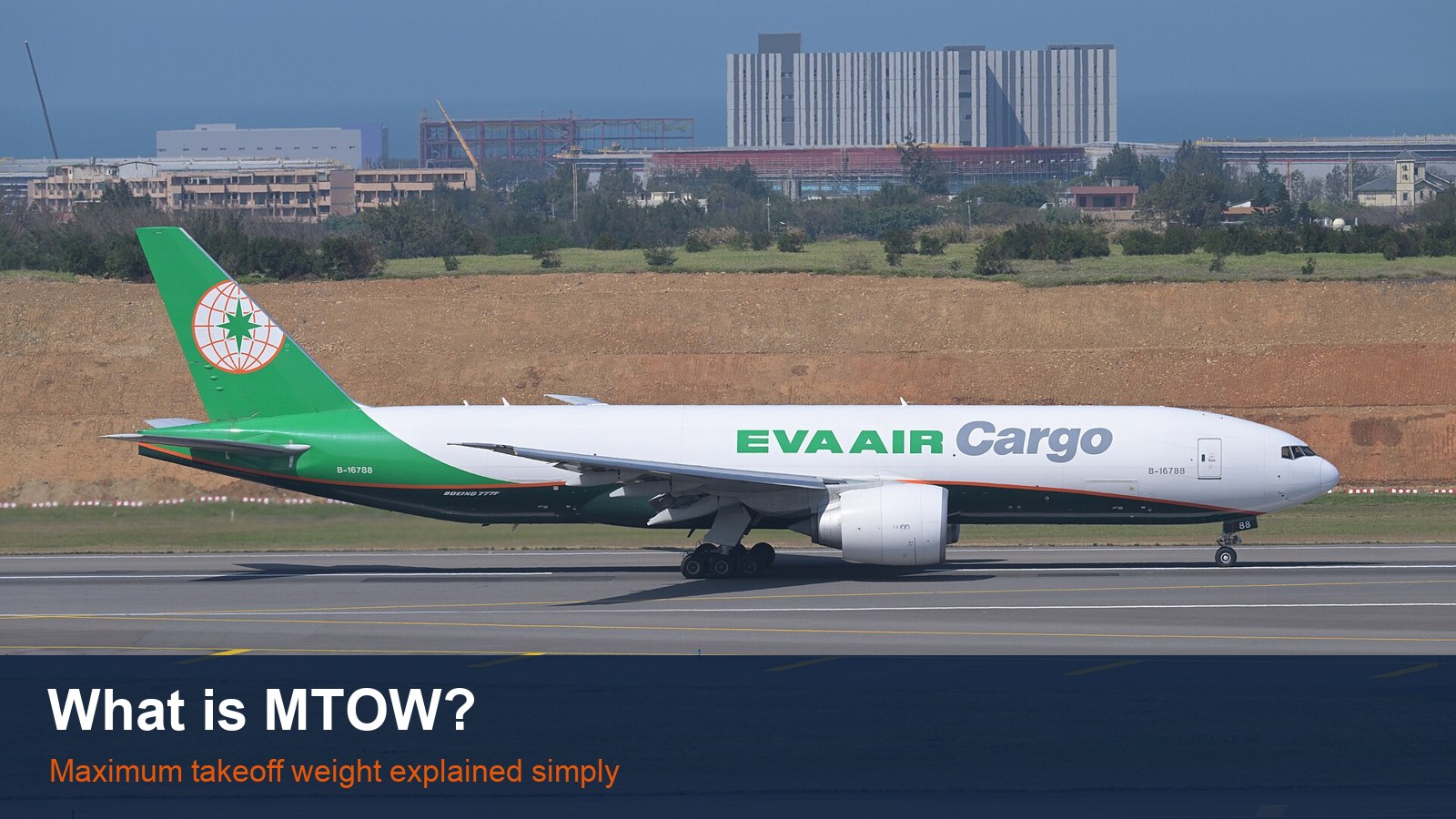
Featured image: FlyingFuel graphic using a photo of EVA Air Cargo Boeing 777F B-16788 on its take-off run at Taipei Taoyuan by 4300streetcar, CC BY 4.0, via Wikimedia Commons.
 Embraer Executive JetsEmbraer Business Jets: Phenom 100EX, Phenom 300EV, Praetor 500E and 600E Explained (2026)
 NewseasyJet to Fit Starlink Wi-Fi Across Its Airbus Fleet From 2027
 NewsFAA Proposes Fan Blade Checks on Every CFM56-7B Engine After 737 Blade Failure
 Dassault FalconDassault Falcon Jets: Every Model From the 2000LXS to the 10X Explained (2026)
 GulfstreamGulfstream Business Jets: Every Model From the G300 to the G800 Explained (2026)
 NewsBombardier to Hire 800 in the US and Spend $270 Million on First Phase of Expansion