
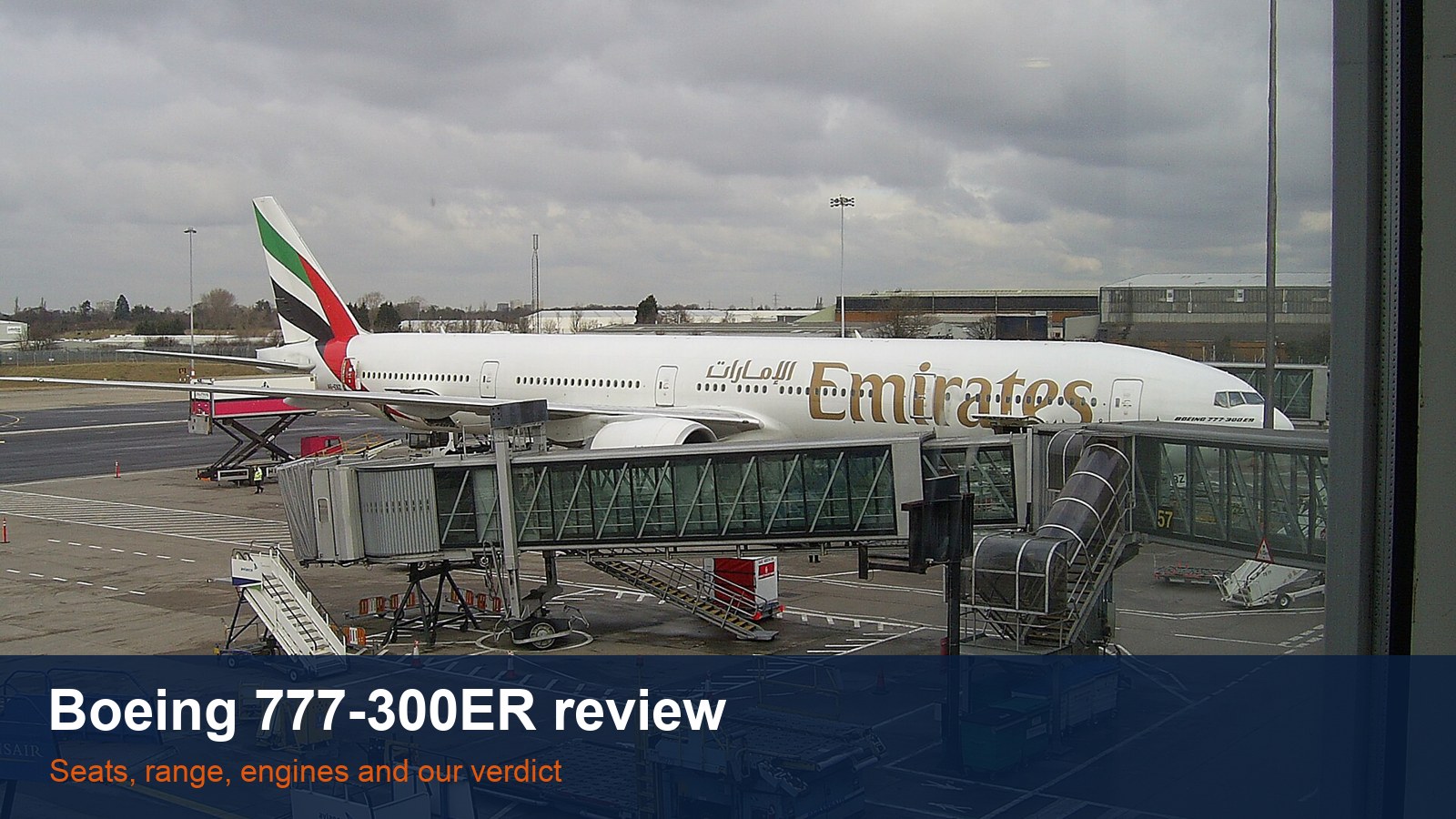
The Boeing 777-300ER is the longest model of the original Boeing 777 family, the best-selling version of the best-selling widebody airliner ever built, and for two decades the backbone of long-haul fleets from Emirates to Air India. It is the aircraft that convinced airlines they could replace four-engine jumbo jets with a twin.
Our verdict in one line: the 777-300ER is a proven, big-capacity workhorse, with 350 to 425 seats in two classes, up to 7,500 nm of range and two of the most powerful jet engines ever flown. It is now being replaced by the more efficient 777-9 and A350-1000, but it will remain one of the most common long-haul jets in the sky for years.
This review explains the 777-300ER in detail: its history, how to recognise it, what is inside the cabin and cockpit, the giant GE90-115B engine in simple words, range and payload, safety, who flies it in India, and how it compares with the A350-1000 and its own successor, the 777-9.
Boeing 777-300ER Quick Facts
| Item | Boeing 777-300ER |
|---|---|
| Type | Twin-aisle (widebody) twin-engine airliner |
| Seats (two-class) | 350 to 425 |
| Range | Up to 7,500 nm (13,890 km) |
| Length | 73.9 m (242 ft 4 in) |
| Wingspan | 64.8 m (212 ft 7 in) |
| Height | 18.5 m (60 ft 8 in) |
| Maximum take-off weight | 351,530 kg (775,000 lb) |
| Engines | 2 x GE Aerospace GE90-115B (115,000 lbf class) |
| Economy layout | Usually 10 per row (3-4-3); some airlines 9 (3-3-3) |
| First flight | 24 February 2003 |
| First delivery | 29 April 2004, Air France |
| Delivered | 833, the best-selling 777 model |
Sources: Boeing 777 technical specifications; Wikipedia: Boeing 777 (deliveries as of September 2026).
What Is the 777-300ER?
The Boeing 777, nicknamed the “Triple Seven”, first flew on 12 June 1994 and entered service with United Airlines on 7 June 1995. It was the first Boeing airliner with fly-by-wire controls and the first commercial aircraft designed entirely on computer (in 3D CAD software called CATIA), according to its history. Airlines including United, All Nippon Airways, Cathay Pacific and British Airways helped design it.
The first 777s (“Classics”) were the 777-200, 777-200ER and a longer 777-300. Airlines then asked for more range and payload. Boeing launched the 777-300ER (“Extended Range”) with an order for ten aircraft from Air France. It first flew on 24 February 2003, was certified by the FAA and EASA on 16 March 2004, and Air France received the first one on 29 April 2004.
The 777-300ER combined the extra length of the 777-300 with the range of the 777-200ER, and it became the top-selling 777 model as airlines replaced four-engine aircraft with cheaper-to-run twins. In total 2,502 777s of all versions have been ordered and 1,796 delivered, making the 777 the world’s best-selling widebody airliner and the largest twinjet. The 777-300ER accounts for 833 of those deliveries.
From 777-300 to 777-300ER: What Changed
The 777-300ER looks almost identical to the original 777-300, but under the skin it is a much more capable aircraft. These were the main changes, according to the 777 development history:
| Original 777-300 (Classic) | 777-300ER | |
|---|---|---|
| Maximum take-off weight | About 263 to 300 tonnes | 351.5 tonnes (775,000 lb) |
| Engines | GE90, PW4000 or Trent 800, 77,200 to 98,000 lbf | GE90-115B only, 110,000 to 115,300 lbf |
| Wingtips | Standard | Extended raked wingtips |
| Tail protection on take-off | Tail skid | Flight-control software keeps the tail off the runway |
| Structure | – | Strengthened fuselage section above the wing, new evacuation door pair |
| Range | Shorter | Up to 7,500 nm |
In plain words, Boeing took the long 777-300, gave it much more powerful engines, more fuel weight and longer wings, and turned a medium-range people carrier into a true long-haul aircraft. That is exactly what airlines wanted when fuel prices rose: an aircraft that could carry close to 747 loads on two engines instead of four, with lower operating costs. Wikipedia notes that the -300ER became the top-selling 777 variant in the late 2000s as airlines replaced four-engine aircraft with twinjets.
Flying on a 777-300ER: Passenger Tips
- Check the seats per row: a nine-abreast 777 economy cabin is noticeably roomier than a ten-abreast one. The airline’s seat map shows the layout.
- Look for the newest cabins: many airlines, including Emirates, are refitting their 777s with new seats and interiors, so the same route can feel very different on a refreshed aircraft.
- Long flights, big hold: the 777-300ER’s large lower deck means airlines can carry plenty of checked bags and cargo, but your baggage allowance still depends on your fare, not the aircraft.
- Windows: 777 windows are large by older standards, but smaller than the 787’s and they use traditional pull-down shades.
How the 777-300ER Looks
The 777 is easy to recognise once you know what to look for:
- Enormous engines: the GE90-115B fan is 128 inches across, roughly half the 777 fuselage’s 244-inch diameter.
- Six-wheel main landing gear: each main gear leg has six wheels (three pairs).
- Blade-shaped tail cone: the very back of the fuselage ends in a flat, vertical blade instead of a round point.
- Raked wingtips: the 777-300ER has extended, swept-back wingtips with no winglet.
- Length: at 73.9 m it is almost 10 m longer than the 777-200ER and 777-200LR (63.7 m).
The 777-300ER also gained a strengthened fuselage section above the wing, an extra pair of evacuation doors compared with the 777-200, and flight-control software that keeps the long tail off the runway during take-off, so it does not need the tail skid used on the earlier 777-300.
Engines: The Giant GE90-115B
Every 777-300ER flies with two GE Aerospace GE90-115B engines. As part of its deal with GE, Boeing agreed to offer only GE90 engines on the new long-range 777s, so airlines have one choice.
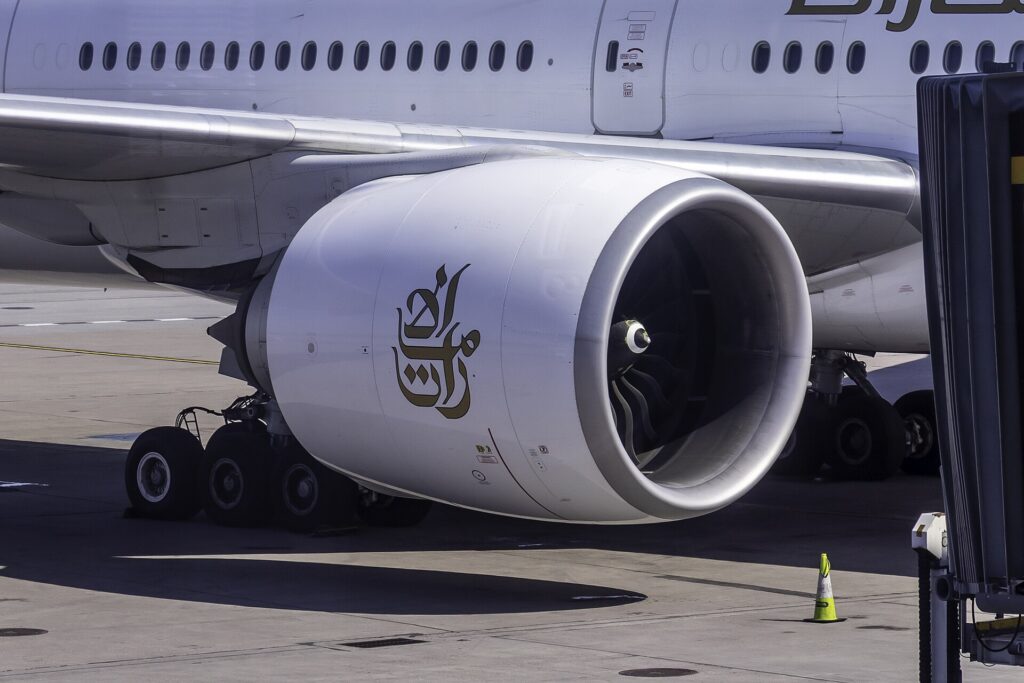
| GE90-115B detail | Figure |
|---|---|
| Thrust | Rated at 115,000 lbf, higher than the newer GE9X |
| Fan diameter | 128 in (325 cm) |
| Fan blades | 22 carbon-fibre composite blades |
| Title | Largest jet engine in the world until the GE9X (January 2020) |
| Entered service (GE90 family) | November 1995, British Airways |
Source: Wikipedia: General Electric GE90.
In simple words: a turbofan uses a huge fan to push a large amount of air around the engine core. A bigger fan moves more air for the same fuel, making the engine more efficient and quieter. The GE90’s big innovation was its carbon-fibre fan blades, which are twice as strong as traditional titanium blades at one-third of the weight. That let GE build a very large fan with only 22 blades. See our turbofan vs turboprop guide for the basics of how these engines work.
Why does a twin need such powerful engines? A heavy, long-range twin must be able to take off and climb safely on one engine if the other fails. Bigger engines are the price of carrying 350+ passengers with two engines instead of four, and they are why the 777 could fly long routes far from diversion airports under ETOPS rules. It is a big part of why twin-engine jets took over long-haul flying.
Inside the Cabin
The 777 has a fully circular, wide fuselage, which is why it can seat up to ten people per row in economy. The original interior, known as the Boeing Signature Interior, introduced curved panels, larger overhead bins and indirect lighting, and later spread to other Boeing jets. The 777’s windows measure about 15 by 10 inches; they were the largest of any airliner until the 787.
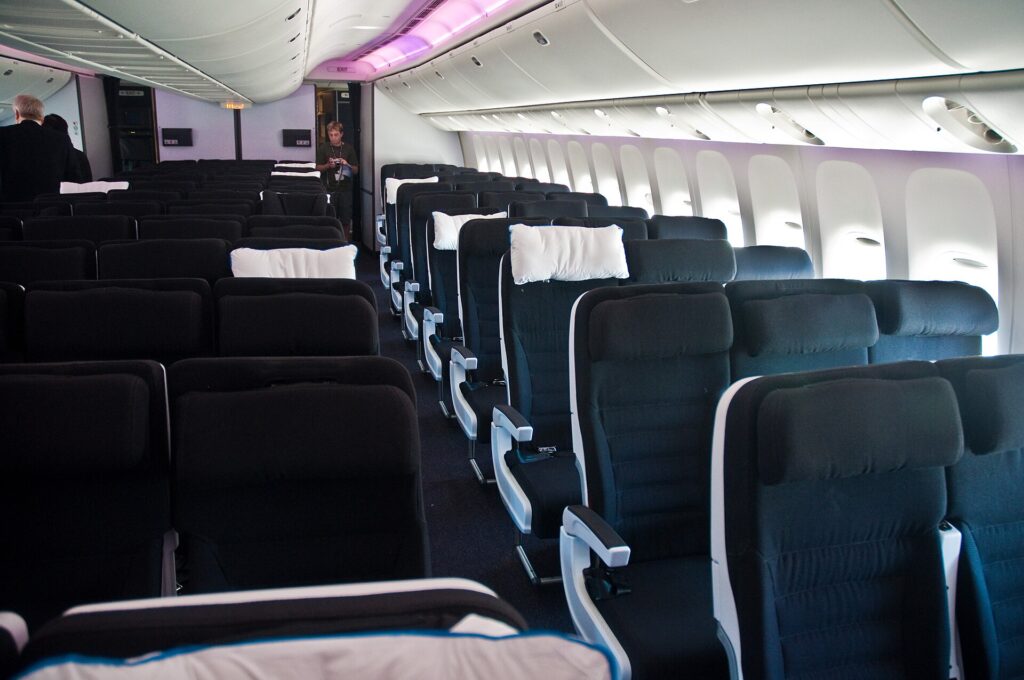
Nine or ten seats per row?
When the 777 was new, most airlines fitted nine economy seats per row (3-3-3). To lower the cost per seat, airlines have moved to ten across (3-4-3). In 2001 only 5% of 777 deliveries had ten-abreast economy; by 2016 it was over 50%, and many airlines retrofitted older aircraft, according to the aircraft’s interior history. Ten-abreast is tighter, so if comfort matters, check the seat map before you book. At the other extreme, Air France has a 777-300ER version with 472 seats.
Hidden crew rests
On long flights pilots and cabin crew need to sleep. Since 2003 airlines can order overhead crew rests: hidden compartments above the main cabin reached by stairs. The forward pilot rest has two seats and two bunks, and the rear crew rest has several bunks, leaving the main deck free for paying passengers.
Premium cabins depend entirely on the airline. Business class layouts vary by airline; EVA Air, for example, uses a 1-2-1 reverse-herringbone layout on its 777-300ERs. Emirates, for example, has a large retrofit programme; by May 2026 it had refreshed 53 of its Boeing 777s with new seats and interiors, as covered in our Emirates fleet story.
The Cockpit
The 777 was Boeing’s first fly-by-wire airliner: the pilots’ inputs go to computers that move the control surfaces, which allows protections such as the take-off tail-strike software on the 777-300ER. Pilots still use a control yoke, and the two-crew glass cockpit uses large flat-panel displays. The 787’s cockpit was designed to be similar, so Boeing says pilots can move between the 777 and 787 with minimal extra training.
Range and Payload
Boeing lists the 777-300ER at up to 7,500 nautical miles (13,890 km) with a maximum take-off weight of 351,530 kg. That is enough to fly nonstop from Delhi or Mumbai to anywhere in Europe. Just as important for airlines is payload: the 777-300ER can carry a full cabin and a large amount of cargo in its lower hold at the same time, which makes long routes more profitable. In 2010 Boeing raised its maximum zero-fuel weight by 5,000 lb, equal to 20 to 25 more passengers, and gave the GE90-115B a 1 to 2.5% thrust boost for hot and high airports.
The 777 Family
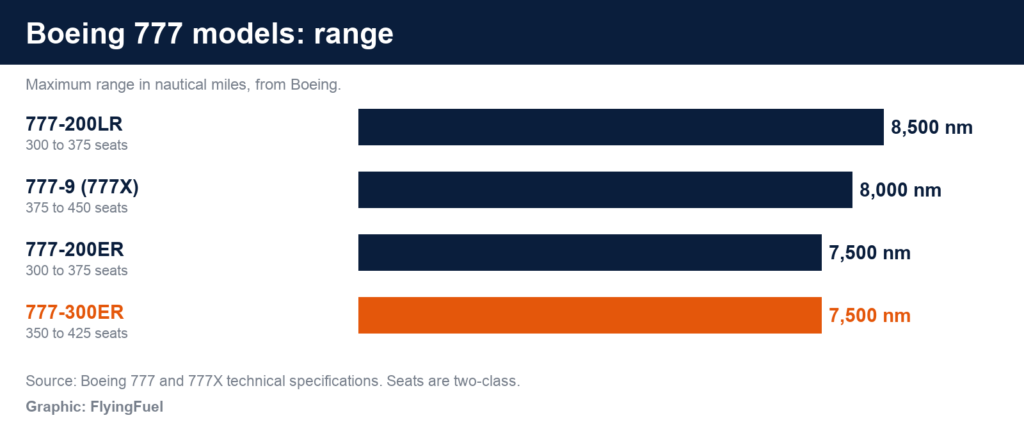
| Model | Seats (two-class) | Range | Length | Engines |
|---|---|---|---|---|
| 777-200ER | 300-375 | 7,500 nm | 63.7 m | PW4000, Trent 800 or GE90 |
| 777-200LR | 300-375 | 8,500 nm | 63.7 m | GE90 |
| 777-300ER | 350-425 | 7,500 nm | 73.9 m | GE90 |
| 777-9 (777X) | 375-450 | 8,000 nm | 76.7 m | GE9X |
Sources: Boeing 777 technical specifications and Boeing 777X specifications.
The 777-200LR has the longest range of the original 777s, but the 777-300ER carries about 50 more passengers over the same 7,500 nm as the 777-200ER. That balance is why it outsold every other 777 version. There is also a freighter world: the 777F is built new, and Israel Aerospace Industries converts retired 777-300ERs into 777-300ERSF freighters; Kalitta Air was the launch operator.
Safety Record
The 777 has a strong safety record for an aircraft that has flown for three decades. As of May 2024 the type had been involved in 31 accidents and incidents, including five hull-loss accidents out of eight total hull losses, with 542 deaths, according to Wikipedia’s 777 summary. The 777 was also the first airliner to enter service with 180-minute ETOPS approval, in 1995.
Who Flies the 777-300ER?
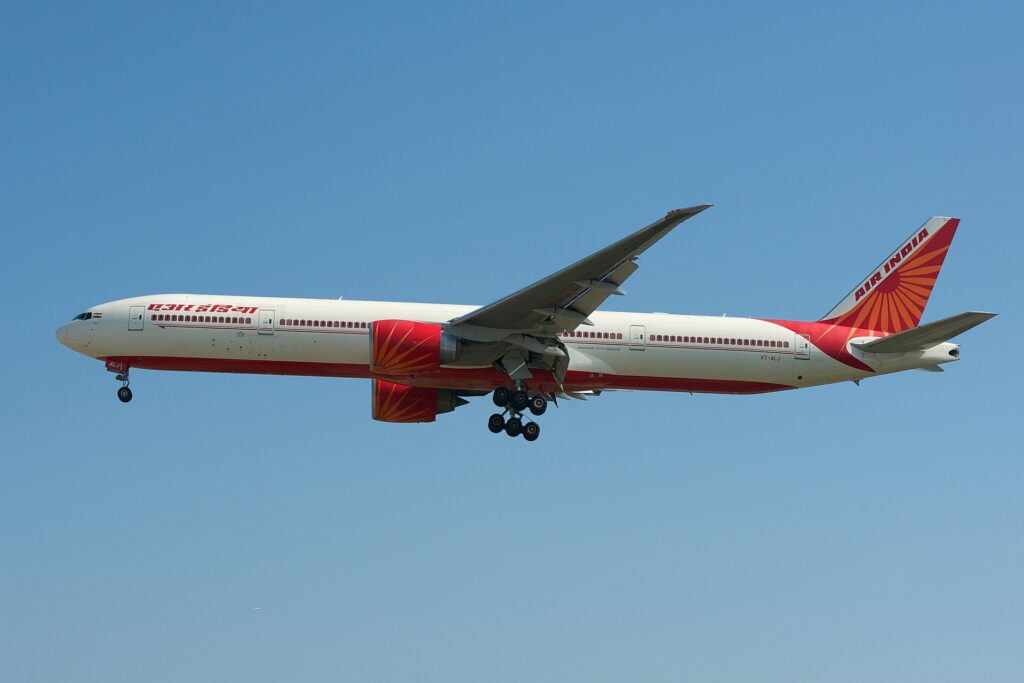
- Air India had 19 Boeing 777-300ERs in September 2026, flying long-haul international routes alongside its 787s and A350s. See our Air India fleet guide.
- Emirates is the world’s largest 777 operator, with 119 777-300ERs in November 2025 and 270 777-9s on order to replace them; see our Emirates fleet story.
- Other major operators include Qatar Airways, United Airlines, American Airlines and Air France.
777-300ER vs Its Rivals
777-300ER vs Airbus A350-1000
| Boeing 777-300ER | Airbus A350-1000 | Better | |
|---|---|---|---|
| Status | In service since 2004 | In service since 2018 | A350 (newer technology) |
| Length | 73.9 m | 73.78 m | About equal |
| Wingspan | 64.8 m | 64.75 m | Equal (same gates) |
| Seats | 350-425 (two-class) | 375-400 (three-class), max 480 | Depends on layout |
| Range | 7,500 nm | 8,100 nm | A350 |
| Maximum take-off weight | 351.5 t | 308-322 t | A350 (lighter, less fuel) |
| Engines | GE90-115B, 115,000 lbf | Trent XWB-97, 97,000 lbf | A350 (newer, more efficient) |
| Body | Aluminium | Mostly carbon-fibre composite | A350 |
| Economy | Usually 10 across | 9 or 10 across | Depends on the airline |
Sources: Boeing and Airbus specifications, as compiled in our A350-1000 vs 777-9 comparison.
The A350-1000 is about the same length but roughly 30 to 40 tonnes lighter, so it needs much less fuel for the same trip. That is why airlines ordering new aircraft of this size now choose the A350-1000 or the 777-9 instead.
777-300ER vs 777-9 (its replacement)
| Boeing 777-300ER | Boeing 777-9 | |
|---|---|---|
| Seats (two-class) | 350 to 425 | 375 to 450 |
| Range | Up to 7,500 nm | Up to 8,000 nm |
| Length | 73.9 m | 76.7 m |
| Wingspan | 64.8 m | 71.8 m in flight; 64.8 m folded |
| Engines | GE90-115B | GE9X (134 in fan) |
| Status | In service | In certification; first delivery expected 2027 |
The 777-9 is longer, carries more people and flies further, and its folding wingtips let it use the same gates as the 777-300ER. Boeing says it will use about 20% less fuel than the aircraft it replaces. Read our full Boeing 777-9 review.
Pros and Cons
Pros
- Big capacity: 350 to 425 seats in two classes
- 7,500 nm range with a large cargo load
- Proven over 20 years with the world’s biggest long-haul airlines
- Two engines instead of four, cutting fuel and maintenance costs
- Wide cabin and large windows
- Overhead crew rests free up main-deck space
- Strong second life as a converted freighter
Cons
- Burns more fuel than the newer A350-1000 and 777-9
- Heavy aluminium airframe
- Ten-abreast economy is tight on many airlines
- Only one engine option (GE90-115B)
- Older cabin technology: higher cabin altitude and drier air than 787/A350
- No longer the first choice for new orders
Our Verdict
The 777-300ER is one of the most important airliners ever built. It proved that a twin-engine jet could do the job of a 747 on long routes, and it did so reliably for two decades. For airlines it is a cash machine on busy routes: lots of seats, lots of cargo and enough range for almost any city pair.
For passengers, the experience depends on the airline. A nine-abreast 777 with modern seats is still very comfortable, while a ten-abreast cabin can feel cramped on a 14-hour flight. As newer, lighter jets arrive, the 777-300ER is slowly moving from the front line to the second line, but you will keep seeing it at Indian airports with Air India, Emirates and many other airlines for years to come. Compare it with Boeing’s smaller long-haul jet in our Boeing 787-9 Dreamliner review.
Frequently Asked Questions
How many seats does a Boeing 777-300ER have?
Boeing lists 350 to 425 seats in a typical two-class layout. Air France has a 777-300ER version with 472 seats, more than any other international airline’s.
What is the range of the 777-300ER?
Up to 7,500 nautical miles (13,890 km), according to Boeing.
What engine does the 777-300ER use?
Only the GE Aerospace GE90-115B. It has a 128-inch (325 cm) fan with 22 carbon-fibre composite blades and is rated at 115,000 lbf of thrust. It was the largest jet engine in the world until the GE9X, built for the 777X, overtook it in 2020.
What does ER mean in 777-300ER?
Extended Range. The 777-300ER combined the extra length and capacity of the original 777-300 with the range of the 777-200ER.
How many seats per row are there in 777-300ER economy?
Usually ten (3-4-3). Many airlines first flew the 777 with nine seats per row, but by 2016 more than half of new 777 deliveries had ten-abreast economy.
Is the 777-300ER still being built?
The 777-300ER is being replaced by the 777-9 (777X), which Boeing expects to deliver from 2027. Many 777-300ERs will keep flying for years, and some are being converted into freighters, such as the IAI 777-300ERSF.
Does Air India fly the 777-300ER?
Yes. Air India had 19 Boeing 777-300ERs in September 2026, used on long-haul international routes.
Which airline has the most 777-300ERs?
Emirates is the largest 777 operator. It had 119 777-300ERs in its fleet in November 2025, according to its fleet table.
Is the 777-300ER better than the A350-1000?
The A350-1000 is newer and much lighter, so it burns less fuel. The 777-300ER is longer, has a wider cabin for ten-abreast economy, and has decades of proven service. Airlines now buy the A350-1000 or the 777-9 instead of new 777-300ERs.
Featured image: FlyingFuel graphic using a photo of an Emirates Boeing 777-300ER by Kookaburra125 (talk), CC BY 3.0, via Wikimedia Commons.
 Embraer Executive JetsEmbraer Business Jets: Phenom 100EX, Phenom 300EV, Praetor 500E and 600E Explained (2026)
 NewseasyJet to Fit Starlink Wi-Fi Across Its Airbus Fleet From 2027
 NewsFAA Proposes Fan Blade Checks on Every CFM56-7B Engine After 737 Blade Failure
 Dassault FalconDassault Falcon Jets: Every Model From the 2000LXS to the 10X Explained (2026)
 GulfstreamGulfstream Business Jets: Every Model From the G300 to the G800 Explained (2026)
 NewsBombardier to Hire 800 in the US and Spend $270 Million on First Phase of Expansion