
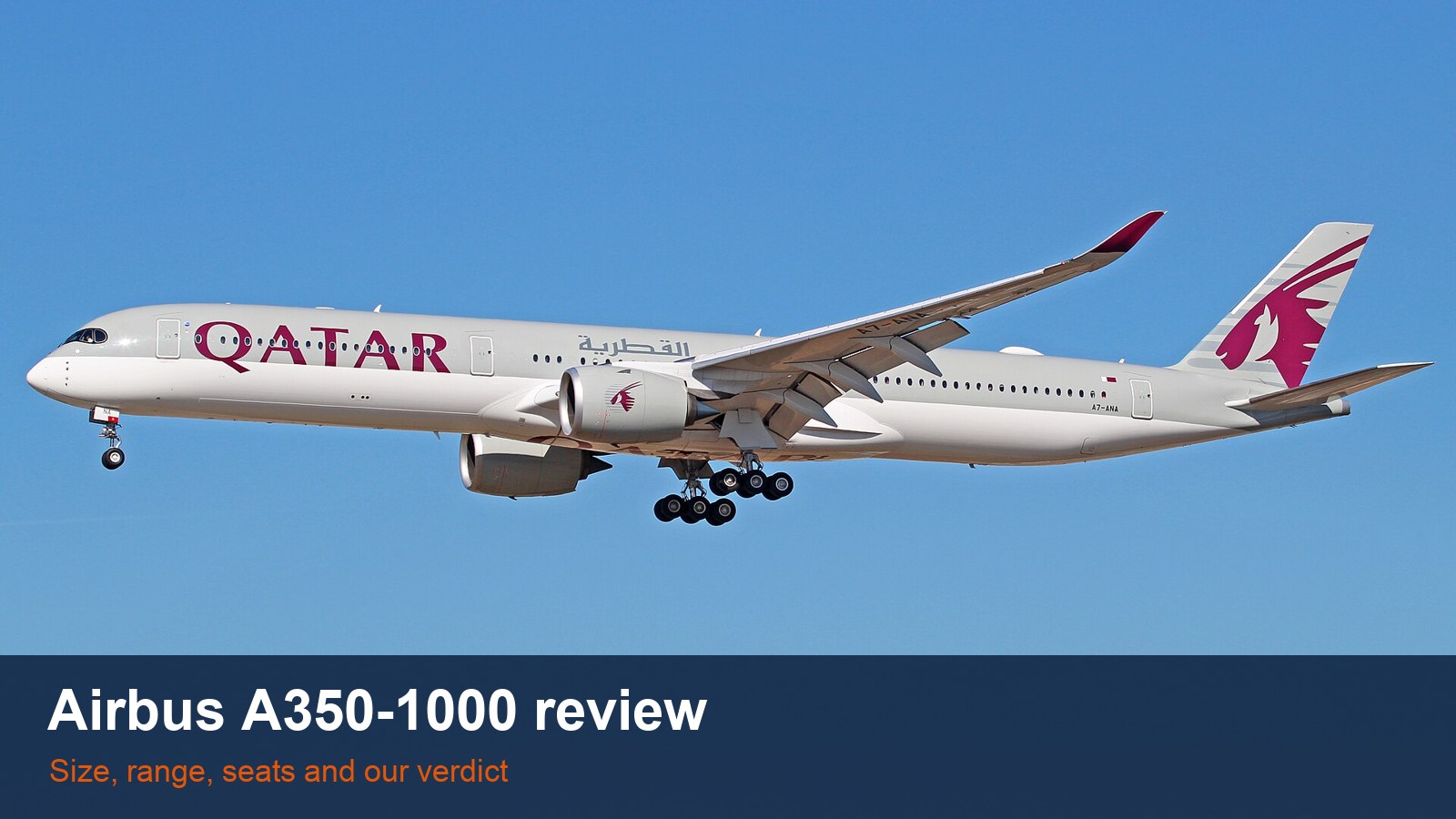
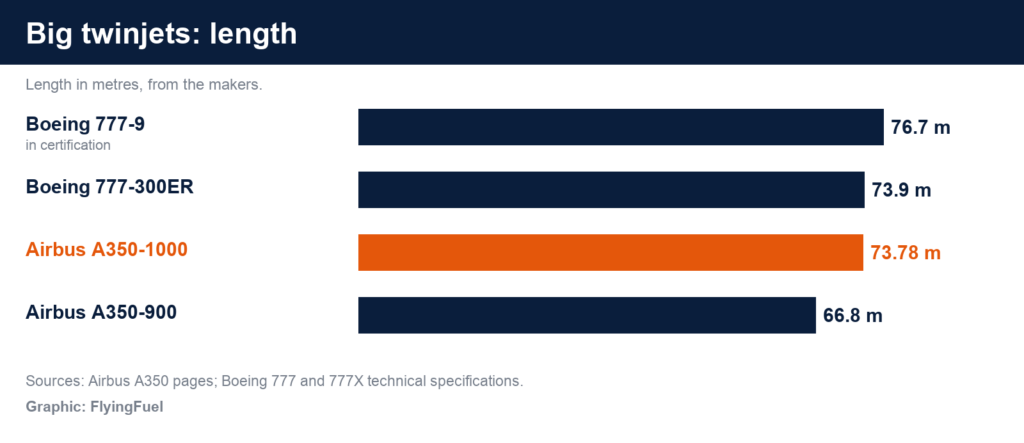
The Airbus A350-1000 is the largest member of the A350 family. At 73.78 m it is almost exactly as long as the Boeing 777-300ER it was designed to replace, but it is built mostly from carbon fibre and burns far less fuel. It is also the aircraft Qantas chose for Project Sunrise, nonstop flights from Sydney to London and New York.
Our verdict in one line: the A350-1000 is the best big twin-engine airliner you can fly on today, with 375 to 400 seats in three classes (up to 480), a range of 8,100 nm, and, Airbus claims, 25% lower fuel burn per seat than the 777-300ER. The bigger Boeing 777-9 will carry more people when it arrives, but the A350-1000 has been flying since 2018.
In this review we explain everything step by step: what changed from the A350-900, how to spot the -1000, the cabin and its two very different layouts, the Trent XWB-97 engine, range and weights, Project Sunrise, safety and reliability, who flies it, and how it compares with the 777-300ER and 777-9.
Airbus A350-1000 Quick Facts
| Item | Airbus A350-1000 |
|---|---|
| Type | Twin-aisle (widebody) twin-engine airliner |
| Seats (three-class) | 375 to 400 |
| Maximum seats | 480 (since 2019) |
| Range | 8,100 nm (15,000 km); 9,000 nm version planned for 2030 |
| Length | 73.78 m (242 ft 1 in) |
| Wingspan | 64.75 m (212 ft 5 in) |
| Height | 17.08 m |
| Maximum take-off weight | 308 tonnes, up to 322 tonnes |
| Fuel capacity | 158,790 to 168,300 litres |
| Engines | 2 x Rolls-Royce Trent XWB-97 (97,000 lbf) |
| Main landing gear | Six-wheel bogies |
| First flight | 24 November 2016 |
| Entered service | February 2018, Qatar Airways |
| Delivered | 112 by end of May 2026 |
Sources: Airbus A350 product page and facts and figures, as compiled in our A350-1000 vs 777-9 comparison; Wikipedia: Airbus A350.
What Is the A350-1000?
The A350 family was launched in 2006 as a clean-sheet “Extra Wide Body” (XWB) design. The A350-900 came first in 2015; the stretched A350-1000 followed. Its first aircraft was assembled in 2016 and first flew on 24 November 2016. Qatar Airways, which had also launched the -900, received the first A350-1000, A7-ANA, on 20 February 2018 and flew it from Doha to London Heathrow, according to its history.
Airbus designed the -1000 to replace the four-engine A340-600 and to compete with the Boeing 777-300ER and 777X. Airbus claims a 369-seat A350-1000 has a 25% fuel burn per seat advantage over a 360-seat 777-300ER, and estimates that against a 398-seat 777-9 it has a 35-tonne lighter empty weight, 15% lower trip cost, 7% lower seat cost and 400 nm more range. These are Airbus’s own figures.
For the background on the A350 family, including its carbon-fibre construction and morphing wing, read our A350-900 review first.
What Changed From the A350-900
The -1000 is far more than a simple stretch. To carry more people over a similar distance, Airbus changed several things, according to Wikipedia:
- Longer fuselage: 11 extra frames, about 7 m, giving room for about 40 more passengers and 40% more premium cabin area.
- Bigger wing: a trailing-edge extension adds about 4% wing area and roughly 400 mm of chord, improving both lift at low speed and cruise efficiency. The span stays 64.75 m, inside airport Code E.
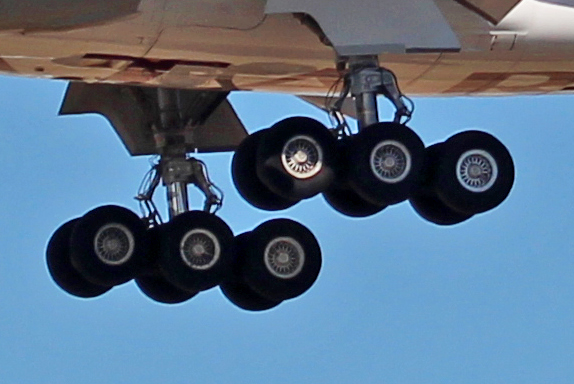
- Six-wheel main landing gear: each main leg has six wheels instead of four, to spread the extra weight on runways and taxiways.
- More powerful engines: the Trent XWB-97 with 97,000 lbf of thrust instead of 84,000.
- Automatic emergency descent: if the cabin loses pressure and the crew do not respond to alerts, the aircraft can descend on its own to about 10,000 ft and notify air traffic control.
How to recognise an A350-1000
- Six-wheel main gear under the belly; the A350-900 has four wheels per leg.
- Length: the -1000 looks noticeably longer and slimmer than the -900, with more windows between the wing and tail.
- Shared A350 features: the dark “raccoon mask” around the cockpit windows and the curved wingtips.
Inside the Cabin
The A350-1000 has the same wide A350 cabin as the -900: Airbus quotes 5.71 m (225 in), designed around nine-abreast economy. It is pressurised to the equivalent of 6,000 ft rather than the 8,000 ft typical of older aircraft, with about 20% humidity, which Airbus says reduces fatigue on long flights. Airbus also calls it the quietest twin-aisle cabin.
Two very different layouts show the aircraft’s range:
- Premium long-haul: Airbus says the stretch adds 40% more premium cabin area than the -900, and its typical three-class layout has 375 to 400 seats.
- Maximum density: in November 2019 Airbus raised the maximum to 480 seats using new Type-A+ exits with dual-lane slides. French Bee took the first 480-seat A350-1000 in December 2021, with 40 premium and 440 economy seats, for flights from Paris to Reunion.
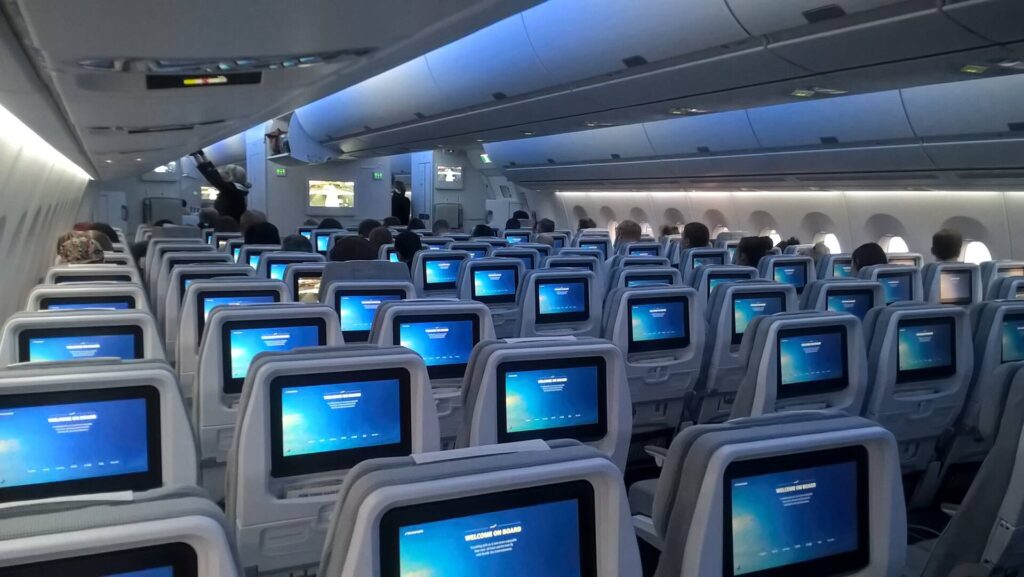
Airbus notes that the -1000 can match the 777-9’s extra seats by going to ten across in economy, but with less comfort. If your airline flies nine across, you will find A350 economy among the more comfortable widebody cabins.
The Cockpit
The flight deck is the same as on the A350-900, with fly-by-wire controls, sidesticks and large displays. A350 pilots can fly both sizes, and Airbus’s Common Type Rating with the A330 lets A330 pilots move to the A350 in about eight days without full flight simulator sessions. The -1000 adds the automatic emergency descent function described above, which Airbus said could also be retrofitted to the -900.
The Trent XWB-97 Engine
The A350-1000 uses the Rolls-Royce Trent XWB-97, which Rolls-Royce describes as the most powerful version of the Trent XWB. It shares the 3 m (118 in) fan, 9.6:1 bypass ratio and 50:1 pressure ratio of the family, but produces 97,000 lbf of thrust, against 84,000 lbf on the -900’s XWB-84. Rolls-Royce first ran it on 15 July 2014.
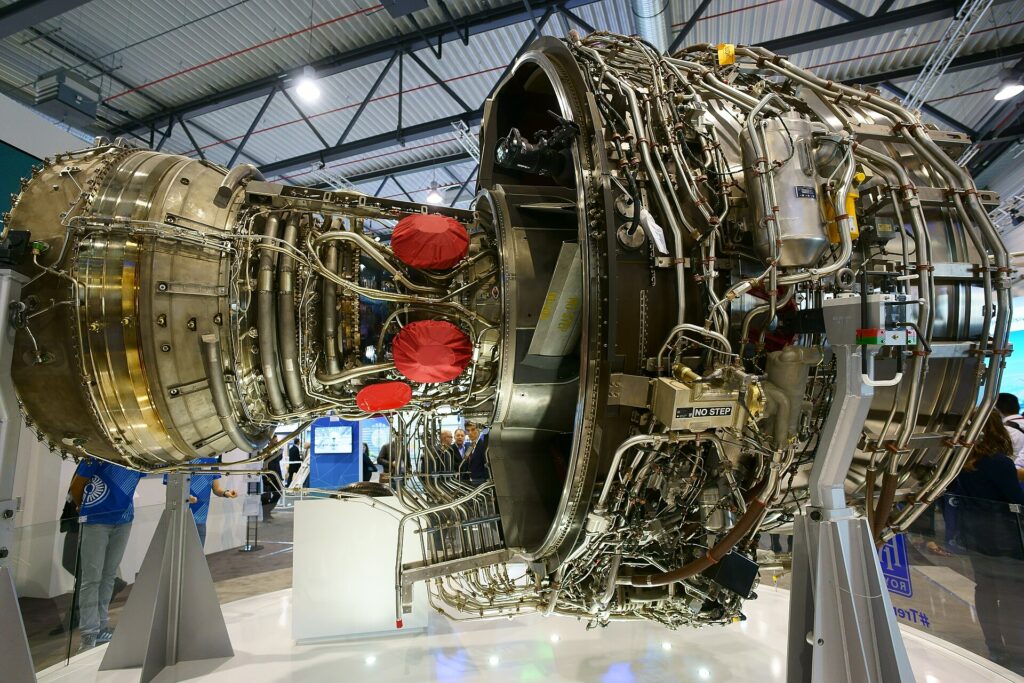
In simple words: a heavier aircraft needs more thrust to take off and climb, so Rolls-Royce turned up the power of the same basic engine. There is no second engine choice. Compared with the 777-9’s GE9X (134 in fan, 105,000 lbf), the XWB-97 is smaller and less powerful, matching the A350-1000’s lower weight. For the basics of how these engines work, see our turbofan vs turboprop guide.
Range, Weights and Project Sunrise
Airbus lists the basic A350-1000 at 8,100 nm (15,000 km). Its maximum take-off weight started at 308 tonnes and has been raised in steps: 311 t, 316 t (which raised range from 7,950 to 8,400 nm) and, in October 2023, 322 t. Airbus is developing a higher-weight version with 9,000 nm of range, which its facts sheet shows entering service in 2030. With that range, routes such as London to Singapore or Dubai to Los Angeles are easy nonstops.
Project Sunrise: the longest flights ever planned
Qantas chose the A350-1000 in December 2019 for Project Sunrise, its plan to fly nonstop from Sydney to London and New York, and placed a firm order for 12 on 2 May 2022. To reach those distances, the aircraft gets an extra rear centre fuel tank, whose design EASA approved in 2024 after a redesign. The test aircraft flew from Toulouse to Melbourne on 23 to 24 July 2026 in 19 hours 12 minutes, and the return flight on 27 to 28 July took 24 hours 25 minutes and covered roughly 12,460 nm, according to Wikipedia. When these flights start, they will top our list of the longest flights in the world.
Safety and Reliability
The A350 family has an excellent safety record; its only hull loss, a Japan Airlines A350-900 at Tokyo Haneda in January 2024, ended with all 379 people on board evacuated (see our A350-900 review). No A350-1000 has been lost. Wikipedia also reports that the A350 fleet achieved 99.28% operational reliability over a recent three-month period.
One controversy is worth knowing: in 2021 Qatar Airways grounded some A350s over degraded paint and surface damage and took Airbus to court in London. Other airlines had reported paint damage too, but only Qatar’s regulator treated it as an airworthiness issue.
Who Flies the A350-1000?
- Qatar Airways, the launch customer, since February 2018.
- British Airways flies it on long-haul routes, including to North America (pictured below).
- French Bee flies the 480-seat high-density version.
- Qantas will fly ultra-long-range versions on Project Sunrise.

No Indian airline flies the A350-1000 yet. Air India’s current A350s are A350-900s, and it has 50 A350s on order in total; see our Air India fleet guide.
A350-1000 vs Its Rivals
A350-1000 vs Boeing 777-9
| Airbus A350-1000 | Boeing 777-9 | Better | |
|---|---|---|---|
| Status | In service since 2018 | First delivery expected 2027 | A350 |
| Length | 73.78 m | 76.7 m | 777-9 (more seats) |
| Wingspan | 64.75 m | 71.8 m (64.8 m folded) | Equal at the gate |
| Seats | 375-400 (three-class), max 480 | 357 (three-class), 426 (two-class) | Depends on layout |
| Range | 8,100 nm (9,000 nm from 2030) | Up to 8,000 nm | A350 |
| Maximum take-off weight | 308-322 t | 351.5 t | A350 (lighter) |
| Engine | Trent XWB-97, 97,000 lbf | GE9X, 105,000 lbf | 777-9 (more power) |
Sources: Airbus and Boeing specifications, as compiled in our A350-1000 vs 777-9 comparison.
The 777-9 is bigger in every dimension and will carry more passengers. The A350-1000 is about 30 tonnes lighter, which favours it on fuel burn per trip, and it is already flying. Read our Boeing 777-9 review.
A350-1000 vs Boeing 777-300ER
| Airbus A350-1000 | Boeing 777-300ER | |
|---|---|---|
| Length | 73.78 m | 73.9 m |
| Range | 8,100 nm | 7,500 nm |
| Maximum take-off weight | 308-322 t | 351.5 t |
| Engines | Trent XWB-97 | GE90-115B |
| Structure | 53% composites | Mostly aluminium |
| Fuel per seat | 25% lower (Airbus claim) | Baseline |
Same length, but the A350-1000 flies further on much less weight. That is why airlines replacing 777-300ERs often choose it. See our Boeing 777-300ER review.
Pros and Cons
Pros
- 375 to 400 seats in three classes, up to 480
- 8,100 nm range, with 9,000 nm and Project Sunrise versions coming
- About 30 tonnes lighter than the 777-9
- Wide, quiet A350 cabin with 6,000 ft cabin altitude
- Already in service since 2018 with major airlines
- Automatic emergency descent function
- Common pilot training with the A350-900 and A330
Cons
- Fewer seats than the 777-9
- Only one engine choice (Trent XWB-97)
- Ten-abreast economy removes much of the comfort advantage
- Paint and surface dispute with Qatar Airways in 2021
- Not yet flown by any Indian airline
Our Verdict
The A350-1000 is the most capable big twin flying today. It matches the 777-300ER in length, beats it on range and burns much less fuel, while offering one of the most comfortable widebody cabins in the sky. Its upgrades over the -900, from the six-wheel gear to the stronger engines, are well thought out.
The Boeing 777-9 will carry more people when it finally arrives, but the A350-1000 has already proved itself with airlines such as Qatar Airways and British Airways, and Project Sunrise will make it the aircraft behind the longest flights ever operated. If you get the chance to fly one in a nine-abreast cabin, take it. Compare it with its smaller sibling in our A350-900 review.
Frequently Asked Questions
How many seats does the A350-1000 have?
Airbus lists 375 to 400 seats in a typical three-class layout and a certified maximum of 480. French Bee flies a 480-seat version with 40 premium and 440 economy seats.
What is the range of the A350-1000?
Airbus lists 8,100 nm (15,000 km) for the basic version. A higher-weight version with 9,000 nm of range is planned to enter service in 2030.
How long is the A350-1000?
73.78 m, about 7 m longer than the A350-900. That is almost exactly the length of the Boeing 777-300ER (73.9 m).
What engine does the A350-1000 use?
The Rolls-Royce Trent XWB-97, rated at 97,000 lbf of thrust, the most powerful version of the Trent XWB. Its fan is 118 inches (3 m) across.
What is the difference between the A350-900 and A350-1000?
The -1000 is 11 frames (about 7 m) longer, seats about 40 more passengers, has a slightly larger wing, six-wheel main landing gear instead of four-wheel, and more powerful Trent XWB-97 engines.
What is Project Sunrise?
Qantas’s plan to fly nonstop from Sydney to London and New York. Qantas ordered 12 A350-1000s with an extra rear centre fuel tank for these flights, and the test aircraft first flew Toulouse to Melbourne in July 2026, a 19-hour 12-minute flight.
Is the A350-1000 better than the 777-9?
The 777-9 is bigger and carries more passengers. The A350-1000 is about 30 tonnes lighter, already in service since 2018 and offered with more range. Airbus claims a lower trip cost than the 777-9.
Which airlines fly the A350-1000?
Qatar Airways was the launch customer in February 2018. Other operators include British Airways and French Bee, and Qantas is getting ultra-long-range versions.
Do Indian airlines fly the A350-1000?
Not yet. Air India’s current A350s are A350-900s. Air India has ordered 50 A350s in total.
Featured image: FlyingFuel graphic using a photo of Qatar Airways Airbus A350-1000 by Juke Schweizer, CC BY-SA 4.0, via Wikimedia Commons.
 Embraer Executive JetsEmbraer Business Jets: Phenom 100EX, Phenom 300EV, Praetor 500E and 600E Explained (2026)
 NewseasyJet to Fit Starlink Wi-Fi Across Its Airbus Fleet From 2027
 NewsFAA Proposes Fan Blade Checks on Every CFM56-7B Engine After 737 Blade Failure
 Dassault FalconDassault Falcon Jets: Every Model From the 2000LXS to the 10X Explained (2026)
 GulfstreamGulfstream Business Jets: Every Model From the G300 to the G800 Explained (2026)
 NewsBombardier to Hire 800 in the US and Spend $270 Million on First Phase of Expansion