
When the Airbus A380 entered service in 2007, it was meant to be the future of air travel: the world’s biggest airliner, with two full decks and room for up to 853 passengers. Fourteen years later, Airbus delivered the last one. Only 251 were built, and Airbus never recovered the estimated US$25 billion it spent on the programme. So what went wrong?
Short answer: Airbus bet that airlines would keep flying passengers through big hub airports on giant aircraft. Instead, efficient twin-engine jets let airlines fly smaller planes directly between more cities, more often. Add years of delays, high costs, no freighter version and too few customers, and the A380 could not pay its way. When its biggest customer, Emirates, cut its order in 2019, Airbus ended production.
Below we explain each reason step by step, using Wikipedia’s detailed history of the programme. For the aircraft’s size and specifications, see our list of the largest passenger aircraft in the world.
A380 Timeline at a Glance
| Year | What happened |
|---|---|
| 1988 | Airbus engineers secretly begin studying an ultra-high-capacity airliner to challenge the Boeing 747 |
| 2000 | Airbus launches the A380 programme on 19 December with 50 firm orders from six customers |
| 2005 | First flight on 27 April; first of three delays announced in June |
| 2007 | Singapore Airlines flies the first commercial service on 25 October |
| 2014 | Production peaks at 30 aircraft per year (also in 2012) |
| 2017 | Airbus rules out an A380neo: “there is no business case” |
| 2019 | On 14 February Airbus announces the end of production after Emirates cuts its order |
| 2021 | The last A380 is delivered to Emirates on 16 December; 251 built in total |
Source: Wikipedia: Airbus A380.
Reason 1: Airbus Bet on Hubs, Airlines Chose Point-to-Point
The A380 was designed for a hub-and-spoke world: passengers fly from smaller cities to a big hub, then board a giant aircraft for the long leg. Airbus did extensive market research, including more than 200 focus groups, and chose this model. Boeing went the other way, betting on point-to-point flying with aircraft like the 777 and later the 787.
Boeing was right. Wikipedia explains that airlines “underwent a fundamental transition to a point-to-point system, which gets customers to their destination in one flight instead of two or three flights”. The A380’s huge size gave a very low cost per seat-kilometre, but that was not enough to beat the efficiency of fewer, more direct flights. Even before launch, analysts had warned that air travel was moving away from hubs.
There was also a frequency problem. Many business travellers prefer several flights a day on smaller aircraft to one giant flight. United Airlines said the A380 “just doesn’t really work for us”, with a much higher trip cost than the 787. In 2013 Air France dropped A380 flights to Singapore and Montreal for smaller aircraft, and China Southern struggled for two years to use its A380s.
Reason 2: Big Twinjets Got Good Enough
When the A380 was launched in 2000, most long routes were flown by four-engine Boeing 747-400s. Over the next two decades, twin-engine widebodies such as the 777-300ER, 787 and A350 gained similar range with much better fuel efficiency. Wikipedia notes that orders for “very large aircraft” slowed in the mid-2010s because twinjets offered similar range and greater fuel efficiency, giving airlines more flexibility at a lower upfront cost.
Wikipedia quotes 2015 AirInsight estimates: an A380 cost about US$26,000 an hour to fly, or about US$50 per seat-hour, against US$44 for a 777-300ER. A twin that is almost as cheap per seat, but much cheaper per flight, is easier to fill and less risky. The A380 also carried a heavy wing and tail designed for a stretched version that was never built, which raised its empty weight per seat.
Read more in why twin-engine jets took over long-haul flying and what is ETOPS.
Reason 3: Delays and Exploding Costs
The A380 was late from the start. Each aircraft had about 530 km of wiring, with 98,000 wires and 40,000 connectors. Airbus’s German and Spanish sites used an older version of the CATIA design software while the British and French sites used a newer one, and the wiring designs did not transfer correctly. Airbus announced three delays in 2005 and 2006, pushing the first delivery to October 2007.
The delays were expensive. The 2006 announcement caused a 26% fall in the share price of Airbus’s parent, EADS, and the chief executives of EADS and Airbus and the A380 programme manager left. Development cost estimates rose from €9.5 billion in 2000 to an estimated US$25 billion or more. Highly customised cabins also slowed production: each airline wanted different interiors, installed one after another rather than all at once.
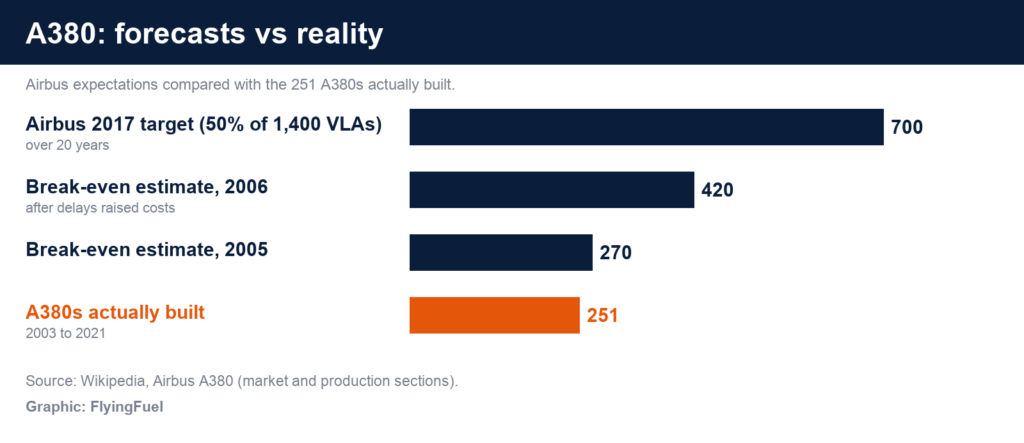
The numbers never worked. In 2005 Airbus needed 270 sales to break even; after the delays, that rose to 420. Airbus’s 2017 forecast still expected demand for 1,400 very large aircraft over 20 years, and it hoped to win half of them. In the end it built 251.
Reason 4: Too Few Customers, Too Dependent on Emirates
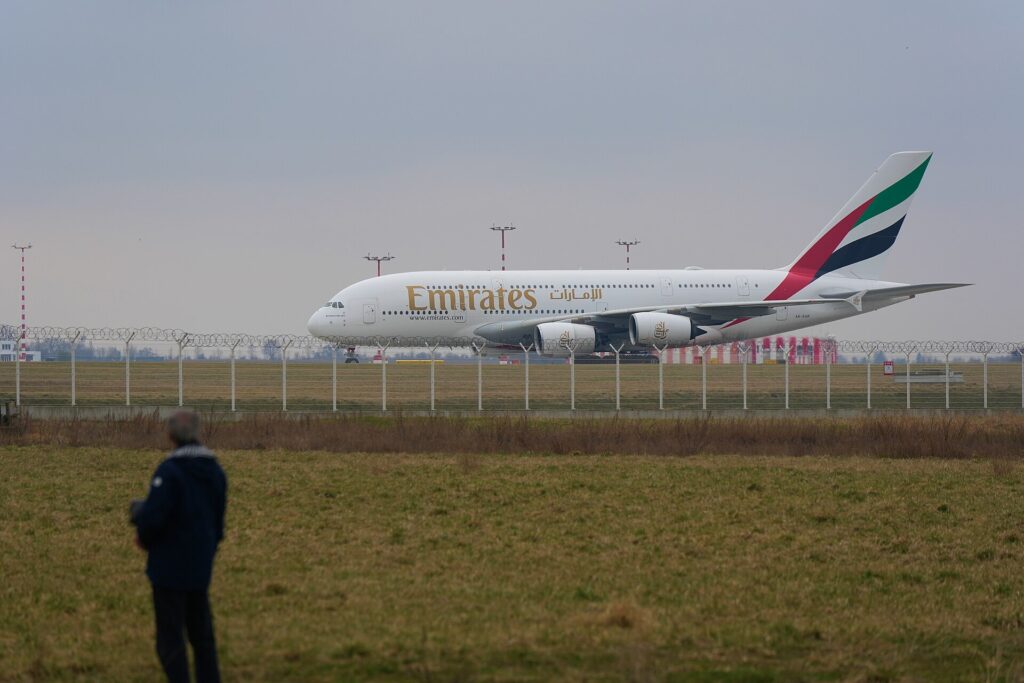
Only 14 customers ever took delivery of the A380, and one airline dominated: Emirates took 123 of the 251 built, almost half. That made the whole programme depend on one customer’s decisions.
In January 2018 Emirates confirmed an order for 36 more A380s, which would have kept production going, but the deal was questioned again in October 2018 over a disagreement about engine fuel burn. In February 2019, Emirates agreed to drop an order for 39 A380s and take 40 A330-900s and 30 A350-900s instead. With that, Airbus announced it would end A380 production by 2021.
Other airlines were already backing away. In 2019 Lufthansa retired 6 of its 14 A380s because they were unprofitable, and Qatar Airways said it would switch from the A380 to the Boeing 777X. Air France decided to retire all ten of its A380s by 2022. Airbus chief executive Tom Enders summed it up on 14 February 2019: “If you have a product that nobody wants anymore, or you can sell only below production cost, you have to stop it.”
Reason 5: No Freighter to Fall Back On
The Boeing 747 had a second life as a freighter, which kept its production line open for years after airlines stopped buying the passenger version; see our 747-8 review. The A380 had no such safety net. Airbus planned an A380F freighter to carry 150 tonnes over 5,600 nm, but suspended it to focus on the delayed passenger version. FedEx and UPS cancelled their orders, and all 27 freighter orders were cancelled or converted.
The A380 was also designed mainly for passengers. Wikipedia explains that its cockpit sits by the lower deck and its upper floor is part of the main structure, so it could not have a 747-style swing-up nose door or a single tall cargo deck. Our list of the largest cargo planes shows which aircraft took the freight market instead.
Reason 6: No Upgrade Worth Paying For
Airbus did look at keeping the A380 competitive. In 2015 it discussed an A380neo with new engines and room for about 50 more passengers; Emirates president Tim Clark said new engines could cut fuel burn by 12 to 14%. In 2017 Airbus proposed the A380plus, with new winglets, up to 80 more seats and 13% lower cost per seat. But in June 2017 Airbus said of the neo: “there is no business case to do that, this is absolutely clear.” Without enough orders, an expensive upgrade made no sense.
Ten years after the first flight, Airbus chief executive Fabrice Brégier said the A380 had been “almost certainly introduced ten years too early”.
The A380 Today
Ending production did not mean the end of the aircraft. In May 2025, 189 A380s (of 251 delivered) were in service with 12 operators. Emirates had 116, followed by British Airways (12), Singapore Airlines (12) and Qantas (10). Emirates plans to keep its A380s flying until at least 2035, using retired aircraft as spare parts; read our Emirates A380 story.
Passengers have long liked it: in 2014 Emirates reported A380 load factors of 90 to 100%. The cabin has 50% less noise than the 747-400, more headroom and wider economy seats, and Emirates offers first-class showers. By December 2021 the fleet had carried over 300 million passengers on more than 800,000 flights with no hull-loss accidents.
Used A380s have been harder to place. Some early aircraft have been scrapped in France, and Wikipedia notes that even their engines are hard to sell as parts, because no other aircraft uses them. A few have found second lives, such as Hi Fly’s leased A380 for charter work.
In India, you can still fly the A380 on foreign airlines: Wikipedia notes that Emirates began A380 flights to Bengaluru in October 2022, the airport’s first A380 service.
Lessons From the A380
- Bigger is not always better: the lowest cost per seat does not win if airlines cannot fill the seats or want more frequent flights.
- Engines changed the game: efficient big twins took over long-haul flying from four-engine giants.
- One customer is not enough: relying on Emirates for half of all orders left the programme exposed.
- Timing matters: delays and rising costs hurt the A380 just as the market was moving away from it.
The A380 remains an engineering triumph and a passenger favourite. But as a business, it showed that airlines buy the aircraft that fits their network, not the biggest one.
Frequently Asked Questions
Why was the A380 discontinued?
Because not enough airlines wanted it. Airlines moved from hub-and-spoke networks to point-to-point flights served by efficient twin-engine jets such as the 787, A350 and 777. When Emirates, the biggest customer, cut its order by 39 aircraft in February 2019, Airbus announced it would end production by 2021.
When did Airbus stop making the A380?
Airbus announced the end of production on 14 February 2019. The final fuselage was assembled in September 2020, and the last A380 (serial number 272) was delivered to Emirates on 16 December 2021.
How many A380s were built?
251, delivered to 14 customers. Emirates took 123 of them.
How much did the A380 cost to develop?
About US$25 billion, according to estimates quoted by Wikipedia. Airbus never recovered that money.
Was the A380 a failure?
Commercially, yes, for Airbus. Passengers liked it and it has a perfect safety record with no hull losses, but Airbus built only 251 against hopes of several hundred more and never recouped its development cost.
Why didn’t Airbus build an A380neo?
Airbus studied an A380neo with new engines in 2015, but in June 2017 it said “there is no business case to do that”. Not enough airlines were ready to order.
Will the A380 keep flying?
Yes, for years. Emirates had 116 A380s in May 2025 and plans to fly the type until at least 2035, using retired aircraft as spare parts. British Airways, Singapore Airlines and Qantas also still fly it.
Why was there no A380 freighter?
Airbus suspended the A380F to focus on the passenger version after the delays, and FedEx and UPS cancelled their orders. The A380 was designed mainly for passengers, unlike the 747, whose freighter version kept its production going for years.
Which aircraft replaced the A380?
Large twinjets. Emirates swapped its last 39 A380s for 40 A330-900s and 30 A350-900s, Qatar Airways said it would move from the A380 to the Boeing 777X, and Air France considered the A330-900, A350-900 and 787-9 as replacements.
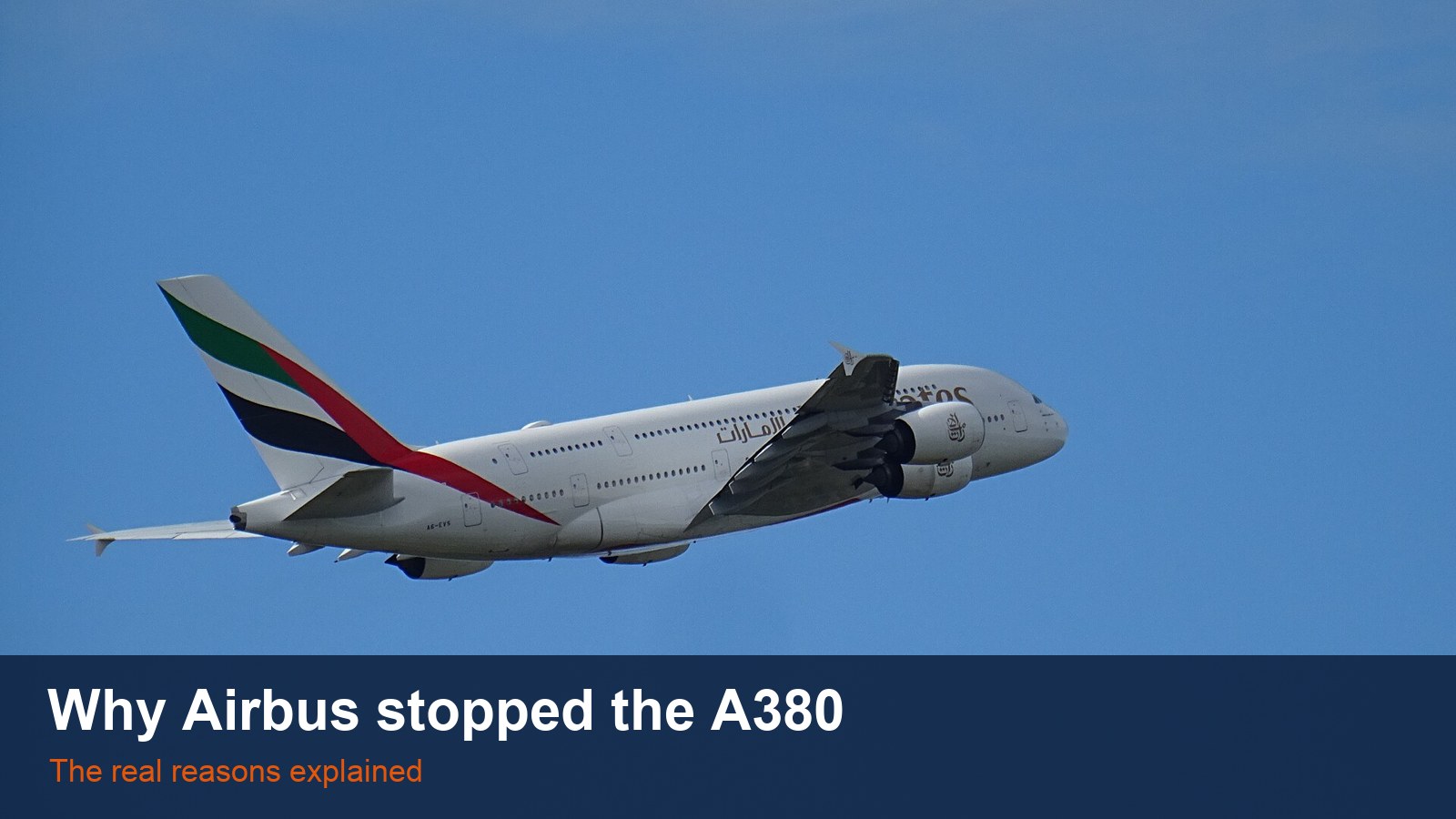
Featured image: FlyingFuel graphic using a photo of Emirates Airbus A380 A6-EVS, the last A380 built, climbing out of London Heathrow by BWard 1997, CC BY 4.0, via Wikimedia Commons.
 Embraer Executive JetsEmbraer Business Jets: Phenom 100EX, Phenom 300EV, Praetor 500E and 600E Explained (2026)
 NewseasyJet to Fit Starlink Wi-Fi Across Its Airbus Fleet From 2027
 NewsFAA Proposes Fan Blade Checks on Every CFM56-7B Engine After 737 Blade Failure
 Dassault FalconDassault Falcon Jets: Every Model From the 2000LXS to the 10X Explained (2026)
 GulfstreamGulfstream Business Jets: Every Model From the G300 to the G800 Explained (2026)
 NewsBombardier to Hire 800 in the US and Spend $270 Million on First Phase of Expansion