
Summary
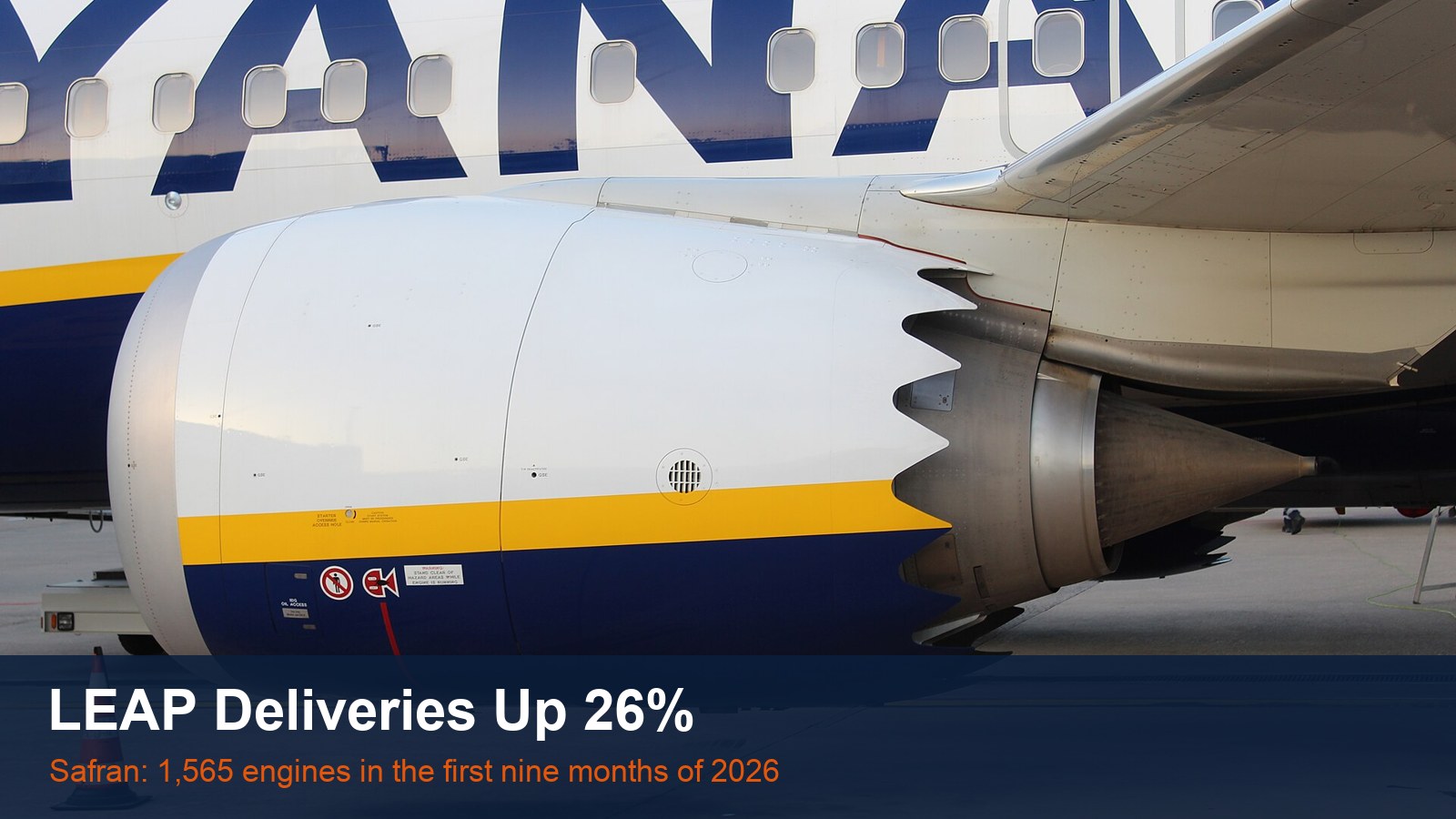
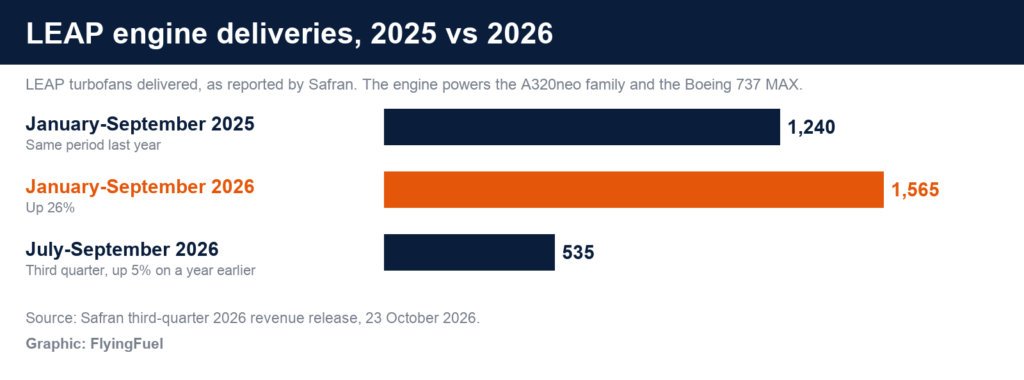
- 1,565 LEAP engines were delivered in the first nine months of 2026, up 26% on the same period of 2025, Safran said
- Third-quarter deliveries were 535, up 5%; the LEAP powers the Airbus A320neo family and every Boeing 737 MAX
- Safran confirmed it expects LEAP deliveries to grow by a high-teens percentage for the full year
PARIS, France, 23 October 2026 – French engine maker Safran said 1,565 LEAP engines were delivered in the first nine months of 2026, up 26% from 1,240 a year earlier, as it reported third-quarter revenue of €9.0 billion, up 14.7%.
The LEAP is built by CFM International, Safran’s 50-50 joint venture with GE Aerospace. It is the only engine on the Boeing 737 MAX and one of two engine options on the Airbus A320neo family, so its output has a direct bearing on how many new narrowbody jets airlines can receive.
The numbers
In the July-September quarter, 535 LEAP engines were delivered, 5% more than a year earlier. Deliveries of the older CFM56, which powers earlier 737 generations and many A320ceo-family jets, fell to 12 in the quarter from 15. Safran’s adjusted revenue for the first nine months reached €26.6 billion, up 17.5%.
By business, propulsion revenue rose 14.4% to €4.63 billion in the quarter and equipment and defence revenue rose 20.6% to €3.62 billion. Aircraft interiors, which includes the cabin seats many passengers sit in, fell 6.4% to €751 million, although Safran said it delivered 635 business class seats in the quarter, up 48%.
Safran confirmed its full-year outlook: revenue growth in the mid-teens, recurring operating income of €6.4-6.5 billion and LEAP deliveries up by a high-teens percentage over 2025.
What Safran says about supply
Chief executive Olivier Andriès said in the release: “We are making solid progress on the LEAP ramp-up, supported by improving supply chain conditions.” Safran still lists supply chain capacity and the possible impact of the Middle East conflict among the risks to its outlook.
In an interview published on 25 October, FlightGlobal reported that Andriès is confident the LEAP production ramp-up will meet Safran’s delivery commitments to Airbus and Boeing.
Spare parts growth slows
Sales of spare parts for civil engines, measured in US dollars, rose 17% in the third quarter, down from 29.3% in the first quarter and 26.7% in the second, Safran’s figures show. Investing.com reported that the slowdown was weaker than analysts at Jefferies had expected and that Safran shares fell to a five-month low on the day.
Andriès said spare parts sales continue to be driven by sustained spending on maintenance by airlines.
Why it matters for travellers
More engines mean more new A320neo-family and 737 MAX jets reaching airlines in the US, UK, Europe and Australia, where both types fly in large numbers. The newly certified Boeing 737 MAX 10 also uses the LEAP-1B. Our A320neo vs 737 MAX 8 comparison explains how the two jets that depend on this engine differ for passengers.
Read more
- A320neo vs 737 MAX 8: which is better?
- Airbus A320neo review
- Boeing 737 MAX 8 review
- Turbofan vs turboprop: how jet engines work
Sources: Safran third-quarter 2026 revenue release, 23 October 2026; FlightGlobal, 25 October 2026; Investing.com via Yahoo Finance, 23 October 2026.
Featured image: FlyingFuel graphic using a photo of a CFM LEAP-1B engine on a Boeing 737-8 at Alghero Airport, Sardinia by Thyrome, CC0, via Wikimedia Commons.
 Embraer Executive JetsEmbraer Business Jets: Phenom 100EX, Phenom 300EV, Praetor 500E and 600E Explained (2026)
 NewseasyJet to Fit Starlink Wi-Fi Across Its Airbus Fleet From 2027
 NewsFAA Proposes Fan Blade Checks on Every CFM56-7B Engine After 737 Blade Failure
 Dassault FalconDassault Falcon Jets: Every Model From the 2000LXS to the 10X Explained (2026)
 GulfstreamGulfstream Business Jets: Every Model From the G300 to the G800 Explained (2026)
 NewsBombardier to Hire 800 in the US and Spend $270 Million on First Phase of Expansion