
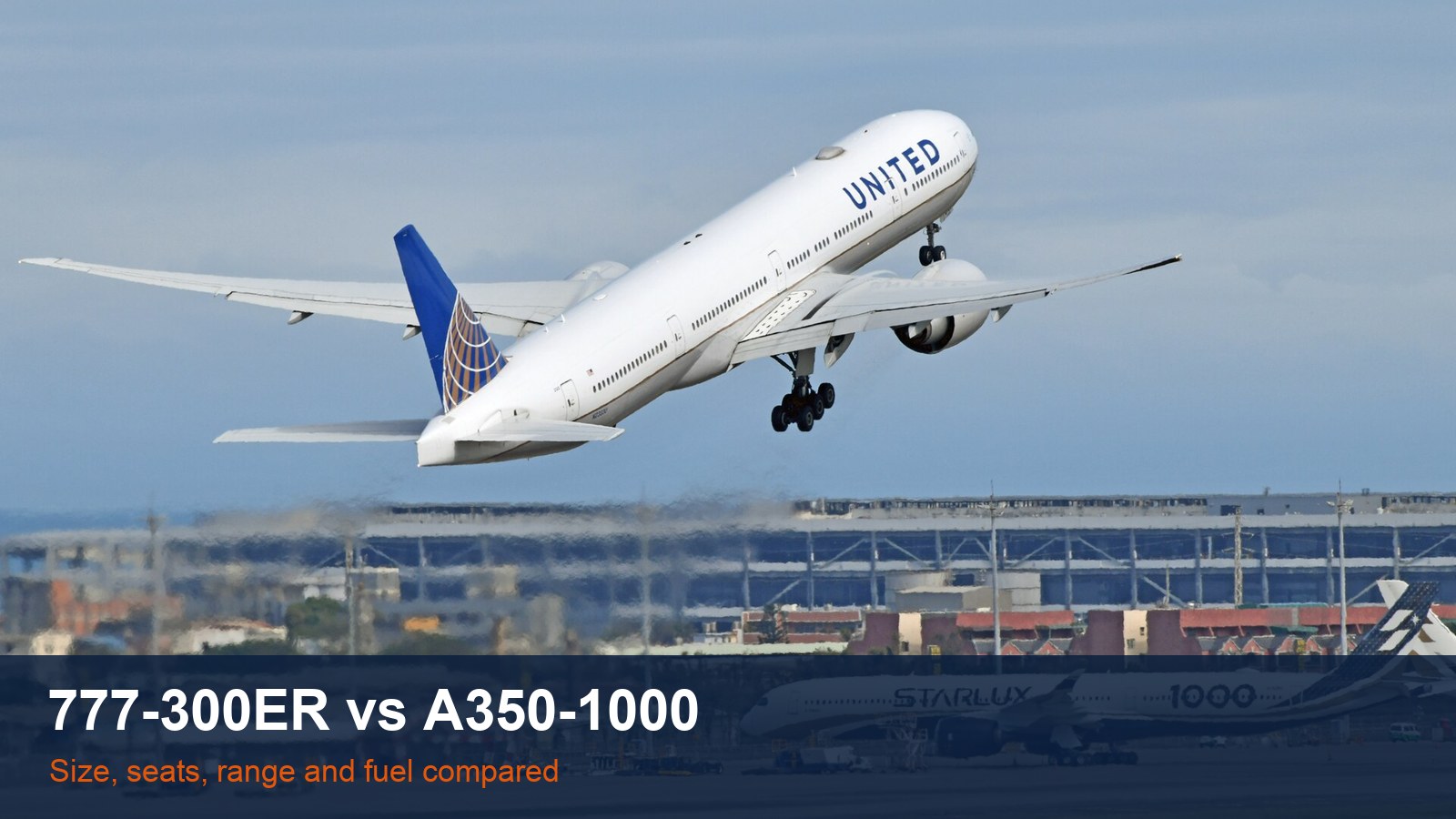
Put a Boeing 777-300ER next to an Airbus A350-1000 at the gate and you would struggle to tell which is longer. They are almost exactly the same size: 73.9 m against 73.78 m, with the same 64.8 m class of wingspan. But they are a generation apart. The 777-300ER first flew in 2003 and is mostly aluminium; the A350-1000 first flew in 2016 and is built mostly from carbon fibre. Airbus designed it partly to replace the 777-300ER.
Quick verdict: the A350-1000 is the better aircraft for an airline buying today: it flies further (8,100 nm against 7,500), weighs up to about 30 tonnes less, and Airbus claims 25% lower fuel burn per seat. The 777-300ER is a proven, high-capacity workhorse with a huge cabin and cargo hold, and it will stay common for years, but new orders now go to the A350-1000 or the 777-9.
Below we explain the differences step by step: size, how to recognise each, seats and cabin, engines, weight and fuel, range, safety, India and our verdict. For each aircraft in detail, see our 777-300ER review and A350-1000 review. For the newer Boeing rival, read A350-1000 vs 777-9.
777-300ER vs A350-1000: Quick Comparison
| Item | Boeing 777-300ER | Airbus A350-1000 |
|---|---|---|
| Seats | 350 to 425 (two-class) | 375 to 400 (three-class) |
| Maximum seats | Air France version: 472 | 480 (certified since 2019) |
| Range | Up to 7,500 nm (13,890 km) | 8,100 nm (15,000 km); 9,000 nm version planned for 2030 |
| Length | 73.9 m | 73.78 m |
| Wingspan | 64.8 m | 64.75 m |
| Height | 18.5 m | 17.08 m |
| Maximum take-off weight | 351.5 tonnes | 308 to 322 tonnes |
| Engines | 2 x GE90-115B (115,000 lbf class) | 2 x Rolls-Royce Trent XWB-97 (97,000 lbf) |
| Structure | Mostly aluminium | Mostly carbon-fibre composite (53%) |
| Main landing gear | Six wheels per leg | Six wheels per leg |
| Economy layout | Usually 10 per row (3-4-3) | Usually 9 per row (3-3-3) |
| First flight | 24 February 2003 | 24 November 2016 |
| In service | April 2004 (Air France) | February 2018 (Qatar Airways) |
| Delivered | 833 (Sept 2026) | 112 (end of May 2026) |
Sources: Boeing 777 specifications; Wikipedia: Boeing 777; Wikipedia: Airbus A350; Airbus A350 facts and figures, as compiled in our A350-1000 review.
Same Size, Different Generation
The 777-300ER (“Extended Range”) was Boeing’s answer to airlines that wanted 747-like loads on two engines. Boeing took the long 777-300, added the giant GE90-115B engine, longer raked wingtips and much more take-off weight. It first flew on 24 February 2003, Air France received the first one on 29 April 2004, and it became the best-selling 777 model with 833 delivered. Wikipedia notes it became the top-selling 777 variant as airlines replaced four-engine aircraft with twins.
The A350-1000 is the stretched member of Airbus’s clean-sheet A350 XWB family, launched in 2006. It is 11 frames (about 7 m) longer than the A350-900, with a bigger wing, six-wheel main landing gear and more powerful engines. Airbus designed it to replace the four-engine A340-600 and to compete with the 777-300ER and 777X. Qatar Airways received the first one on 20 February 2018.
So this is really a comparison between the best of the 1990s-era widebody design and its modern replacement. Wherever the A350-1000 wins, it is because of 15 years of progress in materials, aerodynamics and engines.
How to Tell Them Apart
Both are long twin-aisle jets with six-wheel main landing gear, so look at these details:
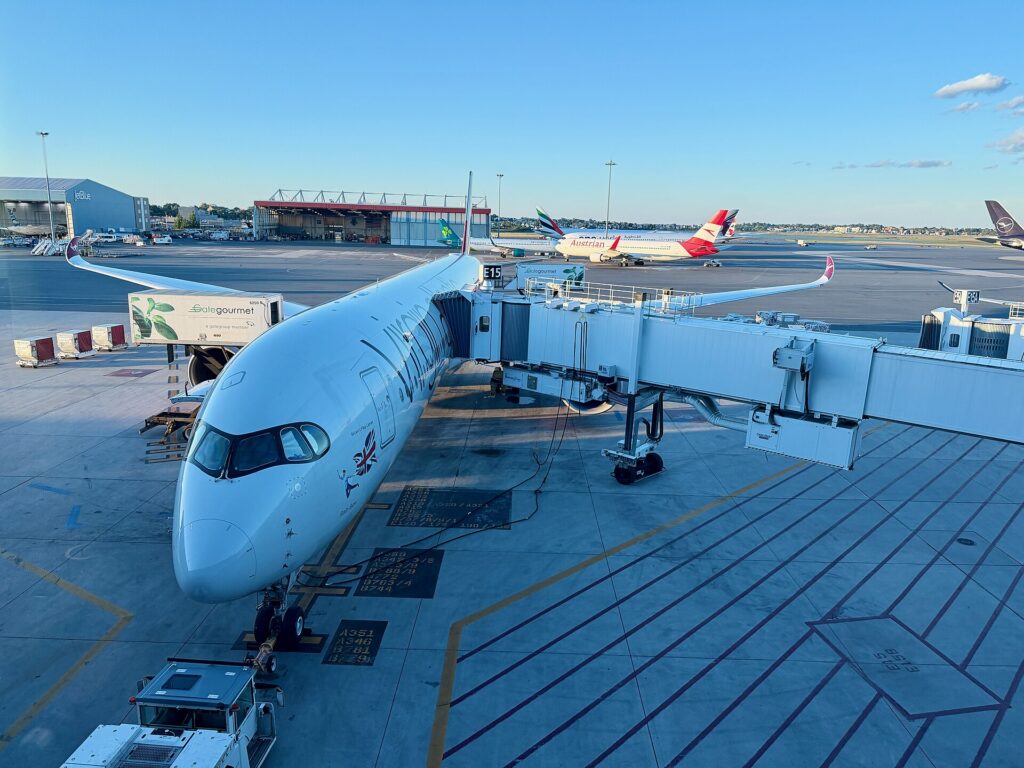
- Cockpit windows: the A350 has a dark “raccoon mask” painted around its cockpit windows. The 777 has no mask.
- Wingtips: the A350-1000’s wingtips curve smoothly upward. The 777-300ER has long, swept-back raked wingtips with no upward curve.
- Tail cone: the 777 ends in a flat, vertical blade instead of a round point.
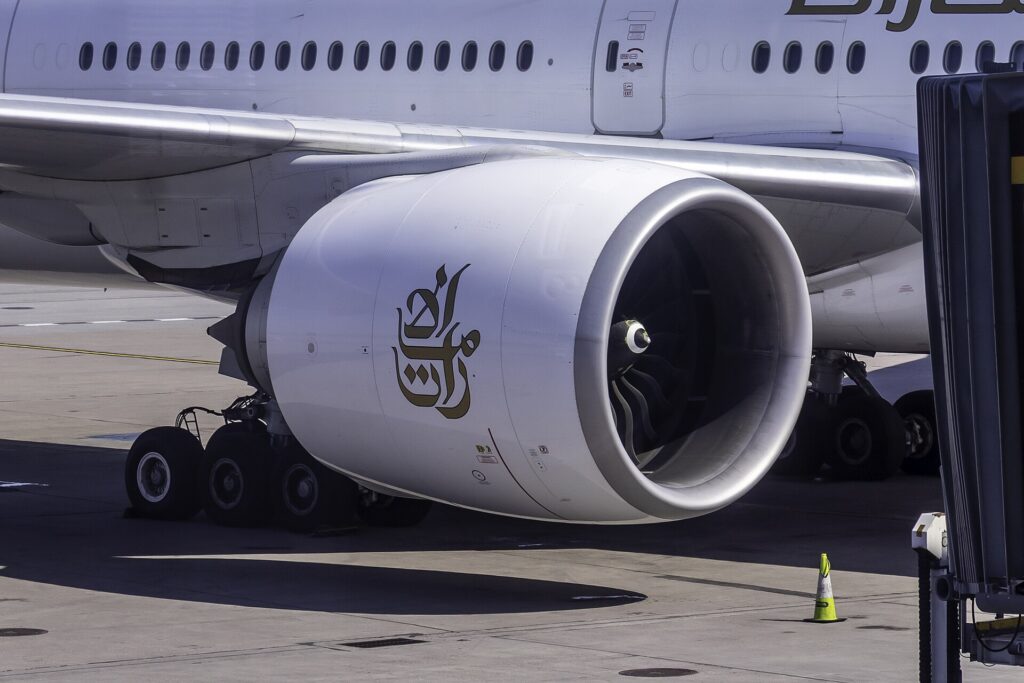
- Engines: the 777-300ER’s GE90-115B fan is huge, 128 inches across, about half the 777 fuselage’s diameter. The A350-1000’s Trent XWB-97 fan is 118 inches.
Seats and Cabin
On paper the two carry similar numbers of people: Boeing lists the 777-300ER at 350 to 425 seats in two classes, and Airbus lists the A350-1000 at 375 to 400 in three classes. At the extremes, Air France has a 472-seat 777-300ER, and French Bee flies a 480-seat A350-1000 with 40 premium and 440 economy seats.
Nine across vs ten across
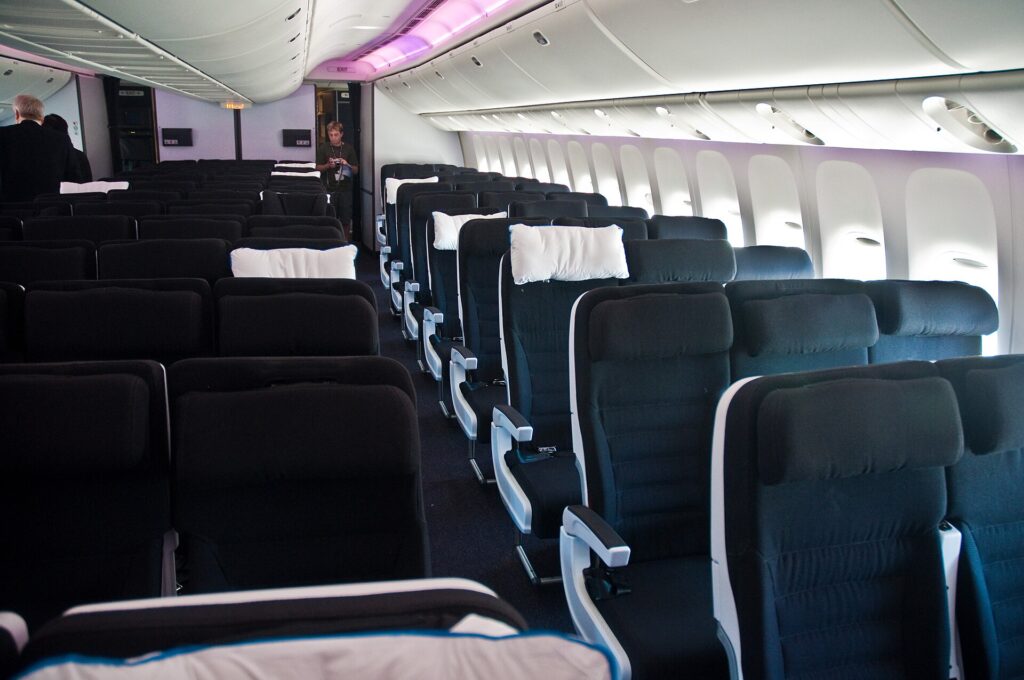
The 777 has a wide, circular fuselage. When it was new, most airlines fitted nine economy seats per row, but to cut the cost per seat they moved to ten across (3-4-3): in 2001 only 5% of new 777s had ten-abreast economy, and by 2016 it was over 50%, according to Wikipedia. Ten across is tight.
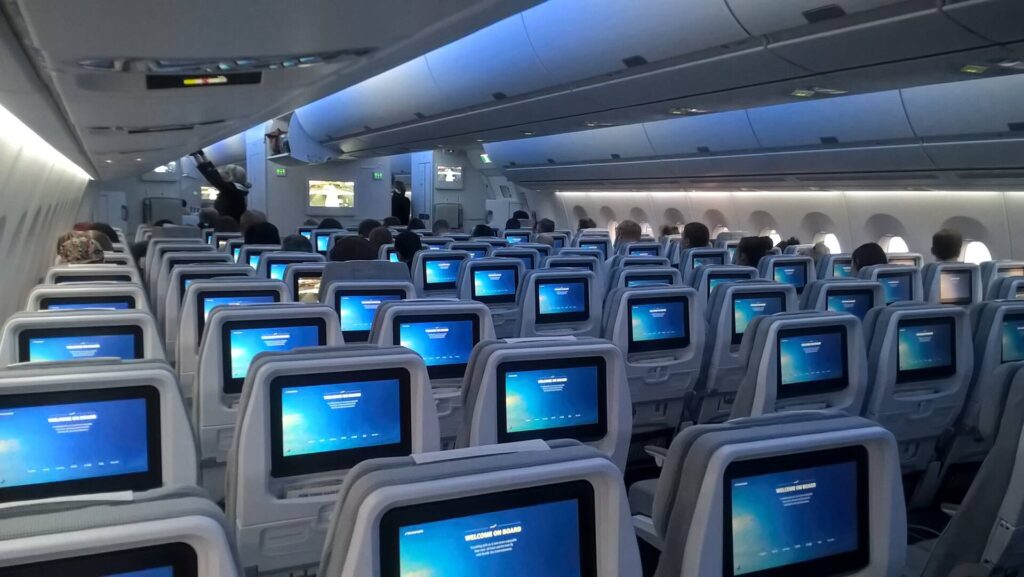
The A350 cabin is 5.71 m (225 in) wide and was designed around nine-abreast economy. Airbus notes that the A350-1000 could go to ten across to match bigger aircraft, but with less comfort, and most airlines keep nine. For you as a passenger, a nine-across A350-1000 usually means a wider seat than a ten-across 777-300ER.
Air, pressure and noise
- Cabin altitude: the A350-1000 is pressurised to the equivalent of 6,000 ft, rather than the 8,000 ft typical of older aircraft such as the 777. Airbus says this reduces fatigue on long flights.
- Humidity: about 20% on the A350, because carbon fibre does not corrode the way aluminium can.
- Noise: Airbus calls the A350 the quietest twin-aisle cabin.
- Windows: 777 windows, about 15 by 10 inches, were the largest of any airliner until the 787; they use pull-down shades.
One area where the 777 still shines is crew rest. Since 2003 airlines have been able to order overhead crew rests, hidden bunk areas above the main cabin, which keep the main deck free for paying passengers on ultra-long flights.
Engines Explained
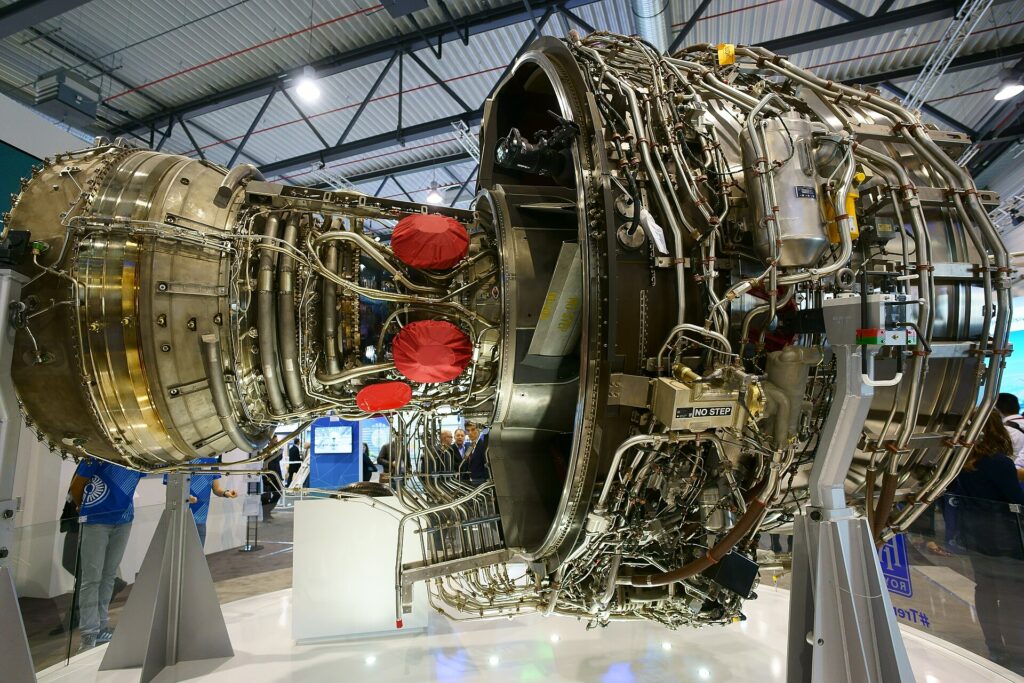
Neither aircraft offers an engine choice. Both use one huge high-bypass turbofan type; our turbofan vs turboprop guide explains how they work.
| Engine detail | GE90-115B (777-300ER) | Trent XWB-97 (A350-1000) |
|---|---|---|
| Maker | GE Aerospace | Rolls-Royce |
| Thrust | Rated at 115,000 lbf | 97,000 lbf |
| Fan diameter | 128 in (325 cm) | 118 in (3 m) |
| Fan blades | 22 carbon-fibre composite blades | – |
| Bypass ratio | – | 9.6:1 |
| Pressure ratio | – | 50:1 |
| Claim to fame | Largest jet engine in the world until the GE9X (2020) | Most powerful version of the Trent XWB |
Sources: Wikipedia: General Electric GE90; Wikipedia: Rolls-Royce Trent XWB.
Why does the 777-300ER need so much more thrust? Because it is heavier. A long-range twin must be able to climb safely on one engine if the other fails, so a 351-tonne aircraft needs bigger engines than a 322-tonne one. The GE90’s carbon-fibre fan blades were a breakthrough when it entered service in 1995: twice as strong as titanium blades at one-third of the weight. The Trent XWB-97 is a newer design matched to a lighter aircraft.
Weight and Fuel Burn
This is the heart of the comparison. The two aircraft are the same length, but the 777-300ER can take off at up to 351.5 tonnes, while the A350-1000 started at 308 tonnes and has been raised in steps to 322 tonnes. Less weight means less fuel to carry the same people the same distance.
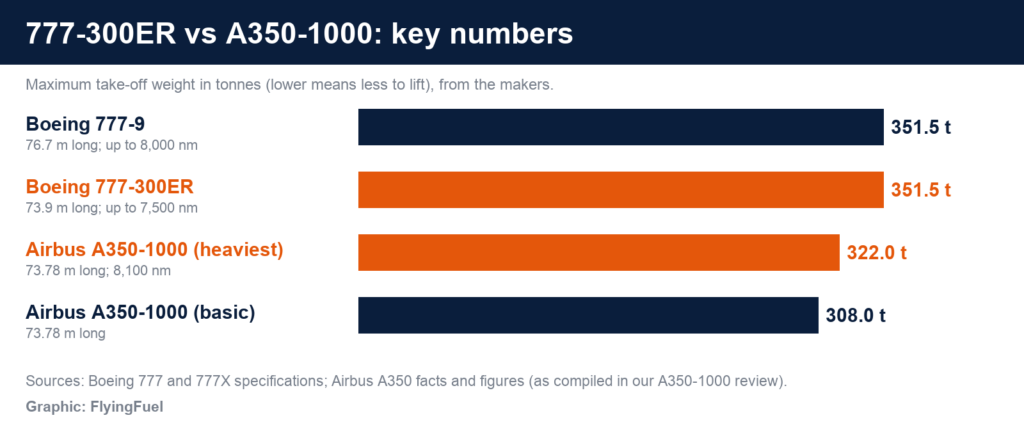
Where does the A350-1000 save weight? Mainly in its structure: about 53% of it is composite material, against a mostly aluminium 777. Composites are lighter and do not corrode or suffer metal fatigue in the same way, which also means fewer inspections.
Airbus claims a 369-seat A350-1000 has a 25% fuel burn per seat advantage over a 360-seat 777-300ER. That is Airbus’s own figure for its preferred layouts, so treat it as a best case. But even allowing for marketing, a lighter aircraft with newer engines carrying a similar load will burn noticeably less fuel. That saving is the main reason airlines are replacing 777-300ERs.
Range and Payload
Boeing lists the 777-300ER at up to 7,500 nm (13,890 km). Airbus lists the basic A350-1000 at 8,100 nm (15,000 km), and a higher-weight version with 9,000 nm is planned for 2030. Both can fly nonstop from Delhi or Mumbai to anywhere in Europe.
The A350-1000’s extra range has made it the choice for the world’s most extreme route. Qantas chose it for Project Sunrise, nonstop flights from Sydney to London and New York, and ordered 12 with an extra rear centre fuel tank. The test aircraft flew Toulouse to Melbourne in July 2026 in 19 hours 12 minutes. When those flights start, they will top our list of the longest flights in the world.
The 777-300ER’s strength is payload: it can carry a full cabin and a large amount of cargo in its lower hold at the same time, which makes long routes more profitable. In 2010 Boeing raised its maximum zero-fuel weight by 5,000 lb, equal to 20 to 25 more passengers. Retired 777-300ERs are now being converted into freighters, such as the IAI 777-300ERSF.
Cockpit and Pilots
The 777 was Boeing’s first fly-by-wire airliner, but pilots still use a control yoke. Its cockpit is similar to the 787’s, and Boeing says pilots can move between the 777 and 787 with minimal extra training. The A350-1000 has sidesticks and the same flight deck as the A350-900, and Airbus’s Common Type Rating lets A330 pilots move to the A350 in about eight days. The A350-1000 also adds an automatic emergency descent function: if the cabin loses pressure and the crew do not respond, the aircraft can descend on its own to about 10,000 ft.
Safety and Reliability
Both have strong safety records. As of May 2024, Wikipedia lists the 777 family, flying since 1995, with 31 accidents and incidents including eight hull losses and 542 deaths across all models; the 777 was also the first airliner to enter service with 180-minute ETOPS approval. The A350 family’s only hull loss, a Japan Airlines A350-900 at Tokyo Haneda in January 2024, ended with all 379 people on board evacuated. No A350-1000 has been lost.
Remember that the 777 has flown far longer and in far greater numbers, so raw totals are not a fair comparison. Both are among the safest widebody aircraft ever built.
India: Air India Flies One, Not the Other
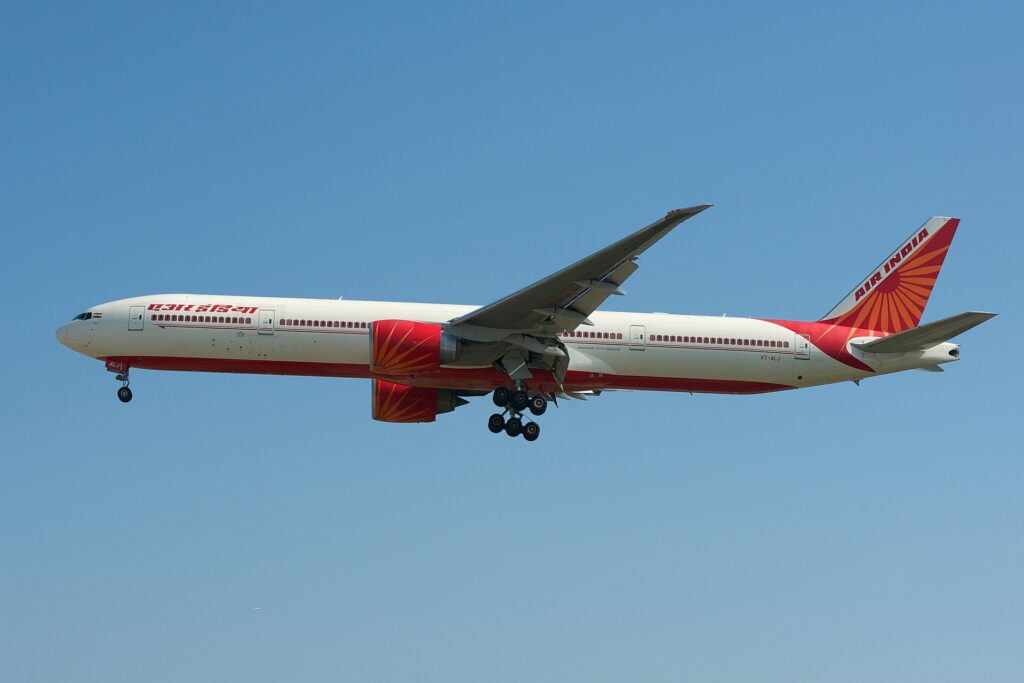
Air India had 19 Boeing 777-300ERs in September 2026, used on long-haul international routes alongside its 787s and A350-900s. It has 50 A350s on order in total, but its current A350s are all A350-900s. No Indian airline flies the A350-1000 yet. See our Air India fleet guide.
Globally, Emirates is the world’s largest 777 operator, with 119 777-300ERs in November 2025, and it is replacing them with 777-9s rather than A350-1000s; see our Emirates fleet story. Qatar Airways flies both: it is a major 777-300ER operator and was the A350-1000 launch customer. British Airways, Virgin Atlantic and Starlux also fly the A350-1000.
Which Is Better? Head to Head
| Area | 777-300ER | A350-1000 | Better |
|---|---|---|---|
| Length and gates | 73.9 m, Code E | 73.78 m, Code E | Equal |
| Range | 7,500 nm | 8,100 nm (9,000 nm planned) | A350-1000 |
| Maximum take-off weight | 351.5 t | 308 to 322 t | A350-1000 (lighter) |
| Fuel per seat | Baseline | 25% lower (Airbus claim) | A350-1000 |
| Typical economy | 10 across | 9 across | A350-1000 (wider seats) |
| Cabin altitude | Conventional | 6,000 ft | A350-1000 |
| Engine thrust | 115,000 lbf class | 97,000 lbf | 777 (needs it for its weight) |
| Cargo and payload | Very large | Large | 777-300ER |
| Fleet size | 833 delivered | 112 delivered | 777-300ER (more common) |
| Still on sale? | Replaced by 777-9 | Yes | A350-1000 |
Sources: Boeing and Airbus specifications; Wikipedia: Boeing 777 and Airbus A350.
Pros and Cons
Boeing 777-300ER
- Pros: proven since 2004 with 833 delivered; big cabin and huge cargo hold; overhead crew rests for long flights; spare parts and trained crews everywhere.
- Cons: heavy, so it burns more fuel; older aluminium airframe; ten-across economy is tight; no longer offered for new orders.
Airbus A350-1000
- Pros: 8,100 nm range, with 9,000 nm planned; up to about 30 tonnes lighter; Airbus claims 25% lower fuel per seat; 6,000 ft cabin altitude and quiet cabin; usually nine-across economy.
- Cons: far fewer in service; only one engine choice; the bigger 777-9 carries more passengers; Qatar Airways’ 2021 paint-damage dispute with Airbus affected the A350 family’s image.
Our Verdict
If an airline is buying new aircraft today, the A350-1000 is the better choice of these two. It carries a similar load over a longer distance on much less fuel, and passengers get a quieter, more comfortable cabin. That is why it has taken over the 777-300ER’s old role on many routes, and why Qantas trusted it with the longest flights ever planned.
The 777-300ER is still a great aircraft and will be one of the most common long-haul jets in the sky for years, including at Air India. Its true replacement from Boeing is the larger, folding-wing 777-9. For passengers, the practical tip is simple: check the seat map. A nine-across A350-1000 is usually roomier in economy than a ten-across 777-300ER.
Frequently Asked Questions
Is the A350-1000 the same size as the 777-300ER?
Almost exactly. The A350-1000 is 73.78 m long with a 64.75 m wingspan; the 777-300ER is 73.9 m long with a 64.8 m wingspan. They fit the same airport gates. The big difference is weight: the 777-300ER can take off at up to 351.5 tonnes, the A350-1000 at up to 322 tonnes.
Which has more range, the 777-300ER or A350-1000?
The A350-1000. Airbus lists it at 8,100 nm (15,000 km), with a 9,000 nm version planned for 2030. Boeing lists the 777-300ER at up to 7,500 nm (13,890 km).
Which is more fuel efficient?
The A350-1000. Airbus claims a 369-seat A350-1000 burns 25% less fuel per seat than a 360-seat 777-300ER. That is Airbus’s own figure, but the A350-1000 is clearly lighter, newer and built mostly from composites, so a large saving is expected.
Which carries more passengers?
It depends on the layout. Boeing lists the 777-300ER at 350 to 425 seats in two classes. Airbus lists the A350-1000 at 375 to 400 in three classes, with a certified maximum of 480. Air France has a 472-seat 777-300ER, and French Bee flies a 480-seat A350-1000.
Which is more comfortable?
Usually the A350-1000. Its cabin is pressurised to 6,000 ft instead of 8,000 ft, has more humid air, and Airbus calls it the quietest twin-aisle cabin. Most A350s have nine seats per row in economy, while most 777-300ERs now have ten, which means narrower seats.
What engines do they use?
The 777-300ER uses only the GE Aerospace GE90-115B (rated at 115,000 lbf, with a 128-inch fan). The A350-1000 uses only the Rolls-Royce Trent XWB-97 (97,000 lbf, 118-inch fan).
Is the 777-300ER still being built?
It is being replaced by the 777-9, which Boeing expects to deliver from 2027. Many airlines are instead buying the A350-1000 or the 777-9 to replace their 777-300ERs.
Do Indian airlines fly the 777-300ER or A350-1000?
Air India had 19 Boeing 777-300ERs in September 2026. No Indian airline flies the A350-1000 yet; Air India’s A350s are A350-900s, and it has 50 A350s on order in total.
Which is better, the 777-300ER or A350-1000?
The A350-1000 is the better new aircraft: lighter, longer-range, more efficient and more comfortable. The 777-300ER is a proven workhorse with a huge fleet and a big cargo hold, and it will keep flying for many years, but airlines no longer choose it for new orders.
Featured image: FlyingFuel graphic using a photo of a United Airlines Boeing 777-300ER taking off from Taoyuan, with a Starlux Airbus A350-1000 in the background by Steven Byles from Yokohama, Japan, CC BY-SA 4.0, via Wikimedia Commons.
 Embraer Executive JetsEmbraer Business Jets: Phenom 100EX, Phenom 300EV, Praetor 500E and 600E Explained (2026)
 NewseasyJet to Fit Starlink Wi-Fi Across Its Airbus Fleet From 2027
 NewsFAA Proposes Fan Blade Checks on Every CFM56-7B Engine After 737 Blade Failure
 Dassault FalconDassault Falcon Jets: Every Model From the 2000LXS to the 10X Explained (2026)
 GulfstreamGulfstream Business Jets: Every Model From the G300 to the G800 Explained (2026)
 NewsBombardier to Hire 800 in the US and Spend $270 Million on First Phase of Expansion